

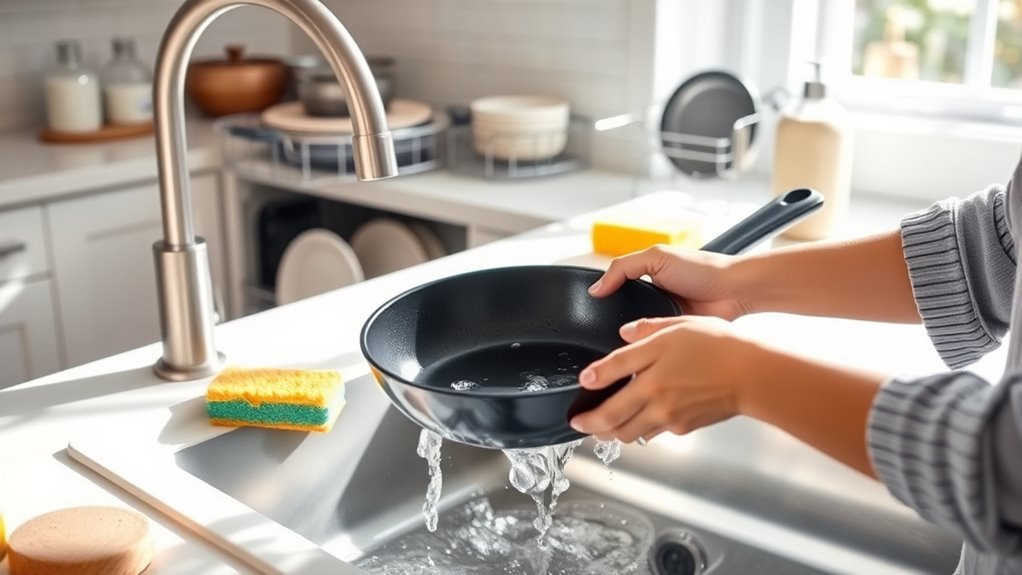
Can you put nonstick cookware in the dishwasher? Only if the manufacturer says your exact pan is dishwasher safe. Some brands allow it, some say it voids the warranty, and even the ones that allow it usually recommend hand washing. When there is no clear guidance, wash it by hand with a soft sponge.
This page focuses on nonstick coatings, both traditional PTFE and ceramic. For rules covering every cookware material, see our main dishwasher and cookware guide.
What major brands say about the dishwasher
| Brand and line | What the brand says |
|---|---|
| Made In Non Stick | Recommends hand washing; warranty page says dishwasher use voids the nonstick warranty |
| Caraway ceramic | Advises against the dishwasher for cookware and bakeware |
| T-fal (one use and care guide) | Most nonstick is dishwasher safe, hand wash recommended; no detergent tablets |
| HexClad | Says dishwasher safe, but frequent washing can dull and darken the metal |
These statements come from the brands’ own care and warranty pages at the time of writing and can change between product lines and years. Always check the paperwork for your own pan.
Why the dishwasher is hard on nonstick
A nonstick surface is a thin layer bonded to metal. A dishwasher attacks it in several ways:
- Alkaline detergent: strong cleaners can roughen coatings and dull the aluminum body underneath.
- Heat and the dry cycle: repeated high temperatures speed wear.
- Contact: pans rub against racks and other items, causing micro-scratches.
- Detergent tablets: some makers, including T-fal in one guide, specifically warn against them.
PTFE versus ceramic coatings
Most traditional nonstick pans use PTFE (the material often sold as Teflon). Ceramic nonstick pans use a different coating, a silica-based sol-gel layer applied to a metal body, not solid ceramic. Both are thin coatings and both wear faster in a dishwasher. For more on ceramic, read what is ceramic coating cookware.
PTFE is a type of PFAS. The FDA has authorized PFAS in nonstick cookware for decades and says only negligible amounts of PFAS in the coating migrate to food. Even so, many people choose to replace worn pans, avoid overheating them, and use PTFE-free options. Our T-fal ceramic cookware safety guide covers the ceramic side.
How to hand wash a nonstick pan
- Let the pan cool completely, since cold water on a hot pan can warp it.
- Wash with warm water, a few drops of mild dish soap, and a soft sponge or cloth.
- For stuck-on food, soak in warm soapy water for 10 to 15 minutes. Made In also suggests simmering a little water with baking soda and vinegar for about five minutes, then scraping gently with a wooden or silicone tool.
- Rinse and dry fully with a towel.
- Stack pans with a cloth or pan protector between them.
Avoid steel wool, scouring pads and abrasive powders. Use wood, silicone or nylon utensils, and skip aerosol cooking sprays, which can leave a sticky residue that is hard to remove.
If you use the dishwasher anyway
- Do it only when the care guide explicitly allows it.
- Use a mild liquid or powder detergent, not tablets.
- Place the pan securely on the rack so it does not hit other items.
- Dry it after the cycle and expect the coating to age sooner.
When to replace a nonstick pan
| Sign | What to do |
|---|---|
| Flaking or peeling coating | Replace the pan |
| Deep scratches through the coating | Replace the pan |
| Warped base that spins on the burner | Replace the pan |
| Food sticks despite clean technique and oil | Consider replacing |
| Dull, rough or discolored surface | Check care guide; replace if performance drops |
Dishwasher-friendlier alternatives
If you want pans you can put in the dishwasher without worry, stainless steel is the usual choice. Read can stainless steel go in the dishwasher first. Seasoned cast iron and carbon steel must never go in. Our Made In dishwasher guide compares several lines in one place.
Frequently Asked Questions
Can you put nonstick pans in the dishwasher?
Only if the manufacturer’s care guide says that exact pan is dishwasher safe. Some brands allow it, while others say it voids the warranty. Even when allowed, detergent and heat gradually wear down the coating, so hand washing with a soft sponge is the safer habit.
Why does the dishwasher ruin nonstick pans?
Hot water, strong alkaline detergent and a heated dry cycle slowly wear the coating and roughen the surface. Pans knocking against other items can also scratch it. The result is usually food sticking sooner, dullness, or flaking, rather than a sudden failure.
Is ceramic nonstick dishwasher safe?
Depends on the brand. Caraway recommends hand washing its ceramic cookware, while a T-fal care guide lists its ceramic pieces as dishwasher safe but still prefers hand washing. Check the guide for your product before running a cycle.
Is HexClad dishwasher safe?
HexClad says its cookware is dishwasher safe but notes that frequent cycles can dull the finish and darken the metal over time. It recommends washing by hand with warm soapy water and a soft sponge for everyday cleaning.
When should I replace a nonstick pan?
Replace it if the coating is flaking, peeling or deeply scratched, or if food sticks even with oil and clean technique. Manufacturers advise against continuing to use a pan with a damaged coating. Most coatings last a few years with careful care.
Conclusion
Nonstick pans last longest when washed by hand with a soft sponge. A few brands allow the dishwasher, but that convenience usually shortens the life of the coating. Read your care guide, and when in doubt, wash by hand.
