Have you ever wondered why some pots heat up faster than others on an induction cooktop? Understanding induction compatibility is vital for efficient cooking. A simple magnet test can determine if your cookware is suitable, but there’s more to it than just that. Knowing which materials work best, identifying the right symbols, and selecting flat-bottomed designs will optimize your cooking experience. Let’s explore these essential factors to guarantee you choose the right cookware.
What Is Induction Cooking and How Does It Work?
Induction cooking is a modern culinary method that harnesses electromagnetic energy to heat cookware directly, making it a highly efficient option compared to traditional gas or electric stoves.
Beneath the induction cooktop, a copper coil generates an electromagnetic field that activates ferromagnetic cookware. This process creates heat through electrical currents within the pot or pan, allowing for rapid cooking. For instance, you can boil water about twice as fast as conventional methods, showcasing its superior energy efficiency.
The cooktop surface remains cool to the touch after removing the cookware, considerably reducing burn risks—ideal for kitchens with children.
However, to take advantage of induction cooking, your cookware must feature a magnetic base. Cookware made from cast iron or specific stainless steel will work, while non-magnetic materials like aluminum or glass won’t heat up.
Embracing induction cooking means revealing a faster, safer, and more efficient way to prepare meals.
How to Test Your Cookware for Induction Compatibility?
To test your cookware for induction compatibility, start with the magnet test: if a magnet sticks firmly to the bottom, your cookware is likely suitable.
Next, consider the materials; cast iron, carbon steel, and magnetic stainless steel work best, while aluminum and glass do not.
Finally, look for the induction symbol on the bottom, which confirms its compatibility with induction cooktops.
Magnet Test Method
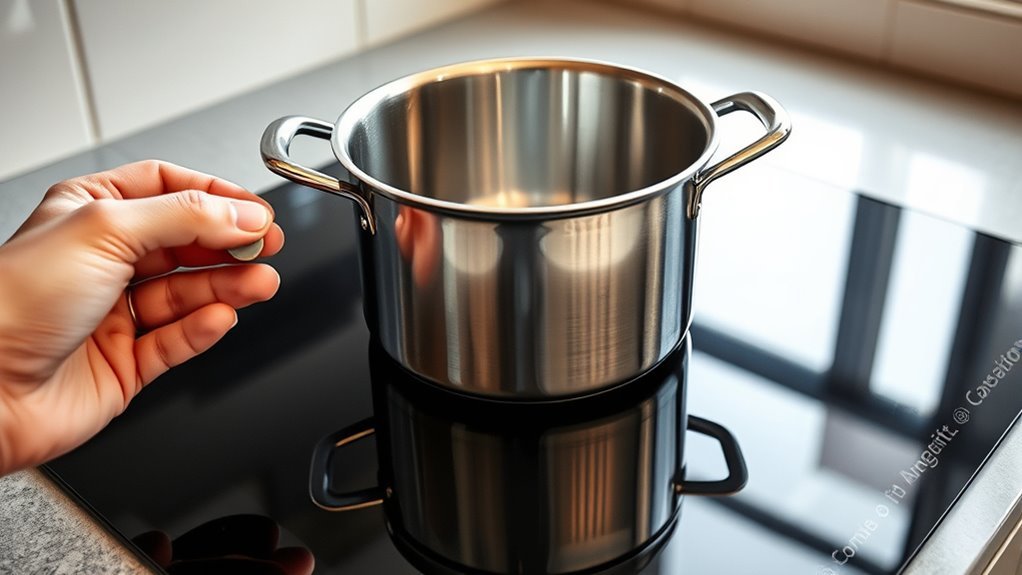
If you’re unsure whether your cookware is suitable for induction cooking, the magnet test is a quick and effective method. Simply take a refrigerator magnet and place it against the bottom of your pot or pan. If it sticks firmly, you’ve got induction compatibility.
This works because induction cooktops require ferromagnetic materials—like cast iron and certain stainless steel cookware—to generate heat. Be cautious, though; nonstick aluminum and pure copper typically won’t attract magnets and are generally not induction-compatible unless they’ve a magnetic base.
Cookware Material Considerations
When determining cookware material suitability for induction cooking, understanding the properties of different metals is essential. To check if your cookware is induction compatible, use a magnet; if it sticks, you’re likely in good shape. Here’s a quick reference:
| Cookware Material | Induction Compatibility |
|---|---|
| Cast Iron | Yes |
| Carbon Steel | Yes |
| Magnetic Stainless Steel | Yes |
| Aluminum (unmodified) | No |
| Glass | No |
Some nonstick pans can also be induction-ready if they contain magnetic materials. Additionally, look for an induction symbol on the bottom of your pots. You can also perform the water boil test; rapid boiling indicates the cookware is induction-compatible.
Visual Compatibility Indicators
Visual indicators play an essential role in determining whether your cookware is induction compatible. Start by checking the bottom of your pots and pans for a stamped coil or the induction symbol, which often signifies compatibility.
Conduct a magnet test by placing a magnet on the base; if it sticks firmly, your cookware is likely induction-ready. Look for materials like cast iron, carbon steel, and magnetic stainless steel, which are suitable for induction cooking.
While some nonstick cookware may feature a magnetic base, always confirm compatibility, as not all nonstick options are induction-friendly.
Finally, perform a water boil test; if water heats quickly on an induction burner, it confirms the cookware’s compatibility.
Essential Materials for Induction-Compatible Cookware
Understanding the essential materials for induction-compatible cookware is crucial for effective cooking on induction cooktops. To guarantee your cookware works seamlessly, focus on these key materials:
- Ferromagnetic Materials: Cookware made from cast iron or magnetic stainless steel interacts effectively with the electromagnetic field.
- Enameled and Carbon Steel: Both maintain magnetic properties, making them suitable for induction cooking.
- Magnetic Base Stainless Steel: Not all stainless steel is compatible; only those designed with a magnetic base will work.
Avoid nonferromagnetic materials like pure aluminum, glass, or non-magnetic stainless steel unless they’ve a magnetic base.
A quick magnet test can determine compatibility: if a magnet sticks to the bottom, your induction cookware is ready.
Cookware Types That Are Incompatible With Induction
Certain cookware types simply won’t work with induction cooktops due to their lack of magnetic properties. To guarantee you’re using compatible cookware, avoid the following types:
| Cookware Type | Compatibility |
|---|---|
| Pure aluminum | Non-magnetic cookware |
| Glass and ceramic | Non-magnetic cookware |
| Traditional copper | Non-compatible |
| Non-magnetic stainless steel | Non-compatible |
Cookware designed with a magnetic base is essential for induction cooking. Non-magnetic stainless steel and traditional copper pots will not heat effectively unless altered for compatibility. Additionally, curved-bottom woks may disrupt the necessary magnetic connection, leading to inefficient cooking. Even nonstick pans must be specifically designed with a magnetic base to function on induction cooktops. By understanding these incompatibilities, you can make informed choices and fully harness the efficiency of induction cooking.
What Do Induction Symbols Mean?
Induction symbols, often seen as coiled springs or loops on cookware, indicate its compatibility with induction cooktops.
Understanding these symbols helps you quickly identify whether your cookware contains the necessary magnetic materials for induction heating.
However, remember that not all compatible items will display these symbols, so it’s wise to know how to interpret them and perform a magnet test when needed.
Common Induction Symbols
Cookware designed for induction cooking often features specific symbols that indicate compatibility. Recognizing these induction symbols is vital for ensuring your cookware works efficiently with induction stovetops.
Here are some common signs to look for:
- Coiled Spring: This symbol represents induction-compatible cookware, indicating it has a magnetic base.
- Series of Loops: Similar to the coiled spring, this also signifies that the pot or pan is suitable for induction cooking.
- Induction-Ready Label: Cookware labeled in this manner typically includes clear symbols for easy identification.
While many induction-compatible options will display these symbols, remember that not all will.
Always perform a magnet test as a backup method to confirm compatibility.
Interpreting Symbol Meanings
Recognizing the meanings behind induction symbols helps you determine whether your cookware is suitable for induction cooking. Typically, these symbols resemble a coiled spring or loops, indicating that the item has a magnetic base, vital for compatibility with induction cooktops.
If you see this symbol, your cookware can effectively interact with the electromagnetic field generated by induction burners. However, not all induction-compatible cookware will display visible symbols, so performing a magnet test is essential for verification.
Additionally, you might find other symbols, like a flame for stovetop use or a fork and knife for oven safety, which provide further cooking guidance. Understanding these symbols empowers you to make informed decisions when purchasing induction cookware.
Identifying Compatibility Marks
Understanding compatibility marks on cookware is essential for efficient induction cooking.
These symbols help you identify which pots and pans will work seamlessly with your induction cooktop. Here’s what to look for:
- Induction Symbol: A coiled spring or loop design indicates the cookware is induction-compatible.
- Induction-Ready Label: Some products are explicitly labeled as “induction-ready,” simplifying your shopping experience.
- Magnet Test: If you can’t find the symbol, use a magnet to check the base. A strong attraction confirms compatibility.
Choosing the Right Induction Cookware
When selecting the right induction cookware, it’s essential to evaluate materials that interact effectively with induction cooktops. Opt for cookware made from ferromagnetic materials like cast iron, carbon steel, or magnetic stainless steel. These materials guarantee efficient heat transfer and cooking performance.
To quickly check compatibility, conduct a magnet test: place a magnet on the bottom of the pot. If it sticks firmly, your cookware is likely suitable for induction cooking. Additionally, look for the induction symbol on the packaging, indicating it’s designed for induction use.
Consider the shape of your cookware; flat-bottomed pans provide better contact with the cooktop. Finally, read expert reviews and consumer ratings to find top-rated induction cookware that combines durability and performance.
| Material Type | Compatibility |
|---|---|
| Cast Iron | Yes |
| Carbon Steel | Yes |
| Non-Ferromagnetic | No |
Best Maintenance Practices for Induction Cookware
Proper maintenance of your induction cookware is vital for guaranteeing longevity and peak performance. Following these appliance care tips can keep your cookware in top shape:
- Hand Wash: Always hand wash your induction cookware. Dishwashers can damage the material composition over time, affecting its performance.
- Gentle Cleaning: Use mild cleaning agents and avoid abrasive scrubbers. This is important for preserving nonstick coatings and stainless steel finishes.
- Proper Storage: Store your cookware properly to prevent scratches. Stacking with cloth or using cookware organizers helps maintain its condition.
Regularly inspect your cookware for signs of wear, such as warping or chipping. These checks guarantee excellent cooking performance and extend the life of your investment.
Frequently Asked Questions About Induction Cooking?
Have you ever wondered what makes induction cooking unique? Induction cooktops use electromagnetic fields to heat cookware directly, offering faster and more energy-efficient cooking than traditional methods.
To guarantee cookware compatibility, it’s essential to use pots and pans made from ferromagnetic materials like cast iron or magnetic stainless steel. Not all stainless steel is suitable, so check for a magnetic base. A simple magnet test can help; if the magnet sticks to the bottom, it’s induction-ready.
Some nonstick and aluminum cookware may also work if designed with a magnetic base. This technology not only speeds up cooking but also provides precise temperature control, enhancing your culinary experience.
If you’re shifting to induction cooking, understanding these basics will help you choose the right cookware and optimize your kitchen efficiency.
Frequently Asked Questions
How Can I Test My Cookware for Compatibility With Induction Cooktops?
To test your cookware for compatibility with induction cooktops, start by using a magnet; if it sticks, your pot types are likely induction-ready.
Next, conduct the water boil test—if the water heats up quickly, you’ve got induction heat compatibility.
Check the cookware materials: cast iron, magnetic stainless steel, and carbon steel usually work, while aluminum, glass, and pure copper typically don’t, unless modified.
Always consult product labels for confirmation.
What Happens if You Use a Regular Pot on an Induction Stove?
If you use a regular pot on an induction stove, you’ll find it won’t heat at all.
Induction heating effects depend on magnetic properties of cookware material types, so non-compatible materials like aluminum or glass remain cold. This prevents cooking and wastes energy, negating the energy efficiency benefits of induction cooking.
To guarantee peak performance, always choose pots made from ferrous materials, allowing your stove to work effectively and efficiently.
How Can I Test if My Cookware Is Induction-Compatible Using a Magnet?
To see if your cookware’s up to snuff, grab a refrigerator magnet and stick it to the bottom.
If it clings like a best friend, your cookware materials are likely induction-compatible, enhancing your induction efficiency.
If the magnet barely sticks or doesn’t attach at all, you might want to reconsider.
What Is the Symbol on Cookware That Indicates It Is Induction-Compatible?
The symbol indicating induction compatibility on cookware typically resembles a coiled spring or loops. This induction symbol signifies that the cookware materials possess magnetic properties, allowing them to work efficiently on induction cooktops.
While many manufacturers print this symbol on the bottom, some compatible items may lack it but still function effectively if made from ferromagnetic materials or featuring a magnetic base.
Always check for the symbol to verify your cookware’s compatibility.
Conclusion
To sum up, ensuring your cookware is induction-ready is as simple as a magnet test. By choosing the right materials and understanding compatibility, you can make the most of your induction cooktop. Remember, a good pot is like a reliable partner in the kitchen—together, you create culinary magic. With proper care and the right choices, you’ll enjoy efficient and safe cooking for years to come. So, grab that magnet and get started!