
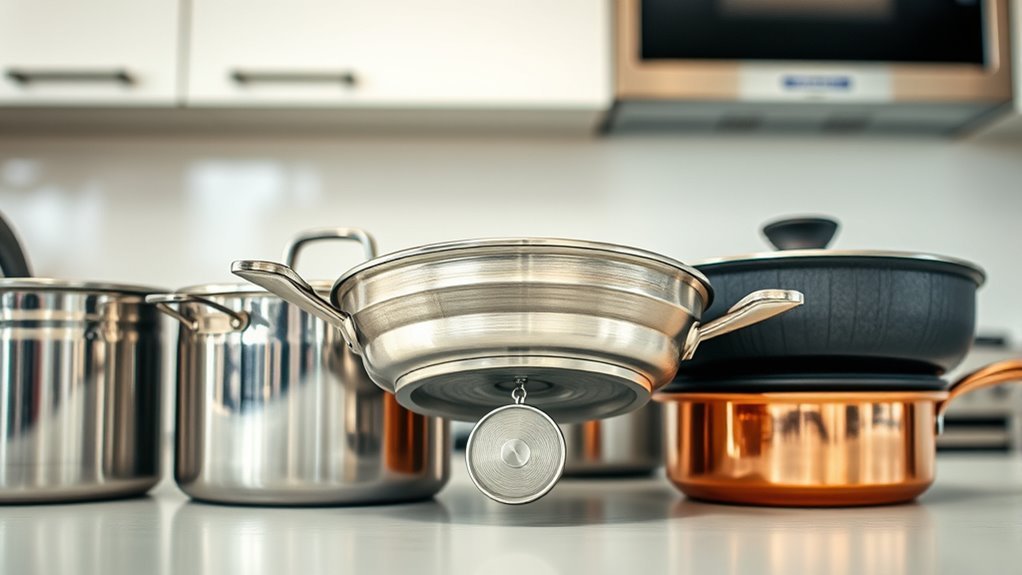
To tell if cookware is induction ready, check three things: the label or listing says induction, a magnet sticks to the base, and the base is flat and the right size. This guide focuses on reading labels, symbols and product listings, which helps most when you are buying cookware or sorting through a set. For the hands-on test, see how to tell if a pot is induction ready.
Check the Label, Stamp and Symbol
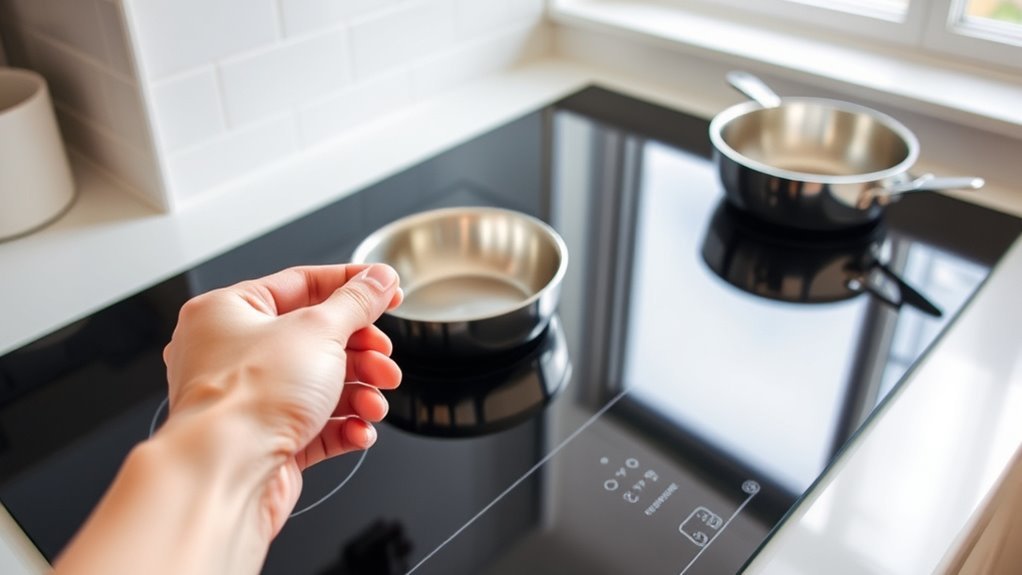
Flip the pan over. Many makers stamp the base with the word induction or a coil symbol. The same information is often on the box, handle sticker or care card.
The coil symbol is usually a spiral or looping line, sometimes above a straight line. Designs differ between brands, so do not rely on shape alone. The symbol is the maker’s claim, and the magnet confirms it.
Label Terms and What They Mean
| Wording | What it means |
|---|---|
| Induction ready / compatible / suitable | Works on induction cooktops |
| Suitable for all hob types | Usually includes induction; confirm in the details |
| Magnetic stainless steel base | Should work; test it |
| Not for induction | Will not work |
| No mention of induction | Unknown; test with a magnet before you rely on it |
For a deeper look at the wording, see what “induction safe” means.
Read Product Listings Carefully
When shopping online, look beyond the headline.
- Material of the base: stainless steel with a magnetic layer, cast iron and carbon steel are good signs.
- Cooktop compatibility list: it should name induction explicitly.
- Whether it applies to all pieces: in sets, check each pot, pan and lid.
- Base diameter: compare it with your zones.
If the listing is vague, ask the seller or choose a pan that states induction clearly. Prices and specs change, so check the current listing.
Confirm With a Magnet and Your Cooktop
Once the cookware arrives, hold a magnet to the base. A firm hold means it should work. Then place it on your cooktop with a little water at low power. If it heats, you are set. If the cooktop shows a message or does nothing, return or exchange it.
Check the Base Shape and Size
- Flat: a pan that rocks on a counter will not make full contact with the glass.
- Size: the magnetic base should match the cooking zone. A base that is too small may not be detected.
- Thickness: a heavier, thicker base heats more evenly and stays flatter.
Which Materials Are Induction Ready?
- Usually yes: cast iron, enameled cast iron, carbon steel, enameled steel, and clad stainless steel with a magnetic base.
- Only with a magnetic base layer: nonstick, ceramic-coated, aluminum and copper pans.
- No: glass, stoneware, porcelain and plain aluminum or copper.
See the full induction cookware guide or the pots quick table. If you are comparing ceramic options, read using ceramic on induction.
Frequently Asked Questions
How do I identify induction compatible cookware?
Look for the word induction or a coil-shaped symbol on the base, packaging or product listing, then confirm with a magnet. A magnet that sticks firmly to the flat bottom is a good sign. Also check that the base is flat and the right size for your cooking zone.
What is the symbol for induction ready cookware?
It is usually a coil or loop, drawn as a spiral or curly line, often with a straight line under it. It may be stamped on the bottom or printed on the box. Designs vary by brand, so treat the symbol as a clue and back it up with a magnet test.
Can I use aluminum pots and pans on an induction cooktop?
Plain aluminum does not work because it is not magnetic. Aluminum cookware with a stainless steel or iron plate bonded into the base can work. Look for a clear induction statement in the manufacturer’s description, and test the bottom with a magnet.
Is a cookware set labeled induction compatible fully compatible?
Not always. Some sets include pieces with different bases, and a lid or utensil in the box is not meant for the cooktop. Check each pot and pan separately, and read the manufacturer’s product page rather than a short marketplace summary.
Does the size of the pan matter for induction?
Yes. Cooktops detect pans by base size, and many have a minimum diameter for each zone. A base that is much smaller than the zone may heat poorly or not at all. Your cooktop manual lists the recommended pan sizes for each zone.
Conclusion
Read the label, confirm with a magnet, and check the base size and shape. If all three line up, your cookware is induction ready.
