
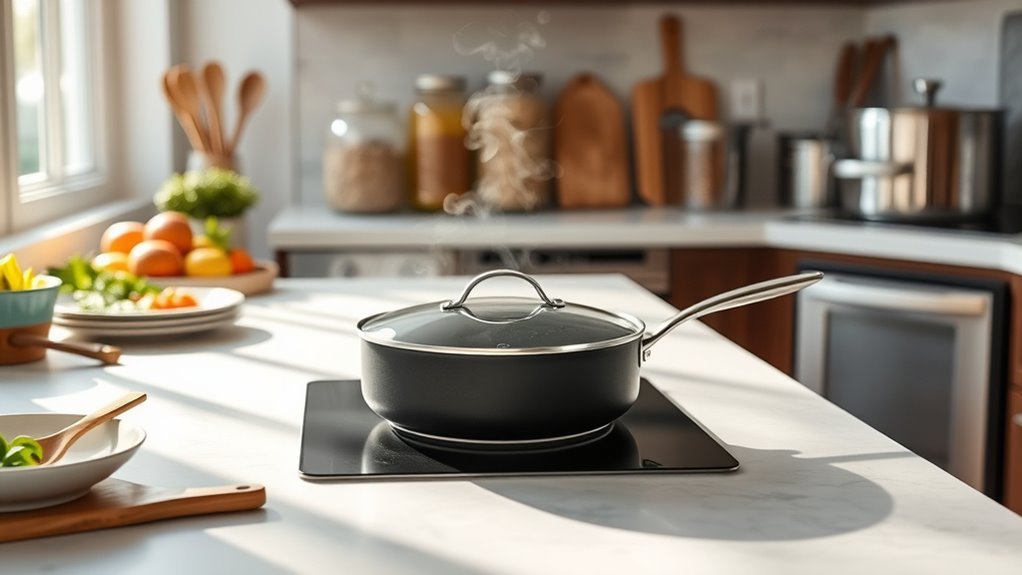
About 78% of cookware shoppers now list non‑toxic finishes as a top buying factor, so you’ll care about what Our Place uses. You’re getting lightweight cast aluminum with a ceramic‑based, titanium‑reinforced nonstick layer that’s advertised PFOA/PFAS‑free, but the safety profile depends on temperature limits, wear patterns, and maintenance. Keep an eye on coatings and heat; I’ll cover what materials, tests, and practices actually matter next.
Quick Answer: Is Our Place Cookware Non-Toxic?
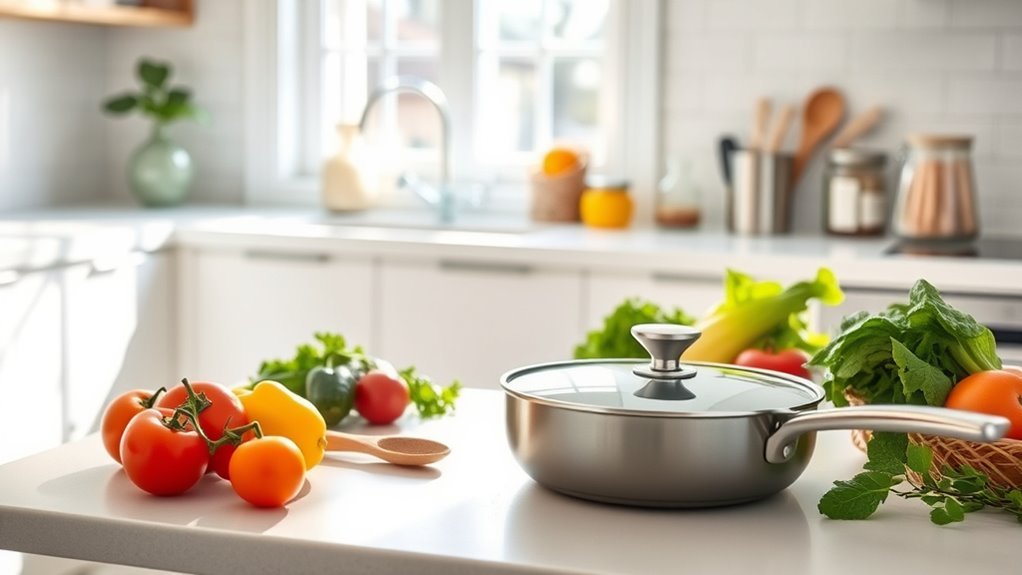
Wondering whether Our Place cookware is non-toxic? You can answer yes with qualifications: the brand uses a ceramic-based non-stick coating formulated without PFOA and PFAS, which reduces exposure to those well-documented toxics.
Laboratory-grade descriptions indicate the coating tolerates high temperatures while retaining its non-toxic claim under normal use parameters. You should, however, account for degradation dynamics—ceramic surfaces can wear with abrasion and misuse, and that wear may affect both performance and long-term safety perception.
You’ll need to follow care instructions precisely to preserve the non-toxic surface and extend lifespan. Reports from users reinforce that maintenance—avoiding metal utensils, high-heat dry heating, and abrasive cleaners—matters for sustained non-toxic performance.
The brand’s transparency about materials supports an evidence-based assessment: Our Place presents a healthier alternative to traditional PTFE-based non-stick options, but your practices determine whether the cookware remains functionally and chemically non-toxic over time.
What Materials Does Our Place Use?
Although Our Place prioritizes safer chemistry, its cookware mixes specific engineered materials to balance performance and health: a ceramic-based, PTFE- and PFOA-free non-stick coating covers lightweight cast-aluminum bodies for even heat distribution, while stainless-steel steamer baskets add durability and food-safe contact surfaces. You’ll find a non-toxic, ceramic coating formulated to avoid PTFE/PFOA, applied to cast aluminum to deliver responsive heating with lower mass. The stainless-steel basket provides a direct food contact surface that’s corrosion-resistant and recyclable. Materials are specified to be free from heavy metals and other harmful substances, aligning with sustainability commitments and responsible sourcing. You can thus cook with reduced chemical exposure and support material stewardship.
| Component | Material | Functional role |
|---|---|---|
| Body | Cast aluminum | Even heat distribution, light weight |
| Coating | Ceramic coating (PTFE/PFOA-free) | Non-stick, non-toxic surface |
| Insert | Stainless steel | Durable, food-safe steamer |
| Compliance | Heavy-metal-free | Health-oriented sourcing |
| Sustainability | Responsibly sourced | Environmental stewardship |
Which Chemicals Worry Cooks (PFOA, PFAS, PTFE)?
You should be aware that PFAS — a class of persistent “forever chemicals” — have been associated with immune, developmental, and carcinogenic risks due to bioaccumulation.
PTFE (Teflon) itself is largely inert at normal cooking temperatures but can decompose at high heat to emit toxic pyrolysis products, so thermal limits matter.
PFOA, once used to make PTFE coatings, has been phased out globally because of documented health effects, and manufacturers now supply third-party test data to support PFOA– and PFAS-free claims.
PFAS And Health Risks
Which chemicals in nonstick cookware should you worry about most? PFAS are a class of persistent synthetic chemicals linked to cancer, liver toxicity, and immune dysfunction; they’ve been detected in some non-stick pan coatings.
PFOA, a long-chain PFAS, was phased out after epidemiological and toxicological evidence tied it to adverse outcomes, but legacy contamination and replacement chemistries remain concerns.
You should scrutinize labels: products claiming “PFAS-free” or “PFOA-free” and third-party certifications reduce risk.
Opting for alternatives like ceramic or stainless steel eliminates many PFAS exposure pathways.
Prioritize transparent manufacturer data and independent testing results so you can reclaim control over your kitchen environment and minimize long-term chemical burden.
PTFE (Teflon) Concerns
Having covered PFAS and PFOA, it’s important to examine PTFE (polytetrafluoroethylene), the polymer commonly sold as Teflon, because its unique properties and production history create distinct exposure and toxicity considerations.
You should know PTFE yields exceptional nonstick performance but can emit hazardous fumes if overheated, posing acute respiratory risks in poorly ventilated spaces.
Manufacturing historically involved PFOA, which raised chronic-toxicity concerns; many makers now market PFOA-free products, yet PFAS persistence warrants scrutiny beyond that claim.
You can reduce risk by using low-to-medium heat, preventing scratches, and replacing compromised pans, since coating damage increases exposure potential.
When evaluating cookware, verify independent testing for PTFE and broader PFAS suites so your choices align with health and liberation goals.
PFOA Phase-Out History
Because manufacturing practices changed after mounting evidence of persistence and human health effects, major cookware makers phased out perfluorooctanoic acid (PFOA) in the U.S. by 2015.
You should view the PFOA Phase-Out as a targeted industrial response to evidence linking PFOA, a PFAS member, with bioaccumulation and adverse outcomes.
Regulators and manufacturers moved to eliminate PFOA from processing aids, reducing direct release into products and the environment.
That shift doesn’t erase legacy contamination or PFAS class risks; these “forever chemicals” persist and can accumulate in people and ecosystems.
You can still rely on PTFE-based cookware when used under recommended temperatures, but you’ll want transparency from brands and continued regulatory pressure to phase out hazardous inputs across supply chains.
Does Our Place Claim PFOA/PFOS-Free?
Curious whether Our Place avoids the most scrutinized PFAS, the company explicitly markets its cookware as PFOA- and PFOS-free. You’ll see PFOA, PFOS-free claims in product descriptions and marketing, signaling absence of those legacy fluorinated surfactants tied to traditional non-stick coatings.
The surface uses a ceramic non-stick layer the firm describes as non-toxic and thermally stable for normal cooking temperatures.
Evaluate this claim by noting two points: first, explicit exclusion of PFOA and PFOS reduces risk associated with those specific chemicals; second, “PFOA- and PFOS-free” doesn’t guarantee absence of all PFAS or other potentially concerning additives.
Users report switching from Teflon to Our Place based on these assertions and improved handling, yet community skepticism persists about coating longevity and thorough chemical composition.
If you value autonomy in health choices, demand full material disclosure and independent testing data to verify that marketed PFOA/PFOS-free status aligns with broader non-toxic expectations.
How the Titanium-Reinforced Coating Works
Think of the titanium-reinforced coating as a multilayer engineered surface: a ceramic or polymeric non-stick matrix is embedded with microscopic titanium particles or a thin titanium-based layer to increase hardness, thermal stability, and abrasion resistance.
You’ll notice this design boosts scratch resistance and sustains non-stick performance by distributing mechanical stress across a harder phase. The formulation omits PFOA/PFAS chemistries, reducing toxicant risk during normal cooking. You can cook at typical high temperatures without expecting chemical release, provided you follow care guidelines.
- Enhanced hardness: titanium-reinforced particles increase surface wear resistance, preserving texture and release properties.
- Thermal behavior: titanium presence raises stability, helping the matrix resist thermal degradation under culinary use.
- Safety profile: absence of PFOA/PFAS aligns with reduced persistent chemical exposure.
- Maintenance needs: avoid metal utensils and use gentle cleaning to prevent mechanical compromise of the composite surface.
This technical architecture gives you durable, safer non-stick performance while supporting mindful, liberating culinary practices.
Coating Durability, Heat Limits, and Smoke Points
When you push Our Place cookware toward higher heat, its titanium-reinforced non-stick surface holds functional integrity up to about 450°F under normal use. However, sustained exposure to high temperatures or abrasive contact will accelerate wear and reduce release performance.
You should understand that the specified heat limit reflects coating stability; exceeding it raises risk of accelerated degradation, though the brand positions the finish as non-toxic under intended conditions. Empirical reports show variable longevity—some users migrating from traditional Teflon note faster loss of release when routinely cooking at medium-to-high settings.
To minimize breakdown, choose oils with high smoke points so you’re not repeatedly subjecting the coating to smoke-induced chemical stress. Use non-metal utensils and avoid prolonged dry-heating to preserve surface microstructure.
These practices don’t guarantee infinite life, but they align with the coating’s engineered thermal tolerance and help maintain non-toxic performance and predictable release characteristics over a practical service life.
Care and Maintenance to Preserve Safety
Having established the coating’s practical heat limits and common wear mechanisms, focus next on how routine care preserves both release performance and the non-toxic properties of Our Place cookware.
You’ll extend functional life by following targeted care and maintenance: avoid metal utensils, don’t exceed recommended temperatures, and clean gently after each use.
Use soft cloths or sponges and mild detergents; abrasive pads or cleaners abrade the coating and increase contamination risk.
For dishwasher-safe models like the Always Pan, follow manufacturer guidelines to retain surface integrity across cycles.
Store cookware with protective layers or pot protectors to prevent scratches that compromise safety.
- Use non-metal utensils to prevent mechanical abrasion.
- Limit cooking temperatures to within tested heat limits.
- Clean with soft cloths/sponge; avoid abrasive cleaners.
- Stack with protectors to prevent surface damage.
These practices are evidence-based, minimal, and liberating: they let you cook confidently while actively preserving the cookware’s engineered non-toxic performance.
Alternatives: Cast Iron vs Stainless vs Our Place
Although each option has trade-offs in durability, heat tolerance, and maintenance, you can choose the best fit by matching cookware properties to your cooking habits and willingness to maintain surfaces.
If you prioritize long-term robustness and high-heat searing, cast iron delivers predictable thermal mass and a natural non-stick layer when seasoned; it’s inert and non-toxic under normal use.
If you require a versatile, low-reactivity workhorse for deglazing and delicate sauces, stainless offers controlled heat response when you use fats and proper technique, though it isn’t inherently non-stick.
Our Place provides a manufactured non-stick surface that simplifies release and cleaning, reducing maintenance time, but its coating longevity is an open variable for users concerned with lifespan.
Evaluate whether you value minimal upkeep and immediate convenience or maximal durability and repairability.
Match material properties to cooking frequency, temperature range, and your commitment to maintenance to achieve culinary freedom without compromising safety.
User Reports and Independent Testing on Wear
User and lab data show mixed outcomes on Our Place ceramic-coated pans: some owners report coating degradation within months while independent testers note that the ceramic surface resists typical toxicants but appears less abrasion- and heat-tolerant than established PTFE (Teflon) products.
You should weigh anecdotal wear reports against controlled abrasion and thermal cycling results; both matter for long-term non-toxic performance. Users consistently advise avoiding high heat and metal utensils to sustain the coating.
Independent labs confirm low extractables under normal cooking but register increased surface roughness after repeated medium–high heat exposure.
Independent lab testing shows minimal extractables during normal cooking, but repeated medium–high heat increases surface roughness.
- Documented user timelines: variable failure onset, often correlated with high-heat use.
- Lab abrasion scores: ceramic coatings show higher mass loss than PTFE analogs under standardized rub tests.
- Thermal tolerance: reversible discoloration below manufacturer limits, irreversible microcracking above.
- Practical implication: you can reduce risk by following care protocols to preserve non-toxic surface integrity.
Should You Buy Our Place Cookware?
When deciding whether to buy Our Place cookware, weigh safety versus convenience by noting its ceramic, PFOA/PTFE-free coating and user-reported high-temperature performance against questions about coating longevity.
Consider long-term durability: lightweight cast aluminum and stainless construction promotes even heat and durability, but non-toxic coatings may require careful use and maintenance to preserve non-stick properties.
Finally, compare alternatives and tradeoffs—traditional non-stick pans offer long-term convenience while stainless or seasoned cast-iron provide proven longevity without coating concerns—so match your purchase to your cooking habits and maintenance willingness.
Safety Vs. Convenience
Because Our Place combines a non-toxic, temperature-stable nonstick surface with lightweight cast-aluminum construction, you’ll get efficient, even heating and easier cleanup without obvious chemical risks reported in lab testing.
However, documented user concerns about coating longevity mean you must follow manufacturer care instructions and accept potential performance decline over time when weighing the convenience of an all-in-one pan against long-term safety and durability.
You’ll enjoy streamlined cooking and reduced exposure from genuine non-toxic cookware, but you should plan for maintenance: avoid high heat, metal utensils, and dishwasher cycles that accelerate wear.
Evaluate whether convenience aligns with your values for lasting, safe tools or if you’ll prioritize replaceable ease over minimized material degradation.
- Assess typical cooking temperatures and techniques
- Compare care regimen to your routines
- Monitor coating condition periodically
- Balance replacement cost vs. safety gains
Long-Term Durability
Although the Always Pan’s lightweight cast-aluminum core and ceramic, non-toxic coating are engineered for even heating and sustained nonstick performance, you should treat longevity as conditional on care: manufacturers and user data indicate that avoiding high heat, metal utensils, and aggressive cleaning preserves the coating, while repeated abrasion or thermal abuse accelerates degradation. You’ll get durable service if you follow protocols: medium heat, silicone or wooden tools, and routine gentle washing—even though the pans are dishwasher-safe, handwashing reduces cumulative wear. Users report extended life versus traditional PTFE coatings; the non-toxic ceramic coating resists breakdown when handled correctly. Evaluate expected lifespan against your cooking habits and commit to maintenance that aligns with your autonomy and cookware’s material limits.
| Factor | Best Practice | Expected Effect |
|---|---|---|
| Heat | Medium | Preserves coating |
| Utensils | Soft | Prevents abrasion |
| Cleaning | Gentle | Reduces wear |
Alternatives And Tradeoffs
How should you decide whether to buy Our Place cookware? You’ll weigh non-toxic intent versus proven longevity: Our Place uses a ceramic-based non-stick that minimizes toxic exposure but raises questions about long-term integrity. Alternatives like cast iron and stainless steel offer durability and, with proper technique, reliable release.
- Evaluate your cooking patterns: high-heat searing favors stainless steel or cast iron.
- Consider maintenance: cast iron needs seasoning; stainless steel demands oiling technique for non-stick behavior.
- Assess aesthetics versus lifecycle: Our Place is multifunctional and stylish but may need replacement sooner.
- Pilot-test: try a single piece to gauge performance against your routine.
Choose based on empirical tradeoffs between short-term convenience and long-term resilience.
Frequently Asked Questions
What Is the Safest Non-Toxic Cookware Brand?
GreenPan is often the safest non-toxic cookware brand; you’ll get ceramic-based, PTFE/PFOA-free coatings with independent testing and clear material specs.
You’ll also consider Caraway and Our Place for Eco Friendly Options—each uses non-stick ceramics or anodized aluminum, offers transparent sourcing, and demands careful use to preserve coatings.
You’ll prioritize certifications, user data, and longevity tests to guarantee liberation from toxic exposures while retaining practical performance.
What’s Better, Caraway or Our Place?
Don’t assume one’s clearly superior — it depends.
You’ll prefer Caraway if you want minimalist, dishwasher-safe sets and durable ceramic nonstick; choose Our Place for multifunctional pieces (Always Pan), aluminum construction and easy wipe cleanup.
Material Comparison shows both use non-toxic ceramic coatings, but differ in form factor, thermal response and storage.
You’ll make an evidence-based choice by prioritizing function (multitasking) versus compact, sustainable set design for liberation in your kitchen.
What Are Common Our Place Complaints?
Common Our Place complaints center on Customer Feedback about coating durability, heat performance, and maintenance.
You’ll note users report non-stick wear over time, reduced effectiveness at medium heat, and sensitivity to improper care.
Some challenge marketing claims about materials and non-toxicity, citing mixed shifts from Teflon.
Evidence-based reviews emphasize careful use and maintenance to preserve function, while liberation-minded cooks demand transparent longevity testing and clearer performance metrics.
Is Our Place Titanium Pan Involved in a Lawsuit?
No — you won’t find any known lawsuits involving the Our Place Titanium Always Pan® Pro.
You can cite Titanium Benefits such as hardness, corrosion resistance, and inertness that support safety claims; the brand reports a titanium-reinforced ceramic, non-toxic coating.
Users worry about long-term wear, but evidence hasn’t produced legal challenges.
You’re entitled to demand transparency and durability data; keep insisting on independent testing to secure your culinary freedom.
Conclusion
You can reasonably consider Our Place cookware non-toxic when used and cared for as directed: its ceramic-based, titanium-reinforced surface contains no PFOA/PFAS and avoids classic PTFE risks under normal temps. Like a Tudor blacksmith’s cautionary note, practical limits matter—overheating, metal utensils, or harsh abrasives will degrade coatings and release particulates. Follow temperature guidelines, avoid thermal shock, and inspect for wear; evidence and independent testing support safety while performance and longevity depend on proper maintenance.

