
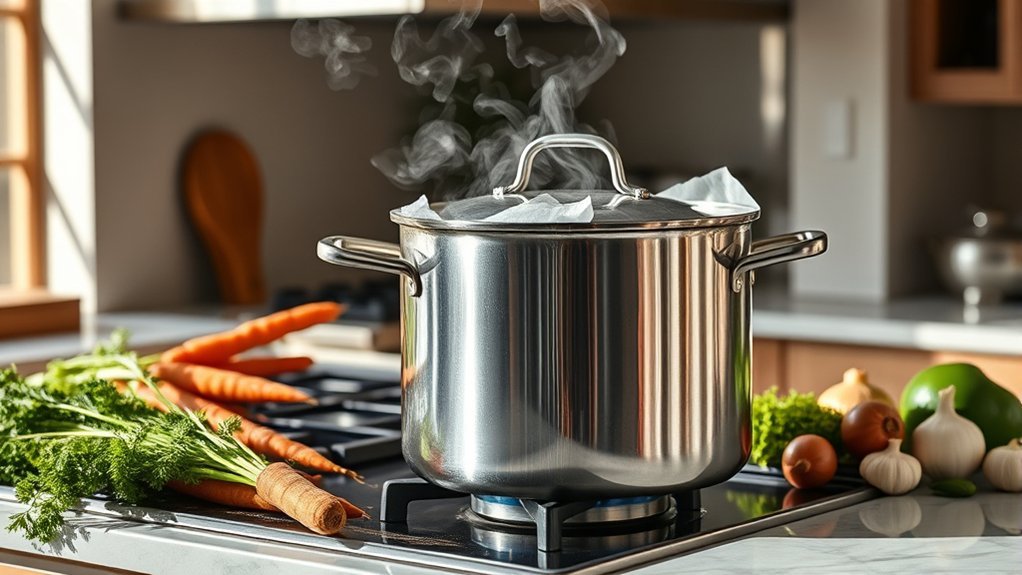
A stock pot is a large, deep cooking pot built for jobs that need plenty of liquid or cooking space. It is especially useful for stocks, soups, stews, pasta, blanching, steaming, chili, seafood boils, and meal prep. Tall sides give liquids room to simmer or boil with less splashing, while the best size and material depend on how much you cook and the cooktop you use.
Quick Answer
A stock pot is best for high-volume cooking such as stock, soup, chili, pasta, blanching vegetables, steaming, and other liquid-heavy recipes. An 8- to 12-quart pot covers many home-kitchen needs. Choose the material and base construction for your cooktop, and use a Dutch oven instead when strong browning and heat retention matter more than capacity.
Key Takeaways
- Stock pots excel at soups, stocks, pasta, blanching, steaming, chili, and large-batch meals.
- Tall sides provide capacity and help contain splashing, but they do not automatically create even heat.
- For many homes, 8 to 12 quarts is a practical range; larger pots are useful for crowds but become heavy when full.
- A Dutch oven usually performs better for searing, braising, and recipes where heat retention is a priority.
- Induction cooktops require a stock pot with a magnetic base.
What Can You Cook in a Stock Pot?
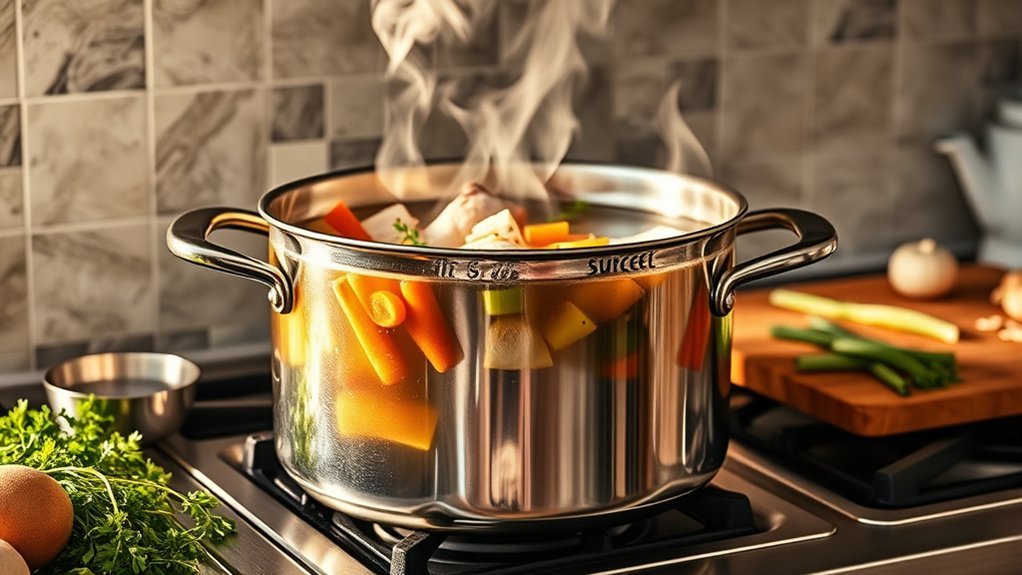
A stock pot can handle much more than broth. Its large capacity and tall sides make it especially useful for foods that need plenty of liquid or room to move. Common stock pot uses include making chicken, beef, vegetable, or seafood stock; cooking soups and stews; simmering chili; boiling pasta; blanching vegetables; and steaming food with an insert.
Stock pots are also practical for large-batch recipes. An 8-quart pot may be enough for many households, while larger 10-, 12-, or 16-quart models make more sense when cooking for a crowd. Stock pots are commonly designed with tall sides, two handles, a flat base, and a lid, although exact construction varies by model. Tramontina’s stock-pot guidance similarly lists stocks, soups, bone broth, pasta, chili, blanching, steaming shellfish, and batch cooking among their typical uses.
For pasta, the larger capacity lets you use enough water while leaving room above the waterline to reduce boil-over. For steaming, a basket or insert keeps the food above the boiling water instead of submerging it.
Note: A stock pot’s shape provides volume, but heating performance depends heavily on its material and base construction. A thick or clad base generally manages heat more evenly than a thin single-layer base.
Best Stock Pot Uses for Soups, Boiling, and Steaming
Stock pots are most useful when a recipe needs a combination of capacity, liquid, and steady cooking. Their tall sides provide room for simmering without requiring an extremely wide footprint.
| Use | Why a Stock Pot Works Well |
|---|---|
| Stocks and broths | Plenty of room for bones, vegetables, aromatics, and water |
| Soups and chili | Large capacity for batch cooking and steady simmering |
| Boiling pasta | Room for water and pasta with headspace above the boil |
| Steaming | Can hold a steaming basket or insert above the water |
| Blanching | Enough water to handle vegetables in manageable batches |
A larger pot does not automatically boil faster. Heating time depends on how much water is in the pot, burner output, whether a lid is used, the pot’s base, and how well the pot matches the burner. The advantage of the stock pot is capacity, not a guaranteed faster boil.
Warning: A stock pot filled with hot liquid can become very heavy. Leave safe headroom, use both handles, keep handles dry, and avoid carrying a pot filled close to the rim with boiling liquid.
What Size Stock Pot Do You Need?
The right capacity depends on what you normally cook. There is no single standard size that fits every kitchen.
| Capacity | Good For |
|---|---|
| 6–8 quarts | Everyday soup, pasta, smaller batches, and households with limited storage |
| 8–12 quarts | A versatile home range for stock, chili, pasta, steaming, and meal prep |
| 12–16+ quarts | Large families, parties, seafood boils, and high-volume batch cooking |
Capacity is only part of the decision. Check the pot’s diameter against your largest burner, measure cabinet space before buying an oversized model, and remember that every additional quart of water adds substantial weight.
Stock Pot Materials and Cooktop Compatibility
The material and construction of a stock pot affect weight, heating behavior, durability, maintenance, and cooktop compatibility.
Stainless steel is popular because it is durable and easy to maintain. Better-performing stainless cookware often combines stainless surfaces with a more conductive aluminum core or base. Aluminum is lightweight and conducts heat well, but its surface and care requirements depend on whether it is bare, anodized, or coated. Nonstick-coated stock pots can simplify cleanup but should be used within the coating manufacturer’s temperature and utensil guidelines.
If you cook on induction, the bottom must contain magnetic material. GE Appliances recommends a simple test: place a magnet against the base. If it sticks securely, the cookware is generally suitable for induction.
Pro Tip: Do not judge a stock pot by wall thickness alone. A solid, flat base that matches the burner can matter more for everyday performance than very thick sidewalls.
Can You Brown Food in a Stock Pot?
Yes, you can brown food in a stock pot, especially when beginning a soup, chili, sauce, or stew. However, a tall stock pot is usually less convenient for searing than a wide Dutch oven, sauté pan, or skillet.
For better browning, preheat the pot, dry the food’s surface, add an appropriate cooking fat, and place ingredients in a single uncrowded layer. Surface moisture must evaporate before strong browning develops, so overcrowding encourages steaming instead.
The Maillard reaction creates many of the browned flavors associated with seared meat and other foods. Rather than trying to hold the pot at one supposedly perfect temperature, watch the food: the surface should sizzle and brown without burning.
For better browning in a stock pot, dry the food, preheat the cooking surface, and work in small batches instead of crowding the bottom.
Stock Pot vs. Dutch Oven: Which Should You Buy?
A stock pot and a Dutch oven can both make soups and stews, but they emphasize different strengths.
A stock pot is usually taller and offers more capacity for its footprint. It is a practical choice for stocks, broth, pasta, blanching, steaming, large soups, and other recipes that use plenty of liquid.
A Dutch oven is usually shorter and heavier. Enameled cast-iron models are particularly good at retaining heat and provide a broad cooking surface for browning before braising or simmering. For example, Le Creuset’s 5.5-quart enameled cast-iron Dutch oven specifically emphasizes heat distribution and retention.
| Feature | Stock Pot | Dutch Oven |
|---|---|---|
| Best strength | Volume | Heat retention and browning |
| Typical shape | Tall and deep | Shorter and wider |
| Weight | Often lighter | Often heavier, especially cast iron |
| Great for | Stock, pasta, soup, steaming, blanching | Braising, searing, stews, oven cooking |
If you regularly cook gallons of soup or boil large quantities of pasta, the stock pot is usually more practical. If you more often sear meat and then braise it slowly, a Dutch oven may be the more useful vessel. Many kitchens benefit from having both because they solve different problems.
How Do You Clean and Care for a Stock Pot?
Cleaning depends on the stock pot’s material, so check the manufacturer’s directions first. For stainless steel, allow the pot to cool before washing it. Sudden exposure of a very hot pan to cold water can contribute to thermal shock or warping.
| Task | Purpose |
|---|---|
| Wash with warm, soapy water | Removes grease and ordinary food residue |
| Use a non-abrasive sponge | Reduces scratching |
| Treat stubborn stainless-steel residue gently | Helps lift cooked-on deposits without aggressive scraping |
| Dry before storage | Reduces spotting and prolonged moisture exposure |
| Inspect the base and handles | Helps identify warping, loose hardware, or damage |
Le Creuset’s stainless-steel care guidance recommends warm soapy water, non-abrasive cleaning tools, and thorough drying. Avoid steel wool and harsh cleaners unless the cookware manufacturer specifically approves them.
Aluminum does not “rust” like iron-containing steel, although it can oxidize, stain, or corrode under some conditions. Coated or anodized aluminum should be cleaned according to the coating manufacturer’s instructions. Dishwasher compatibility also varies by model, so do not assume every stock pot is dishwasher-safe.
Frequently Asked Questions
Can You Cook Regular Food in a Stock Pot?
Yes. A stock pot can cook everyday foods such as soup, chili, pasta, rice-based dishes, vegetable stews, boiled potatoes, seafood, and many one-pot meals. Its main limitation is shape: the tall sides make it less convenient than a skillet or Dutch oven for foods that need a large browning surface.
Is a Stock Pot Worth It?
A stock pot is worthwhile if you regularly make soup, stock, pasta, chili, steamed foods, or large batches. It may be less useful if you cook mainly small portions and already own a large Dutch oven or saucepan. Storage space is also worth considering because high-capacity models are bulky.
Are Stock Pots Unhealthy?
A stock pot is not inherently unhealthy. Safety depends on the actual material, coating, manufacturing quality, condition, and intended use. The FDA has warned consumers about certain tested imported cookware that may leach lead, so cookware from reputable sources should be used according to manufacturer instructions. For nonstick cookware, FDA also notes that authorized polymerized PFAS coatings used for certain food-contact applications have negligible migration to food under their intended use.
What’s the Difference Between a Stock Pot and a Regular Pot?
A stock pot is typically taller and larger than an everyday saucepan or cooking pot. That extra depth makes it better for stocks, soups, pasta, blanching, steaming, and large quantities of liquid. Smaller pots are easier to handle for sauces, reheating, grains, and modest portions.
What Size Stock Pot Is Best for Home Use?
An 8- to 12-quart stock pot is a useful range for many households because it handles soup, pasta, stock, and batch cooking without becoming as difficult to store as very large commercial-style pots. Smaller households may prefer 6 to 8 quarts, while frequent large-batch cooks may want 12 quarts or more.
Can You Use a Stock Pot on an Induction Cooktop?
Yes, if the stock pot has an induction-compatible magnetic base. Place a magnet against the bottom: if it sticks firmly, the pot will generally work on induction. Plain aluminum, copper, glass, and some stainless-steel cookware will not work unless the base includes magnetic material.
Conclusion
A stock pot is most useful for cooking that needs volume: stocks, soups, chili, pasta, blanching, steaming, and other large-batch recipes. Tall sides provide capacity and help control splashing, while material and base construction determine how the pot actually handles heat. For many homes, an 8- to 12-quart model offers a practical balance of capacity and storage. Choose a Dutch oven when browning and heat retention matter more, and choose a stock pot when liquid capacity is the priority.
Sources
- Tramontina — Stock Pots, Sauce Pots & Multi-Cookers — stock-pot design and common cooking uses.
- Le Creuset — Round Dutch Oven — enameled cast-iron heat retention, capacity, and cooktop compatibility.
- GE Appliances — Induction Cooktops — magnetic cookware requirements and the magnet compatibility test.
- U.S. Food and Drug Administration — Questions and Answers on PFAS in Food — current FDA information on PFAS and nonstick food-contact applications.
- U.S. Food and Drug Administration — Imported Cookware Lead Warning — current safety information on specific cookware that may leach lead.
- Le Creuset — Stainless Steel Cookware Care and Use — stainless-steel washing, drying, and maintenance guidance.