
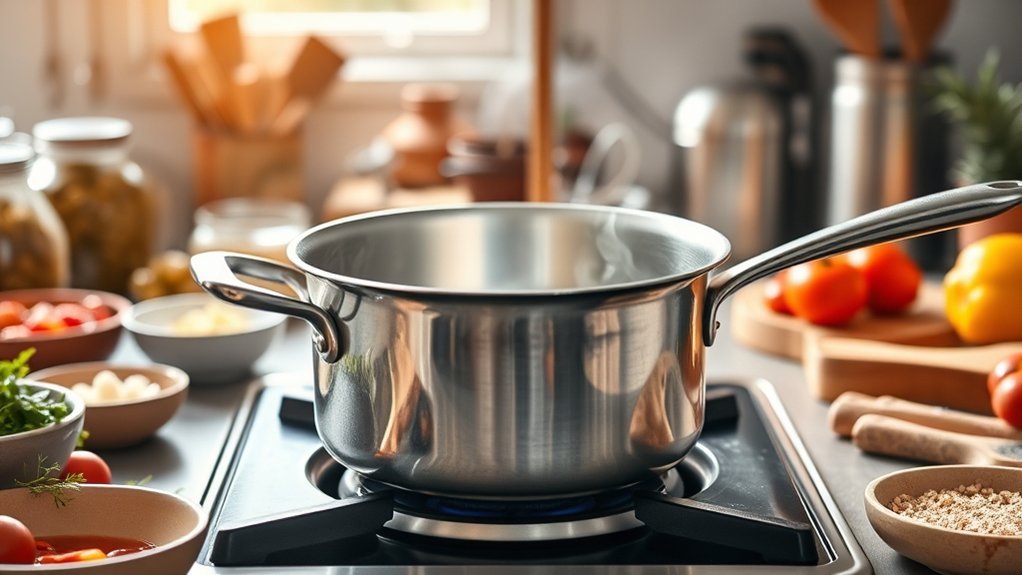
A medium saucepan is usually a 2- to 3-quart stovetop pot with tall sides, a long handle, and often a lid. That capacity works well for sauces, grains, oatmeal, eggs, soup, reheating, and small portions of pasta. However, “medium” is a useful kitchen label rather than a fixed industry size, so exact diameter and height vary by brand and design.
Quick Answer
A medium saucepan is commonly about 2 to 3 quarts. Capacity is a better guide than diameter because brands use different shapes and measurement methods. For everyday cooking, this size is well suited to sauces, rice, grains, soup, eggs, reheating, and modest batches of pasta.
Key Takeaways
- A 2- to 3-quart capacity is a practical working definition of a medium saucepan, but there is no universal dimensional standard.
- Use the manufacturer’s listed capacity before relying on height or diameter.
- Stainless steel, aluminum-based cookware, and enameled cast iron offer different balances of durability, heating response, and weight.
- Check cooktop compatibility, handle comfort, lid fit, construction, and actual capacity before buying.
- For an unmarked pan, measuring how much water it holds is more reliable than guessing from its outside dimensions.
What Is a Medium Saucepan?
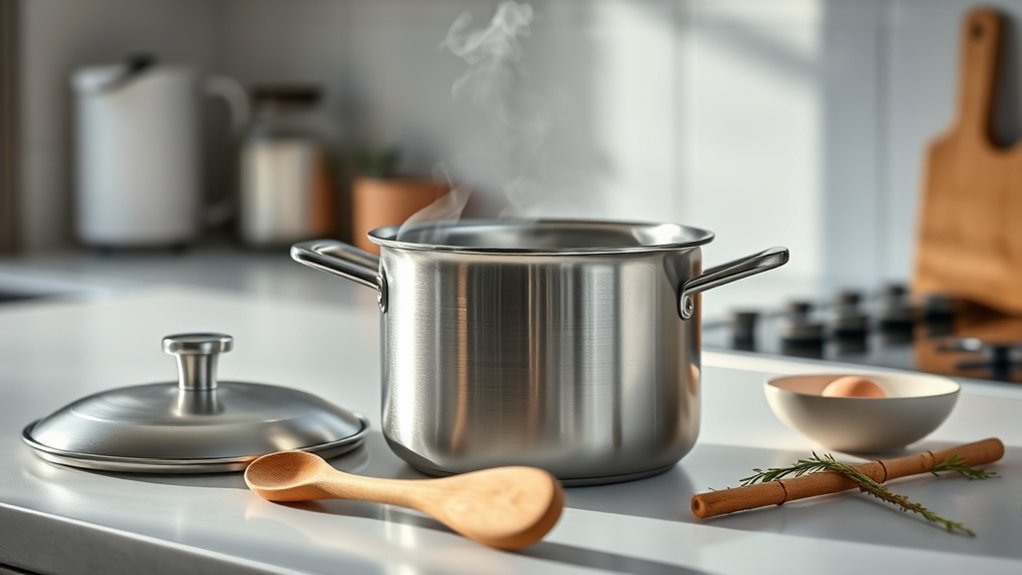
A medium saucepan is a versatile cooking vessel that commonly holds about 2 to 3 quarts. It normally has relatively tall sides, one long handle, and a lid.
The shape is designed mainly for foods cooked in liquid. Compared with a frying pan or skillet, a saucepan has a smaller opening relative to its depth, which helps contain splashes and gives liquids room to simmer without taking up a large burner.
A medium saucepan is useful for sauces, rice, oatmeal, small batches of soup, boiled eggs, reheating leftovers, steamed vegetables, and other everyday tasks. A 3-quart model also gives more room for modest portions of pasta or potatoes.
A lid helps retain heat and moisture, while a long handle makes the pan easier to lift and pour. Some medium saucepans also include a helper handle, pouring spout, straining lid, or interior measurement marks.
Note: “Medium saucepan” is not a tightly standardized cookware category. Capacity is the most useful identifier. Exact diameter, height, handle length, and lid dimensions vary by manufacturer.
Medium Saucepan Size and Dimensions
A medium saucepan commonly holds about 2 to 3 quarts, or roughly 1.9 to 2.8 liters. That range is useful for identifying the size described as “medium” in many recipes.
Exact physical dimensions are less reliable because manufacturers use different shapes. One brand may make a narrow, deep 2.5-quart saucepan while another uses a wider body for the same capacity.
Manufacturer dimension listings can also include the lid, handle, or overall product width, so numbers from different brands are not always directly comparable.
Typical Capacity Range
Capacity is usually the easiest way to identify a medium saucepan. A practical range is 2 to 3 quarts, although cookware sets and manufacturers may use the word “medium” differently.
| Capacity | Good Uses | What to Expect |
|---|---|---|
| 2 qt | Sauces, oatmeal, reheating, eggs, small grain batches | Compact and quick to handle |
| 2.5 qt | Rice, vegetables, sauces, soup | Balanced everyday capacity |
| 3 qt | Grains, soup, potatoes, larger sauces, modest pasta batches | More headroom and flexibility |
A 2-quart pan may be enough for small daily jobs, while a 3-quart saucepan gives extra room before liquids reach the rim. For foods that foam or expand, including rice, oatmeal, and pasta, extra headroom can reduce boil-over risk.
Common Height And Width
There is no single height or width that every medium saucepan follows. Many fall roughly in the 7- to 9-inch body-width range, but shape and measuring method can move a pan outside that range.
Current manufacturer specifications illustrate the variation. An All-Clad 2-quart saucepan is listed at 6.8 inches wide, a Cuisinart 3-quart saucepan at 7.9 inches wide, and a Calphalon 2.5-quart saucepan is listed with an 8.5-inch diameter.
Those figures should not be treated as interchangeable measurements because one manufacturer may report overall width while another reports pan diameter. They do show why capacity is more useful than a fixed width when identifying a medium saucepan.
Pan geometry affects cooking too. A wider opening exposes more liquid surface and can speed evaporation, while a narrower, deeper shape generally retains liquid more readily. Even heating, however, depends much more on the pan’s material, thickness, and construction than on its height alone.
For saucepan sizing, capacity is the useful constant; diameter and height are manufacturer-dependent.
Measuring By Manufacturer
The manufacturer’s stated capacity is the best starting point when identifying a saucepan. Product specifications may also list width, height, weight, cooktop compatibility, and oven limits.
Check exactly what a dimension means before comparing products. A listed height may include the lid or lid knob, while product length usually includes the long handle.
This matters when you are matching a pan to a burner, cabinet, dishwasher rack, or recipe. A saucepan that is too small can boil over, while an unnecessarily large pan can expose more surface area and increase evaporation.
Pro Tip: If the saucepan is unmarked, set it on a level counter and add water with a known measuring jug or quart measure. Count the amount required to fill the vessel to determine its actual capacity. Do not estimate capacity from outside diameter alone.
Top Diameter vs. Base Diameter
The diameter across the top is not necessarily the same as the diameter of the flat base touching the cooktop. Tapered or curved saucepans can have a noticeably smaller burner-contact area.
This is especially relevant for induction and electric cooking. A pan may physically measure 8 inches across the rim but have a smaller magnetic base. Follow the cooktop and cookware manufacturer’s recommendations for burner sizing.
Best Uses for a Medium Saucepan
A medium saucepan is best for cooking tasks that need moderate capacity, depth, and controlled stovetop heating.
- Make sauces: the deep sides help contain splashes while leaving room for whisking and stirring.
- Cook rice and grains: a lid and moderate depth work well for absorption cooking.
- Boil eggs or potatoes: the pan is deep enough to cover small batches with water.
- Prepare soup: 2- to 3-quart capacity suits smaller batches and side portions.
- Steam vegetables: models that accept a steamer insert can handle modest portions.
- Reheat food: the smaller volume is convenient for soup, gravy, beans, vegetables, and leftovers.
- Cook small pasta batches: a 3-quart saucepan can work for modest amounts, although a larger pot gives pasta more water and room to move.
Because a medium saucepan is neither tiny nor bulky, it is one of the most frequently useful sizes for everyday cooking.
How Medium Saucepans Compare to Other Sizes
A medium saucepan falls between compact saucepans used for small quantities and larger saucepans used for higher-volume cooking. Capacity is the clearest way to compare them.
Small Vs. Medium Saucepans
A small saucepan is often around 1 to 2 quarts, while a medium saucepan is commonly around 2 to 3 quarts. The ranges can overlap because cookware naming is not standardized.
- Small saucepan: useful for butter, a small amount of sauce, reheating one portion, or other low-volume work.
- Medium saucepan: provides more headroom for grains, soup, vegetables, eggs, sauces, and everyday reheating.
- Handling: both remain relatively easy to lift, but weight depends heavily on material and construction.
If you often find a 1- or 1.5-quart pan close to overflowing, moving to a 2.5- or 3-quart model usually gives more useful working room.
Medium Vs. Large Sizes
A medium saucepan commonly holds 2 to 3 quarts. Larger saucepans frequently begin around 4 quarts, although manufacturers may use different naming systems.
A large saucepan provides more room for soup, potatoes, vegetables, pasta, and larger batches. It is also heavier when full and takes up more storage space.
Diameter should not be used to define the categories by itself. For example, a current Cuisinart 4-quart saucepan is listed at 7.9 inches wide, showing that a 4-quart pan does not necessarily need a 9- to 12-inch body.
Choosing The Right Size
Select saucepan capacity according to what you cook most often rather than choosing from the words “small,” “medium,” or “large” alone.
- About 1 to 2 quarts: low-volume sauces, reheating, melting, and small portions.
- About 2 to 3 quarts: general everyday cooking, grains, soup, vegetables, sauces, and eggs.
- About 4 quarts and above: larger batches, more boiling water, family-size soups, potatoes, and pasta.
Leave some empty space above foods that foam, swell, or boil vigorously. A pan filled nearly to the rim is difficult to stir and much more likely to boil over.
How to Choose a Medium Saucepan
Start with capacity. For a general-purpose medium saucepan, 2.5 to 3 quarts gives useful flexibility without becoming excessively large.
Then compare construction and features:
- Cooktop compatibility: verify that the model works with your gas, electric, ceramic, or induction cooktop.
- Base construction: aluminum-core or other conductive layers can help distribute heat more evenly.
- Fully clad construction: conductive layers extending up the sidewalls can improve heat response beyond the base.
- Handle: look for a secure grip that remains comfortable when the pan is full.
- Helper handle: useful on heavier 3-quart models.
- Lid: a well-fitting lid is useful for grains, steaming, and simmering.
- Pouring rim or spout: helpful for sauces and hot liquids.
- Measurement markings: convenient for adding liquids without a separate measuring vessel.
- Weight: the pan should feel stable but still be manageable when full.
Check Cooktop Compatibility
Capacity does not tell you whether a saucepan will work on a particular stove. If you use induction, choose cookware specifically labeled as induction compatible.
For example, Cuisinart states that its current 3-quart stainless saucepan is compatible with all stovetops, including induction. Other cookware, especially some aluminum designs, may require a magnetic stainless-steel base for induction use.
Also compare the flat base with your burner size. An extremely small pan on an oversized electric burner wastes heat, while some induction cooktops require a minimum magnetic base diameter.
Best Medium Saucepan Materials and Features
Stainless steel, aluminum-based cookware, nonstick cookware, and enameled cast iron can all work well in a medium saucepan. The best choice depends on cooking style, weight, maintenance, and cooktop compatibility.
Health Canada describes aluminum as lightweight and a good heat conductor, stainless steel as strong and resistant to rusting and staining, and cast iron as durable with strong heat retention.
| Material / Construction | Main Strength | Consideration |
|---|---|---|
| Clad stainless steel | Durable, versatile, often induction compatible | Usually heavier and more expensive than basic aluminum |
| Aluminum / hard-anodized aluminum | Lightweight and responsive heating | Induction compatibility varies by base construction |
| Nonstick | Easy food release and cleanup | Coating requires suitable heat and care |
| Enameled cast iron | Excellent heat retention | Heavy for frequent one-handed lifting and pouring |
Stainless steel cookware often uses an aluminum core or aluminum base because stainless steel itself is less conductive. A current Cuisinart saucepan, for example, combines stainless steel with an encapsulated aluminum base for more even heating.
A tight-fitting lid, stable base, comfortable handle, balanced weight, and drip-resistant pouring rim can matter just as much as the material itself.
Warning: Follow the manufacturer’s care and temperature instructions for coated cookware. Health Canada advises against preheating empty nonstick cookware and recommends avoiding high heat above about 260°C (500°F). Cookware materials and coatings can have different care requirements.
Frequently Asked Questions
How Do I Know What Size My Saucepan Is?
Look for a capacity marking on the bottom, packaging, or manufacturer’s product page. If the pan is unmarked, fill it with measured water while it sits on a level counter and count the amount it holds. Capacity is more reliable than estimating size from outside diameter.
What’s the Difference Between a Saucepan and a Regular Pan?
A saucepan has relatively tall sides and is designed mainly for liquids, simmering, boiling, grains, sauces, and reheating. A frying pan or skillet is broader and shallower, giving food more contact with the hot cooking surface for browning, frying, and sautéing.
What Would a Medium Saucepan Look Like?
A medium saucepan is usually an upright 2- to 3-quart pot with tall sides, one long handle, and often a lid. Its exact diameter and height vary by brand. Stainless steel, aluminum-based, nonstick, and enameled designs are all common.
Is a 2 Quart Saucepan Big?
A 2-quart saucepan is compact rather than large. It works well for sauces, oatmeal, grains, eggs, reheating, and other small-volume tasks. Whether it is large enough depends on the recipe; foods that expand or foam may be easier to manage in a 2.5- or 3-quart pan.
Is a 3 Quart Saucepan Considered Medium?
Yes. A 3-quart saucepan fits comfortably within the range commonly described as medium. It offers more headroom than a 2-quart model while remaining manageable for everyday sauces, grains, soup, vegetables, potatoes, and reheating.
Can You Cook Pasta in a Medium Saucepan?
Yes, especially in a 3-quart saucepan when cooking a modest amount. Use enough water for the pasta to move and stir regularly. For larger quantities, long pasta, or recipes needing plenty of boiling water, a larger saucepan or stockpot is easier to manage.
Conclusion
A medium saucepan is best identified by capacity rather than a fixed set of dimensions. About 2 to 3 quarts is a useful everyday range for sauces, grains, eggs, vegetables, soup, reheating, and other routine cooking.
Exact height and diameter vary considerably, so check the manufacturer’s specifications instead of assuming every medium saucepan has the same measurements. When choosing one, consider capacity, construction, cooktop compatibility, handle comfort, lid fit, weight, and the foods you cook most often.
For many kitchens, a 2.5- or 3-quart saucepan offers the broadest everyday flexibility without taking up the space or adding the weight of a larger pot.
Sources
- All-Clad — D5 2-Quart Sauce Pan — current 2-quart dimensions, construction, uses, cooktop compatibility, and care guidance.
- Cuisinart — 3-Quart Saucepan with Cover — current 3-quart dimensions, aluminum-base construction, and induction compatibility.
- Calphalon — Premier 2.5-Quart Sauce Pan — example of an 8.5-inch-diameter medium-capacity saucepan.
- Cuisinart — 4-Quart Saucepan with Cover — current 4-quart dimensions used to compare medium and larger saucepans.
- Health Canada — The Safe Use of Cookware and Bakeware — cookware materials, aluminum and stainless-steel characteristics, nonstick care, and heat-safety guidance.