
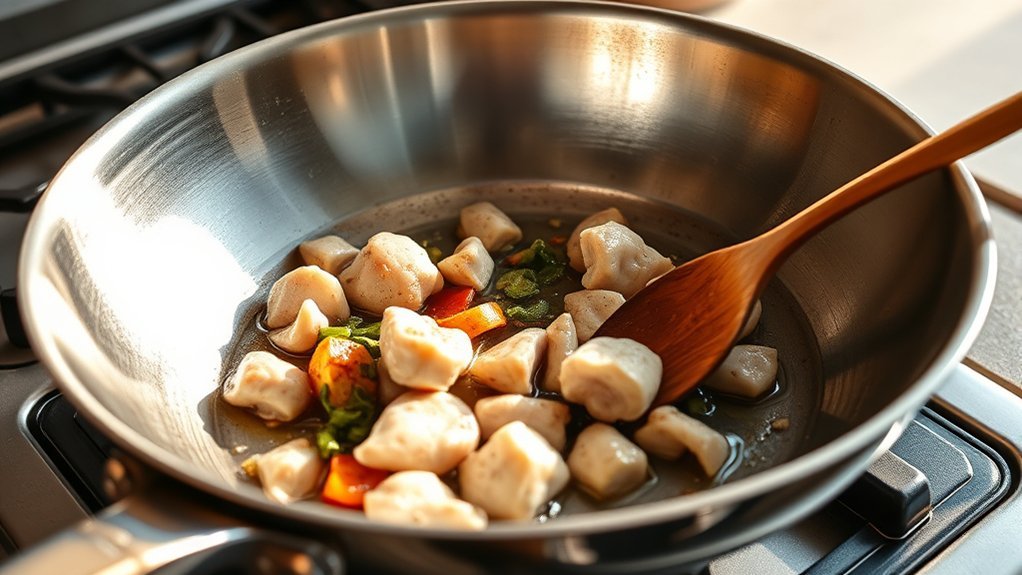
A sauteuse pan is a versatile, moderately deep cooking vessel used for sautéing, simmering, braising, reducing sauces, risotto, pasta, and other one-pot meals. Many modern sauteuses have a wide base with curved or sloping sides that make stirring and whisking easy. However, the name is not completely standardized, so the actual shape and construction matter more than the label.
Quick Answer
A sauteuse is a wide, relatively deep pan designed for flexible stovetop and oven cooking. Many versions use curved or sloping sides for easy stirring, tossing, and sauce reduction, although some manufacturers use the name for straighter-sided pans. It works especially well for risotto, pasta, braises, sauces, stews, and one-pan meals.
Key Takeaways
- The term sauteuse is not perfectly standardized, so compare the pan’s actual shape rather than relying only on its name.
- Rounded or sloping sides are especially useful for whisking sauces, stirring risotto, finishing pasta, and reducing liquids.
- A traditional sauté pan normally has straighter walls and more usable flat cooking area for searing in a single layer.
- Stainless steel, cast iron, enameled cast iron, carbon steel, and coated pans require different heat and care routines.
- Check capacity, usable base diameter, weight, handles, lid design, cooktop compatibility, and oven limits before buying.
What Is a Sauteuse Pan?
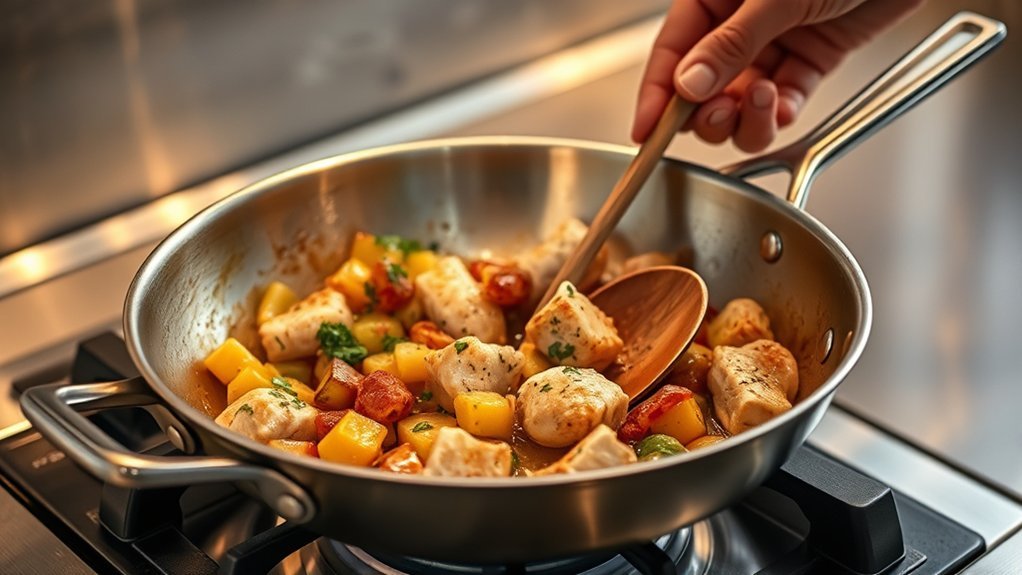
A sauteuse pan is a versatile, relatively deep pan designed for tasks such as sautéing, simmering, braising, stirring sauces, and preparing one-pot meals. A well-known modern example is Le Creuset’s sauteuse, which has a curved base and sloping sides that make it easier to reach the interior with a spoon, spatula, or whisk.
Other manufacturers use the name differently. Demeyere, for example, describes a conical sauteuse designed for smooth stirring and sauce work, while some cookware sold as a sauteuse has noticeably straighter walls. Because of that variation, shoppers should compare the pan’s profile, depth, cooking-surface diameter, material, handles, and lid rather than assuming every sauteuse has the same geometry.
Many sauteuses are made from stainless steel, enameled cast iron, cast iron, aluminum, carbon steel, or multi-layer constructions. Some include a tight-fitting lid for braising and moisture retention. Larger models may also use a helper handle, which makes a full pan safer and easier to lift.
Curved interior corners are especially helpful for stirring, whisking, and scraping sauces because food is less likely to collect in a sharp corner. A broad flat portion of the base still provides direct burner contact for browning and sautéing.
Note: Cookware terminology varies considerably between brands. Before buying a sauteuse, look at a side-profile photo and the actual dimensions to confirm whether it has the curved, sloped, deep, or straight-sided shape you want.
Sauteuse Pan vs. Saute Pan
A traditional sauté pan normally has a broad, flat cooking surface with relatively straight sides. That geometry maximizes usable base area and helps contain liquid and splatter. All-Clad describes its sauté pan as having a wide surface for browning and straight sides for holding liquids and braised dishes.
A curved or conical sauteuse sacrifices some flat-bottom area in exchange for easier stirring, tossing, whisking, and access to the perimeter of the pan. This makes that style particularly useful for risotto, sauces, pasta, polenta, stews, and dishes that move repeatedly between browning and simmering.
| Feature | Curved/Sloped Sauteuse | Traditional Sauté Pan |
|---|---|---|
| Side profile | Curved or sloping | Relatively straight |
| Flat cooking area | Moderate to large | Usually larger for a similar rim diameter |
| Whisking and stirring | Excellent | Good |
| Single-layer searing | Good when the base is wide enough | Excellent |
| Sauces and risotto | Excellent | Good |
| Liquid containment | Very good | Very good |
Choose a traditional sauté pan when maximum flat searing area matters most. Choose a curved sauteuse when frequent stirring, whisking, tossing, and sauce work are higher priorities.
Sauteuse Pan vs. Saucier: Why the Names Overlap
A saucier is generally easier to define than a sauteuse. It normally has a rounded transition between the bottom and walls, with sloping sides that make continuous whisking and stirring easier. Le Creuset’s saucier, for example, uses a contoured profile and rounded bottom for sauces and risotto.
The confusion is that some cookware marketed as a sauteuse has almost the same curved or conical profile. Demeyere even describes certain sauteuses as conical pans intended for delicate sauces. As a result, there is no dependable rule saying every saucier has one shape and every sauteuse has another.
When comparing the two, focus on measurable features:
- Base diameter: A larger flat base gives more room for browning.
- Wall curve: A smoother curve makes whisking and scraping easier.
- Depth: Greater depth helps contain soups, stews, and larger one-pot meals.
- Capacity: Compare actual quarts or liters rather than the visual size.
- Handles: A long handle favors stovetop maneuverability; helper or loop handles make a heavy pan easier to carry.
- Lid: A lid increases usefulness for braising, steaming, and covered simmering.
Best Recipes for a Sauteuse Pan
A sauteuse works especially well for dishes that combine browning, stirring, liquid, and finishing in the same pan. Its depth keeps sauces contained while a broad base provides enough surface area for sautéing.
Good choices include one-pan pasta, risotto, polenta, braised meat, stews, curries, shallow-fried foods, sautéed vegetables, pan sauces, casseroles, and rice dishes.
The best recipe depends partly on the pan’s construction. Stainless steel is strong for browning and fond development, cast iron excels at retaining heat, and coated cookware can make delicate or low-fat foods easier to release.
One-Pan Pasta Dishes
One-pan pasta dishes are a natural fit for a sauteuse because the pan can move from sautéing aromatics to simmering sauce and finishing pasta without transferring ingredients to another vessel.
A broad base provides room for vegetables, meat, or seafood, while curved sides make it easy to stir noodles through the sauce. That is particularly useful when finishing pasta with a small amount of pasta water, where constant movement helps sauce coat the noodles.
A sauteuse can handle creamy Alfredo-style sauces, tomato-based arrabbiata, vegetable primavera, meat sauces, and similar pasta dishes.
The same pan can often move from stovetop to oven or table when its handles, lid, coating, and manufacturer temperature rating allow it.
Using one vessel also means fewer transfers and less cleanup.
Braised Meat Classics
Braised meat dishes work well in a sauteuse pan when the base is wide enough to brown the meat without crowding and the pan includes a suitable lid.
The basic technique is to brown the meat first, remove it if necessary, sauté aromatics, deglaze the browned fond with stock, wine, water, or another suitable liquid, then return the meat and continue cooking gently.
Recipes such as Coq au Vin, Beef Bourguignon, braised chicken thighs, short ribs, or pork can work well in an appropriately sized sauteuse.
The deeper body helps contain braising liquid, while curved sides make vegetables and sauce easier to stir.
For large cuts, make sure the pan is wide enough to brown the meat in batches rather than packing the pieces tightly together.
Use the lid during the slow-cooking stage when moisture retention is desirable. Remove or partially uncover the pan near the end if the sauce needs further reduction.
Risotto And Rice Bowls
Risotto benefits from a sauteuse with a broad base and curved interior because those features make frequent stirring easier. The creamy texture comes from the rice, liquid, starch release, heat control, and stirring technique rather than from the pan having a nonstick surface.
- Sauté onions, shallots, garlic, or other aromatics gently in the appropriate cooking fat.
- Add the rice and toast it briefly according to the recipe.
- Add hot cooking liquid in stages while maintaining a controlled simmer.
- Stir often enough to cook evenly and prevent scorching.
- Finish with the recipe’s cheese, butter, vegetables, herbs, or protein.
For rice bowls, the same wide base can sauté vegetables and proteins before cooked grains and sauce are combined. A lid can also be useful for covered grain cooking when the recipe calls for trapped steam.
How to Cook With a Sauteuse Pan
The correct heat depends on the sauteuse pan’s material. Stainless steel, carbon steel, enameled cast iron, raw cast iron, aluminum, and nonstick surfaces should not all be treated identically.
For browning, keep ingredients in a reasonably even single layer so steam can escape. Curved sides make tossing and stirring easy, but overcrowding can still prevent good surface color.
For simmering or braising, add the required liquid after browning or sautéing. Cover the pan when the goal is moisture retention; leave it uncovered or partially uncovered when the goal is evaporation and reduction.
Choosing The Right Heat
Medium heat is a sensible starting point for many sauteuse cooking tasks, but the correct setting depends on both the recipe and the material.
- Stainless steel: Moderate preheating can help with searing. Add an appropriate cooking fat before the food and adjust the burner if the fat begins to smoke excessively.
- Carbon steel: Preheat according to the manufacturer’s instructions and maintain the seasoning layer. Carbon steel responds more quickly to heat changes than heavy cast iron.
- Raw cast iron: Give the pan time to heat through. Its strong heat retention is useful for searing and braising.
- Enameled cast iron: Heat gradually. Le Creuset specifically recommends low-to-medium heat for best results with its enameled cast iron and warns against rapid, maximum-heat preheating.
- Nonstick or ceramic-coated cookware: Follow the maker’s heat instructions and avoid prolonged empty overheating. Maximum oven temperatures vary by coating, lid, and handle design.
Warning: Do not assume every sauteuse can tolerate the same burner or oven temperature. Check the manufacturer’s limit for the pan, handles, lid, and knob. Le Creuset, for example, rates phenolic knobs to 390°F and standard stainless steel knobs to 500°F, while its enameled cast-iron pieces with cast-iron handles are rated to 660°F. Handles and lids can become dangerously hot, and sudden temperature changes can damage some cookware, particularly enamel.
Best Cooking Techniques
A sauteuse works across several cooking techniques because it combines a useful flat base with enough depth for liquids. The exact strengths depend on the pan’s shape and material.
| Technique | Typical Foods | Main Benefit |
|---|---|---|
| Sautéing | Vegetables, meat, seafood | Fast surface cooking and browning |
| Simmering | Sauces, soups, curries | Good liquid capacity and easy stirring |
| Braising | Meat and vegetables | Browning and covered cooking in one pan |
| One-pot cooking | Pasta, casseroles, stews | Fewer transfers and less cleanup |
| Risotto | Rice dishes | Easy stirring around curved edges |
| Reduction | Pan sauces, stocks, gravies | Broad evaporation area |
Use the lid for braising, steaming, covered simmering, and recipes that need moisture retention. For reductions, simmer with the lid off so water vapor can escape.
Sauteuse Pan Cooking Tips for Better Browning
Better browning depends on heat, surface contact, moisture, and crowding. The sauteuse should be heated according to its material and manufacturer’s instructions rather than automatically placed over maximum heat.
Use enough cooking fat for the food and pan surface. The fat should become hot enough to promote browning without being allowed to burn uncontrollably.
- Pat meat, seafood, and watery vegetables reasonably dry before they enter the pan.
- Cut ingredients into similar-sized pieces so they cook at a similar rate.
- Arrange food in a single layer when strong browning is the goal.
- Work in batches when necessary instead of overcrowding the pan.
- Allow the first side to develop color before repeatedly moving the food.
- Deglaze browned fond with an appropriate liquid when making a pan sauce.
Lodge notes that excess surface water interferes with browning and recommends drying foods before searing. Cast iron and carbon steel also benefit from giving food time to develop a crust before it is moved.
Pro Tip: If meat releases a pool of liquid and turns gray instead of brown, the problem is usually excess moisture, crowding, or insufficient surface temperature. Remove some food, let the moisture evaporate, and continue in smaller batches.
Common Sauteuse Cooking Problems and Fixes
| Problem | Likely Cause | What to Do |
|---|---|---|
| Food steams instead of browning | Crowding or excess moisture | Dry ingredients and cook in smaller batches |
| Food burns before the center cooks | Heat is too high | Reduce burner heat and allow gentler cooking |
| Sauce will not reduce | Pan is covered or simmer is too weak | Remove the lid and maintain an appropriate simmer |
| Sauce catches around the edge | Insufficient stirring or excessive heat | Lower heat and scrape the curved perimeter regularly |
| Pan is difficult to lift when full | Large capacity or heavy material | Choose a model with a helper handle and use both hands |
| Pan warps or enamel is damaged | Thermal shock or excessive heat | Heat and cool gradually and follow manufacturer care limits |
How to Choose a Sauteuse Pan Material
Selecting a sauteuse material depends on the type of cooking, preferred weight, heat response, maintenance, and cooktop. There is no single best material for every kitchen.
| Material | Strengths | Considerations |
|---|---|---|
| Clad Stainless Steel | Durable, good for searing and pan sauces, low maintenance | Food can stick without good heat and fat control |
| Carbon Steel | Responsive, durable, excellent browning potential | Usually requires seasoning and careful drying |
| Raw Cast Iron | Excellent heat retention and durability | Heavy and normally requires seasoning |
| Enameled Cast Iron | Strong heat retention, non-reactive enamel, useful for braising | Heavy; enamel requires protection from thermal shock and impacts |
| Nonstick / Coated | Easy food release and cleanup | Usually has lower heat limits and a finite coating life |
| Copper-Based Multi-Layer | Very responsive heat control | Often expensive and construction varies by product |
Clad stainless steel is a practical all-purpose choice for cooks who want durability, browning, and straightforward maintenance. Cast iron is useful when heat retention matters more than low weight. Carbon steel offers strong browning with faster response than heavy cast iron but generally needs more surface care.
Nonstick can be useful for delicate foods, but its oven-safe temperature is model-specific. Do not assume a nonstick sauteuse is either oven-safe or oven-unsafe without checking its manufacturer rating.
What Size Sauteuse Pan Should You Buy?
Capacity matters, but the advertised quart or liter rating does not tell you how much flat browning area the pan provides. Two 4-quart pans can have very different base diameters and wall shapes.
| Capacity | Typical Use | Best For |
|---|---|---|
| 2–3 qt | Sauces, grains, small risotto batches, side dishes | 1–3 people or supplemental dishes |
| 3–4 qt | Pasta, risotto, vegetables, chicken pieces, small braises | Versatile everyday use |
| 5–6 qt | Larger braises, family pasta, stews, casseroles | Families and batch cooking |
| 6+ qt | Large meals and entertaining | High-volume cooking |
Before choosing a size, check the actual cooking-surface diameter, total weight, handle arrangement, and available storage space. A large cast-iron sauteuse can become very heavy once filled with food and liquid, so helper handles become increasingly important.
Why a Sauteuse Pan Is So Useful
The main advantage of a sauteuse is versatility. One vessel can often handle initial sautéing, browning, deglazing, simmering, braising, reduction, and serving.
Curved or sloping sides make stirring and tossing easier, particularly for vegetables, grains, risotto, and sauces. The deeper body provides more liquid capacity than a shallow skillet and helps control splatter.
- Sauté vegetables while keeping them easy to toss and stir.
- Prepare one-pot meals such as risotto, pasta, curries, or casseroles.
- Braise meat under a suitable lid for controlled moisture retention.
- Simmer or reduce sauces using a broad evaporation surface.
A flat portion of the base improves contact with the cooktop, while the pan’s metal construction determines how quickly and evenly heat moves across that surface. A lid adds flexibility for recipes that require covered cooking.
Sauteuse Pan vs. Skillet, Dutch Oven, and Wok
A sauteuse pan occupies useful middle ground between several common cookware types, but each shape has a different strength.
Compared with a skillet: a typical skillet or frying pan has lower, flared sides that encourage evaporation and make flipping or sliding food easier. A sauteuse is generally deeper, giving it greater liquid capacity and better splatter containment.
Compared with a Dutch oven: a sauteuse is usually shallower and often has more accessible sloping sides. A Dutch oven’s tall walls and large capacity make it especially useful for soups, long braises, bread, and large-batch cooking, while a sauteuse can provide easier stirring and faster evaporation.
Compared with a wok: a wok has dramatically steeper curved walls and is optimized for tossing food through different heat zones. A flat-bottomed sauteuse provides more conventional contact with flat burners and is usually better suited to Western-style pan sauces, risotto, braising, and shallow one-pan meals.
Compared with a braiser: both can be excellent for browning followed by covered slow cooking. Braisers are normally broad and relatively shallow with two short loop handles. Some sauteuses, such as Demeyere’s, use a single long handle, while others, including Le Creuset’s enameled cast-iron sauteuse, use two loop handles much like a braiser but have a deeper, more curved profile. Because designs vary this much, dimensions should be compared directly.
How to Pick the Best Sauteuse Pan
Choosing the best sauteuse pan means matching its construction and dimensions to your cooking habits rather than shopping by name alone.
- Check the wall shape: Choose rounded or sloping sides for whisking and stirring, or a larger flat base when browning area matters more.
- Compare usable base diameter: Rim diameter alone can exaggerate the amount of food that can actually contact the heated base.
- Choose the material: Clad stainless steel is versatile; cast iron retains heat; carbon steel is responsive and seasonable; coated surfaces simplify release.
- Inspect the lid: A well-fitting lid is valuable for braising, steaming, and moisture retention.
- Check capacity: Around 3–4 quarts is a practical general-purpose range, while larger pans suit family meals and braises.
- Check handles: A comfortable main handle and helper handle make a large, full pan easier to move safely.
- Confirm cooktop compatibility: Do not assume every stainless or aluminum pan works on induction; the base must be induction-compatible.
- Confirm oven limits: Check the manufacturer’s limit for the body, handles, lid, knob, and coating rather than relying on the pan material alone.
- Consider weight: Heavy cast iron retains heat well but may be uncomfortable for frequent tossing or one-handed lifting.
- Check cleaning requirements: Stainless, enamel, seasoned carbon steel, raw cast iron, and nonstick surfaces require different care.
The most useful sauteuse is one whose actual cooking area, capacity, weight, wall profile, handles, and heat limits match the dishes you prepare most often.
How to Clean and Care for a Sauteuse Pan
Care depends primarily on the material rather than on the sauteuse shape.
- Stainless steel: Allow the pan to cool before washing. Use nonabrasive cleaning methods unless the manufacturer permits something stronger.
- Enameled cast iron: Cool gradually and avoid plunging a hot pan into cold water. Le Creuset’s care instructions warn that sudden temperature changes can damage enamel.
- Raw cast iron: Clean according to the manufacturer’s seasoning instructions, dry thoroughly, and maintain the seasoned surface.
- Carbon steel: Dry promptly and maintain seasoning. Some handles or coatings can impose specific oven-temperature limits.
- Nonstick: Avoid harsh abrasives and utensils that the manufacturer says can damage the coating.
Do not assume dishwasher safety. Even when a manufacturer labels cookware dishwasher-safe, hand washing may extend the appearance or working life of certain finishes.
Frequently Asked Questions
What Are the Differences Between a Sauteuse Pan and a Braiser Pan?
Both can brown food and then continue with liquid under a lid. A braiser is typically broad and relatively shallow, often with two short loop handles. A sauteuse may be deeper or more curved and may use either a single long handle or two loop handles, depending on the manufacturer. Compare the actual base diameter, depth, handles, lid, and capacity rather than relying only on the product name.
What Is the Difference Between a Saucier Pan and a Sauteuse Pan?
A saucier normally has rounded interior corners and sloping walls designed for whisking, stirring, sauces, and risotto. Some sauteuses have almost the same profile, while others are deeper or straighter. Because cookware brands use “sauteuse” inconsistently, the most reliable comparison is the actual shape and dimensions of the two pans.
What Is a Sauteuse Pan?
A sauteuse is a versatile cooking pan used for sautéing, simmering, braising, sauce work, risotto, pasta, and one-pan meals. Many versions have a broad base with rounded or sloping sides, but the term is not standardized across all cookware brands. Material, wall shape, depth, handles, and lid design therefore matter more than the name alone.
What Are the Three Types of Pans?
There is no authoritative rule limiting cookware to three pan types. Three very common categories are frying pans or skillets, sauté pans, and saucepans, but kitchens also use sauciers, sauteuses, braisers, roasting pans, woks, griddles, Dutch ovens, stockpots, and many other shapes.
What Size Sauteuse Pan Is Best for Everyday Cooking?
A 3- to 4-quart sauteuse is a practical general-purpose size for many households because it can handle sauces, risotto, pasta, vegetables, and modest braises without becoming excessively large. However, base diameter matters as much as capacity when you need room for browning.
Can a Sauteuse Pan Go in the Oven?
Many sauteuses are oven-safe, but there is no universal temperature limit. The body material, handle, helper handle, lid, knob, and any nonstick coating can each affect the maximum temperature. Check the exact manufacturer’s rating before placing the pan in the oven or under a broiler.
Does a Sauteuse Pan Work on Induction?
It works on induction only when the base is induction-compatible. Cast iron and many magnetic stainless-steel constructions work, while some aluminum, copper, or stainless products require an added magnetic base layer. Check the manufacturer’s cooktop specifications.
Do You Need a Sauteuse If You Already Own a Skillet and Dutch Oven?
Not necessarily. A skillet and Dutch oven can cover many of the same jobs. A sauteuse becomes especially useful when you frequently make risotto, pasta sauces, reductions, smaller braises, or one-pan dishes and want a vessel that is deeper than a skillet but easier to stir and reduce in than a tall Dutch oven.
Conclusion
A sauteuse pan can bridge the gap between a skillet, saucier, sauté pan, braiser, and Dutch oven, particularly for dishes that combine browning with frequent stirring or simmering. Curved versions are excellent for risotto, sauces, pasta, and reductions, while deeper designs also handle stews and braises effectively.
The most important buying lesson is not to rely on the word sauteuse alone. Compare the actual base diameter, wall profile, capacity, weight, handles, lid, material, cooktop compatibility, and oven limits. Choosing those features around the way you cook will matter far more than the name printed on the box.
Sources
- Le Creuset — What Is a Sauteuse? — sauteuse shape, capacity, curved base, uses, and comparison with sauté pans and Dutch ovens.
- Demeyere / Zwilling — Conical Sauteuse — modern conical sauteuse design, rounded construction, heat distribution, and sauce applications.
- All-Clad — D3 Stainless Sauté Pan — traditional straight-sided sauté-pan geometry, browning surface, construction, and oven compatibility.
- Le Creuset — Signature Stainless Steel Saucier — rounded saucier profile, whisking, stirring, risotto, and sauce use.
- Le Creuset — Care and Use — cookware heating, hot-handle, thermal-shock, oven, knob-temperature, and care precautions.
- Lodge Cast Iron — How to Sear in a Cast Iron Pan — browning, surface moisture, heat retention, and searing technique.

1 thought on “What Is a Sauteuse Pan Used for? Uses & Best Cooking Tips”