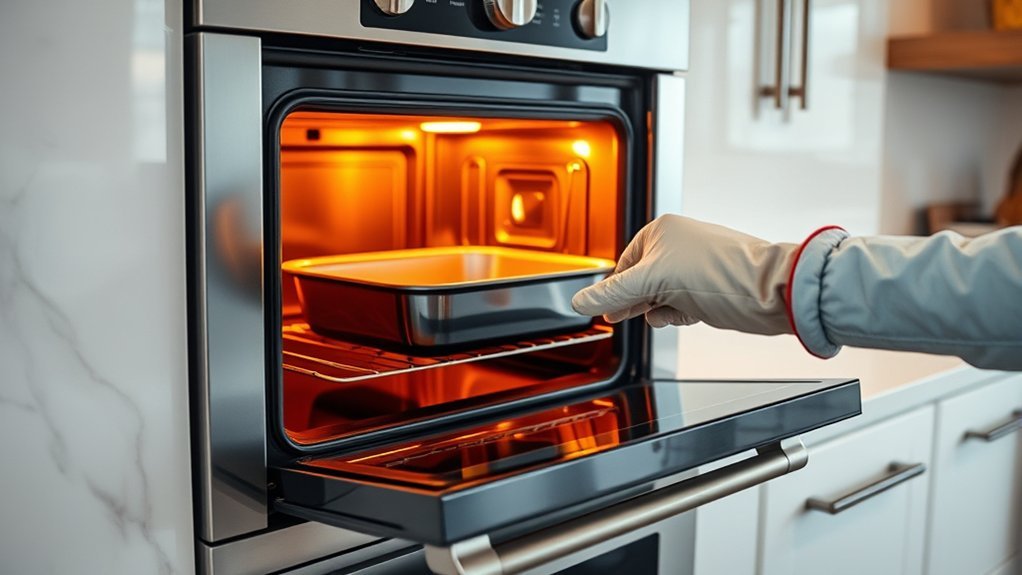
Whether the oven door should stay open or closed while broiling depends on the specific oven. Many newer gas and electric ovens are designed for closed-door broiling, and some automatically switch the broiler off when the door opens. Older ovens may have a dedicated broil-stop position that holds the door slightly ajar. The safest rule is simple: check the owner’s manual before broiling and use only the door position the manufacturer specifies.
Quick Answer
Do not automatically leave the oven door open when broiling. Most newer ovens are designed for closed-door broiling, while some older models have a specific partially open broil position. Follow the owner’s manual for your exact oven. If it requires the door closed, opening it can interrupt the broiler or expose nearby controls to excess heat.
Key Takeaways
- The owner’s manual decides the correct door position. Gas versus electric alone is not enough to determine it.
- Many modern ovens require the door fully closed and may switch the broiler off when it is opened.
- Use a partially open door only when the manufacturer specifically provides or recommends a broil-stop position.
- Reduce smoke with proper rack placement, a clean broiler pan, good kitchen ventilation, less excess fat, and a lower broil setting when appropriate.
- For meat, poultry, and fish, check doneness with a food thermometer rather than relying only on surface browning.
Should You Leave the Oven Door Open When Broiling?
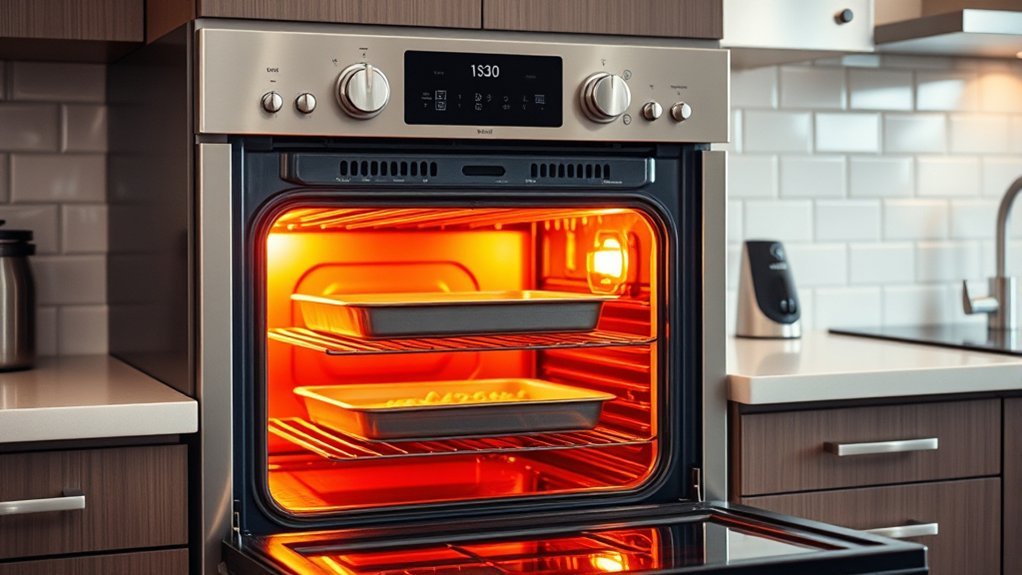
You should leave the oven door open during broiling only if your oven’s instructions specifically call for it. Door position is part of the appliance’s design, not a universal cooking preference.
Some older electric ranges have a mechanical broil-stop position that holds the door several inches open. On those ovens, the opening can release heat and keep the broil element operating as intended. However, GE Appliances explains that most newer ovens use closed-door broiling, even though open-door broiling was common on older ranges.
Modern ovens may use door switches, electronic temperature controls, stronger broil elements, cooling systems, or control panels that assume the door will remain closed. Whirlpool notes that on some models the broil element turns off when the oven door opens.
Warning: Never prop an oven door open simply because another oven was used that way. If the owner’s manual requires closed-door broiling, keep it closed. Broilers produce intense heat, and incorrect door position can interfere with the appliance’s controls, expose surrounding surfaces to heat, and increase burn or grease-fire risk.
Why Some Ovens Use an Open Broil Position
On an oven specifically designed for open-door broiling, the partially open position can allow heat to escape so the heating element remains on longer instead of cycling as quickly. It can also vent moisture from the oven cavity while food receives intense radiant heat from above.
This is why some older electric ranges include a built-in door detent called a broil stop. The door rests at a fixed partially open angle rather than being held at an arbitrary opening.
For quick-cooking foods such as thin steaks, chops, fish, vegetables, garlic bread, or cheese toppings, a manufacturer-approved open-door setting can provide rapid surface browning. The important qualification is that this behavior applies only to appliances engineered to broil that way.
The correct broiling position is determined by the oven’s design—not by a universal rule that the door should always be open or always be closed.
When You Should Keep the Door Closed
Keep the oven door closed whenever the manufacturer requires closed-door broiling. This is common on newer wall ovens, ranges, and electronically controlled models.
A closed door allows the oven’s temperature sensors, broil element or burner, cooling system, and control electronics to operate under the conditions for which they were designed. Some appliances will immediately or shortly afterward stop broiling if the door is opened.
Closed-door broiling does not mean the food is merely being baked. Modern ovens designed for this method still direct intense radiant heat toward the food. The broiler may cycle on and off as part of normal temperature control.
Closed-door operation can also protect knobs and electronic controls mounted above the oven opening from prolonged exposure to escaping heat. GE specifically recommends closed-door operation on many newer ranges and wall ovens, including its gas models.
Note: If the broiler turns off every time you open the door, that may be normal operation rather than a fault. Close the door and check the owner’s manual before troubleshooting the appliance.
How Gas and Electric Ovens Differ
Gas and electric ovens create broiling heat differently, but fuel type does not reliably tell you whether the door should be open or closed. Oven age, burner or element design, door switches, controls, ventilation, and manufacturer instructions are more important.
Gas Oven Broiling
A gas broiler uses a burner or flame to provide intense heat. Depending on the range, the broiler may be at the top of the main oven cavity or in a separate lower broiler drawer.
It is incorrect to assume that gas ovens should normally broil with the door ajar. Many modern gas appliances require the door to remain closed. GE, for example, instructs users to use closed-door broiling on its current gas ranges and states that gas wall ovens should be broiled with the door closed.
If a gas oven has a separate broiler compartment or an unusual door arrangement, follow that model’s instructions rather than applying rules intended for a conventional oven cavity.
Electric Oven Behavior
Electric broilers normally use an upper heating element to direct intense radiant heat at the food. Many newer electric ovens are designed for closed-door operation.
Opening the door on these ovens can trigger a door switch that temporarily shuts off the broil element. It can also release heat around the front control area and prevent the oven from operating according to its programmed broiling cycle.
Older electric ranges are an important exception. Some were deliberately designed with an open broil-stop position. If the door naturally rests at such a position and the owner’s manual calls for open-door broiling, use that setting as directed.
Manual Guidance Matters
The owner’s manual is the most reliable authority because broiling behavior can differ even between two ovens from the same manufacturer.
Before broiling, look for instructions under terms such as Broil, Broiling, Broil Stop Position, or Oven Door Position During Broil. Also check the recommended rack level, whether preheating is required, and whether the appliance offers High and Low Broil settings.
If the original manual is unavailable, search the manufacturer’s support site using the full model number from the appliance’s rating label.
How to Choose the Correct Broiling Door Position
- Find the oven model number. Check the frame around the oven opening, door jamb, storage drawer area, or another location specified by the manufacturer.
- Read the broiling section of the owner’s manual. Look specifically for instructions about the door.
- Use a broil-stop position only when the manual specifies one. Do not improvise by wedging the door open.
- If the manual says closed-door broiling, close it fully. A broiler that switches off with the door open may be functioning normally.
- Follow the specified rack and broil setting. Door position is only one part of proper broiler operation.
Pro Tip: Check the rack position before turning on the broiler. Moving a rack after the oven is extremely hot increases burn risk and makes it harder to position the food accurately.
What Foods Broil Best With Direct Broiler Heat?
Foods that broil well are generally those that benefit from fast surface browning and intense radiant heat. Whether the oven door is open or closed does not change which foods are suitable; the required door position still comes from the oven manufacturer.
Good broiling candidates include steaks, thin chops, hamburgers, fish fillets, chicken pieces, asparagus, zucchini, peppers, tomatoes, fruit, garlic bread, and cheese-topped dishes.
Best Broiling Foods
Thin or moderately thick foods are particularly well suited to broiling because their surfaces can brown before the exterior burns. Steaks, fish, chops, cutlets, and burgers can develop a browned exterior quickly under direct heat.
Vegetables such as asparagus, bell peppers, zucchini, and tomatoes also respond well. Broiling can char edges and evaporate surface moisture without requiring a long cooking time.
Garlic bread, gratins, casseroles, and other already-cooked dishes can be placed briefly under the broiler to toast bread or brown cheese on top.
Very thick foods require more care. Moving them farther from the broiler or using a lower broil setting can give the center more time to cook before the exterior becomes too dark.
Crisping and Browning
Broiling works well for browning because food is exposed to concentrated radiant heat. Foods placed closer to the broiler generally brown faster, while greater distance gives thicker food more time to heat through.
- Meats: fast searing and surface browning
- Vegetables: caramelized or lightly charred edges
- Fish: quick browning with a short cooking time
- Fruit: browned surfaces and concentrated sweetness
- Bread and cheese toppings: rapid toasting, melting, and crisping
Whirlpool recommends adjusting rack distance according to food thickness, with thinner foods generally closer to the broiler and thicker foods farther away.
Broiling Tips for Less Smoke
Some smoke is normal when fatty foods are exposed to intense broiler heat, but heavy smoke usually calls for changes to the pan, rack position, food preparation, ventilation, or oven cleanliness—not simply opening the door.
| Method | Effect | Best Use |
|---|---|---|
| Use a clean broiler pan and grid | Lets grease drain away from intense heat | Meat and fatty foods |
| Move food to a lower rack | Reduces scorching and excessive smoke | Food browning too quickly |
| Trim excess fat | Reduces dripping and spattering | Steaks, chops, and other fatty cuts |
| Use Low Broil when appropriate | Slows surface browning | Thicker or delicate foods |
| Run the range hood | Removes cooking smoke from the kitchen | All broiling |
| Clean old grease and food residue | Prevents old deposits from burning | Ovens that smoke excessively |
LG’s broiling guidance recommends a clean broiler pan, kitchen ventilation, a clean oven, avoiding excessive fatty marinades or sugary glazes, lowering the rack, or switching to a lower broil setting when smoke is excessive.
Warning: Broiling fatty foods can produce smoke and, if grease overheats, a fire. Stay nearby, keep the oven and broiler pan clean, use the recommended pan and rack position, and follow the appliance manual. If a fire occurs, follow the manufacturer’s emergency instructions and do not pour water on a grease fire.
Broiler Pan, Rack Position, and Preheating
A proper broiler pan has a slotted grid above a lower pan. Fat and juices drip through the grid instead of pooling directly beside the food, which can reduce spattering and smoke.
Do not block the grid’s drainage openings with an unperforated sheet of foil. If the manufacturer allows foil in the bottom pan, keep the drainage system open and follow the owner’s manual.
Rack distance controls how aggressively food browns. Food close to the broiler receives more intense heat and can char quickly. A lower rack is often more suitable for thicker foods because the center has more time to cook.
Preheating instructions also vary. Some manufacturers specify a short broiler preheat, while other models or recipes may not require one. For example, a current Whirlpool control guide specifies a short preheat for its broil mode and also requires the door to remain closed. Follow the instructions for your own model instead of assuming every broiler needs the same preheat time.
Safe Broiling Temperatures for Meat, Poultry, and Fish
Broiled food can look deeply browned before its center reaches a safe temperature. Use a food thermometer in the thickest part of meat or fish, avoiding bone when possible.
According to FoodSafety.gov’s safe minimum internal temperature guidance:
- Beef, pork, veal, lamb, and similar whole cuts: 145°F (63°C), followed by a 3-minute rest.
- Ground meat and sausage: 160°F (71°C).
- Chicken, turkey, and other poultry: 165°F (74°C).
- Fish: 145°F (63°C), or until the flesh is opaque and separates easily with a fork according to the federal guidance.
- Casseroles: 165°F (74°C).
Cooking time alone is not a reliable safety test because thickness, starting temperature, rack position, broiler strength, cookware, and oven design all affect how quickly food heats.
Frequently Asked Questions
Can You Leave the Oven Door Closed When Broiling?
Yes. In fact, many newer ovens require the door to remain fully closed while broiling. Some models switch the broiler off when the door opens. Older ovens may instead specify a partially open broil-stop position, so follow the instructions for the exact appliance.
What Are Common Mistakes When Using a Broiler?
Common mistakes include using the wrong door position, putting food too close to the broiler, walking away while food cooks, using a dirty grease-covered pan, blocking grease drainage, failing to adjust for food thickness, and judging meat safety only by color. Follow the manual, monitor food closely, and use a food thermometer when appropriate.
How Do I Know if My Broiler Is on Top or Bottom?
Most electric ovens broil from an upper heating element inside the main oven cavity. Some gas ranges also have an upper broil burner, while others use a separate broiler drawer beneath the main oven. Check the oven layout and owner’s manual before choosing a rack or pan position.
How Long Can the Broiler Be On?
There is no universal 10- or 15-minute maximum for broiling. Cheese or toast may need only a minute or two, while thicker foods can take much longer. Automatic shutoff behavior also varies by oven. Follow the recipe and owner’s manual, stay nearby, and do not rely on an automatic shutoff as a safety timer.
Should You Preheat the Broiler?
It depends on the oven. Many current models recommend a short preheat before food is placed under the broiler, while some appliances or recipes do not require one. Check the owner’s manual instead of using a single preheat time for every oven.
Does Opening the Oven Door Reduce Broiling Smoke?
Do not open the door solely to control smoke unless the oven is designed for open-door broiling. Better smoke-control methods include using a clean broiler pan and grid, lowering the rack, trimming excess fat, choosing Low Broil when appropriate, cleaning grease from the oven, and running the kitchen ventilation system.
Conclusion
The safest answer to whether the oven door should stay open while broiling is to follow the instructions for the exact oven. Many newer gas and electric models require closed-door broiling, while some older ovens were intentionally designed with a partially open broil-stop position. Do not assume one method applies to every appliance.
For better broiling results, use the recommended rack and pan, watch food closely, keep grease under control, and check meat, poultry, and fish with a food thermometer. Broilers cook and brown quickly, so correct setup and close supervision matter as much as the door position.
Sources
- GE Appliances — Oven Door Position During Broil — explains the shift from older open-door broiling to closed-door operation on many newer ranges.
- Whirlpool — Broil Not Working — documents models where opening the oven door turns the broil element off.
- Whirlpool — Helpful Tips for Broiling — supports broiler-pan, grease-drainage, rack, and smoke-reduction guidance.
- LG Owner’s Manual — Broiling and Smoke Guidance — supports closed-door operation and practical smoke-control techniques for the documented range.
- FoodSafety.gov — Safe Minimum Internal Temperatures — supports thermometer-based safe temperatures for meat, poultry, fish, and casseroles.
1 thought on “Do You Leave the Oven Door Open When Broiling? What You Need to Know”