
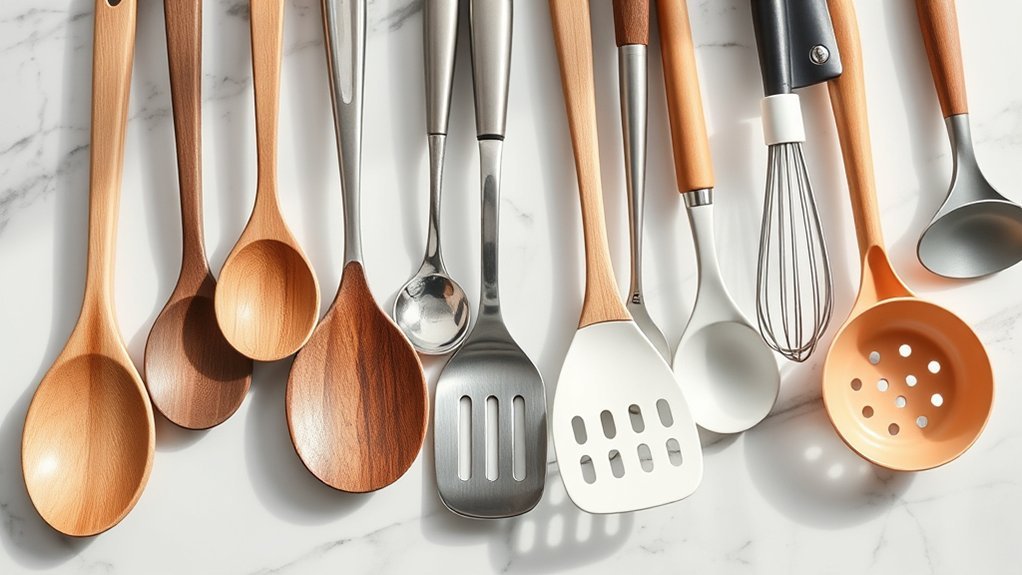
Cooking utensils are commonly made from food-grade silicone, stainless steel, wood, bamboo, nylon, plastic, ceramic, porcelain, and glass. Each material has different strengths. Silicone and wood are gentle on coated cookware, stainless steel is rigid and durable, and nylon is lightweight and inexpensive. The best choice depends on the cooking temperature, cookware surface, cleaning routine, and the manufacturer’s intended use.
Quick Answer
Most cooking utensils are made from silicone, stainless steel, wood, bamboo, nylon, or other food-contact plastics. No single material is best for every job. Silicone and wood suit delicate or nonstick cookware, while stainless steel works well for rigid, high-heat tasks. Always follow the utensil’s stated temperature and care limits.
Key Takeaways
- Silicone, wood, and many nylon utensils are useful on nonstick and enameled cookware because they are less likely than metal to scratch the surface.
- Stainless steel is durable and rigid, making it useful for grilling, lifting heavy foods, whisking, and cooking on uncoated stainless steel or cast iron.
- Heat limits vary by product. Do not assume every silicone or nylon utensil has the same maximum temperature rating.
- Replace utensils that are melted, cracked, badly worn, sticky, splintering, or difficult to clean.
- Food-contact suitability, condition, intended use, and maintenance matter more than choosing one supposedly “perfect” material.
Common Cooking Utensil Materials
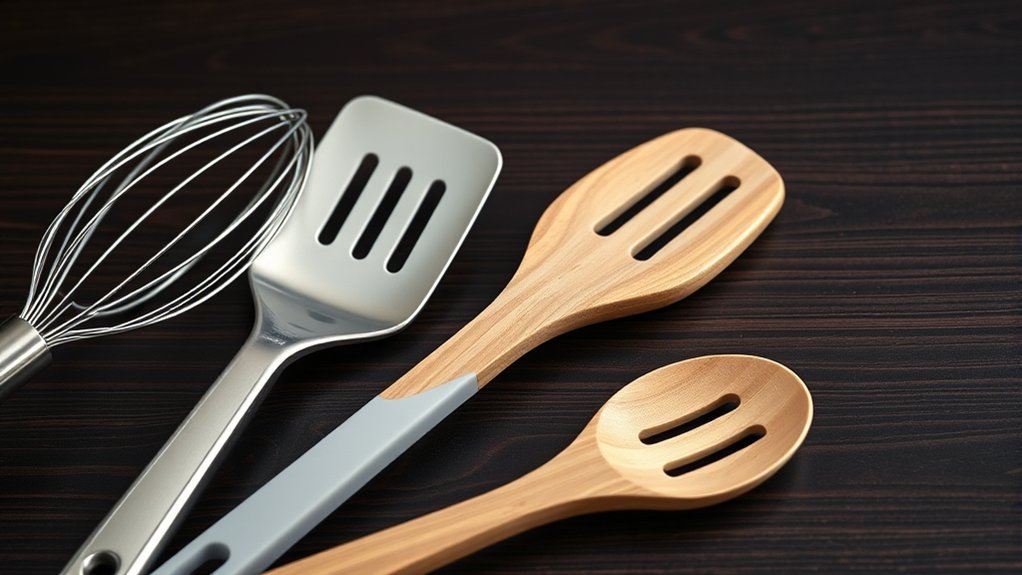
Common cooking utensils are manufactured from several material categories. The right material depends on whether the tool needs flexibility, rigidity, heat resistance, a non-abrasive edge, or easy cleaning.
Silicone
Food-grade silicone is flexible, non-abrasive, and useful for spatulas, spoonulas, scrapers, pastry tools, and coated cookware. It also tolerates cooking heat well when used within the manufacturer’s stated temperature range.
There is no single temperature limit that applies to every silicone utensil. Formulation, construction, internal cores, handles, and manufacturer specifications can differ. Health Canada, for example, advises keeping silicone bakeware at or below 220°C (428°F) and following the manufacturer’s intended-use instructions.
Food-grade silicone is flexible and cookware-friendly, but its maximum safe temperature should come from the product’s own instructions rather than a universal temperature claim.
Stainless Steel
Stainless steel is strong, corrosion resistant, easy to clean, and useful when a utensil needs rigidity. Stainless tongs, whisks, ladles, turners, and serving spoons can provide excellent control during demanding cooking tasks.
Grades described as 18/8 or 18/10 contain chromium and nickel. Chromium helps stainless steel resist corrosion. Stainless steel is generally durable for food-contact use, although research has shown that small amounts of nickel and chromium can move into acidic foods under some cooking conditions, particularly with new cookware and prolonged contact. People with a significant nickel allergy may prefer nickel-free alternatives for items that contact food frequently.
Wood and Bamboo
Wooden utensils, including tools made from acacia, beech, walnut, olive wood, or similar hardwoods, are popular because they are rigid enough for stirring while remaining gentle on cookware surfaces. They also do not conduct heat as quickly as metal.
Wood should not be treated as automatically germ-free. Clean wooden tools after use, dry them thoroughly, and replace them if they split, develop deep grooves, retain persistent odors, or become difficult to clean. USDA food-safety guidance likewise emphasizes cleaning and replacing badly worn food-contact surfaces.
Bamboo is another plant-based option. It is generally harder and less absorbent than many traditional woods, although bamboo utensils can still crack or split if repeatedly soaked or exposed to harsh dishwasher cycles.
Nylon and Other Plastics
Nylon is itself a type of plastic, but it is often discussed separately because it is widely used for spatulas, ladles, turners, and slotted spoons. Nylon tools are light, inexpensive, and usually gentle on coated cookware.
The main limitation is temperature. Nylon and other plastics can soften, warp, or melt if exposed to temperatures beyond their rated use. Exact limits vary, so check the manufacturer’s instructions rather than relying on one temperature for every product.
The U.S. Food and Drug Administration regulates materials intended to contact food according to their composition and expected conditions of use. That means a properly manufactured food-contact plastic used as intended should not automatically be labeled unsafe simply because it is plastic.
Ceramic, Porcelain, and Glass
Ceramic, porcelain, and glass are more common in bakeware, mixing tools, serving pieces, crocks, and containers than in everyday handheld spatulas and turners. Properly manufactured food-contact products can provide stable, non-absorbing surfaces that do not readily retain flavors.
However, ceramic should not be described as universally non-toxic without qualification. Some improperly manufactured, decorative, antique, or non-food-use glazes may contain lead or cadmium. Use ceramic and porcelain products that are specifically intended for food contact and comply with applicable safety requirements.
Which Cooking Utensil Materials Are Safest?
There is no single safest cooking utensil material for every kitchen task. A safer utensil is one that is made for food contact, used within its temperature limits, kept in good condition, and matched to the cookware surface.
Food-grade silicone is practical for nonstick and enameled pans because it is flexible and non-abrasive. The key is to respect the manufacturer’s maximum temperature and keep the utensil away from direct flames or heating elements.
Stainless steel is an excellent choice when strength and rigidity matter. It is especially useful with stainless steel, cast iron, grills, and other durable uncoated surfaces. Metal utensils should generally be avoided on cookware whose manufacturer warns against scratching the coating.
Wood and bamboo work well for stirring and mixing and are gentle on most cookware. They require more drying and maintenance than stainless steel or many silicone tools.
Nylon and other food-contact plastics can also be appropriate when used for their intended purpose and kept below their rated temperature. Discard any plastic utensil that has melted, warped, cracked, become sticky, or developed damage that makes it difficult to clean.
Warning: Do not leave silicone, nylon, plastic, or wooden utensils resting against a burner, heating element, open flame, or excessively hot pan edge. A material that is suitable for normal cooking can still scorch, soften, melt, or ignite when exposed to conditions beyond its intended use.
For ceramic and porcelain, use products clearly intended for food preparation or serving. Food-contact glazes are important because poorly controlled decorative glazes can present lead or cadmium concerns.
How Silicone, Steel, Wood, and Plastic Compare
Silicone, stainless steel, wood, nylon, and other plastics serve different kitchen needs. Comparing them by cookware compatibility, rigidity, maintenance, and temperature limits is more useful than trying to identify one material as universally superior.
| Material | Best Uses | Main Advantages | Main Limitations |
|---|---|---|---|
| Silicone | Nonstick cookware, scraping, folding, stirring | Flexible, non-abrasive, heat tolerant when properly rated | Less rigid; temperature ratings vary |
| Stainless steel | Grilling, tongs, whisks, lifting, uncoated cookware | Durable, rigid, corrosion resistant | Can scratch delicate coatings; many grades contain nickel |
| Wood | Stirring, mixing, sauces, coated cookware | Gentle on cookware, comfortable, does not heat quickly | Needs thorough drying and can split with poor care |
| Nylon | Light-duty turning, serving, nonstick pans | Affordable, lightweight, non-abrasive | Lower heat tolerance than many metal tools; can melt if overheated |
| Other food-contact plastics | Varies by polymer and product | Lightweight, inexpensive, many shapes available | Performance and temperature limits vary widely |
For long-term use, silicone, stainless steel, and well-maintained wood can all provide excellent service. Plastic and nylon remain practical options when the product is designed for cooking and is used within its stated limits.
Pro Tip: A mixed utensil set is usually more useful than an all-one-material set. Keep silicone or wood for coated pans, stainless-steel tongs or a turner for uncoated high-heat cookware, and a sturdy whisk for mixing and sauces.
Best Utensils for Nonstick, BBQ, and Bakeware
For nonstick cookware, silicone, wood, bamboo, and suitable nylon utensils are usually preferred because their working edges are less abrasive than metal. This helps reduce scratches and premature coating damage.
In practice, silicone cooking tools work well for scraping, folding, flipping, and stirring. Wooden spoons provide more rigidity for sauces and thicker foods, while nylon utensils can be practical for lighter cooking when kept within their rated temperature.
Nylon, silicone, and wood can all work well with nonstick cookware when the utensil is undamaged and used within its temperature limits.
For BBQ and grilling, stainless steel utensils are usually the most practical choice because long metal tongs, forks, and turners provide rigidity and reach around high heat. Handles should remain far enough from the heat source to be comfortable and safe to hold.
For bakeware, ceramic, porcelain, glass, metal, and silicone products can all be useful depending on the recipe. Bakeware is different from handheld utensils, so follow the manufacturer’s oven-temperature instructions and use only products specifically intended for baking.
These distinctions make utensil selection easier: use softer tools for vulnerable coatings, rigid metal tools for durable high-heat surfaces, and properly rated bakeware for oven use.
How to Choose Durable, Nontoxic Utensils
Choosing durable cooking utensils is less about finding a product marketed as “non-toxic” and more about checking the material, intended use, construction quality, temperature rating, and condition over time.
- Check the stated material. Look for clear identification such as silicone, stainless steel, nylon, hardwood, or bamboo instead of vague descriptions.
- Verify temperature limits. Silicone and nylon ratings vary by manufacturer. Do not assume that similar-looking utensils have identical heat resistance.
- Match the tool to the cookware. Use silicone, wood, bamboo, or suitable nylon on surfaces that can be scratched. Reserve metal tools for cookware that permits them.
- Inspect seams and joints. Loose heads, cracked handles, opening seams, and trapped food can make a tool difficult to clean.
- Consider one-piece construction. Seamless silicone or solid metal designs can reduce places where food and moisture collect.
- Check wood for cracks and splinters. Smooth wood is easier to maintain than a tool with deep grooves or splitting fibers.
- Consider nickel sensitivity. Many common stainless steels contain nickel, so people with significant nickel allergies may prefer an alternative material.
- Use ceramics intended for food. Avoid decorative pottery or damaged glazes unless the item is clearly manufactured for food contact.
- Replace damaged tools. Do not continue cooking with utensils that have melted edges, deep cracks, severe warping, sticky surfaces, loose components, or damage that cannot be cleaned properly.
The FDA’s food-contact framework considers both the type of food and the expected conditions of use, including temperature. That is why intended use and manufacturer instructions matter as much as the material’s name.
How to Care for Cooking Utensils
Good care improves both hygiene and service life. Different materials need different treatment.
- Silicone: Wash after use according to the manufacturer’s directions. Inspect for cuts, torn edges, exposed internal cores, or permanently sticky surfaces.
- Stainless steel: Wash thoroughly and dry if spotting is a concern. Replace tools with loose welds, sharp damaged edges, or badly damaged handles.
- Wood and bamboo: Wash promptly, avoid prolonged soaking, and dry completely. Follow the maker’s instructions for occasional food-safe conditioning if recommended.
- Nylon and plastic: Keep away from temperatures above the stated rating. Replace tools that become melted, rough, cracked, warped, or difficult to clean.
- Ceramic and porcelain: Stop using food-contact pieces with badly damaged surfaces if the damage exposes questionable underlying material or makes cleaning difficult.
Note: “Dishwasher safe” does not automatically mean every dishwasher cycle is ideal for every material. Wood and bamboo in particular may last longer when washed promptly and dried thoroughly rather than repeatedly soaked or exposed to aggressive high-heat cycles.
What About Black Plastic Cooking Utensils?
Black plastic utensils received significant attention after researchers detected brominated and other flame retardants in some tested household products, raising concerns that plastics recycled from electronics could enter products that were never intended to contain those chemicals.
The research is important, but it should not be interpreted as proof that every black plastic utensil is hazardous. A widely reported 2024 Chemosphere study later received corrections to its exposure calculations. A 2025 corrigendum reduced the estimated BDE-209 exposure in the modeled contaminated-utensil scenario from 34,700 nanograms per day to about 7,900 nanograms per day and emphasized uncertainties in estimating real-world exposure.
The core contamination finding remained: some tested black plastic products contained flame retardants that were not needed for their intended function. Consumers who prefer to minimize uncertainty can choose stainless steel, wood, or appropriately rated silicone utensils, but the available evidence does not justify describing every black plastic utensil as toxic.
Plastic Utensils and Microplastics
Plastic materials can wear and degrade over time, which is one reason damaged food-contact tools should be replaced. People who want to reduce the number of plastic surfaces touching hot food can choose stainless steel, wood, bamboo, glass, ceramic, or silicone where those materials suit the task.
However, reducing plastic contact should not be presented as a proven medical treatment or guaranteed health benefit. The FDA’s current microplastics guidance says microplastics and nanoplastics have been detected in the food supply, but current scientific evidence does not demonstrate that the levels found in foods pose a risk to human health. The agency also notes major research gaps and a lack of standardized analytical methods.
A practical approach is therefore to avoid overheating plastic tools, replace visibly damaged utensils, use products according to their intended conditions, and choose alternative materials when reducing plastic food contact is a personal priority.
Frequently Asked Questions
What Is the Healthiest Material for Cooking Utensils?
There is no single healthiest material for every cooking task. Food-contact silicone, stainless steel, wood, bamboo, and appropriately rated nylon can all be practical choices when they are made for food use, kept in good condition, and used within their intended temperature limits. Silicone and wood are especially useful on coated cookware, while stainless steel provides greater rigidity for uncoated pans and grills.
How Can You Tell if a Utensil Is Plastic or Silicone?
Silicone utensils are usually softer, more flexible, and more rubber-like than rigid nylon or polypropylene tools, but appearance and feel are not reliable enough to identify every material. Check the packaging, molded markings, manufacturer’s specifications, or product documentation. Do not use an open-flame or improvised heat test to identify an unknown utensil.
Are Plastic Cooking Utensils Unhealthy?
Plastic cooking utensils should not automatically be described as unhealthy. Food-contact plastics are designed for specific conditions of use, and those conditions matter. The bigger practical concerns are overheating a tool beyond its rating, using products not intended for cooking, or continuing to use utensils that have melted, warped, cracked, or otherwise deteriorated.
What Utensils Can You Use to Reduce Plastic Contact?
To reduce plastic contact during cooking, use stainless-steel tongs, whisks, and turners on compatible cookware; wooden or bamboo spoons for stirring; and silicone tools where a flexible, non-abrasive edge is needed. Glass and food-contact ceramic are useful for some mixing, baking, and serving tasks. Reducing plastic contact is a personal exposure-reduction choice, not proof of a specific health benefit.
Is Silicone Better Than Nylon for Nonstick Pans?
Both can work well on nonstick cookware because they are generally less abrasive than metal. Silicone is more flexible and many products are rated for higher temperatures, while nylon is usually firmer and less expensive. Check the temperature rating of the specific utensil because neither material has one universal heat limit.
Can You Use Stainless-Steel Utensils on Nonstick Cookware?
Usually it is better to use silicone, wood, bamboo, or suitable nylon unless the cookware manufacturer specifically allows metal utensils. A hard or sharp stainless-steel edge can scratch some nonstick or coated surfaces and shorten their useful life.
Conclusion
Cooking utensils are commonly made from silicone, stainless steel, wood, bamboo, nylon, and other food-contact materials, and each has distinct advantages. Stainless steel provides strength, wood and bamboo offer rigid but cookware-friendly surfaces, silicone combines flexibility with good heat tolerance, and nylon provides lightweight convenience at a lower cost.
Rather than choosing one material as universally safest, match the utensil to its intended task. Check temperature ratings, protect delicate cookware from scratches, clean and dry tools correctly, consider nickel sensitivity where relevant, and replace damaged utensils. Proper material selection and maintenance can improve cooking performance while helping utensils last longer.
Sources
- Health Canada — The Safe Use of Cookware and Bakeware — silicone temperature guidance, stainless steel, plastics, ceramic glazes, and cookware safety.
- U.S. Food and Drug Administration — Food Types and Conditions of Use for Food Contact Substances — how food-contact materials are evaluated for temperature and intended use.
- U.S. Food and Drug Administration — Microplastics and Nanoplastics in Foods — current evidence, regulatory context, and research limitations concerning microplastics.
- USDA Food Safety and Inspection Service — Cutting Boards — cleaning, wood and bamboo food-contact surfaces, and replacement of worn surfaces.
- PubMed — Stainless Steel Leaches Nickel and Chromium Into Foods During Cooking — evidence on metal release under acidic and extended cooking conditions.
- Chemosphere — 2025 Corrigendum to the Black-Plastic Flame-Retardant Study — corrected BDE-209 exposure estimate and interpretation limitations.

1 thought on “What Are Cooking Utensils Made of? Materials & Construction Explained”