
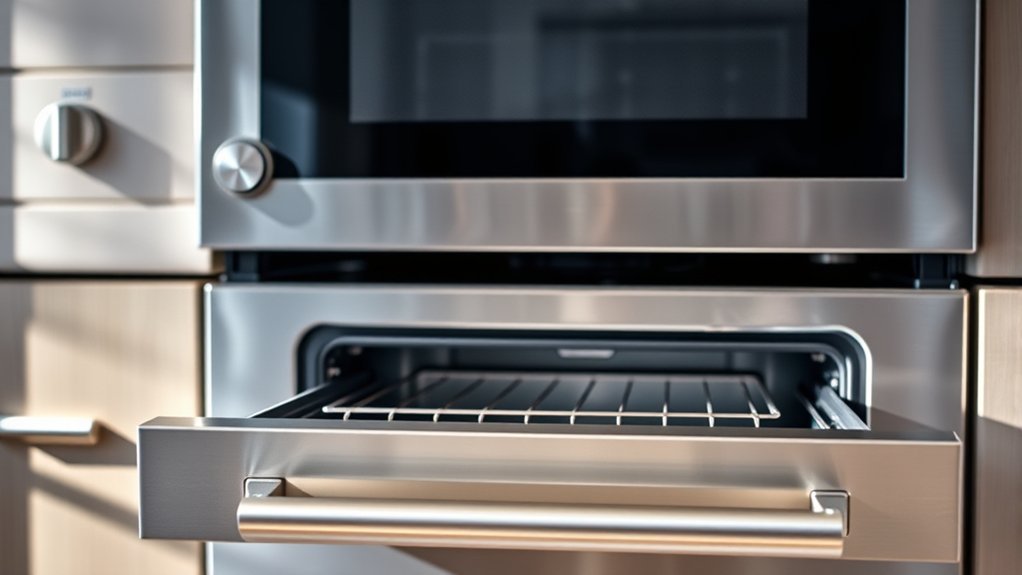
Not every oven has a broiler, although most full-size ranges and wall ovens include some form of high, direct-heat broiling. In many ovens, the broiler is at the top of the main cavity; some ranges use a separate lower broiler compartment. The fastest way to confirm what your oven has is to check the controls, inspect the cavity, and verify the exact model in its owner’s manual.
Quick Answer
No. Most full-size ovens have a broil function, but it is not universal. In many electric and modern gas ovens, the broiler is at the top of the main cavity; some ranges use a separate lower broiler compartment. Check the controls and model manual before assuming the bottom drawer is a broiler.
Key Takeaways
- Most ovens have a broiler, but some models do not have a dedicated Broil function.
- A Broil button or setting is a strong clue; the owner’s manual for the exact model is the best confirmation.
- A lower drawer may be a broiler, warming drawer, or storage drawer, so never assume its purpose.
- Use broiler-safe cookware, watch food closely, and follow the appliance manual for rack position and whether the oven door stays open or closed.
- For meat and poultry, use a food thermometer instead of judging safety by browning alone.
At a Glance
| Time Required | About 2–5 minutes to identify the broiler; cooking time varies by food |
| Difficulty | Easy |
| Tools Needed | Owner’s manual or model number; optional flashlight; broiler-safe metal pan and food thermometer when cooking |
| Cost | $0 to identify the feature; cookware or a thermometer costs extra only if needed |
How to Tell If Your Oven Has a Broiler?
The most reliable way to determine whether your oven has a broiler is to combine a few clues instead of relying on one feature alone.
- Check the control panel. Look for a button, dial position, or menu option labeled Broil, Broil Hi/Lo, Grill, or a similar top-heat function.
- Look inside the oven while it is off and cool. Many ovens have a broil element at the ceiling of the cavity. It may look like a metal tube or serpentine element, although some designs conceal parts of the heating system.
- Inspect the lower compartment. Some ranges use a separate lower broiler compartment. A rack or broiler-style pan may be a clue, but it is not proof by itself.
- Find the model number. It is commonly printed on a label around the door frame, drawer area, or rear portion of the appliance. Search the manufacturer’s support site for the exact manual.
- Use the manual as final confirmation. It should identify the Broil function, heating location, rack positions, controls, and correct door position.
Whirlpool explains that most ovens have a broiler either in the main cavity or in a separate compartment underneath. However, designs vary enough that the exact model documentation should control how the appliance is used.
A labeled Broil setting is strong evidence that the function is built in; the owner’s manual is the best way to confirm exactly where it is and how it operates.
Some compact, specialty, or simplified ovens may omit a dedicated Broil mode. Price alone is not a dependable way to predict whether the feature is present.
Where to Find Your Oven Broiler
A broiler delivers strong, direct heat toward the top surface of food. Where the heat source sits depends on the appliance design, not simply whether the oven uses gas or electricity.
| Oven setup | Common broiler location | What to check |
|---|---|---|
| Electric range or wall oven | Usually at the top of the main oven cavity | Broil setting, upper element, owner’s manual |
| Gas range | May be in the main cavity or a separate lower compartment | Controls, lower drawer design, manual |
| Compact or multifunction oven | Varies; some have Top Heat or Grill instead of a U.S.-style Broil label | Function list and manufacturer instructions |
In many electric ovens, the upper broil element supplies direct radiant heat from above. In a gas oven, the broiler may also operate in the main cavity, while some models—especially certain older or select range designs—use a lower broiling compartment.
Do not conclude that an oven lacks a broiler merely because an exposed top coil is not obvious. Controls and manuals are more reliable than appearance alone.
Note: Fuel type is only a clue. Modern gas and electric ovens use several broiler layouts, so model-specific instructions are more dependable than general rules.
Broiler Drawer, Warming Drawer, or Storage Drawer?
A drawer beneath the oven may be a broiler drawer, warming drawer, or storage drawer. Using it for the wrong purpose can damage cookware or create a fire risk.
- Broiler compartment: Designed for high direct heat and normally includes a rack, support structure, or specified broiler pan position. Food sits below the heat source rather than being surrounded by ordinary baking heat.
- Warming drawer: Designed to hold already-cooked food at serving temperature. Some models have temperature or warming controls and may include racks.
- Storage drawer: Has no cooking function and is intended for suitable cookware or bakeware. Because the area can still become warm when the oven operates, avoid storing plastic, paper, towels, or other heat-sensitive or combustible objects unless the manufacturer specifically allows them.
The presence of a broiler pan can help identify a broiling compartment, but a pan could have been added later. A labeled control or the model manual is better evidence.
Pro Tip: If the paper manual is missing, locate the appliance model number and download the manual from the manufacturer’s support site before using an unfamiliar lower drawer.
Broiling vs. Baking: What Is the Difference?
Broiling exposes one side of food to intense direct heat, usually from above. Baking relies more on heated air surrounding the food and generally cooks more gradually. This is why broiling works well for fast browning, melting cheese, charring vegetables, or cooking relatively thin foods.
Broiling can operate at very high heat—some ovens reach roughly 500°F to 550°F on high—but a specific temperature should not be assumed. Many ovens instead provide settings such as Hi Broil and Lo Broil. Follow the recipe and the controls provided by your oven.
How to Broil in a Regular Oven
Once the broiler location is confirmed, a regular oven can usually be set up for broiling in a few steps.
- Position the rack before heating. A common starting point is to place the top of the food about 3 to 5 inches from the broiler, but thicker foods may need more distance. Follow the recipe and manual.
- Choose broiler-safe cookware. A broiler pan, sturdy rimmed metal sheet pan, or broiler-safe cast-iron pan is usually suitable when its manufacturer permits broiler use.
- Select Broil. If the oven offers Hi and Lo, Hi is generally useful for fast surface browning, while a lower setting can give thicker food more time before the exterior becomes too dark.
- Preheat if instructed. Many full-size broilers are allowed to preheat for roughly five minutes, but the correct procedure varies by model.
- Follow the required door position. Do not automatically leave the oven door open. GE Appliances notes that many newer ovens require closed-door broiling, while some models allow or require a broil-stop position. The owner’s manual decides.
- Watch the food closely. Broilers brown quickly. Stay in the kitchen, check frequently, and turn food when the recipe requires it.
- Verify doneness. For meat and poultry, use a food thermometer rather than relying only on surface color.
A useful version of “measure twice, broil once” is to set the rack and choose the correct cookware before turning on the broiler. Moving hot oven racks after broiling begins creates unnecessary burn risk.
Best Foods for Broiling
Broiling works especially well for relatively thin foods and dishes that benefit from quick surface browning.
- Thin proteins: steaks, pork chops, fish fillets, chicken cutlets, and shrimp can brown quickly under direct heat.
- Vegetables: asparagus, bell peppers, zucchini, tomatoes, onions, and similar vegetables can develop browned or lightly charred edges.
- Fruit: peaches, pineapple, mango, and bananas can caramelize rapidly because of their natural sugars.
- Cheese-topped dishes: nachos, casseroles, gratins, garlic bread, and French onion soup can be finished under the broiler for fast melting and browning.
Foods containing significant sugar or fat can move from browned to burned quickly, so continuous attention matters more under the broiler than during ordinary baking.
Safe Internal Temperatures for Broiled Meat and Poultry
The USDA Food Safety and Inspection Service recommends checking meat and poultry with a food thermometer:
- Whole cuts of beef, pork, lamb, and veal: at least 145°F, followed by a three-minute rest.
- Ground beef, pork, lamb, and veal: at least 160°F.
- Poultry: at least 165°F.
A browned or charred exterior does not prove that the center has reached a safe temperature.
What If Your Oven Does Not Have a Broiler?
If the manual confirms that the oven has no dedicated broiler, you can still brown many foods with other methods, although the result may not be identical.
- Use a manufacturer-approved Top Heat or Grill setting if the oven provides one.
- Bake or roast at a relatively high temperature allowed by the recipe and cookware, then finish foods in a hot skillet when appropriate.
- Use convection or air-fry mode for extra surface browning if your oven includes those functions.
- Use a toaster oven or countertop oven that has a dedicated broil function, following that appliance’s instructions.
Do not imitate broiling by placing cookware against an oven element or using a pan above its rated temperature.
Broiler Safety Tips for Better Results
Broilers operate with intense direct heat, so safe setup and close attention are essential.
- Stay nearby. The U.S. Fire Administration advises staying in the kitchen when broiling because unattended cooking is a major fire risk.
- Use appropriate cookware. Metal broiler pans and other cookware specifically rated for broiler heat are safer choices than ordinary glass.
- Check glassware instructions. For example, Pyrex explicitly states that its glass bakeware must not be used under a broiler.
- Keep grease under control. A broiler pan and grid allow fat to drain away from food and can reduce pooling around meat.
- Use the correct rack distance. Roughly 3 to 5 inches from the heat source is common for many foods, but thicker cuts may need more distance.
- Keep combustible objects away. Towels, paper packaging, plastic utensils, and similar materials should not be near the oven opening or broiler compartment.
Warning: If a fire starts inside the oven, turn the oven off and keep the door closed. Do not open the door to inspect the flames. The U.S. Fire Administration advises leaving the home and calling the local emergency number—911 in the United States—if flames escape the oven or the fire cannot be safely contained.
What to Check If the Broiler Is Not Working
If the oven should have a broiler but it does not appear to heat, start with simple checks rather than disassembling the appliance.
- Confirm that Broil, rather than Bake or Warm, is selected.
- Check whether the model requires the oven door open, at a broil-stop position, or fully closed.
- Verify the rack is in an appropriate broiling position.
- Remember that some electric broil elements cycle on and off during normal operation.
- If the element never heats, a gas burner does not ignite, an error code appears, or the element looks damaged, stop using the broiler and follow the manufacturer’s troubleshooting or service instructions.
Do not bypass safety switches, igniters, door interlocks, or other appliance controls in an attempt to force the broiler to operate.
Frequently Asked Questions
How Do I Know if My Oven Has a Broiler?
Look for a Broil setting on the control panel, inspect the top of the oven cavity for a broil element, and check whether a lower compartment is identified for broiling. A broiler pan may be a clue, but the owner’s manual for the exact model is the most reliable confirmation.
How Do You Broil in a Regular Oven?
Set the oven rack before heating, use broiler-safe cookware, select Broil, and preheat if the recipe or manual recommends it. Many foods are placed about 3 to 5 inches below the heat source, but the correct distance depends on thickness and the appliance. Watch the food continuously and use a thermometer for meat and poultry.
Which Oven Has the Best Broiler?
There is no single oven with the universally “best” broiler. Brands such as Wolf, Viking, Bosch, and many mainstream manufacturers sell models with different broiler designs. Compare specific models for even browning, Hi/Lo control, useful rack positions, convection-broil options, easy-to-follow controls, and manufacturer performance information rather than choosing on brand or price alone.
Can I Put Something in the Oven if It Says “No Broiler”?
Possibly, but only if its instructions separately say it is oven-safe. “No Broiler” means the item should not be exposed to the broiler’s intense direct heat. It does not automatically mean the item cannot be baked or roasted. Follow the cookware, container, or food-package instructions for permitted oven temperatures and cooking methods.
Should the Oven Door Be Open or Closed When Broiling?
It depends on the oven. Many newer ovens require closed-door broiling, while some models use an open or partially open broil-stop position. Always follow the owner’s manual for the exact appliance rather than using a universal rule.
Do All Gas Ovens Have a Broiler Drawer?
No. Some gas ranges use a separate lower broiler compartment, but many gas ovens broil inside the main oven cavity. A lower drawer may instead be for warming or storage, so verify its purpose in the model manual.
Conclusion
Most ovens include some type of broiler, but the feature is not guaranteed and its location varies. A Broil control, an upper heating element, or a lower broiler compartment can help identify it, while the owner’s manual provides the final answer. Once confirmed, broiling is useful for fast browning, crisping, charring, and melting, provided you use heat-safe cookware, correct rack placement, and close supervision. Knowing the exact setup removes guesswork and makes the oven safer and more effective to use.
Sources
- Whirlpool — What Is a Broiler? — broiler location, rack distance, preheating, and general broiling use.
- GE Appliances — Oven Door Position During Broil — model-specific open- versus closed-door broiling guidance.
- USDA Food Safety and Inspection Service — How Temperatures Affect Food — safe minimum internal temperatures for meat and poultry.
- U.S. Fire Administration — Cooking Fire Safety — broiling supervision and oven-fire safety.
- Pyrex — Frequently Asked Questions — prohibition on using Pyrex glass bakeware under a broiler or other direct heat source.

2 thoughts on “Do All Ovens Have a Broiler? What You Need to Know”