
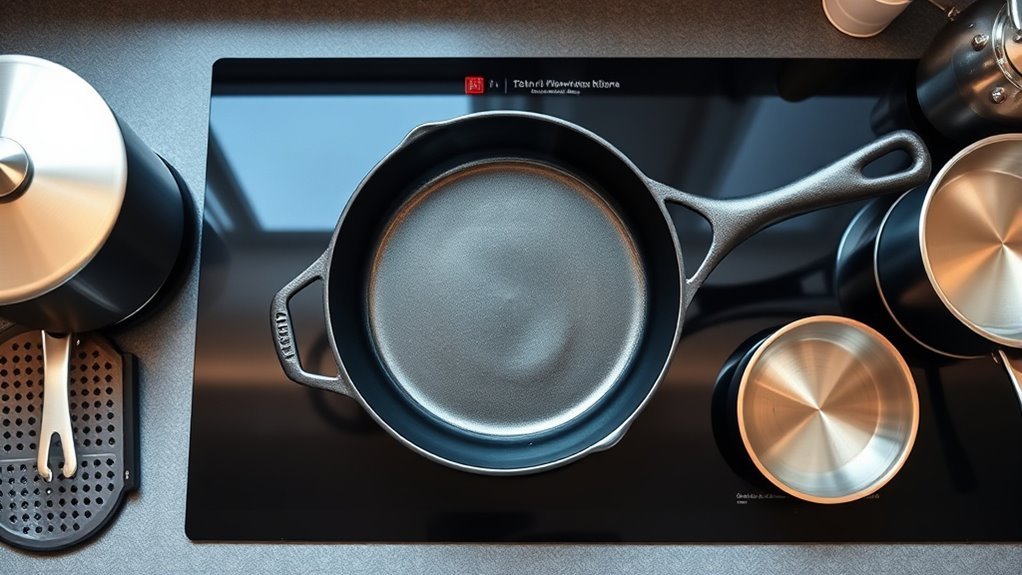
You can use cast iron on induction because its ferrous metal couples with the cooktop’s magnetic field, giving efficient, even heat. Both bare and enameled cast iron work, though each has different care and performance trade-offs. A quick magnet test tells you compatibility, but fit, flatness, and burner size matter for best results—keep going and you’ll learn how to choose, use, and maintain the right pan for your induction range.
What “Induction Compatible” Means for Cookware
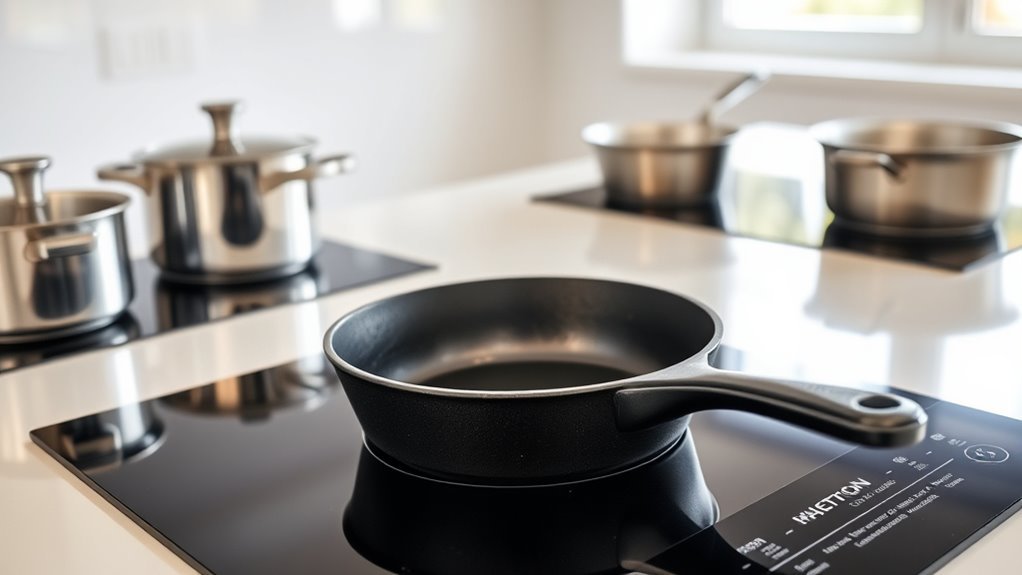
If you want cookware that actually works on an induction cooktop, it must be made from—or have a base layer of—ferrous material that a magnet will stick to.
You want induction compatible pans because they let the cooktop induce electric currents within the cookware’s base, producing heat quickly and delivering precise temperature control. That requires ferrous materials with the magnetic properties of iron; a simple magnet sticks to suitable bases and proves compatibility.
Non-magnetic metals like pure aluminum, glass, or ceramic won’t respond unless they’re bonded to a magnetic layer. You’ll choose pieces—often stainless with an iron core or cast iron cookware—that couple tightly to the cooktop’s field so energy transfer is efficient and responsive.
Pure aluminum, glass, or ceramic won’t heat on induction unless bonded to a magnetic layer like iron.
This isn’t picky tech; it’s liberation: you gain control over heat, reduce wasted energy, and trust your tools to behave predictably.
Test with a magnet, favor true ferrous construction, and you’ll reveal induction’s full performance.
Quick Answer: Does Cast Iron Work on Induction?
Yes — cast iron works very well on induction because its ferrous body couples directly with the cooktop’s magnetic field.
You should preheat it slowly and evenly to prevent thermal shock, cracking, or warping.
For best results use a flat-based, high-quality pan and confirm compatibility with a strong magnet.
Works Very Well
Because cast iron contains ferrous metal, it works very well on induction cooktops, heating quickly and offering the precise temperature control you need for searing and simmering.
You’ll find cast iron cookware reliably magnetic, so it couples directly with the induction field for efficient energy transfer.
When your pan has a smooth, flat bottom it makes full contact with the cooktop, improving heat distribution and producing even results across the surface.
This compatibility means you can depend on cast iron for high-heat tasks and low, steady simmering alike.
Choose high-quality brands that resist warping and maintain magnetic performance; they’ll serve your cooking freedom by delivering durability, predictable heat response, and the confidence to push techniques without compromise.
Preheat Slowly
When you’re using cast iron on induction, preheat slowly—start on low and raise the heat gradually—so the metal warms evenly and avoids thermal shock that can warp or crack the pan.
You’ll rely on the induction cooktops’ magnetic field to generate heat in the ferrous metal, but that rapid generation can still create hotspots if you crank power too fast.
Preheat slowly to achieve even heat distribution across the cooking surface; add oil and watch for a shimmer as your cue that the skillet is ready, and back off if the oil smokes.
Make sure the pan’s bottom is flat and smooth for full contact with the induction surface.
Controlled warming protects your cookware and frees you to cook confidently and creatively.
Test Your Pan: Magnet Test & Compatibility Symbols
Wondering if your cast iron will work on an induction cooktop? You can free yourself from doubt with a simple magnet test: press a magnet to the bottom of your cast iron pans—if it sticks firmly, the pan is induction compatible and ready for induction cooking.
Look for cookware for induction markings too; manufacturers often stamp a coil symbol or the word “induction” on packaging and bases.
Know the materials: ferrous metals like enameled cast iron, magnetic stainless steel, and carbon steel perform reliably on induction. Non-magnetic items—pure aluminum, glass, ceramic—won’t heat, so the magnet test is essential before you buy or use them.
Don’t rely solely on appearance; always consult manufacturers guidelines for specific symbols or fit recommendations.
Armed with this quick check, you’ll confidently choose the right pots and pans, claim practical control over your kitchen, and avoid incompatible cookware that stalls your induction ambitions.
How to Use Cast Iron on Induction: Safe Preheat & Handling
Start your cast iron on induction slowly: set the burner to low and raise heat gradually to avoid thermal shock and poor seasoning. You’ll preheat until a small amount of oil shimmers — that’s your cue the cooking surface reached ideal temperature without smoking.
Trust the pan to hold heat, but monitor temperature because Cast Iron can develop hot spots; if you need uniformity, preheat briefly in the oven before finishing on the induction burner.
Protect the glass: always lift the cookware when moving it between zones to avoid scratch risks. Use a smooth, flat-bottomed skillet for best contact with the induction surface so the pan will heat evenly and efficiently.
When you lower heat, do it incrementally to preserve seasoning and prevent sudden contraction. You’re in control: steady, deliberate preheat and mindful handling free you to cook boldly without damaging your cooktop or your Cast Iron.
Pan Size & Contact: Choose for Even Heating on Induction
Because induction transfers heat through direct magnetic contact, pick a pan that closely matches the burner so you get even heating and minimal cold spots. You want pan size that covers at least 70% of the burner surface; smaller pans may not engage the coil fully and can fail to heat.
Aim for full contact between the cookware base and the cooktop—gaps reduce heat transfer and efficiency, though tiny imperfections usually won’t ruin a cook. Choose cookware designs with flat bases or heat rings that sit flush on induction cooktops to minimize wobble and improve the magnetic seal.
For oversized griddles or pans, use a bridge burner to spread the magnetic field and achieve more even heating across the surface. Prioritize compatible materials and shapes that maximize contact so you reclaim control of your kitchen: precision in pan selection yields consistent results and frees you from unpredictable hot and cold spots.
Enameled vs. Bare Cast Iron: Which Should You Buy?
When choosing between enameled and bare cast iron for induction, consider what you cook most: enameled gives you a smooth, non-reactive surface that’s easy to clean and great for acidic braises.
Bare cast iron needs regular seasoning to build a natural non-stick layer but is lighter and responds faster to temperature changes for high-heat searing.
Both work on induction, so pick enameled for versatility and low maintenance or bare for searing performance and traditional care.
Enameled Cast Iron Benefits
If you want low-maintenance, versatile cookware for induction, enameled cast iron delivers: you get a non-reactive surface that prevents metallic flavors in acidic dishes, so you can cook tomatoes, wine reductions, and braises without compromise.
It needs no seasoning, resists rust, and cleans easily—ideal if you want freedom from constant upkeep. Its excellent heat retention guarantees steady temperatures and even cooking on induction cooktops, making slow-simmering and searing more reliable.
The enamel layer protects the iron from corrosion and reduces thermal shock risk, extending lifespan and performance. Compared with bare cast iron, enameled cast iron gives you a more versatile cooking experience straight away—durable, forgiving, and ready whenever you are.
Bare Cast Iron Care
Though it demands more attention than enameled pieces, bare cast iron rewards you with superior searing and heat responsiveness when cared for properly. You’ll embrace Iron Care: season regularly to build a durable non-stick surface and prevent rust. Use high heat on induction cooktops for searing; enjoy unmatched heat retention and responsiveness that frees your technique. Clean with hot water and a stiff brush, dry immediately, and apply a thin oil layer. Both enameled and bare are compatible materials for induction, but bare’s maintenance is the trade-off for performance.
| Task | Frequency | Benefit |
|---|---|---|
| Seasoning | After use/periodically | Non-stick surface |
| Drying/oiling | Every wash | Rust prevention |
Other Materials That Work on Induction (Steel, Carbon Steel, Nonstick)
Because induction relies on magnetism, you’ll find more than just cast iron works well on these cooktops: magnetic stainless steel, carbon steel, and specially built nonstick pans with magnetic bases all perform reliably.
You’ll free yourself from limits by choosing the right metal for speed, weight, and control. Remember cast iron works, but other options may suit your rhythm better.
- Magnetic stainless steel — use a magnet to confirm induction compatible; it delivers even heat distribution and low maintenance.
- Carbon steel — lighter than cast iron, fully induction compatible, heats fast and responds instantly for precise technique.
- Nonstick cookware with magnetic base — combines easy release with induction’s rapid, controllable heat; look for explicit compatibility assurance.
- Heat distribution — both carbon steel and magnetic stainless steel excel, giving you uniform sears and steady simmering across the pan.
Choose purposefully: verify induction compatibility, match weight to your workflow, and embrace cookware that liberates your cooking style.
Induction Converter Discs: When They Help – and Their Limits
You can still use non-magnetic pans on an induction cooktop by placing an induction converter disc between the hob and the cookware. Converter discs create a ferrous interface that couples with the cooktop’s electromagnetic fields, letting aluminum, glass or other non-compatible cookware work.
They free you from immediate replacement, but they’re a compromise.
Expect slower response and lower efficiency: the disc heats and then conducts to the pan, so temperature changes lag. Heat distribution can be uneven compared with true induction-compatible cookware or cast iron used directly, and that can hurt cooking performance for delicate tasks.
Expect slower response and reduced efficiency: the disc heats first, causing lagging temps and uneven heat—poor for delicate cooking.
Frequent use isn’t ideal; you’ll get inconsistent results versus investing in induction-compatible cookware.
Use converter discs selectively—for short-term adaptability, testing recipes, or preserving prized non-magnetic pieces.
Don’t rely on them as a permanent fix if you want consistent control, efficiency, and the liberation of predictable, high-quality cooking.
Care, Maintenance, and Common Troubleshooting for Cast Iron
How should you care for cast iron on an induction cooktop to keep it performing and rust-free? You’ll own the process: practice regular maintenance and seasoning, clean minimally, and respect heat.
Use gentle soap sparingly, rinse, and dry immediately to protect seasoning and prevent rust. Heat gradually to avoid thermal shock that can crack or warp pans on induction cooktops.
Check flatness regularly—good contact equals efficient heating and predictable results. Protect glass surfaces from scratches with a silicone mat or trivet when moving or resting the pan.
- Seasoning routine: oil thinly after each clean, bake to build a durable non-stick layer.
- Cleaning: avoid soaking; scrub with a brush or coarse salt, then dry and oil.
- Heat management: ramp heat slowly; never place a cold pan on a hot burner to prevent thermal shock.
- Surface care: inspect flatness; use silicone mats to prevent scratches on glass induction cooktops.
Stay deliberate—maintain freedom in the kitchen by keeping tools reliable.
Frequently Asked Questions
What Cannot Be Cooked on Induction?
You can’t cook with non-magnetic cookware on induction—so pure glass, ceramic, aluminum, and copper without a magnetic base won’t work.
You’ll also struggle with warped or curved pans that ruin heat distribution and cooking efficiency.
Using converter discs can help but lowers responsiveness and raises energy consumption.
Protect the cooktop surface and pick flat, magnetic cookware materials to reclaim control, freedom, and reliable results with induction technology.
Does Le Creuset Cast Iron Work on Induction?
Yes — your Le Creuset cast iron works on induction.
Like a steadfast lighthouse guiding ships, it delivers reliable Induction heat and exceptional Heat retention. You’ll value Cast iron benefits for braising and slow cooking, and Le Creuset durability shines through.
For Cookware maintenance, avoid thermal shock and hand-wash enamel.
In Brand comparisons, it’s a premium, versatile choice that frees your cooking techniques and empowers you to cook boldly and independently.
Will Cast Iron Scratch on Induction Cooktop?
Yes — cast iron can scratch an induction cooktop if you slide or drop it.
You’ll protect surfaces by using cast iron durability knowledge, induction cooktop maintenance, scratch prevention tips, cookware weight considerations, surface protection methods, cleaning cast iron, and heat distribution efficiency.
Lift pans, choose smooth, flat bases, use silicone mats or rings when needed, and keep both surfaces clean and flat.
That preserves freedom to cook boldly without damaging your cooktop.
What Pans Don’t Work on Induction?
About 30% of common kitchen pans won’t work on induction. You’ll avoid non-magnetic materials like aluminum cookware, copper pots, glass dishes, ceramic pans, and stoneware items unless they’ve a bonded steel layer.
Pure copper or aluminum and most glass/ceramic won’t heat; many stainless steel pieces will if they’re magnetic and flat-bottomed.
Choose magnetic, flat cookware so you’re free to cook efficiently and confidently on induction.
Conclusion
Yes — cast iron sings on induction. Its magnetic core lets it grab power and heat evenly, so whether you pick enameled or bare, you’ll get solid results. Use the magnet test, match pan size to the burner, preheat gently, and handle with care. Enameled gives a smoother, nonreactive finish; bare excels at searing and seasoning. If needed, converter discs can help, but they limit efficiency. With proper care, cast iron is a dependable, long-lived induction partner.
