
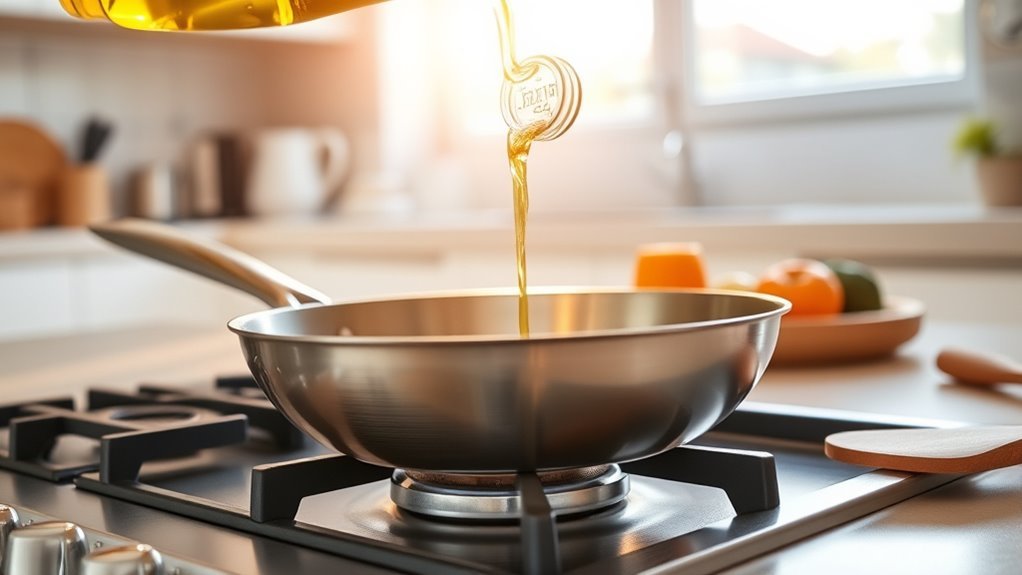
About 70% of home cooks report food sticking to stainless steel at least occasionally, so getting oil and heat right matters. You’ll learn when oil prevents sticking and when it’s unnecessary, how to preheat quickly, which oils withstand high heat, and practical fixes for stuck food or burnt oil. Keep going to master simple timing and oil choices that make stainless steel perform like a reliable, forgiving pan.
Do You Need Oil? When to Use It : And When to Skip
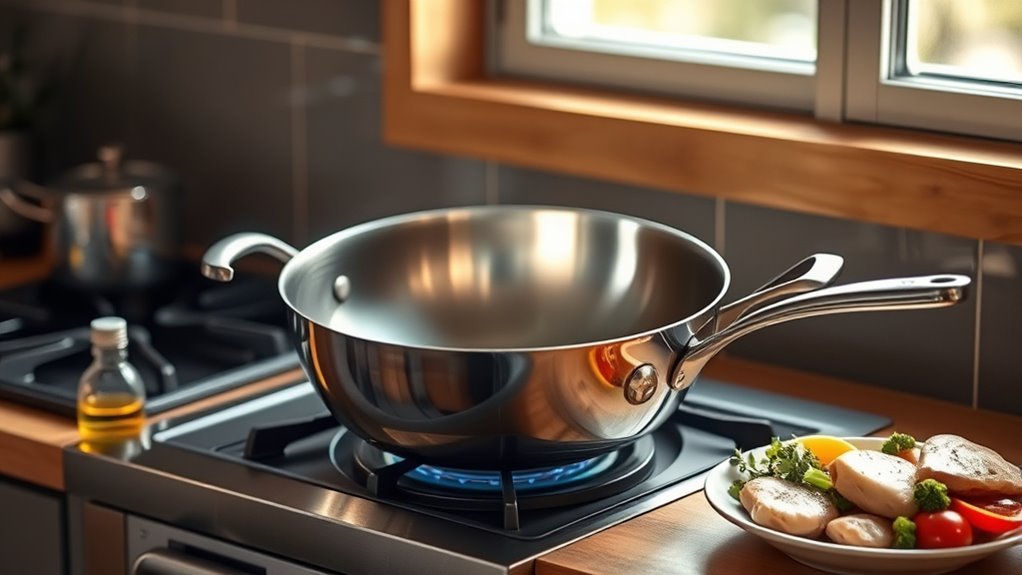
Need oil? You’ll usually add oil to a cold, stainless steel pan only as part of a deliberate cooking method: heat the pan to medium, test with water droplets that sizzle and bounce, then add oil.
That sequence builds a reliable barrier so proteins release and searing stays even. Don’t pour cold oil into a cold pan — that invites sticking and uneven cooking.
Heat the pan first, then add oil so proteins release cleanly and searing remains even.
Still, you can skip oil when the food brings its own fat; skin-on chicken or bacon belong in a cold pan so the fat renders slowly and crisps the surface without added oil.
You’ll choose oil when foods lack sufficient natural fat or when you need controlled browning and nonstick performance. You’ll skip it when rendering fat is the point.
Stay intentional: use the water test, wait for medium heat, then add oil for best release. That disciplined approach frees you from sticky failures and gives you confident results every time.
Preheat Your Pan : Quick 2-Step Method
Heat the pan over medium (about a 5) for 3–5 minutes before anything else.
Test readiness with a few drops of water—if they skitter and evaporate, the surface is hot.
Only then add oil so it fills the expanded surface pores, reducing sticking and improving browning.
Heat Pan First
Start by preheating your stainless steel pan on medium for about 3–4 minutes before adding oil; this step reduces sticking and readies the surface for better searing.
You’ll heat the pan to close microscopic pores so oil forms a smoother layer and food releases cleanly.
Don’t overdo the heat — extreme temps ruin oil and the pan’s finish. Experiment to match your burner.
- Heat the pan evenly on medium for 3–4 minutes.
- Watch for even warming across the base before you add oil.
- Add oil after preheating to create a nonstick-friendly surface.
- Avoid excessively high heat to prevent splatter and degradation.
- Adjust heat settings over time to find what your stovetop needs.
Take control: preheat, add oil, and liberate your cooking.
Water Drop Test
Wondering if your stainless steel pan is ready for oil? Use the water drop test as a fast, liberating check.
Heat the pan on medium (about setting #5) for 3–5 minutes to reach appropriate cooking temperatures. Flick a few drops of water onto the surface: if they bounce and sizzle into tight beads, the pan’s pores have closed and it’s ready for oil and food.
If drops spread and evaporate quickly, your pan’s either too hot or not hot enough — adjust heat and try again.
This simple step prevents sticking by ensuring the metal surface seals correctly, giving you control over results and freeing you from trial-and-error.
Trust the test; it’s precise, repeatable, and efficient.
Add Oil After
1 simple rule: preheat the pan, then add oil. You’ll free yourself from sticking by heating your stainless steel on medium for 3–5 minutes, then doing the water-drop test — droplets should sizzle and dance.
Only then add the oil in a thin layer; wait for it to shimmer before you add your food. Monitor heat to prevent splatter and oil breakdown.
- Preheat 3–5 minutes on medium for even surface
- Perform water test: droplets dance = ready
- Add the oil after pan is hot, not before
- Use a thin coat and wait for a shimmer
- Keep heat controlled to avoid overheating
This quick 2-step method helps you cook reliably, protect your pan, and confidently add your food without sticking.
Choose the Best Oil for Stainless Steel : Why Smoke Point Matters
Why does smoke point matter when you pick an oil for stainless steel pans? You want control: a high smoke point keeps oil stable under heat, prevents burning, and preserves flavor.
Choose oils like avocado oil (up to 520°F) or peanut oil (around 450°F) for searing, sautéing, and frying because they resist breakdown and won’t impart off-flavors.
Avoid low smoke-point fats such as butter (350°F) or flaxseed oil (225°F) for high-heat work; they degrade quickly and can produce unpleasant tastes and harmful compounds.
Olive and canola oils offer balanced options when you stay within their smoke point limits—plus unsaturated fats boost health benefits.
Preheat the stainless steel pans properly so the oil can form a protective layer; that reduces sticking and improves browning.
How Much Oil for Stainless Steel Pans : When to Add It
After you’ve preheated the stainless steel pan and confirmed it’s hot with a water test, add just enough oil to form a thin, even film—pouring cold oil into a cold pan invites sticking as the oil soaks into microscopic pores.
You want to wait until droplets sizzle and bounce; that tells you the pan is hot enough. Pour a small amount, tilt and swipe so the oil coats the surface uniformly. When the oil shimmers, you’re ready to introduce food.
- Use a small amount to create a continuous film, not a puddle.
- Trust the water test and visual shimmer as your cues for timing.
- Choose oils with high smoke points to maintain heat control.
- Tilt the pan to spread oil immediately after adding it.
- Reapply sparingly between batches to preserve surface release.
This approach frees you from guesswork, delivers reliable food release, and respects the pan’s behavior under heat so you can cook boldly and confidently.
Will My Eggs Stick? Eggs, Fatty Meats, and Other Tricky Cases
If your eggs are sticking, it usually means the pan wasn’t at the right temperature or there wasn’t enough fat to create a release; you fix that by preheating, then adding oil once the surface tests ready. Heat stainless steel pans until a water droplet bounces; add oil, watch for a shimmer, then add eggs. Use enough oil to coat the surface for lean eggs; monitor heat—too hot smokes and sticks, too cool cooks unevenly. For fatty meats like bacon or skin-on chicken, start cold without oil so they render fat and self-lubricate, yielding crisp texture and a natural release. You’re empowered to control adhesion by timing and fat.
| Situation | Recommendation |
|---|---|
| Eggs, lean | Preheat, add oil after droplet test |
| Eggs, omelet | More oil, medium heat |
| Bacon/skin-on chicken | Cold pan, no added oil |
| Low heat | Uneven cooking |
| High heat | Smoke, stick risk |
Stuck Food, Burnt Oil, and Cleaning : Fast Fixes
Getting the heat and fat right cuts down on sticking, but when food does cling or oil burns you need quick, effective fixes. You’ll prevent stuck food by preheating the stainless steel pan before adding oil so the fat seals surface pores; add oil when it shimmers.
If something sticks, let the pan cool briefly, then deglaze with hot water or broth—residual heat lifts bits with minimal scrubbing. For burnt oil, soak the pan in warm, soapy water, then use a non‑abrasive sponge; repeat soaking for stubborn discoloration.
Maintain freedom from buildup by drying thoroughly after washing to prevent corrosion.
- Preheat pan, then add oil when it shimmers to avoid burnt oil and sticking.
- Deglaze with water or broth while warm to release stuck food.
- Soak in warm, soapy water for burnt oil cleanup.
- Use non‑abrasive sponges; avoid scratching the stainless steel.
- Dry completely after cleaning to prevent corrosion and make future cleaning easier.
Take control—use heat and technique to minimize trouble and simplify cleaning.
Frequently Asked Questions
How Do You Keep Food From Sticking to Stainless Steel Pans?
Preheat the pan, then add oil so food won’t stick.
You’ll use food preparation techniques like the water droplet test to set the right moment, and follow pan seasoning methods when needed.
Coat the surface evenly, monitor cooking temperature tips to avoid burning or undercooking, and deglaze after to lift stuck bits.
You’ll gain freedom in the kitchen by mastering these concise, precise steps and choosing confident techniques.
Can I Use Olive Oil on Stainless Steel?
Yes — you can use olive oil on stainless steel, like a trusted ally in your kitchen.
You’ll enjoy olive oil benefits such as flavor and heart-healthy fats, but respect oil smoking points: extra virgin smokes ~375°F, refined ~465°F.
Preheat the pan, add oil, and use cooking techniques that prevent sticking and burning.
You’ll cook with confidence and freedom, choosing oils and temps that serve your bold, liberated palate.
Can I Use a Stainless Steel Pan Without Oil?
Yes — but you’ll mostly avoid it for freedom and control.
You can use a stainless steel pan without oil for fatty foods like bacon or skin-on chicken that render their own fat, or employ non stick alternatives such as well-heated water-sear or silicone-lined racks.
Master cooking techniques and preheat properly to prevent sticking.
Maintain your pan by deglazing, regular cleaning, and polishing to preserve performance and longevity.
What Shouldn’t You Cook in Stainless Steel?
You shouldn’t cook delicate eggs, fish, high-starch staples, lean low-fat items, sugary sauces, or very acidic dishes in stainless steel without proper technique.
Choose non stick alternatives for eggs or sticky rice when you want freedom from fuss.
Master cooking techniques and heat management—preheat, add oil, and control temperature—to liberate yourself from sticking.
When in doubt, pick cookware that matches the food instead of forcing stainless steel.
Conclusion
You do need oil for many tasks, but not always—use it when you want browning, easier release, or to protect delicate foods; skip it for high-moisture sears that’ll deglaze. Preheat 3–5 minutes and do the water-drop test, then add a high-smoke-point oil like avocado. Use just enough to coat the surface; add it to a hot pan. For eggs and lean meats, extra fat helps. If things stick, deglaze and clean promptly—no Victrola required.
