
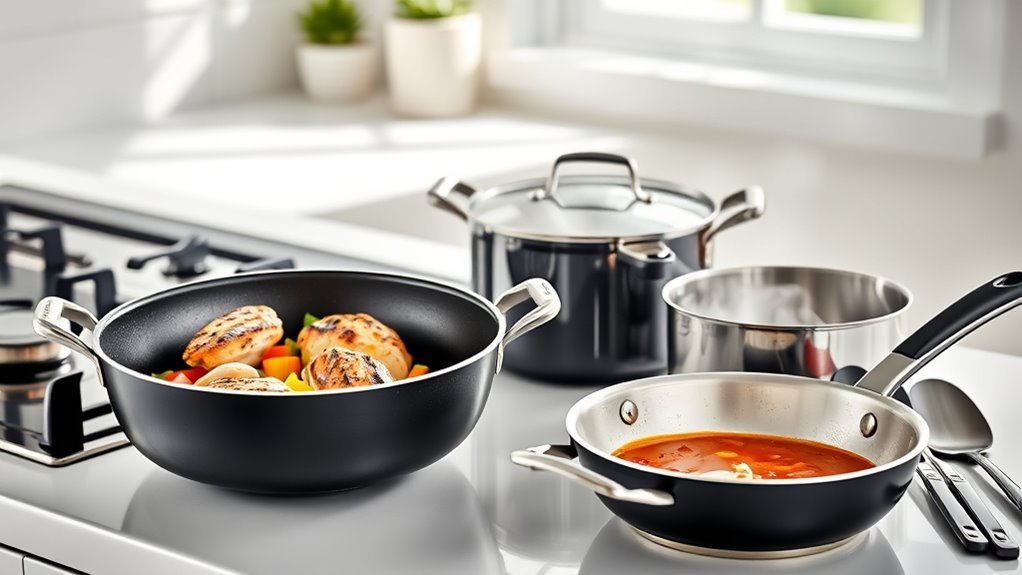
You might find it interesting that many home cooks swear by T-fal cookware, often coincidentally discovering its benefits through friends or family. Known for its affordability and unique features, T-fal offers a blend of practicality and innovation. However, it’s crucial to weigh both the advantages and drawbacks before making a decision. What sets T-fal apart, and are its shortcomings significant enough to reconsider? Let’s explore what makes this cookware a staple in countless kitchens.
Why Is T-fal Cookware So Popular?
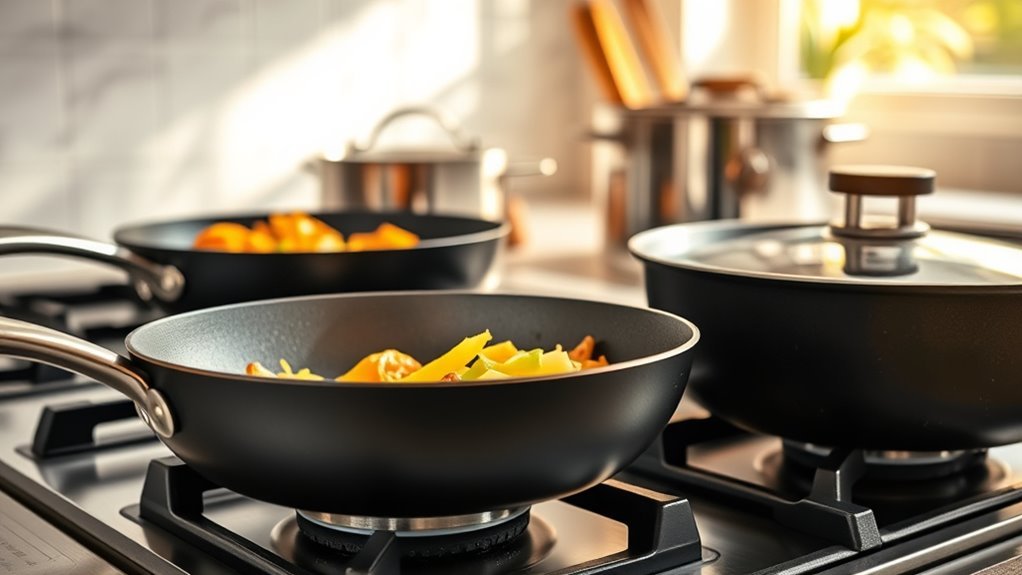
Why is T-fal cookware so popular among home chefs? It’s largely due to its innovative features and affordability. The Thermo-Spot technology guarantees that your pan is perfectly preheated, optimizing cooking results. This attention to detail appeals to both novice and experienced cooks, enhancing their culinary experience.
T-fal’s nonstick properties are another significant draw. You can enjoy easy food release while minimizing the oil you use, promoting healthier cooking. The ergonomic designs of T-fal pans offer comfort and control, making cooking enjoyable.
Moreover, the affordability of sets like the 18-Piece T-fal (RED) Ceramic Set at just $119.99 makes it accessible for budget-conscious consumers.
With various materials available, including hard anodized options, T-fal provides versatility that caters to diverse cooking styles and preferences. This combination of features solidifies T-fal’s reputation as a reliable choice for home chefs seeking quality without breaking the bank.
Pros of Using T-fal Cookware for Everyday Cooking
T-fal cookware stands out for everyday cooking due to its impressive range of benefits tailored for home chefs. One of the key features is the Hard Anodized Nonstick construction, which guarantees durability and scratch resistance, making it ideal for daily use.
With T-fal’s unique Thermo-Spot technology, you can effortlessly know when your pan has reached the perfect cooking temperature, assuring consistent results every time.
T-fal’s innovative Thermo-Spot technology ensures you achieve the perfect cooking temperature for consistent, delicious results every time.
Another advantage is the non-stick surface that requires little to no oil, promoting healthier cooking options and simplifying cleanup. This feature allows you to create delicious meals without the extra fat, supporting a balanced lifestyle.
Plus, the ergonomic handles enhance comfort and control, minimizing hand fatigue during meal prep. Whether you’re whipping up quick weeknight dinners or hosting festive gatherings, T-fal cookware offers the versatility you need to elevate your cooking experience.
T-fal Cookware Drawbacks
While T-fal cookware offers several advantages, you should be aware of its drawbacks.
Users frequently report overheating issues, which can raise safety concerns and affect the pans’ durability.
Additionally, non-stick performance and susceptibility to scratches may undermine your cooking experience and lead to frustration.
Common Overheating Issues
Many users find that T-fal cookware tends to overheat quickly, leading to several issues that can affect both cooking performance and the longevity of the product.
Overheating often results in uneven cooking and damages the non-stick properties, causing them to degrade over time. This can also lead to malfunctioning of the Thermo-Spot heat indicator, giving inaccurate temperature readings.
Users frequently report burn marks and scratches on the surface, which diminish cookware longevity.
To mitigate these issues, it’s essential to follow proper usage guidelines and avoid excessively high heat. By doing so, you can help preserve the integrity of your T-fal cookware and enhance your overall cooking experience.
Non-Stick Performance Concerns
Users often find themselves grappling with the non-stick performance of T-fal cookware, as issues can arise surprisingly quickly. Many report a decline in the nonstick properties after just a short time. Common complaints include overheating, which can lead to food sticking and uneven cooking results. Additionally, T-fal pans are often noted for their susceptibility to scratches and burn marks, diminishing both appearance and functionality. Confusing cleaning instructions further complicate care, contributing to performance issues. Here’s a quick overview of the concerns:
| Concern | Description |
|---|---|
| Nonstick Durability | Decline in nonstick performance |
| Heat Distribution | Inconsistent cooking results |
| Scratches and Burns | Affects appearance and functionality |
| Cleaning Instructions | Often unclear, leading to improper care |
Durability and Scratch Susceptibility
When considering T-fal cookware, durability and susceptibility to scratches are significant concerns that can impact your cooking experience.
Many users report that the non-stick surface is prone to scratches, which can degrade performance over time. Overheating can exacerbate these issues, leading to warping and further damage.
You may find that the non-stick properties wear out faster than expected, resulting in food sticking and uneven cooking. Additionally, T-fal cookware may not withstand high-heat cooking as well as other materials.
Proper care, like avoiding abrasive cleaners, is essential for prolonging the life of your cookware, but many struggle with this.
Ultimately, if durability and scratch resistance are your priorities, you might want to explore alternative options.
How T-fal Cookware Compares to Other Brands
While T-fal cookware offers unique features like Thermo-Spot technology, it’s essential to evaluate how it stacks up against other brands in the market. T-fal stands out for its budget-friendly pricing, making it accessible for everyday cooking, especially when compared to premium options like Pro Tri-Ply Stainless Steel.
However, its nonstick properties have received mixed reviews, particularly regarding durability and scratch susceptibility, which can be a disadvantage against higher-end brands that prioritize longevity. Ergonomically designed, T-fal enhances usability, appealing to home cooks who value practicality over aesthetics.
Additionally, its extensive product line caters to various cooking styles, providing versatility that some less diverse competitors lack. To conclude, while T-fal has its strengths, particularly in affordability and comfort, weigh these against your cooking needs and preferences when considering alternatives.
Top Cooking Scenarios for T-fal Cookware
T-fal cookware excels in various cooking scenarios, particularly for those who need efficiency and ease in the kitchen. The nonstick 10 Piece Cookware set allows for quick meals, enabling easy food release and requiring minimal oil, which promotes healthier cooking.
The Thermo-Spot heat indicator guarantees ideal preheating, making it perfect for searing meats or sautéing vegetables with precision. Its durable hard-anodized construction withstands daily use, perfect for busy households where time is of the essence.
Versatility stands out in T-fal cookware, accommodating frying, simmering, and even baking, so you can explore a wide range of recipes.
The ergonomic handles enhance your cooking experience by providing a comfortable grip, allowing for better maneuverability, especially during high-heat cooking.
Tips for Maintaining and Caring for T-fal Cookware
To keep your T-fal cookware in top shape, focus on proper cleaning techniques and safe cooking practices.
Hand washing with mild detergent and a soft sponge is essential to protect the non-stick surface, while using wooden or silicone utensils prevents scratches.
Regular maintenance not only enhances performance but also extends the lifespan of your cookware.
Proper Cleaning Techniques
Proper cleaning techniques are essential for maintaining the longevity and performance of T-fal cookware. Always wash your pans promptly after use with warm water and mild dishwashing liquid to prevent residue buildup that can compromise their non-stick properties.
Opt for hand washing over machine washing, as this method better preserves the non-stick coating. When cleaning, use a soft sponge instead of abrasive cleaners to avoid scratching the surface, which can reduce the cookware’s effectiveness.
Additionally, steer clear of harsh chemicals that may damage the finish. Finally, store your T-fal pans with soft cloths between them to prevent scratches and keep them looking their best.
Following these steps will guarantee your cookware remains in excellent condition.
Safe Cooking Practices
Maintaining safe cooking practices is essential for maximizing the performance and lifespan of your T-fal cookware.
To preserve its non-stick properties, wash your pans promptly using warm water, mild dish soap, and a soft sponge; avoid harsh chemicals and abrasive cleaners. Hand washing is vital for ensuring the longevity of the non-stick coating.
When storing your T-fal cookware, place soft cloths between items to prevent scratches and protect those valuable non-stick surfaces. Additionally, steer clear of metal utensils, as they can damage the coating and impact performance.
Always preheat your cookware using the Thermo-Spot indicator to promote even cooking and prevent overheating.
Following these practices will help you enjoy your T-fal cookware for years to come.
Frequently Asked Questions
Is T-Fal Cookware Healthy?
Yes, T-fal cookware can be healthy for your cooking. Its nonstick safety guarantees that you use less oil, promoting lower-calorie dishes.
The cooking performance is excellent, allowing for even heat distribution. To maximize health benefits, follow maintenance tips like using non-metal utensils and avoiding high heat, which preserves the non-stick surface.
Is T-Fal the Same as TEFLON?
T-fal isn’t exactly the same as Teflon; it’s more like a superhero sidekick! T-fal cookware often sports a Teflon non-stick coating, giving you fantastic food release and ease of cleaning.
However, T-fal durability and maintenance are essential—excessive heat can ruin that magic surface.
When comparing T-fal vs. alternatives, remember that while Teflon offers longevity, it requires careful handling to keep it in tip-top shape.
Which Is Better, Calphalon or T-Fal?
When comparing Calphalon and T-fal, consider T-fal’s durability, which generally offers solid performance at a budget-friendly price.
However, Calphalon’s premium price reflects its high-quality materials and often superior non-stick performance.
If you’re prioritizing cost efficiency, T-fal might suit you better, but for those seeking long-lasting cookware with a premium feel, Calphalon could be worth the investment.
Ultimately, your choice depends on your cooking needs and financial flexibility.
How Long Do T-Fal Pans Last?
T-fal pans typically last between 2 to 5 years, influenced by durability factors like usage frequency and maintenance tips.
If you frequently cook at high heat, the non-stick surface may wear down faster.
To extend their lifespan, hand wash your pans and avoid abrasive scrubbers.
Using metal utensils can scratch the surface, so opt for silicone or wood instead.
Following these practices can help you get the most out of your T-fal cookware.
Conclusion
To sum up, T-fal cookware offers a blend of affordability and innovative features, making it a solid choice for everyday cooking. While it has its drawbacks, such as potential longevity issues, its ergonomic design and non-stick surface can enhance your culinary experience. As the saying goes, “You get what you pay for.” Thus, if you prioritize budget-friendly performance, T-fal could be a valuable addition to your kitchen arsenal. Just remember to care for it to maximize its lifespan.
