
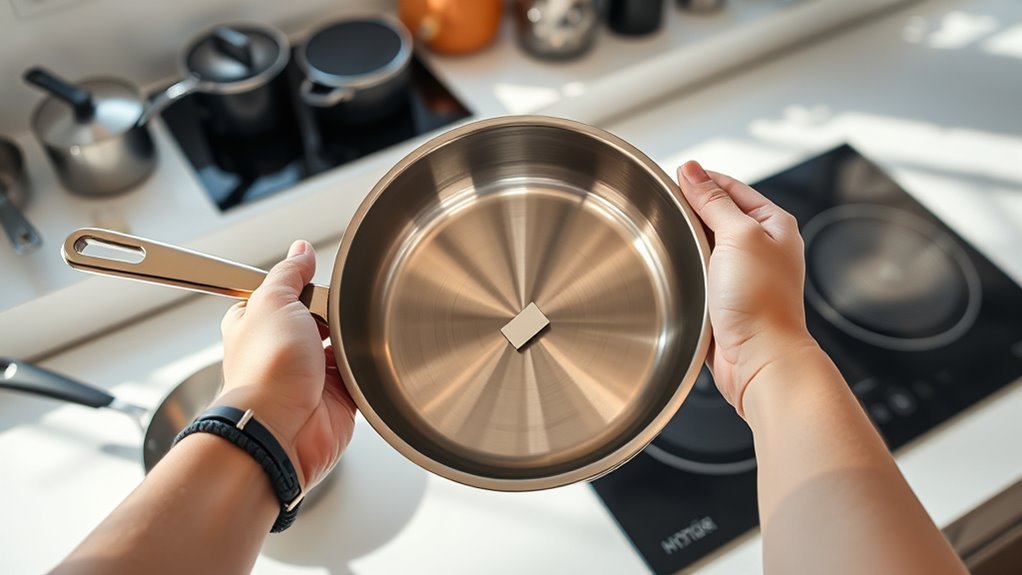
If you want to know whether a pan will work on an induction hob, start with simple, practical checks you can do now: a magnet test, inspection for compatibility symbols, and a size match to the burner. You’ll also learn quick stove trials and which materials reliably perform, plus common exceptions and fixes when a seemingly suitable pan won’t cooperate — and those details will help you avoid wasted heat and uneven cooking.
How Induction Cooks and Why Magnetism Matters
Because induction stoves use electromagnetic fields rather than open flames or electric coils, they heat pots and pans directly and much more efficiently.
Induction cooktops use electromagnetic fields to heat cookware directly, delivering faster, more efficient cooking without open flames.
You rely on a copper coil beneath the induction cooktop to generate an alternating magnetic field that induces electric currents in compatible cookware. That magnetism creates resistive heat inside ferromagnetic materials, so the pan itself becomes the source of heat rather than the surface.
For practical liberation in the kitchen, you’ll want cookware that responds predictably: cast iron and certain stainless steel variants are magnetic and transfer energy efficiently.
Non-magnetic metals like aluminum, glass, and ceramic won’t interact with the field, won’t heat, and may trigger error codes on modern units.
Compatibility hinges on the material’s magnetic properties and construction—multi-layer bases can complicate performance.
Use straightforward verification methods to confirm a pan’s magnetic behavior, prioritize ferromagnetic cookware for consistent heat response, and you’ll free yourself from wasted energy and unreliable cooking results.
Quick Checks: Is Your Pan Induction-Ready? (Magnet, Symbol, Size)
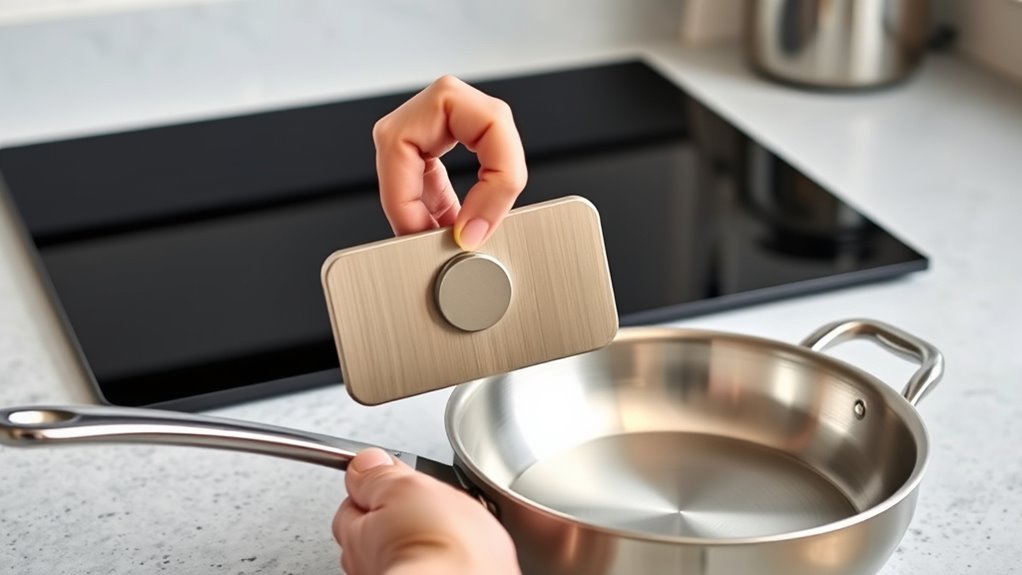
Now that you know induction heats cookware through magnetism, you can quickly check whether a specific pan will work. First, grab a magnet and press it to the pan’s base: if it sticks firmly, the pan has magnetic material and shows induction compatibility. If the magnet won’t stick, the pan is non-magnetic and won’t work on induction cooktops.
Next, inspect the bottom for a compatibility symbol — usually a coil or loops — which manufacturers stamp to indicate induction-ready cookware. Don’t rely solely on markings; confirm with the magnet test because some stainless steel pans look suitable but lack a magnetic base layer.
Finally, match pan size to burner size. The cookware should be at least as wide as the induction burner for efficient coupling and even heat.
These quick technical checks free you from guesswork and let you confidently choose pans that deliver performance and liberation in your kitchen.
Stove Tests: Water-Boil and Heat-Up Checks
Want a quick, practical check? Use the water-boil test: put a small amount of water in the pan, set it on the induction burner, and watch. Because induction cooking produces rapid heat via magnetic fields, water should warm and boil noticeably faster than on gas or conventional electric. If the water heats quickly, the pan is likely induction-ready and your cookware materials are compatible.
Want a quick check? Put water in the pan on an induction burner—if it boils fast, the pan’s induction-ready.
Do a heat-up check next: place the empty pan on the burner and feel for immediate warmth at the base (careful—use a hand hover, not touch). Rapid heat indicates good heat transfer and magnetic cookware.
If the burner fails to detect the pan or the surface stays cool, the material is non-magnetic and lacks compatibility with induction. For reliable results, match the pan’s base to the induction burner size so the field couples effectively.
These stove tests confirm practical performance beyond symbols or magnets.
Materials That Work : and Common Exceptions
Think of induction compatibility regarding magnetism: cookware must contain ferromagnetic materials—like cast iron or magnetic grades of stainless steel—to couple with the cooktop’s electromagnetic field and heat efficiently.
You’ll rely on cast iron and magnetic stainless steel as primary workable cookware materials; they deliver predictable induction performance and durability. Non-magnetic cookware—pure aluminum, glass, ceramic—won’t respond unless manufacturers add a magnetic layer.
Use a magnet test to confirm induction-ready status: if a magnet sticks to the pan’s base, it’s likely compatible.
Clad cookware can work if the core or base is ferromagnetic; many copper or aluminum-clad pans include a magnetic stainless-steel layer for induction compatibility.
Common exceptions to expect: lightweight alloy or single-layer non-magnetic pans, decorative bases, and some nonstick pieces without a magnetic insert.
You should check labels and test each piece rather than assume material by appearance; liberation in the kitchen comes from knowing which pans will actually couple to your cooktop.
Buy & Troubleshoot: Choosing Pans and Fixing Compatibility Issues
Having confirmed which materials work and how to use a magnet test, you’ll next focus on choosing pans that will actually perform on your induction cooktop and on straightforward fixes when they don’t.
When buying induction cookware, check manufacturer labels and look for a stamped coil or loops on the base; those marks plus a magnet test confirm induction-compatible cookware.
Verify material composition: multi‑layer stainless steel with an iron core or a magnetic stainless steel base heats reliably, while pure aluminum, glass, and ceramic are non-magnetic cookware and won’t work without help.
Multi-layer stainless with an iron core or magnetic stainless heats well; pure aluminum, glass, and ceramic won’t work without a converter.
If you encounter compatibility issues, first recheck with a magnet and the manufacturer specs.
For pans you love that fail the magnet test, use converter discs to bridge the gap — they enable induction cooking but reduce responsiveness and efficiency.
Prioritize pans with a full stainless steel base designed for induction to avoid frequent troubleshooting.
That gives you freedom to cook confidently and move toward liberated, efficient induction cooking.
Frequently Asked Questions
How Do I Know if My Pan Is Induction Compatible?
You check induction compatibility by seeing if a magnet sticks to the pan’s base; if it does, it’ll work on induction cooking.
Inspect cookware materials for ferromagnetic layers, stamped induction symbols, and test heating with water to confirm heat distribution and cooking performance.
Consider energy efficiency, pan durability, safety features, maintenance tips, cost comparison, and user reviews to choose liberating cookware that balances performance, longevity, and practical upkeep.
How Can I Test My Cookware for Compatibility With Induction Cooktops?
Like a compass finding north, test cookware materials with a magnet: if it sticks, magnetic properties suit induction.
You’ll check heat distribution and induction efficiency by boiling water—fast boil means good cooking performance.
Inspect pot designs for stamped symbols, weigh brand recommendations and cost comparison, and confirm safety features.
For maintenance tips, avoid abrasive cleaners and recheck magnets periodically so you stay free and empowered in the kitchen.
How Can I Test if My Cookware Is Induction Compatible Using a Magnet?
Use a magnet test: press a fridge magnet to the pan base—if it sticks firmly, it’s induction compatible.
You’ll confirm cookware materials like cast iron or magnetic stainless steel that deliver induction benefits: fast cooking efficiency and even heat distribution.
Try multiple spots and compare pan types.
Don’t trust compatibility myths; check cookware labels and use other testing methods if unsure.
This practical step frees you to choose efficient induction cooktops confidently.
What Is the Symbol for Induction-Compatible Pans?
A friend found a coiled-spring symbol on their pan’s base — that’s the common induction symbol indicating magnetic cookware materials.
You’ll see design variations across brands, but it signals magnetic properties for efficient heat distribution, cooking efficiency and energy savings on various surface types.
If you don’t spot it, test with a magnet and check brand recommendations and user experiences to confirm compatibility and ideal performance.
Conclusion
You’re holding a compass when you test pans: the magnet points you to induction-ready metal, the coil symbol is your map, and matching pan-to-burner size keeps your flame—now invisible—focused. Do quick stove checks (water-boil and heat-up) to confirm performance. Favor ferromagnetic materials like cast iron or magnetic stainless steel, and avoid pure aluminum, glass, and ceramic. With these simple tools you’ll reliably navigate toward efficient, predictable induction cooking.

