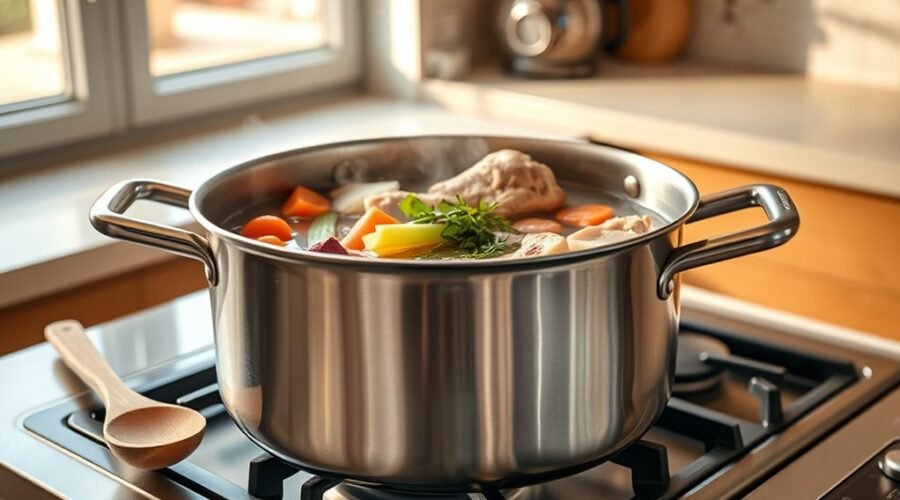
A stock pot is a large, deep cooking vessel used for boiling and simmering food in generous batches. It is ideal for stocks, soups, broths, pasta, grains, chili, and blanching vegetables. Its tall sides help reduce splashing and evaporation, while a tight lid helps hold in heat and moisture. Common sizes range from 6 to 12 quarts, with stainless steel or aluminum offering strong durability and even heating, and more useful details follow.
What Is a Stock Pot?
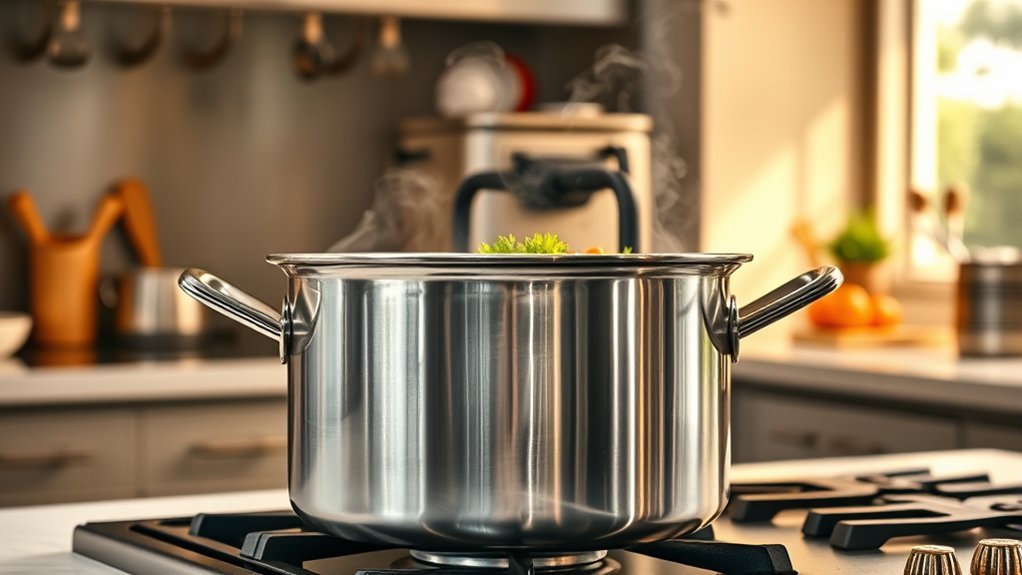
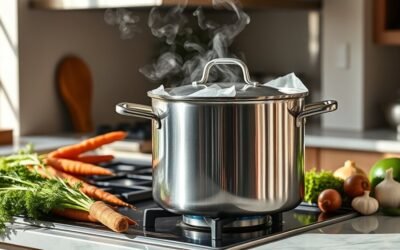
A stock pot is a large, deep cooking vessel with high sides, designed for boiling and simmering liquids in large quantities.
In practical use, a stock pot serves as large capacity cookware for stocks, soups and stews, pasta, and other batch recipes. Its tall shape helps reduce splashing while supporting steady simmering.
Many models are made from stainless steel or aluminum to promote even heat distribution, which helps maintain controlled cooking across the base and sides.
Many models use stainless steel or aluminum for even heat distribution and consistent, controlled cooking.
Two looped handles usually support safe lifting, and a snug lid helps retain moisture and flavor.
Because it works on all stovetops, including induction, it remains versatile cookware for kitchens that value flexibility and self-sufficiency.
For people preparing nourishing meals without constraint, the stock pot offers a direct, efficient way to cook in volume while preserving texture, flavor, and consistency.
Stock Pot Sizes, Materials, and Features
Stock pots commonly range from 6 to 12 quarts, providing the capacity needed for soups, stocks, and other large-batch cooking tasks.
They are often made from stainless steel or aluminum to support durability and even heat distribution, and many include two looped handles and a snug-fitting lid for safer handling and better moisture retention.
Their compatibility with all stovetops, including induction, adds practical versatility in the kitchen.
Common Stock Pot Sizes
When selecting a stock pot, home cooks will typically find capacities ranging from 6 to 12 quarts, with an 8-quart size often recommended for most kitchens because it accommodates large-batch soups, stocks, and stews without taking up excessive space.
Among stock pots, these common sizes provide large capacity for practical meal preparation while keeping storage manageable.
Stainless steel models are widely chosen, though materials may also include aluminum or enameled cast iron, each serving different cooking needs.
Tall sides support efficient simmering by reducing evaporation and helping maintain steady heat.
Smaller pots suit limited portions, while larger ones support freer cooking for gatherings or batch work.
The best choice depends on household volume, stove space, and intended use.
Materials And Key Features
Beyond choosing the right capacity, attention also turns to construction and design details that affect day-to-day performance.
Stock pots usually range from 6 to 12 quarts, giving enough capacity for large batches of soup, broth, and pasta. The most practical materials are stainless steel and aluminum, because they help heat evenly and stand up to repeated use.
Tall, straight sides reduce evaporation and preserve liquid volume during long simmering. Two-loop handles improve control when moving heavy contents from stove to sink.
Many stock pots work on all stovetops, including induction, and are oven-safe; stainless steel versions may tolerate temperatures up to 800°F. These features support efficient, independent cooking without unnecessary compromise.
What Can You Cook in a Stock Pot?
A stock pot is well suited to preparing large batches of soups, stocks, and broths, since its high sides and 6- to 12-quart capacity support generous volumes and steady simmering. A stock pot also handles boiling pasta, cooking grains, and simmering chili or stews without crowding the pot. Its broad base promotes even heating, while the high sides reduce evaporation and help flavors stay balanced.
| Dish | Best Use |
|---|---|
| Soup | Large batches, easy simmering |
| Pasta | Boiling pasta and draining |
| Vegetables | Blanching, then cooling |
It can also support blanching vegetables to preserve color and nutrients. For food preservation, it may be used for canning and sterilizing jars. This versatility gives cooks practical freedom: one vessel can serve multiple tasks, from soup to preservation, with less equipment and more control over output.
How Do You Use a Stock Pot for Best Results?
For best results, a stock pot should be filled only as far as the recipe requires, leaving enough room for the liquid to simmer without overflowing. This supports large batches of stock, soup, or stew while preserving flavor and control.
A stock pot works best when ingredients are covered by water or broth, promoting even cooking and steady extraction. Use a tight-fitting lid to hold in steam and moisture; this shortens simmering time and helps the pot work with less waste.
Keep ingredients covered for even cooking, and use a tight-fitting lid to conserve heat and deepen flavor.
For pasta or blanching, keep a rolling boil so contents move freely and do not stick. Choose stainless steel for ideal heat distribution and reliable performance.
- Freedom from spills
- Confidence in every simmer
- Comfort in controlled heat
- Relief from uneven results
- Satisfaction in fuller flavor
Stock Pot vs. Sauce Pot vs. Dutch Oven
A stock pot has tall, straight sides, two looped handles, and a large capacity for boiling, simmering, and making soups or stocks in volume.
A sauce pot is smaller, with one long handle, and is better suited to slow-cooking sauces and reducing liquids.
A Dutch oven, by contrast, is heavy cast iron built for braising and steady low heat, making it a stronger choice for moisture retention than for quick boiling.
Stock Pot Basics
Stock pots are built for volume: their tall, straight sides and large capacity, typically 8 to 12 quarts, make them well suited to boiling, simmering, and preparing soups, stocks, and stews in batches.
For cooks seeking freedom, stock pots in stainless steel keep tasks simple and durable, especially when making stocks or handling long simmering sessions. Their shape promotes even liquid coverage and makes them ideal for boiling pasta, vegetables, and broth.
- Spacious
- Efficient
- Reliable
- Versatile
- Uncluttered
Two looped handles support safe lifting when full. Compared with smaller sauce pots and rounded Dutch ovens, stock pots stay focused on sheer capacity and steady heat management.
They serve clear, practical needs without forcing unnecessary compromises in everyday cooking.
Sauce Pot Differences
By comparison with other common cooking vessels, stock pots are built for high-volume boiling and simmering, while sauce pots and Dutch ovens serve more specialized purposes.
Stock pots usually offer large capacity, tall straight sides, and two looped handles, making them practical for soups, pasta, and stocks. Their stainless steel construction keeps them lighter than heavy cast alternatives and easier to lift during cooking.
Sauce pots, by contrast, are shorter, broader, and fitted with one long handle for controlled stovetop use, especially for sauces that need slow simmering or reduction. Stock pots also support more efficient evaporation control.
Dutch ovens differ again: they are heavier cast iron vessels intended for braising and low-and-slow cooking, not rapid boiling.
Dutch Oven Comparison
Compared with sauce pots and Dutch ovens, stock pots are built for different cooking demands: their tall, straight sides and large 8- to 12-quart capacity make them well suited to boiling and simmering soups, stocks, stews, and pasta.
Unlike sauce pots, the two looped handles improve stability when full. In this Dutch ovens comparison, stock pots large, often in stainless steel construction, prioritize easy lifting and fast liquid movement; Dutch ovens favor heat retention for braising, roasting, and slow cooking.
Their large capacity supports batch cooking, yet the lighter build helps keep the cook free to work safely.
- Pour with control.
- Lift without strain.
- Simmer in confidence.
- Roast when needed.
- Choose the right vessel.
Best All-Clad Stock Pot Options for Your Kitchen
A few All-Clad options stand out for different cooking needs, starting with the D3 Stainless Everyday Rondeau Pan at 8 quarts for $279.99, which suits large-batch soups and stocks. This stock pot choice uses stainless steel for dependable heat control and generous capacity. For smaller cooking tasks, the D3 Stainless Cassoulet offers 2 quarts at $149.99, useful for side dishes or single servings.
| Model | Key point |
|---|---|
| D3 Everyday Rondeau | 8-quart, large batches |
| D3 Cassoulet | 2-quart, smaller portions |
| D5 Brushed Soup Pot | $199.99, induction-ready |
| Essentials Nonstick Stockpot | $129.99, easy cleanup |
| D5 Polished Steamer Set | $299.99, steam plus stock |
The D5 Stainless Brushed Soup Pot, now $199.99, adds ergonomic handles and stovetop flexibility. The Essentials Nonstick Stockpot with Insert supports low-stress cooking and cleanup. The D5 Stainless Polished Steamer Set broadens All-Clad freedom by pairing steaming with stock making.
Frequently Asked Questions
What’s the Difference Between a Stock Pot and a Regular Pot?
A stock pot is taller, larger, and built for high-volume simmering, while a regular pot is shorter, smaller, and better for everyday tasks.
Its cooking capacity suits stocks, soups, pasta, and canning; regular pots favor sauces and small dishes.
Stock pot materials often improve heat distribution and durability. The lid design and two handles aid handling.
Practical maintenance tips: clean gently, dry fully.
Recipe suitability depends on batch size.
What Can I Use Instead of a Stock Pot?
A large saucepan, Dutch oven, pressure cooker, slow cooker, or large frying pan can replace it, depending on the task.
A saucepan suits soup making and pasta cooking in small batches; a Dutch oven helps with stews preparation and batch cooking.
A pressure cooker speeds boiling vegetables and stocks; a slow cooker favors low, steady cooking.
For canning jars, a true large pot remains preferable for safe heat and capacity.
Can You Cook Regular Food in a Stock Pot?
Yes, regular food can be cooked in a stock pot.
It suits soup recipes, stew preparation, boiling pasta, making broth, braising meat, and simmering sauces. Its tall sides and large capacity support steady heat and reduced evaporation, which helps liquids cook evenly.
It is practical for batch meals and simple everyday cooking.
It is less suitable for frying or fast sautéing, where greater surface area is needed for proper browning.
Is a Stockpot the Same as a Crockpot?
No—about 80% of slow-cooked dishes rely on controlled, low heat, which a stockpot cannot provide like a crockpot.
A stockpot is stovetop cookware for boiling and simmering; a crockpot is an electric appliance for slow cooking.
Their cooking methods, pot materials, heat distribution, and size options differ, affecting recipe versatility.
For practical use, choose by task, then follow maintenance tips suited to each vessel.
Conclusion
In the end, a stock pot proves far more than a large vessel for water and broth. Its depth, capacity, and steady heat make it a practical tool for soups, stocks, pasta, and batch cooking. Yet the real advantage appears in what follows: easier preparation, fewer transfers, and greater control. With the right size and material, a kitchen gains a dependable workhorse—one that quietly turns simple ingredients into something worth waiting for.