
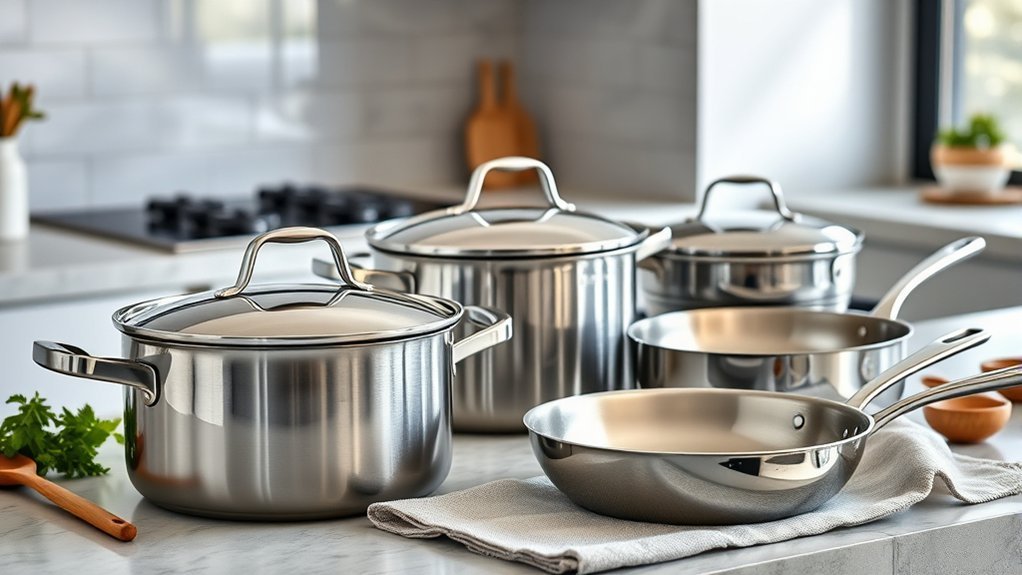
A good pots and pans set should cover the cooking jobs you actually do without filling the cabinet with duplicate or rarely used pieces. For many kitchens, that means at least one frying pan or skillet, one or two saucepans, a larger stockpot or Dutch oven, and possibly a sauté pan. Material, heat performance, cooktop compatibility, oven limits, weight, handles, lids, cleaning requirements, and storage matter more than a large advertised piece count.
Quick Answer
Choose a pots and pans set with a useful skillet, saucepan, larger pot, and any sauté pan you will regularly use. Prioritize even heating, comfortable handles, secure lids, appropriate oven limits, and compatibility with your cooktop. Compare the actual cooking vessels—not just the advertised piece count—before buying.
Key Takeaways
- A skillet, saucepan, and larger pot form a practical starting point; a sauté pan is useful for one-pan meals and shallow frying.
- Lids and accessories usually count toward the advertised piece total, so compare the number of actual pots and pans.
- Stainless steel, nonstick, cast iron, carbon steel, copper, and ceramic-coated cookware have different strengths and maintenance needs.
- Induction cookware needs a magnetic base that works with the cooktop.
- Check oven limits, handle comfort, weight, storage, cleaning instructions, and warranty terms before buying.
What To Look For In A Cookware Set?
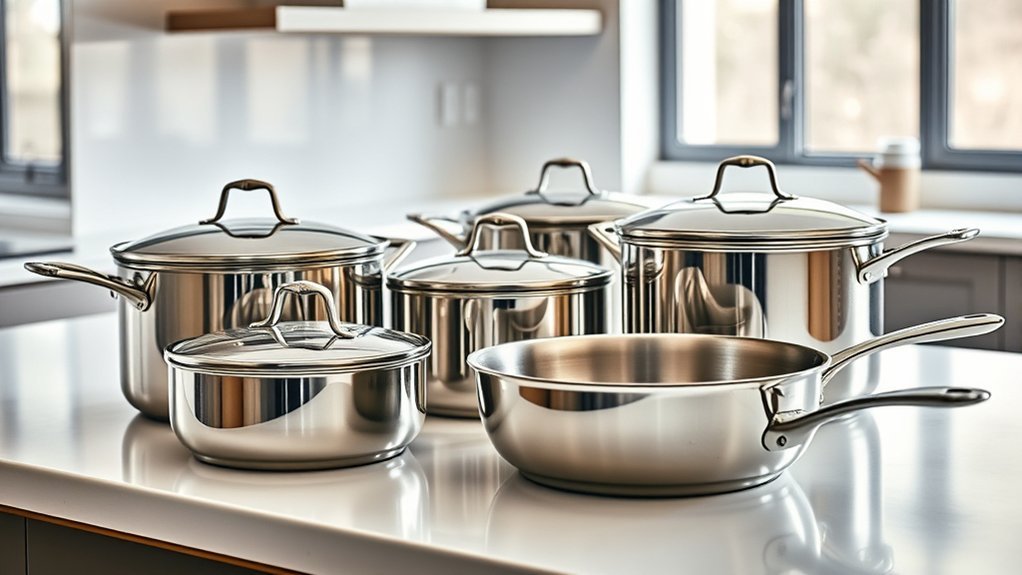
A useful cookware set starts with versatile pieces rather than the highest piece count. A frying pan, saucepan, and larger pot handle many everyday jobs, while a sauté pan or second saucepan may be worthwhile for households that cook several dishes at once.
A useful cookware set is defined by the pieces you cook with, not by the largest number printed on the box.
Next, compare construction. Multi-ply stainless steel commonly sandwiches a conductive aluminum or copper layer between stainless-steel surfaces. This design can improve heat response and spread heat beyond a small area of the pan.
Also check the pan’s weight, handle shape, lid fit, rim design, oven rating, cleaning instructions, and cooktop compatibility. A technically impressive pan is still a poor choice if it feels awkward when full or requires more maintenance than you want to provide.
A warranty can be useful, but its length alone does not prove that one cookware set is better than another. Read what the warranty actually covers, what it excludes, and whether replacement pieces or lids are available.
Pro Tip: Before buying a large set, list the pans you used during the previous two weeks. Prioritize those shapes and sizes instead of paying for specialty pieces that may stay in storage.
The Essential Pots And Pans Pieces
A practical cookware set normally needs enough variety to fry, sauté, simmer, boil, and prepare larger meals. A skillet, saucepan, and stockpot or Dutch oven cover much of that work. A sauté pan adds straight sides and extra capacity for sauces, braises, shallow frying, and one-pan meals.
There is no universal requirement for an eight-inch skillet, six-quart stockpot, or three-quart saucepan. Household size and cooking style matter. A small household may use a 1- to 2-quart saucepan frequently, while a family that cooks pasta, soup, or stock in large batches may benefit from a 6- to 8-quart pot.
Core Pieces To Own
The essential core of a practical pots and pans set usually includes:
- Frying pan or skillet: for eggs, vegetables, browning, sautéing, and searing.
- Small or medium saucepan: for sauces, grains, reheating, and smaller quantities of soup.
- Stockpot or Dutch oven: for pasta, soups, stews, boiling, and larger batches.
- Sauté pan: optional but useful for meals that benefit from a wide cooking surface and taller straight sides.
Many households eventually add a second frying pan or saucepan because those pieces are often needed at the same time.
Skillet, Pot, And Saucepan
A versatile skillet should provide enough flat cooking area for the portions you normally prepare. Around 10 inches is a useful everyday size for many households, while larger families may prefer a 12-inch pan.
A saucepan is best selected by the volume you routinely cook. Smaller pans work well for sauces and reheating; 3- to 4-quart saucepans give more room for grains, vegetables, soups, or pasta.
A larger pot in roughly the 5- to 8-quart range handles jobs that would crowd a saucepan, including boiling pasta and making soups or stews. A Dutch oven can fill a similar role while adding strong braising and oven-cooking capability.
Sizes That Cover Basics
Instead of treating one size combination as mandatory, match cookware capacity to the number of people you feed and the foods you make most often.
- 1–2 people: a smaller saucepan and 8- to 10-inch frying pan may cover many daily meals.
- 3–4 people: a 10- to 12-inch frying pan, 2- to 4-quart saucepan, and 5- to 8-quart larger pot provide more flexibility.
- Batch cooking: prioritize a larger stockpot or Dutch oven and a roomy sauté pan.
- Small kitchens: fewer versatile pieces are usually more useful than a large collection of overlapping sizes.
How Cookware Set Piece Counts Work
Cookware manufacturers usually count lids and some accessories as individual pieces. A “10-piece” set therefore does not necessarily contain 10 cooking vessels. It may contain five or six pans plus matching lids.
Read the full contents list before comparing prices. A smaller set with two useful frying pans, two saucepans, a sauté pan, and a stockpot may provide more practical value than a larger set padded with inserts, utensils, or duplicate lids you do not need.
Note: Piece count is a packaging description, not a direct measure of cookware value. Compare the actual vessel sizes and shapes first.
Best Cookware Materials For Everyday Cooking
The best cookware material depends on what you cook, how much maintenance you accept, and whether you value easy release, searing, heat retention, responsiveness, or low weight.
| Material | Strengths | Tradeoffs | Good For |
|---|---|---|---|
| Clad stainless steel | Durable, non-reactive, good for browning and deglazing | Food can stick without proper preheating and fat | General-purpose cooking |
| PTFE nonstick | Easy food release and cleanup | Coating eventually wears; care and temperature limits matter | Eggs, fish, pancakes, delicate foods |
| Ceramic-coated | Available in PFAS-free designs with easy initial release | Release performance can decline with use and care practices | Low- to medium-heat everyday cooking |
| Cast iron | Excellent heat retention and very long service life | Heavy; traditional cast iron needs drying and seasoning care | Searing, frying, baking, braising |
| Carbon steel | Lighter than cast iron and responsive to heat changes | Requires seasoning and rust prevention | High-heat cooking, sautéing, searing |
| Copper or copper-core | Very responsive temperature control | Expensive; induction requires a compatible magnetic construction | Sauces and temperature-sensitive cooking |
For nonstick cookware, avoid broad claims such as “chemical-free.” The U.S. Food and Drug Administration explains that certain polymerized PFAS are authorized for nonstick cookware applications and that available studies show negligible amounts capable of migrating to food from these coatings.
Some ceramic-nonstick products make specific PFAS-free claims. For example, the GreenPan Valencia Pro uses hard-anodized aluminum bodies, a ceramic nonstick coating marketed as PFAS-free, stainless-steel handles, and an induction-ready base.
Why Heat Distribution Matters Most
Heat distribution is an important part of cookware performance because uneven pans can create hot spots where one area burns while another cooks slowly.
Conductive layers of aluminum or copper are commonly used with stainless steel to spread heat more quickly. Fully clad cookware extends the bonded layers through the sides of the pan, while some cookware uses a conductive disc primarily across the base.
Even heating helps with browning, simmering, sautéing, and sauce work, but it is separate from structural durability. Warping can also be affected by pan construction, thickness, excessive heat, and sudden temperature changes.
Warning: Avoid placing a very hot pan directly under cold water unless the manufacturer specifically allows it. Rapid thermal shock can damage or warp cookware.
- Look for consistent heating across the base.
- Use pan sizes that match the burner or induction zone.
- Preheat gradually when the material requires it.
- Do not assume a heavier pan automatically heats more evenly.
- Follow the manufacturer’s temperature limits.
Cookware Features That Make Life Easier
A well-designed pots and pans set should be comfortable to handle and easy to use, not merely durable on paper.
Check whether long handles feel secure and balanced. Larger sauté pans and stockpots benefit from helper handles because lifting a full pan can be difficult with one hand. Riveted handles are common and durable, although food residue may collect around the rivets during cleaning.
Lids should fit securely without being difficult to lift. Glass lids let you view food without opening the pot but add weight and usually have lower heat limits than an all-metal lid. Metal lids are durable and often tolerate higher oven temperatures, depending on the manufacturer.
Flared pouring rims can make liquids easier to transfer. A flat, stable base is especially important on smooth electric and induction surfaces.
Oven Safety And Handle Limits
Do not assume every piece in a set has the same oven rating. Handles, lids, nonstick coatings, and knobs can have different temperature limits.
For example, All-Clad currently rates its D3 Stainless cookware for oven and broiler use up to 600°F and lists it as compatible with induction. Other sets may have substantially lower limits, particularly when glass lids or heat-sensitive handle components are used.
Weight And Storage
Lift cookware before buying when possible. Cast iron can be excellent for heat retention but may be uncomfortable for someone who wants light, one-handed handling. Large stainless-steel and copper cookware can also become heavy when filled.
Measure cabinet space before purchasing a large collection. Stackable shapes and interchangeable lids can reduce storage requirements, but use pan protectors or soft liners if stacking could scratch finished or nonstick surfaces.
Choose Cookware That Works On Your Cooktop
Cookware should match the cooktop type. Gas, conventional electric, smooth-top electric, and induction can all work well with the right pans, but induction has a specific magnetic requirement.
Cooktop Compatibility
Stainless steel and cast iron are often induction compatible, but stainless steel is not automatically magnetic and aluminum or copper cookware needs an induction-compatible magnetic layer or base.
For glass or ceramic cooktops, a smooth, flat bottom improves contact with the cooking surface. Very rough bases can also be less desirable on surfaces that scratch easily.
- Check the manufacturer’s cooktop symbols or compatibility list.
- Match pan diameter reasonably well to the burner or induction zone.
- Prefer flat bases on smooth electric and induction surfaces.
- Do not assume every stainless-steel pan works on induction.
Induction Readiness
Induction-ready cookware needs a base that interacts with the cooktop’s magnetic field. The U.S. Department of Energy gives a simple check: cookware with a flat bottom that a magnet sticks to can work with an induction cooktop.
A firm magnetic attraction is a useful home test, but also check the manufacturer’s compatibility statement because base diameter and construction can affect performance on a particular induction appliance.
Should You Buy A Set Or Individual Pieces?
A cookware set makes sense when most of the included pieces match your needs and the bundle costs less than buying them separately. Matching lids, handles, and construction can also simplify storage and cooking.
Buying individual pieces may be better when you already own good cookware, have limited storage, or prefer different materials for different jobs. For example, a kitchen may benefit from stainless-steel saucepans and sauté pans, one cast-iron skillet, and one nonstick frying pan rather than an entire nonstick collection.
Open-stock availability is also worth checking. Being able to replace one damaged saucepan or add another size later can extend the useful life of the collection.
How Much Should A Cookware Set Cost?
There is no single correct cookware budget. Price depends on material, construction, manufacturing location, number and size of actual vessels, brand, warranty, and whether the cookware is sold during a promotion.
As a current market reference, the Cuisinart MultiClad Pro 12-Piece Set was listed by the manufacturer at about $300 in September 2026. Premium fully clad collections can cost substantially more. Prices and promotions change, so compare the normal price and the specific pieces included rather than relying on a sale percentage.
Value is usually strongest when nearly every vessel in the set has a clear job in your kitchen. Paying more for durable construction can make sense, but paying more for unused specialty pieces does not.
- Compare the number of actual pots and pans, not only the advertised piece count.
- Prioritize versatile sizes before specialty pieces.
- Check whether replacement lids or individual pans are sold separately.
- Compare warranty coverage, not just warranty length.
- Confirm that a promotional price is genuinely better than the normal selling price.
How To Care For A Cookware Set
Proper care depends on material. Do not assume every item described as stainless steel, nonstick, ceramic, cast iron, or dishwasher-safe should be treated the same way. Follow the instructions for the specific product.
| Material / Task | Best Practice |
|---|---|
| Stainless steel | Follow the maker’s cleaning instructions; allow hot cookware to cool before exposing it to much colder water. |
| Nonstick | Stay within the stated temperature limit and use utensils and cleaning tools permitted by the manufacturer. |
| Cast iron | Wash, dry thoroughly, and apply a very thin layer of oil when needed to protect the seasoning. |
| Carbon steel | Hand-wash, dry promptly, and protect the seasoned surface with a thin film of oil. |
| Storage | Use soft separators when stacked pieces could scratch one another. |
All-Clad currently specifies hand washing for its D3 Stainless set, so “stainless steel” should not automatically be treated as meaning dishwasher-safe. Other stainless-steel products are explicitly dishwasher-safe. Always follow the individual manufacturer’s instructions.
For traditional cast iron, Lodge recommends washing, drying completely, and applying a thin layer of oil. Lodge also states that mild soap is acceptable, while prolonged soaking and dishwashers can promote rust or damage seasoning.
Questions To Ask Before Buying A Cookware Set
- Which three or four pans do I use most often?
- How many people do I normally cook for?
- Does every included pan have a clear purpose?
- Are lids being counted as separate pieces?
- Will the cookware work on my current cooktop and any cooktop I expect to use soon?
- Can I comfortably lift the largest pan when it is full?
- What are the oven and broiler limits for the pans, lids, and handles?
- Can individual pieces or replacement lids be purchased later?
- How much cabinet space will the set require?
- Am I willing to follow the material’s cleaning and seasoning requirements?
Frequently Asked Questions
What Is the #1 Rated Cookware Set?
There is no universal #1 cookware set because testing methods, materials, prices, and cooking needs differ. A strong choice should have the pieces you will use, even heating, suitable cooktop compatibility, comfortable handling, appropriate oven limits, and care requirements you are willing to follow. GreenPan Valencia Pro is one ceramic-nonstick option, while clad stainless-steel sets serve a different type of buyer.
Which Pots and Pans Set Is the Most Reliable?
Reliability depends on construction, heat exposure, maintenance, and how the cookware is used. Fully clad stainless steel is a strong long-term option because it does not depend on a nonstick coating for its cooking surface. All-Clad D3 is one example of tri-ply stainless cookware with an aluminum core, induction compatibility, and a limited lifetime warranty, but other well-built stainless sets can offer similar advantages.
Which Brand Is Best for Cookware Sets?
No single brand is best for every kitchen. Compare the material, construction, included pieces, weight, handles, oven rating, cooktop compatibility, cleaning requirements, replacement availability, warranty coverage, and price. Brands that specialize in clad stainless steel, cast iron, ceramic nonstick, or other materials serve different cooking priorities.
What Is the Best Type of Pots and Pans to Use?
Clad stainless steel is a versatile choice for searing, sautéing, simmering, boiling, and oven cooking, while nonstick is convenient for delicate foods such as eggs and fish. Cast iron offers excellent heat retention, and carbon steel combines high-heat capability with lower weight than most cast iron. Many kitchens work best with a small mix of materials rather than one material for every task.
Conclusion
A good pots and pans set works like a practical kitchen toolkit. Focus first on the cookware you will actually use, then compare material, construction, heating performance, cooktop compatibility, oven limits, handles, lids, weight, care requirements, and storage. A smaller collection of versatile, well-matched pieces is usually more useful than a large set filled with duplicate sizes or specialty pans that rarely leave the cabinet.
Sources
- U.S. Food and Drug Administration — Questions and Answers on PFAS in Food — nonstick cookware and PFAS food-contact guidance.
- U.S. Department of Energy — Making the Switch to Induction Stoves or Cooktops — induction cookware compatibility and magnet test.
- All-Clad — D3 Stainless 10-Piece Cookware Set — construction, included pieces, induction compatibility, oven rating, warranty, and care.
- GreenPan — Valencia Pro 11-Piece Cookware Set — hard-anodized body, ceramic nonstick coating, handles, and induction compatibility.
- Lodge Cast Iron — How to Clean Cast Iron — washing, drying, oiling, soap, rust prevention, and dishwasher guidance.
- Cuisinart — MultiClad Pro 12-Piece Set — current set construction, specifications, compatibility, and price reference.