
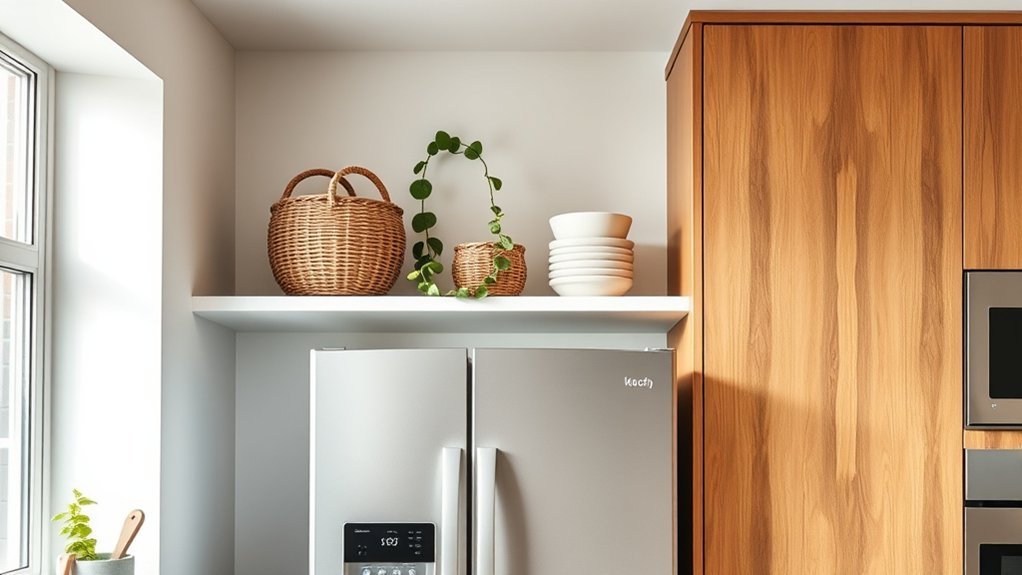
The space above a refrigerator can become useful storage or a clean design feature, but the safest plan starts with the refrigerator’s installation requirements. A properly mounted cabinet, shelf, or set of lightweight handled bins can make good use of this vertical space without interfering with ventilation, door movement, cleaning, or service access. Reserve high storage for light, infrequently used items rather than heavy cookware, loose breakables, food, or operating appliances.
Quick Answer
The safest use of space above a refrigerator is usually a properly mounted cabinet or shelf that respects the exact ventilation clearance in your refrigerator’s manual. Store light, infrequently used items in handled bins. Avoid blocking airflow or placing heavy, fragile, heat-sensitive, or operating appliances directly on top of the refrigerator.
Key Takeaways
- Check your refrigerator’s installation manual before adding cabinets, shelves, baskets, or decor around it.
- Treat a wall-mounted cabinet or shelf above the refrigerator differently from the refrigerator’s top surface.
- Use high storage for lightweight, occasional-use items that are easy to retrieve safely.
- Keep heavy appliances, loose glassware, food, liquids, and heat-sensitive items in more suitable locations.
- Match cabinetry, trim, or baskets to the kitchen if you want the refrigerator area to look built in.
Best Uses for Space Above Your Fridge
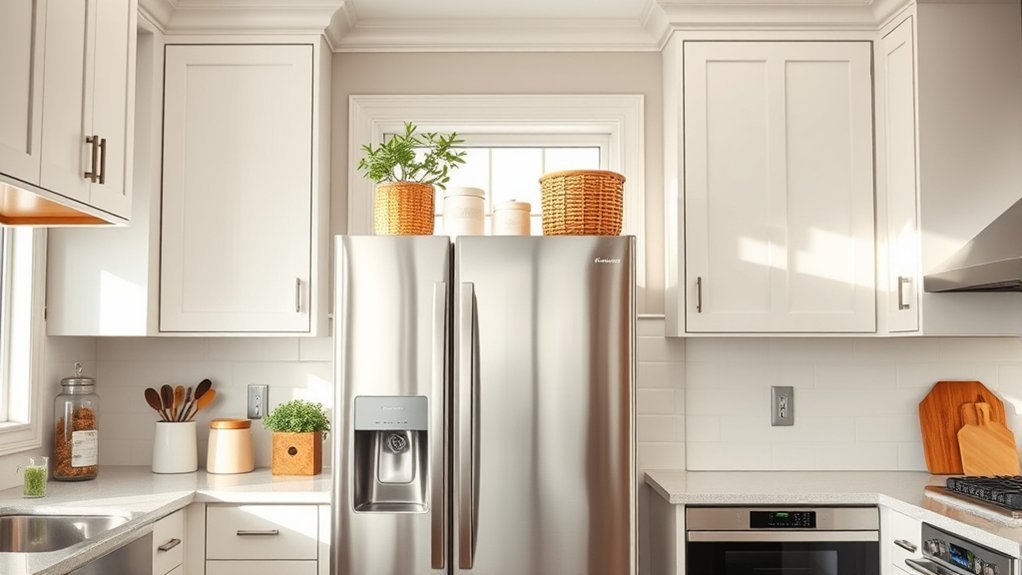
The gap above a fridge can become a practical extension of the kitchen instead of wasted vertical space. The best options are usually a properly mounted cabinet, a shelf that preserves the refrigerator’s required clearance, or lightweight storage baskets placed on a separate shelf rather than directly on the appliance.
Good candidates include serving trays, table linens, cake-decorating supplies, holiday accessories, cookbooks, lightweight baskets, and other items used only occasionally. Decorative pottery, framed art, or artificial greenery can also work when they are stable and do not interfere with required airflow.
Think of the area above the refrigerator as wall space to organize—not automatically as a storage surface on top of the appliance.
Decorative bins or baskets are especially useful because they hide visual clutter and make groups of small items easier to retrieve. Choose lightweight containers with handles so you can bring down the whole bin instead of reaching around above shoulder height.
If you dry herbs or vegetables at home, use a dedicated food-safe drying rack in an appropriate location rather than assuming the top of a refrigerator provides suitable drying conditions. Open refrigerator-top areas can collect dust and cooking grease, and some models require that the area remain unobstructed.
Check Refrigerator Clearance Before Adding Storage
Before installing anything above the refrigerator, find the model number and read its installation instructions. There is no single top-clearance measurement that applies to every refrigerator. Whirlpool, GE, Samsung, Bosch, LG, and other manufacturers specify different requirements depending on the appliance and installation.
For example, Whirlpool’s installation guidance tells owners to preserve ventilation space and consult the specific refrigerator manual, while GE Appliances likewise states that required clearances vary by installation and model.
Check more than the gap above the case. Make sure a new shelf or cabinet does not interfere with top hinges, full door opening, water lines, electrical connections, rear airflow, service access, or removal of the refrigerator.
Warning: Do not reduce a refrigerator’s required ventilation space just to gain extra storage. If your installation manual requires open space above, behind, or beside the appliance, preserve it.
What Not to Store Above a Fridge
High storage works best when the contents are light, stable, and used infrequently. Avoid turning the area into a catch-all.
- Very heavy cookware or countertop appliances
- Loose glass bottles or exposed fragile dishes
- Perishable foods or foods that require controlled storage conditions
- Cleaning chemicals or containers that could leak
- Loose paper piled directly on the appliance
- Operating appliances that produce heat, steam, or hot liquids
- Anything that blocks required ventilation or service access
LG also notes that placing objects directly on top of a refrigerator can create vibration or contribute to malfunction. If your refrigerator manufacturer discourages top storage, use independent cabinetry or shelving instead.
Add a Cabinet Above Your Fridge
A cabinet above the fridge can turn an awkward gap into useful storage for table linens, serving trays, seasonal pieces, and other items that do not need daily access. It also gives the refrigerator wall a more finished, built-in appearance.
The cabinet should be designed around the refrigerator rather than forcing the refrigerator into an undersized opening. Measure the appliance’s full height, including hinges and covers, and preserve every clearance required by the installation manual.
Matching side panels, door profiles, paint, stain, molding, or trim can help the new cabinet blend with the existing kitchen. A deeper refrigerator cabinet may also make contents easier to reach than a shallow cabinet recessed far behind the front of the refrigerator, but cabinet depth must still work with the room and appliance installation.
If you build the cabinet yourself, use materials and hardware suitable for wall cabinetry and follow the cabinet or fastening-system manufacturer’s installation instructions. Structural mounting should never depend on the refrigerator for support.
Pro Tip: Before building permanent cabinetry, consider the dimensions of a likely future replacement refrigerator. Leaving reasonable flexibility can prevent an otherwise good cabinet from limiting your appliance choices later.
Build an Open Shelf for Big Items
An open shelf can work above a refrigerator when you want easier access and a lighter look than enclosed cabinetry. Size the shelf for the actual opening, the objects you plan to store, and the refrigerator’s required ventilation rather than following a universal depth.
Plywood, solid wood, or another shelving material can work when paired with properly rated brackets or a tested mounting system. The shelf and fasteners must be appropriate for the wall construction and expected load.
Use the shelf for relatively light oversized items such as serving trays, placemats, cake boards, baskets, or lightweight platters. Avoid filling a high shelf with dense cast iron, heavy countertop appliances, or unstable stacks.
Shelf Size And Placement
Measure the refrigerator opening at several points before building a shelf. Record the fridge width, case height, hinge height, distance to the ceiling, nearby cabinet depth, and door swing.
Do not rely on a generic “1 to 2 inches” of top clearance. Manufacturer requirements vary. Samsung’s refrigerator installation guidance, for example, specifies model-related spacing and directs owners to check the refrigerator specifications before installation.
The shelf should also be positioned so you can reach its contents without leaning on the refrigerator. If accessing the shelf requires excessive stretching, use it only for very infrequent storage or choose a lower location.
Best Items To Store
The best objects for an open shelf above the fridge are light enough to retrieve comfortably and large enough that they will not disappear into clutter.
- Lightweight holiday platters and serving trays
- Table linens and placemats in a handled bin
- Cake boards and lightweight baking accessories
- Occasional entertaining supplies
- Cookbooks, if the shelf stays reasonably clean and dry
- Decorative baskets containing lightweight items
If you dry herbs, use a dedicated rack in a clean, food-appropriate area instead of hanging them above the refrigerator simply for warmth or airflow.
Store Oversized Kitchen Items
The space above the fridge can help with oversized kitchen items, but “oversized” should not automatically mean “heavy.” Large lightweight trays, serving boards, table linens, and occasional-use accessories are better candidates than heavy appliances or dense cookware.
A closed cabinet is usually more practical than the bare refrigerator top because it contains dust, controls clutter, and keeps objects from shifting with appliance vibration.
Handled baskets can divide the cabinet by use—such as holidays, baking, entertaining, or spare linens—so you can remove one group at a time.
Bulky Item Storage
Bulky but lightweight kitchen items can take up valuable lower-cabinet space even though they are used only a few times each year. Storing these items in an above-fridge cabinet can free easier-to-reach shelves for everyday cookware.
- Keep the lightest items highest.
- Use bins with sturdy handles.
- Avoid unstable stacks.
- Keep frequently used items below shoulder height when possible.
Seasonal rotation also helps. Remove items you no longer use instead of allowing the high cabinet to become permanent overflow storage.
Large Dish Display
Large serving pieces can create an attractive display when they are lightweight, stable, and supported by an independent shelf. A plate rack, bookend-style divider, or enclosed cabinet can help keep flat trays and platters from sliding.
Do not balance fragile or heavy dishes loosely on the refrigerator itself. If a piece would be difficult to lift safely from above shoulder height, give it a lower storage location.
Decorative boxes or baskets can contain smaller accessories while one or two stable display pieces add height without making the area look crowded.
Turn It Into a Coffee Bar
The area above the fridge can work as a coffee-supply station, especially when a cabinet keeps refills and accessories together. Store sealed coffee beans, filters, spare mugs, tea tins, French presses, or other non-operating equipment in clearly labeled containers.
Keep the actual brewing station on a normal countertop or another surface designed for appliance use. Running a coffee maker above a refrigerator can make filling, pouring, cleaning, steam management, and handling hot liquids unnecessarily awkward.
- Use handled bins for filters, pods, tea, and accessories.
- Keep frequently used supplies toward the front.
- Store lightweight mugs only when the cabinet has secure shelving.
- Match baskets or cabinet finishes to the surrounding kitchen.
This approach creates a compact coffee zone without asking the refrigerator top to function as an appliance counter.
Display Cookbooks Up Top
Cookbooks can turn an above-fridge shelf into both a practical library and a decorative display. They work best on a properly mounted shelf or inside cabinetry rather than resting directly on the appliance.
If the area is open, remember that kitchen grease and dust collect on exposed objects. Keep only a small, useful selection on display and clean the shelf periodically.
Cookbook Color Styling
Arranging cookbooks by color can create a simple focal point without adding more decorative objects. Another option is to group them by cuisine, author, or how often you use them.
Keep taller books toward the sides or back where they remain supported. Bookends can prevent a small collection from sliding, while one lightweight vase or art object can break up a long row.
Easy Recipe Access
If the shelf is safely reachable, place frequently used cookbooks toward the front and less-used reference books farther back. Grouping books by purpose can make recipes easier to find.
| Setup | Benefit |
|---|---|
| Most-used books at the front | Faster access |
| Group by cuisine or purpose | Easier locating |
| Use bookends | Reduces sliding and leaning |
Basket Storage Below
If an above-fridge shelf has room for baskets, use lightweight containers with handles so the entire basket can be removed safely. Recipe cards, spare napkins, small baking accessories, and occasional utensils are good candidates.
Woven, plastic, or lidded containers can all work. Choose a surface that can be cleaned easily because exposed kitchen storage eventually collects dust and grease.
- Group similar items together.
- Label containers that are difficult to see inside.
- Avoid overfilling baskets.
- Keep the heaviest storage at lower levels.
Keep Breakables and China Secure Up High
Seasonal china or special-occasion serving pieces can use an above-fridge cabinet when the cabinet is securely mounted and the items are easy to handle. Enclosed cabinetry is preferable to balancing fragile pieces on an exposed refrigerator top.
Use felt separators, plate dividers, soft cloth, or other protective materials to prevent pieces from rubbing together. Keep dishes arranged so you do not have to pull one heavy stack forward while standing on a step stool.
Note: High storage is better for lightweight, infrequently used pieces than for heavy stoneware, large glass objects, or valuable items that would be difficult to retrieve safely.
A closed cabinet also protects special dishes from kitchen grease and dust while freeing lower cupboards for everyday plates and bowls.
Make a To-Be-Recycled Bin
An above-fridge cabinet can hold a lightweight paper-only “to be recycled” or review bin when paperwork tends to accumulate on the counter. Keep the container inside dedicated cabinetry or on a properly mounted shelf rather than allowing loose papers to pile directly on the refrigerator.
Clear labeling keeps school papers, outdated notes, catalogs, and similar material together until you have time to sort them.
- Review the paper bin weekly.
- Recycle unwanted papers before the container becomes overloaded.
- Move important documents to proper long-term storage.
- Keep bottles, cans, wet recyclables, and food packaging in your normal recycling system instead.
A small paper-review bin can reduce counter clutter, but the goal is temporary organization rather than creating another permanent pile.
Add Tall Decor Accents
Tall decorative accents can help the refrigerator wall look intentional when there is enough safe space for them. Lightweight vases, framed art, artificial greenery, or sculptural objects can draw the eye upward without requiring much storage capacity.
Varying the height of two or three objects usually looks cleaner than filling the whole area. Choose stable pieces with broad bases, and avoid anything that could easily roll, tip, leak, or shatter.
If your refrigerator manufacturer advises against storing objects directly on the appliance, display decor on an independent shelf or cabinet instead. LG notes that objects placed on top of a refrigerator can contribute to vibration and malfunction.
Seasonal branches, greenery, or artwork can refresh the display without adding permanent clutter. Keep the arrangement simple enough that cleaning the area remains easy.
Match the Fridge Top to Your Cabinets
Matching the area above the fridge to the surrounding cabinetry creates a more built-in appearance than a collection of unrelated storage containers.
Painted plywood, matching cabinet doors, side panels, molding, or a coordinated open shelf can repeat the kitchen’s existing grain, sheen, color, and hardware. The visual goal is consistency, but the appliance’s installation requirements still come first.
- Match door style or trim where practical.
- Repeat existing cabinet colors or wood tones.
- Keep new panels clear of required ventilation paths.
- Allow full refrigerator door and hinge movement.
- Preserve access needed for cleaning and service.
When custom millwork is not practical, matching baskets on a properly installed shelf can achieve a similar visual effect with less permanent construction. Renters can also use removable decorative storage on an existing wall shelf rather than altering cabinetry or the appliance.
Frequently Asked Questions
How to Fill a Gap Above a Refrigerator?
First check the refrigerator’s required ventilation and hinge clearance. If the remaining space is usable, install a properly mounted cabinet or shelf, or use lightweight baskets on an existing shelf. Matching the finish to nearby cabinetry can make the gap look intentional while adding storage.
How to Decorate Space Above Refrigerator?
Use a small number of lightweight, stable items such as baskets, framed art, artificial greenery, or decorative vessels. Place them on an independent shelf or cabinet when possible, keep the display easy to clean, and never block the appliance clearance specified by the manufacturer.
What to Do With Extra Space Next to the Fridge?
A narrow space beside the fridge may work for a purpose-built pull-out pantry, tray divider, shallow shelving, or another slim organizer. Measure door swing and required side clearance first so the addition does not prevent the refrigerator doors or drawers from opening fully.
What Do People Put in the Cabinet Above the Fridge?
Good choices include lightweight serving trays, table linens, holiday accessories, baking supplies, cookbooks, and other occasional-use items. Use handled bins to group smaller objects. Keep very heavy cookware, unstable glassware, and frequently used essentials in easier-to-reach cabinets.
Can You Put Things Directly on Top of a Refrigerator?
Do not assume the refrigerator top is intended for storage. Check the owner’s or installation manual first. Required airflow, vibration, hinges, heat dissipation, and service access vary by model. A wall-mounted shelf or cabinet that preserves the specified clearance is usually a better storage solution.
How Much Space Should Be Left Above a Refrigerator?
There is no universal clearance that works for every refrigerator. Different manufacturers and models specify different top, side, and rear clearances. Use the installation instructions for your exact model before building a cabinet or shelf around it.
Sources
- Whirlpool Product Help — Refrigerator Location and Spacing Requirements — supports model-specific ventilation and clearance guidance.
- GE Appliances — Refrigerator Minimum Air Clearance Requirements — supports the need for installation-specific air clearance.
- Samsung Support — Refrigerator Installation and Setup — supports checking top, side, rear, and door-opening space during installation.
- LG Support — Refrigerator Rattling Noise — supports avoiding objects on the refrigerator that may contribute to vibration or malfunction.
Conclusion
The space above the fridge can provide useful storage, but the refrigerator’s installation requirements should determine what happens there. A properly mounted cabinet or shelf is usually more practical than piling objects directly on the appliance. Use the area for lightweight, occasional-use items, keep heavy and fragile objects lower, and preserve the airflow and access required by your exact refrigerator model.
Once those practical details are handled, matching cabinetry, baskets, books, or a restrained decorative display can make the refrigerator wall feel more organized and complete without sacrificing safety or function.
