
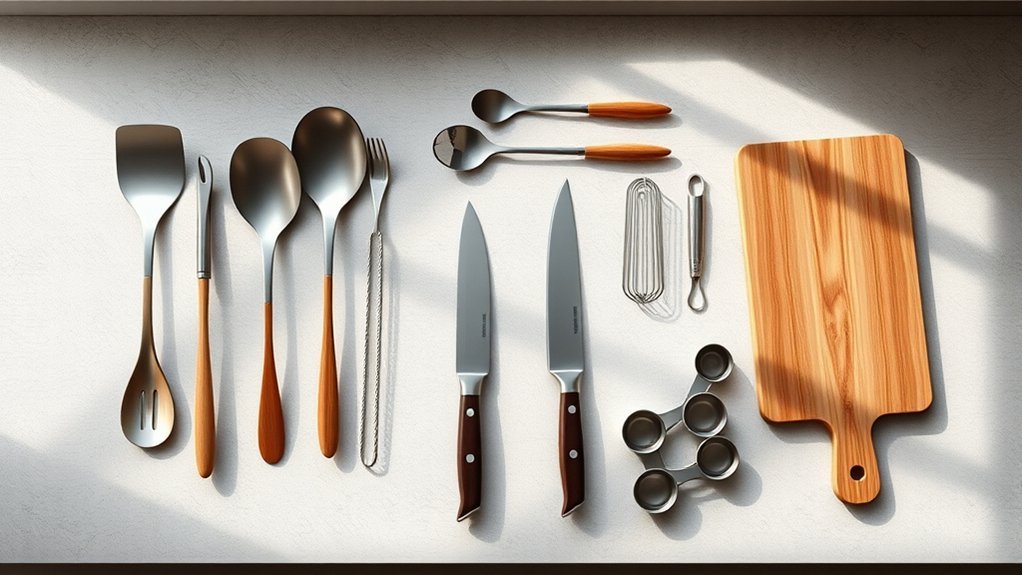
A practical kitchen utensil checklist starts with tools you will use repeatedly: a chef’s knife, cutting board, measuring cups and spoons, wooden or silicone spoon, kitchen shears, vegetable peeler, and can opener. Add a silicone spatula, whisk, tongs, mixing bowls, colander, ladle, and food thermometer as your cooking expands. Choose tools that feel balanced, suit your cookware, clean easily, and store without clutter.
Quick Answer
The most useful kitchen utensils are a chef’s knife, cutting board, measuring cups and spoons, wooden or silicone spoon, spatula, whisk, tongs, peeler, can opener, mixing bowls, colander, ladle, kitchen shears, and food thermometer. Start with multipurpose basics, then add baking and serving tools as you need them.
Key Takeaways
- Buy versatile tools first instead of filling drawers with large sets you may rarely use.
- A chef’s knife, stable cutting board, measuring tools, spoon, spatula, tongs, and mixing bowls cover many everyday jobs.
- Match the utensil material to the task and cookware; metal tools can damage some coated surfaces.
- Clean food-contact tools thoroughly and keep raw meat, poultry, and seafood from contaminating ready-to-eat foods.
- A kitchen scale and food thermometer add accuracy that ordinary utensils cannot provide.
What Kitchen Utensils Do You Need First?
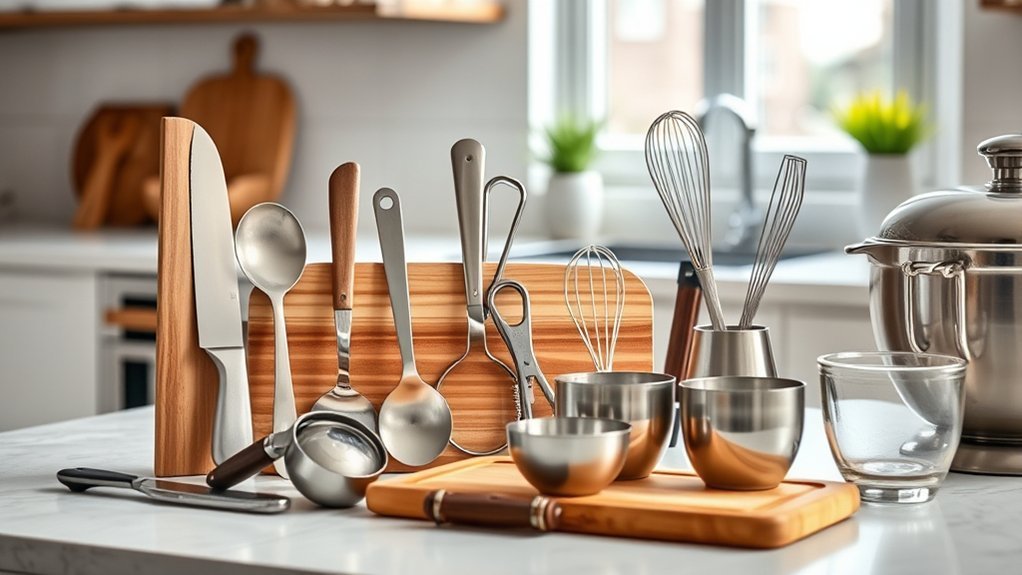
The first kitchen utensils to buy should cover the prep and cooking jobs you perform most often. A comfortable, sharp chef’s knife is one of the most versatile choices because it handles chopping, slicing, mincing, and dicing.
Start with a comfortable chef’s knife and a stable cutting board; together they cover a large share of everyday food preparation.
Pair the knife with a sturdy cutting board that stays flat during use. Wood and nonporous boards can both work well when cleaned correctly. For food safety, the USDA recommends using a separate board for raw meat, poultry, and seafood when practical and another for produce, bread, and other ready-to-eat foods.
Measuring cups and spoons come next because many recipes depend on consistent ingredient ratios. Keep dry measuring cups for ingredients such as flour or sugar and a marked liquid measuring cup for water, milk, oils, and similar liquids.
A wooden spoon or heat-rated silicone spoon is useful for stirring sauces, soups, and mixtures. These materials are generally gentler on coated cookware than metal tools, although you should always follow the cookware manufacturer’s care instructions.
A dependable can opener handles canned ingredients without improvised or unsafe opening methods. Tongs and a silicone spatula are also worthwhile early purchases because they cover flipping, tossing, scraping, folding, and transferring food.
Together, these kitchen essentials create a capable starting setup without filling drawers with rarely used gadgets.
Starter Kitchen Utensil Checklist
If you are building a kitchen from scratch, prioritize tools by how often they solve common tasks.
Buy These First
- Chef’s knife: chopping, slicing, dicing, and mincing.
- Cutting board: a stable surface for knife work.
- Measuring cups: measuring dry and liquid ingredients with the correct type of cup.
- Measuring spoons: small-volume ingredients and seasonings.
- Wooden or silicone spoon: stirring sauces, soups, and mixtures.
- Silicone spatula: scraping bowls, folding batters, and mixing.
- Tongs: turning, tossing, lifting, and serving food.
- Mixing bowls: organizing and combining ingredients.
- Can opener: opening standard food cans safely.
- Vegetable peeler: peeling potatoes, carrots, apples, and similar produce.
Add These Next
- Whisk: eggs, sauces, dressings, and batters.
- Colander: draining pasta and rinsing produce.
- Kitchen shears: herbs, packaging, trimming, and selected poultry-prep jobs.
- Ladle: soups, stews, sauces, and punch.
- Grater or zester: cheese, citrus zest, vegetables, garlic, and spices.
- Fine-mesh sieve: sifting, straining sauces, and rinsing small ingredients.
- Food thermometer: verifying safe internal temperatures.
- Kitchen scale: precise weight-based recipe measurements.
Pro Tip: Buy individual multipurpose tools before buying a large utensil set. Sets can be convenient, but they may include duplicate or specialized pieces that take up space without solving a regular cooking need.
Must-Have Kitchen Utensils for Prep Work
For prep work, a chef’s knife remains one of the most useful utensils because it can perform most routine chopping, slicing, mincing, and dicing tasks with one blade.
A sturdy cutting board provides a stable work surface and protects countertops. Wood and quality nonporous boards can both work; the more important factors are stability, cleaning, and replacing a board when deep grooves become difficult to clean.
Measuring cups and measuring spoons support consistent results in recipes that depend on exact proportions. Kitchen shears are useful for snipping herbs, trimming selected foods, and opening food packaging, while a vegetable peeler removes skins efficiently from potatoes, carrots, apples, and similar produce.
A colander helps rinse produce and drain pasta, while a grater or zester handles cheese, citrus peel, garlic, and vegetables. Mixing bowls keep chopped and measured ingredients organized before cooking begins.
Together, these prep tools reduce unnecessary switching between gadgets and create a cleaner, more efficient work area.
Cook and Serve With Essential Kitchen Utensils
Essential cooking utensils include spatulas, spoons, whisks, tongs, and ladles. Knives, cutting boards, measuring tools, and mixing bowls support preparation before ingredients reach the stove or oven.
Serveware should make portioning and transferring food controlled and comfortable, particularly with soups, stews, casseroles, salads, pasta, and delicate foods.
Proper cleaning and storage help keep every item hygienic, accessible, and in usable condition.
Essential Cooking Tools
A small core of reliable tools can handle many cooking jobs. A chef’s knife anchors prep, while silicone spatulas scrape bowls, fold mixtures, and work well on cookware surfaces that should not be contacted by metal utensils.
A wooden spoon is useful for steady stirring. Tongs provide a secure grip for flipping, tossing, and transferring hot food. A whisk combines eggs, sauces, dressings, and batters, while a ladle portions soups and stews.
Measuring cups and spoons provide repeatable portions. Mixing bowls organize ingredients before cooking and can also serve simple salads and side dishes.
A stainless steel skillet and a frying pan or non-stick pan also add cooking flexibility, although these are cookware rather than utensils. Keeping that distinction clear makes a shopping checklist easier to organize.
Serveware And Utensils
An effective cook-and-serve setup uses a small collection of dependable tools that move food neatly from cookware to the table. Serving dishes in several practical sizes work for salads, casseroles, vegetables, grains, and shared mains.
A serving utensil set can include a ladle, slotted spoon, serving spoon, serving fork, and tongs. Stainless steel is strong and useful for many serving jobs, while heat-rated silicone is useful when a utensil may touch coated cookware.
Measuring spoons remain useful for accurate seasoning, particularly when following a new recipe.
- Serving platters for mains and shared dishes
- Bowls for sides, grains, salads, and sauces
- Measuring spoons for precise preparation
- A small utensil set for cooking and serving
Storage And Care
Proper storage keeps kitchen utensils protected and easy to reach. A knife block, in-drawer knife organizer, or properly installed magnetic strip protects knife edges better than leaving loose blades in a crowded drawer.
Drawer organizers and utensil trays keep spatulas, whisks, peelers, and measuring spoons visible instead of piled together. Frequently used cooking tools can also be kept in a stable countertop crock if they are safely away from burners.
Wash utensils according to their material and the manufacturer’s directions. Wooden utensils generally should not be left soaking because prolonged moisture can encourage swelling, cracking, or splitting. Silicone and plastic tools should be kept away from direct burner flames and heating elements.
Assigning designated areas for baking, prep, cooking, and serving tools makes storage simpler and reduces time spent searching while cooking.
Which Kitchen Utensil Materials Are Best?
No single material is best for every utensil. Choose according to heat exposure, flexibility, cookware surface, cleaning method, and the job the tool performs.
- Stainless steel: strong, rigid, and suitable for many high-heat cooking and serving tasks. Avoid scraping coated nonstick cookware with metal unless its manufacturer specifically allows it.
- Silicone: flexible and useful for scraping, stirring, and coated cookware. Check the manufacturer’s stated temperature limit because heat resistance varies by product.
- Wood: comfortable, rigid enough for stirring, and generally gentle on cookware. Hand washing and prompt drying help reduce cracking and splitting.
- Nylon or plastic: lightweight and often inexpensive. Heat tolerance varies, so keep these tools away from flames, hot heating elements, and temperatures above their rated limit.
Note: “Dishwasher safe” describes a permitted cleaning method; it does not automatically mean an utensil is stronger or will last longer. Follow the manufacturer’s washing instructions for the specific material.
Kitchen Utensil Safety and Cross-Contamination
Kitchen utensils can transfer microorganisms from raw foods to foods that will not receive further cooking. The USDA cutting-board guidance recommends using a separate cutting board for fresh produce and bread and another for raw meat, poultry, and seafood when practical.
Wash cutting boards, knives, dishes, and other food-contact utensils with hot, soapy water after use and especially after contact with raw meat, poultry, seafood, or eggs. USDA also advises replacing cutting boards that develop excessive wear or deep, hard-to-clean grooves.
Warning: Do not use the same unwashed cutting board, plate, knife, or serving utensil for raw animal foods and ready-to-eat or cooked foods. Clean the item before changing tasks to reduce cross-contamination.
A food thermometer also belongs in a complete kitchen. The USDA recommends using a food thermometer to verify that meat, poultry, seafood, egg dishes, and other temperature-sensitive foods reach their safe minimum internal temperature rather than relying only on appearance.
Measuring Kitchen Utensils That Save Every Recipe
Consistent measurement is especially important in baking and in recipes where ingredient ratios affect texture or structure. Measuring cups, measuring spoons, and a kitchen scale are therefore useful essential kitchen utensils.
- Dry measuring cups commonly include 1/4-, 1/3-, 1/2-, and 1-cup sizes and are designed to be filled and leveled.
- Liquid measuring cups have a pouring spout and marked scale so liquids can be measured without filling a cup to the rim.
- Measuring spoons commonly include 1 tablespoon, 1 teaspoon, 1/2 teaspoon, and 1/4 teaspoon.
- Magnetic measuring spoons are an optional convenience that can help keep a set together.
For recipes written by weight, a kitchen scale can provide more repeatable measurements than volume cups. The National Institute of Standards and Technology recommends measuring ingredients by mass with an appropriate kitchen scale when improved recipe accuracy is desired.
Together, these tools reduce guesswork and make successful results easier to repeat.
Baking Kitchen Utensils Every Home Cook Needs
Beyond accurate measuring tools, baking relies on a compact group of utensils that help combine, aerate, sift, scrape, and portion ingredients consistently.
A stainless steel mixing bowl set is useful for combining ingredients in small or large batches. Sets with lids can also keep prepared ingredients covered before the next step.
A well-sized mixing bowl set keeps ingredients organized whether you are preparing a small batter or a larger batch.
Measuring cups, spoons, and a kitchen scale support repeatable ingredient quantities when preparing cookies, cakes, breads, and pastries.
A sturdy whisk combines liquids, beats eggs, and introduces air into selected mixtures. A fine-mesh sieve breaks up lumps in flour, cocoa, powdered sugar, and other dry ingredients and can also strain sauces.
A silicone spatula helps fold delicate mixtures, scrape batter from the sides of a bowl, and transfer mixtures with less waste.
Together, these baking utensils make measuring, mixing, and cleanup more controlled and predictable.
How to Pick Kitchen Utensils That Last
Choosing kitchen utensils that last requires looking beyond the material name. Construction, joints, handle comfort, temperature limits, cleaning requirements, and the amount of stress placed on the tool all matter.
- Check the grip: Choose handles that feel secure in dry and slightly wet hands without sharp edges or uncomfortable pressure points.
- Inspect joints: Loose heads, weak welds, large gaps, and flexible connections can become failure points.
- Match the material to the job: Use metal where rigidity and high-heat durability are useful, and gentler materials where cookware surfaces require them.
- Check heat limits: Silicone, nylon, and plastic tools should have clear manufacturer temperature guidance when used near high heat.
- Follow cleaning instructions: Dishwasher-safe construction can simplify cleanup, but wooden pieces and some specialty tools may last better with hand washing.
- Prefer multipurpose tools: A versatile whisk, spatula, pair of tongs, or spoon often provides more value than a single-purpose gadget.
- Use reviews carefully: Look for recurring comments about loose handles, warping, breakage, rust, staining, or premature wear rather than judging quality from star rating alone.
Well-made utensils should feel comfortable and stable during the jobs for which they were designed. Balanced construction and secure handles can make repetitive preparation easier and safer.
In a well-organized kitchen, each tool should justify its space through frequent use, versatility, or a specific task that other utensils cannot perform well.
When Should Kitchen Utensils Be Replaced?
Kitchen utensils do not all follow the same replacement schedule. Inspect their condition rather than replacing them simply because they reach a certain age.
- Cutting boards: replace boards with excessive wear or deep grooves that are difficult to clean.
- Wooden utensils: replace pieces that are badly split, deeply cracked, splintering, or impossible to clean thoroughly.
- Silicone or nylon utensils: replace pieces that are torn, badly warped, separating from their handles, or otherwise damaged.
- Metal utensils: replace tools with loose handles, sharp unintended edges, broken welds, or corrosion that cannot be removed safely.
- Can openers and peelers: replace them when mechanical parts no longer operate reliably or cutting edges are damaged beyond practical maintenance.
Regular inspection is more useful than an arbitrary calendar schedule because tool quality and usage vary widely between kitchens.
Frequently Asked Questions
What Are the 10 Most Important Kitchen Utensils?
A practical top 10 is a chef’s knife, cutting board, measuring cups, measuring spoons, wooden or silicone spoon, mixing bowls, whisk, silicone spatula, tongs, and can opener. A vegetable peeler and colander are useful next additions. These tools cover measuring, chopping, stirring, mixing, flipping, and basic ingredient preparation.
What Are 20 Essential Kitchen Items?
Twenty useful kitchen items are a chef’s knife, cutting board, measuring cups, measuring spoons, mixing bowls, nonstick frying pan, saucepan, stockpot, baking sheet, silicone spatula, whisk, tongs, peeler, colander, wooden spoon, can opener, food thermometer, storage containers, dish towels, and blender. This broader list includes cookware, storage, textiles, and an appliance in addition to true utensils.
What Are the Essential Cooking Utensils That Every Kitchen Needs?
Most kitchens benefit from a chef’s knife, cutting board, measuring cups and spoons, wooden or silicone spoon, silicone spatula, whisk, tongs, mixing bowls, colander, peeler, can opener, and food thermometer. Together they handle common prep, measuring, stirring, flipping, straining, and safety checks without requiring a drawer full of specialized gadgets.
What Are 15 Essential Kitchen Tools?
Fifteen versatile choices are a chef’s knife, cutting board, measuring cups, measuring spoons, mixing bowls, whisk, silicone spatula, tongs, grater or zester, food thermometer, storage containers, vegetable peeler, ladle, can opener, and colander. This group supports accurate prep, cooking, serving, draining, temperature checking, and storage.
Which Material Is Best for Kitchen Utensils?
There is no single best material. Stainless steel provides rigidity and durability, silicone is flexible and useful with many coated pans, wood is comfortable and generally gentle on cookware, and nylon or plastic can be light and inexpensive. Match the material to the cookware surface, temperature, cleaning method, and task.
How Often Should Kitchen Utensils Be Replaced?
Replace utensils based on condition rather than a fixed schedule. Deeply grooved cutting boards, cracked or splintering wood, torn silicone, badly warped plastic, loose handles, broken joints, and damaged cutting mechanisms are signs that a tool may no longer be safe or practical to use.
Conclusion
An efficient kitchen begins with a small group of reliable utensils rather than a crowded drawer. A comfortable chef’s knife, stable cutting board, sturdy spoon, silicone spatula, measuring tools, mixing bowls, whisk, and dependable tongs cover many everyday jobs. A food thermometer, colander, peeler, can opener, kitchen shears, and scale expand what you can do safely and accurately. Choosing durable, comfortable tools that suit your cookware saves space, simplifies preparation, and makes everyday cooking easier.
Sources
- USDA Food Safety and Inspection Service — Cutting Boards — cutting-board cleaning, separation, sanitation, and replacement guidance.
- USDA Food Safety and Inspection Service — Cleanliness Helps Prevent Foodborne Illness — cleaning utensils and food-contact surfaces.
- USDA Food Safety and Inspection Service — Food Thermometers — using thermometers to verify safe internal temperatures.
- National Institute of Standards and Technology — Culinary Measurement Tips — kitchen scales, measuring cups, and measurement accuracy.
