
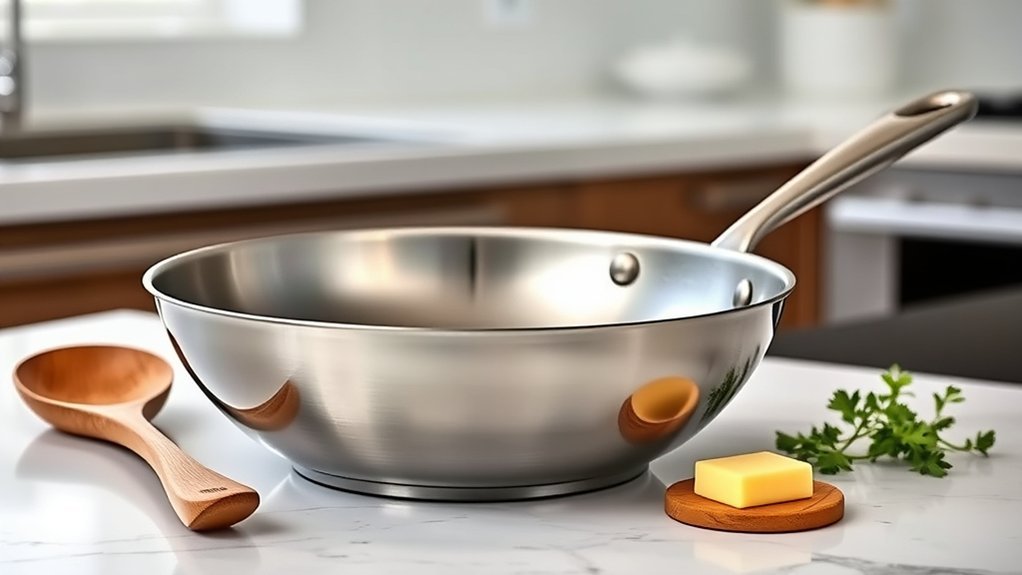
A sauté pan is a wide, flat-bottomed pan with straight sides, usually paired with a lid. The shape gives food plenty of contact with the base while helping contain sauces, oil, and juices. It works especially well for browning meat, sautéing vegetables, simmering sauces, shallow frying, braising, deglazing, and stovetop-to-oven cooking. Common household capacities are roughly 3 to 6 quarts, although dimensions vary by manufacturer.
Quick Answer
A sauté pan combines a broad, flat cooking base with straight sides that hold liquids and reduce spills. Choose it for searing, pan sauces, braising, shallow frying, and larger one-pan meals. A frying pan is usually better when you want sloped sides for easy flipping, tossing, and fast dry-heat cooking.
Key Takeaways
- Straight sides increase containment and make a sauté pan useful for sauces, braises, and shallow frying.
- A frying pan has flared sides that make flipping and tossing easier.
- Heat distribution depends mainly on the pan’s material, thickness, construction, and burner coverage, not simply on whether its sides are straight.
- Check the manufacturer’s oven-temperature and induction-compatibility ratings before buying or oven-finishing a dish.
- For most home kitchens, capacity matters, but the actual flat cooking-base diameter is also important when comparing models.
What Is a Sauté Pan?
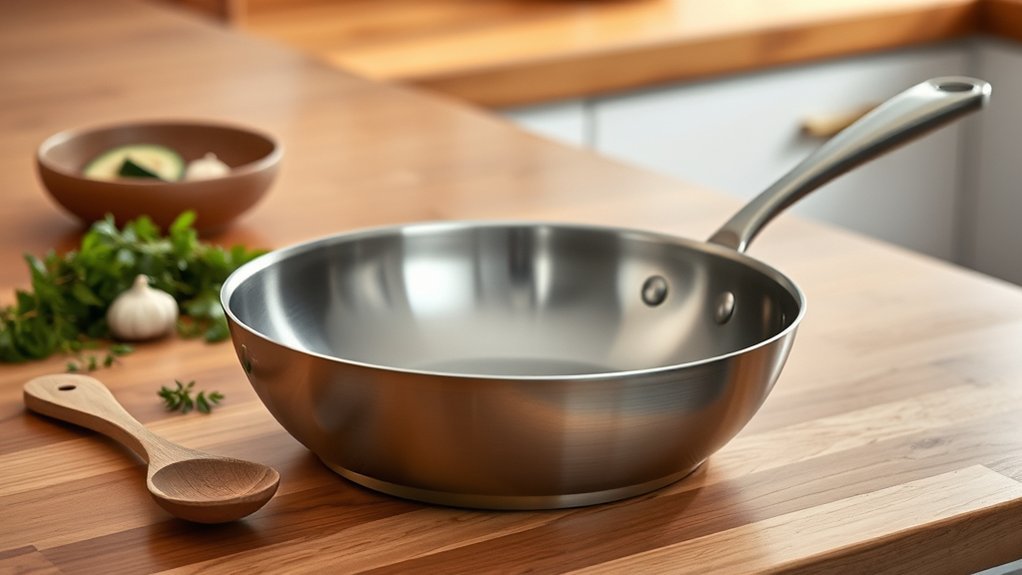
A sauté pan has a broad, flat bottom and straight or nearly vertical sides. Compared with a frying pan with strongly flared walls, this shape helps keep liquid, oil, and food inside the pan while still providing a large area for browning.
A fitted lid is common and makes the pan more useful for covered simmering and braising. For example, All-Clad describes its D3 sauté pan as having straight sides that hold liquids and reduce splatter, while its lid helps retain moisture during covered cooking.
The sauté pan’s main advantage is not that straight walls create more even heat; it is that a broad base and contained sides let the cook move easily from browning to deglazing, simmering, and braising in one vessel.
Unlike the original claim that a sauté pan requires constant stirring, the correct technique depends on the food. Meat often needs to remain undisturbed long enough to brown, while sauces may need occasional stirring and braises may need very little movement.
Sauté Pan vs. Frying Pan
The clearest difference is sidewall shape. A sauté pan has straight sides, while a frying pan or skillet normally has sloped or flared sides. That difference changes how the pans handle liquids, tossing, evaporation, and usable space near the base.
| Feature | Sauté Pan | Frying Pan |
|---|---|---|
| Sides | Straight or nearly vertical | Sloped or flared |
| Best for liquids | Excellent containment | Less containment near the rim |
| Tossing and flipping | Possible, but straight walls are less helpful | Flared sides make tossing and spatula access easier |
| Typical strengths | Searing, pan sauces, braising, shallow frying, one-pan meals | Eggs, pancakes, quick sautés, searing, flipping and tossing |
| Lid | Commonly included | Varies by model |
Shape and Cooking Area
Straight sides allow a sauté pan to keep more of its width through the lower part of the vessel. A frying pan narrows as its walls slope toward the base. As a result, a sauté pan can offer a generous flat cooking area relative to its overall diameter.
However, there is no reliable universal rule such as “a 12-inch sauté pan has 113 square inches while a 12-inch frying pan has 79.” Manufacturers measure and shape pans differently. If base area matters, compare the actual flat interior diameter listed or measured for the specific models.
Heat, Searing, and Tossing
The two shapes encourage different movements, but shape alone does not determine heat evenness. Heating performance depends on factors such as material, pan thickness, bonded layers, burner size, and how closely the pan matches the heat source.
For example, clad stainless cookware often sandwiches a more conductive material such as aluminum between stainless-steel layers. This construction improves heat distribution while retaining the durability and cooking surface of stainless steel.
A frying pan’s sloped walls make it easier to slide a spatula underneath food or toss ingredients with a wrist motion. A sauté pan favors containment and a larger enclosed volume.
- Sauté pan: useful when sauces, oil, stock, or larger batches need to stay contained.
- Frying pan: convenient when frequent flipping, tossing, or fast utensil access matters.
- Both: can sear effectively when properly preheated and matched to the food and burner.
When to Use Each
Choose a sauté pan when a recipe starts with browning and then adds liquid. Chicken with a pan sauce, braised vegetables, shallow-fried cutlets, curries, and one-pan meals are natural fits.
Choose a frying pan when you want to flip eggs, pancakes, fish, or other foods easily, or when ingredients need frequent tossing. Neither pan is automatically better; the right shape depends on the cooking method.
Best Uses for a Sauté Pan
The sauté pan is especially useful when several cooking techniques happen in the same vessel. Its broad base handles browning, while its sides leave room for liquid, vegetables, and sauces afterward.
Searing Meats
A broad cooking surface makes a sauté pan useful for searing steaks, chops, cutlets, chicken pieces, and other proteins. The most important step is to avoid crowding. When too much cold food enters the pan at once, the pan temperature falls and released moisture can slow browning.
Pat food reasonably dry, preheat the pan as appropriate for its material, add the recommended fat, and leave enough room between pieces for moisture to escape.
Pro Tip: After browning meat, use the browned residue on the pan to build a sauce. Add an appropriate liquid such as stock, wine, or water, loosen the browned bits with a wooden spoon or spatula, then reduce the liquid to the desired consistency.
Warning: Browning does not prove that meat is safely cooked. The USDA recommends checking internal temperature with a food thermometer. Current guidance lists 145°F with a three-minute rest for whole cuts of beef, pork, veal, and lamb; 160°F for ground meats; and 165°F for poultry.
Saucy Dishes
Straight sides make a sauté pan particularly useful for sauces, curries, braises, and one-pan dishes. Ingredients can be browned first and then combined with stock, tomatoes, cream, or another liquid without transferring everything to a different vessel.
The broad base can also speed a reduction because a larger exposed liquid surface allows more evaporation. If the goal is to retain moisture instead, adding the fitted lid reduces evaporation substantially.
Oven Finishing
An oven-safe sauté pan can move from stovetop to oven for dishes that need additional cooking, browning, or gentle braising. This is useful for thick cuts of meat, baked egg dishes, braised chicken, and recipes that begin with stovetop searing.
Do not assume every sauté pan, handle, or lid has the same heat rating. Stainless-steel models, coated nonstick models, and pans with glass lids can have very different limits.
Note: Check the manufacturer’s maximum oven temperature for the exact pan and lid before oven use. The pan body’s rating does not automatically mean every lid, knob, coating, or accessory has the same limit.
Sauté Pan Size and Capacity
Sauté pans are often sold by quart capacity, while frying pans are more commonly marketed by diameter. Common home-kitchen sauté pans fall around 3 to 6 quarts, but manufacturers also sell smaller and intermediate capacities.
| Approximate Capacity | Best Fit | Typical Tasks |
|---|---|---|
| Around 3 qt | Smaller meals and kitchens | Vegetables, smaller protein portions, sauces, side dishes |
| Around 4–5 qt | General-purpose family cooking | One-pan meals, braises, larger batches, shallow frying |
| Around 6 qt | Large batches | Family meals, larger cuts, batch cooking, substantial braises |
Capacity does not tell the whole story. Two pans with similar quart ratings can have different base diameters, wall heights, weights, and handle designs. When browning performance matters, compare the flat cooking-base dimensions in addition to total capacity.
When a Sauté Pan Makes Sense
A sauté pan makes the most sense when a recipe needs both a broad browning surface and enough wall height to contain liquid. It is particularly efficient for dishes that move through several stages without changing pans.
- Choose it for recipes that begin with searing and finish with sauce, stock, or wine.
- Use it for deglazing, reducing, shallow frying, braising, and covered simmering.
- Choose a larger model when food must spread out instead of steaming in a crowded pan.
- Use a frying pan instead when flipping, tossing, and quick utensil access are the priority.
A sauté pan is therefore less a replacement for a skillet than a complementary shape. Cooks who often make pan sauces, braised dishes, or larger one-pan meals are most likely to notice the advantage.
What to Look for in a Sauté Pan
A good sauté pan should match the way you cook, the size of your burners, and the weight you can comfortably handle. Construction matters at least as much as the material named on the outside of the box.
Materials and Construction
Clad stainless steel is a strong all-purpose choice for browning, deglazing, acidic sauces, and long service life. Stainless steel itself is not a highly conductive metal, so quality clad pans commonly use an aluminum or other conductive core to spread heat more effectively.
Nonstick sauté pans reduce sticking and simplify cleanup, but their coatings have manufacturer-specific care requirements and oven-temperature limits. Avoid assuming that a nonstick model tolerates the same heat as an uncoated stainless pan.
Carbon steel can develop a seasoned cooking surface and works well for high-heat browning, but seasoning and acidic-food compatibility require more attention than with stainless-clad cookware.
Lid, Handles, and Weight
A close-fitting lid increases versatility for simmering and braising. On larger sauté pans, a helper handle opposite the main handle can make a full pan easier to lift.
Weight matters because a sauté pan may hold several pounds of food and liquid. A heavier pan may feel stable on the burner, but it can become difficult to maneuver once loaded.
Induction and Oven Compatibility
If you cook on induction, confirm that the exact pan is induction compatible. Many stainless-clad pans are designed for induction, but compatibility depends on the magnetic properties of the pan’s base.
For oven cooking, check the manufacturer’s temperature limit for the pan, handle, lid, knob, and coating. Published limits can differ significantly even between products from the same brand.
Rim and Pouring
A flared or shaped pouring rim can make it easier to transfer sauces without dripping down the outside of the pan. This is a useful detail if you frequently make reductions, gravies, or pan sauces.
How to Use a Sauté Pan Well
For better browning, start with a pan that is large enough for the food to sit in a single uncrowded layer. Preheat according to the pan material and recipe, add the appropriate cooking fat, and dry wet ingredients when browning is the goal.
Allow meat or vegetables to develop color before moving them unnecessarily. After browning, lower the heat if needed before adding aromatics or liquid. Straight sides make the pan convenient for deglazing and simmering without transferring the food.
When reducing a sauce, leave the lid off so moisture can escape. When braising or trying to retain moisture, cover the pan according to the recipe.
Care and Maintenance
Care depends on material, so the manufacturer’s instructions should take priority. For stainless steel, allow a very hot pan to cool before washing rather than placing it immediately under cold water. Sudden temperature changes can contribute to warping.
Nonstick coatings generally benefit from gentler utensils and cleaning methods. Carbon steel normally needs drying and seasoning maintenance to limit rust and preserve its cooking surface.
Before using abrasive pads, dishwasher cycles, oven cleaners, or very high heat, check the specific manufacturer’s directions because acceptable cleaning methods vary widely between cookware lines.
Frequently Asked Questions
What’s the Difference Between a Frying Pan and a Sauté Pan?
A frying pan has sloped or flared sides that make flipping, tossing, and utensil access easier. A sauté pan has straight sides that contain liquids and give the vessel more enclosed capacity. Both can sear and sauté, but the sauté pan is usually more convenient for pan sauces, braises, shallow frying, and dishes that add liquid after browning.
What Do You Use a Sauté Pan For?
Use a sauté pan for browning meat, sautéing vegetables, deglazing, simmering sauces, shallow frying, braising, reducing liquids, and one-pan meals. An oven-safe model can also move from the stovetop into the oven, provided the pan and lid remain within their manufacturer-rated temperature limits.
Do You Really Need a Sauté Pan?
No. A good frying pan, saucepan, or Dutch oven can cover many of the same jobs. A sauté pan becomes especially useful if you regularly make pan sauces, braises, shallow-fried foods, or larger one-pan meals and want a wide base without low, flared sides.
What Is the Difference Between Sautéing and Pan Frying?
Sautéing generally cooks food over a broad hot surface with a relatively small amount of fat, with ingredients turned or moved as needed. Pan frying normally uses a deeper layer of fat so more of the food’s lower surface is surrounded by hot oil. Pan frying is common for thicker or breaded foods, while sautéing is common for smaller or thinner ingredients.
What Size Sauté Pan Is Best for Most Home Cooks?
A pan in roughly the 3- to 5-quart range covers many everyday tasks, but capacity alone is not enough. Compare the flat base diameter, total weight, burner size, handle design, and the amount of food you normally cook. Larger 5- to 6-quart pans are useful when crowding is a frequent problem.
Conclusion
A sauté pan is a versatile choice when cooking needs to move from browning to sauce, simmering, braising, or shallow frying without changing vessels. Its straight sides improve containment, while its broad base provides room for searing and larger batches. A frying pan remains better for easy flipping and tossing, so the two shapes complement rather than replace each other. When choosing a sauté pan, pay closest attention to base size, construction, weight, lid and handle design, induction compatibility, and the manufacturer’s oven rating.
Sources
- All-Clad D3 Stainless 5-Quart Sauté Pan — straight-side design, lid, bonded construction, induction compatibility, and oven rating.
- All-Clad HA1 Expert Nonstick Sauté Pan — nonstick construction and model-specific oven-temperature guidance.
- Made In Stainless Clad Sauté Pan — sauté-pan uses, multi-ply construction, induction compatibility, and oven rating.
- USDA Food Safety and Inspection Service: Safe Minimum Internal Temperature Chart — minimum internal cooking temperatures for meat and poultry.

2 thoughts on “What’s a Saute Pan? Meaning, Uses & Key Facts”