
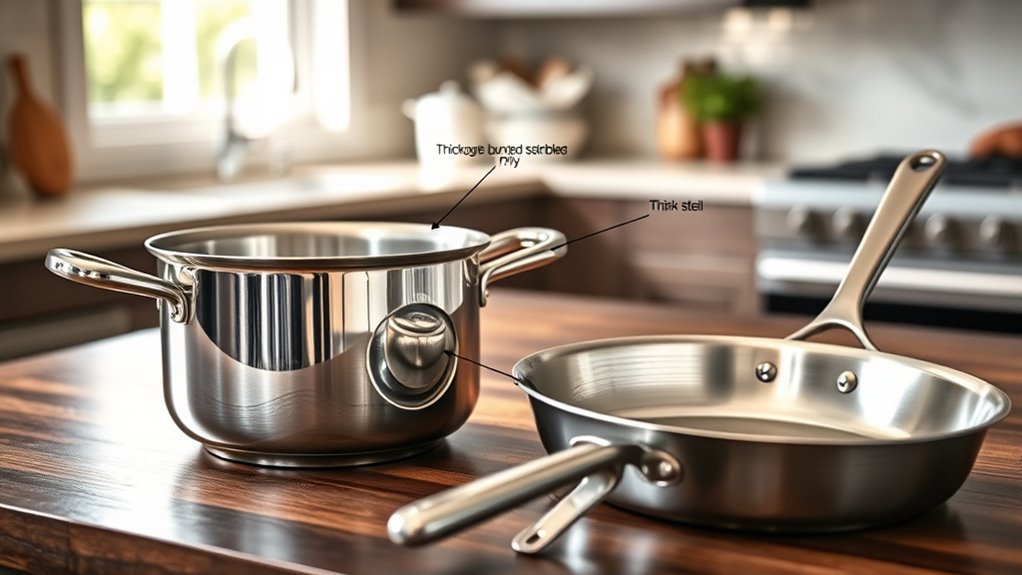
Think of All‑Clad as engineered cookware rather than mere pots—you’ll get layered metals chosen for function over flair. You work with a stainless exterior bonded to conductive cores like aluminum, copper, or multiple alternating layers, all designed for predictable heat control and durability. I’ll walk you through how D3, D5, and Copper Core differ, what nonstick and hard‑anodized options cost you in performance, and which features matter for your stove and habits.
Quick Answer: What All‑Clad Pots Are Made Of
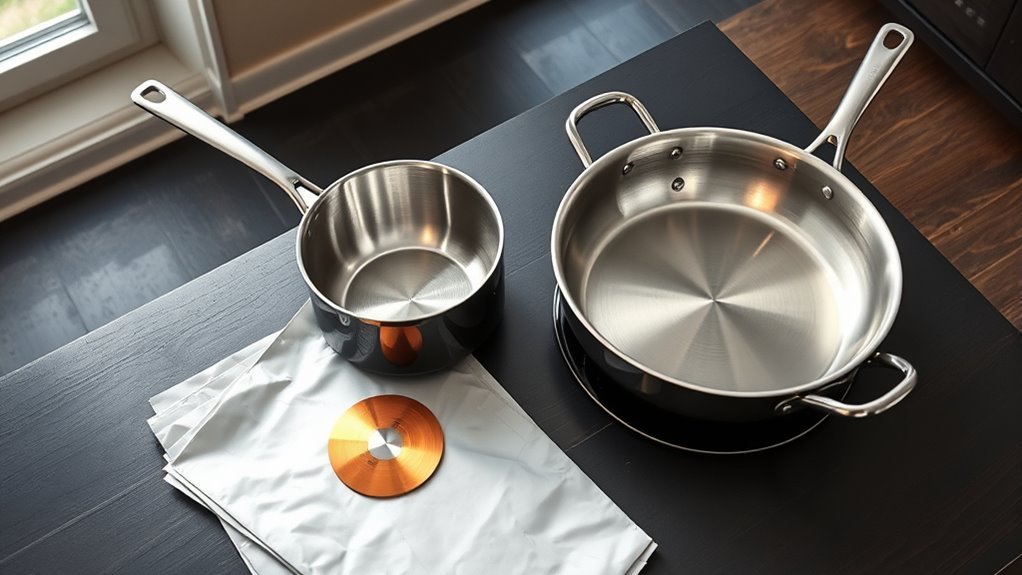
Materials define All‑Clad pots’ performance: they pair stainless steel exteriors for durability and corrosion resistance with layered cores—copper in the Copper Core line and multi‑ply aluminum in D3/D5 constructions—to deliver rapid, even heat conduction and retention.
You’ll recognize All-Clad by that stainless steel shell that resists corrosion while providing a neutral, non-reactive cooking surface. Where targeted heat transfer matters, Copper Core inserts a copper layer to maximize heat conductivity and precise temperature control.
D3’s tri-ply and D5’s five-ply configurations distribute and retain heat more uniformly, reducing hot spots and improving responsiveness.
For lower-weight, abrasion-resistant options, hard anodized aluminum bodies offer enhanced durability and a textured surface that supports a non-stick finish.
All-Clad’s PTFE-based non-stick interiors prioritize release and cleanup without sacrificing performance.
You can choose based on control versus convenience: layered stainless constructions for consistent thermal behavior, Copper Core for speed and finesse, hard anodized/PTFE for freedom from sticking and easier maintenance.
Core Construction: Stainless Exterior + Bonded Aluminum or Copper Core
Think of the pot’s shell as the protective framework: All‑Clad bonds a stainless steel exterior to a conductive core of either aluminum or copper, producing a composite that combines corrosion resistance with rapid, controlled heat transfer.
You’ll rely on that stainless steel surface for durability, a neutral cooking interface, and the polished look suited to professional kitchens. Inside, the bonded aluminum or copper core dictates heat conductivity and thermal performance; aluminum gives you quick, even cooking and excellent retention, while a copper core raises responsiveness for more delicate temperature control.
The multi-ply construction mechanically bonds these layers to eliminate hot spots and deliver predictable cooking results across stovetops.
You can push techniques that demand precision because the assembly maintains structural integrity under high heat and repeated use. This design philosophy liberates you from uneven pans and lets technique—not equipment—limit outcome, offering consistent, professional-grade cooking results with minimal maintenance.
D3 vs D5 vs Copper Core : What the Layers Mean for Heat
You’ll compare how D3’s tri‑ply, D5’s five‑ply, and Copper Core’s copper‑center stacks alter thermal behavior and mass.
Focus on layer composition to quantify heat distribution efficiency, retention, and thermal responsiveness.
Also assess how added plies and copper affect overall weight and the speed at which the pan tracks temperature changes.
Layer Construction Differences
Because the number, type, and thickness of layers directly determine thermal mass, conductivity, and responsiveness, choosing between D3, D5, and Copper Core comes down to how you balance quick heat-up, even distribution, and precise control.
You’ll evaluate layer construction choices technically and strategically to claim freedom from poor cookware.
- D3 Construction: tri-ply stainless steel–aluminum–stainless steel for fast heat-up and reliable heat distribution.
- D5 Construction: five-ply with extra aluminum layers for greater durability, thermal mass, and reduced warping.
- Copper Core Construction: five-ply with a central copper layer for top-tier heat responsiveness and rapid reaction to changes.
- Layer thickness: heavier D5 resists deformation; lighter D3 improves handling.
- Stainless steel exterior: durable, non-reactive surface across all lines, enabling long-term culinary autonomy.
Heat Distribution Efficiency
When you compare D3, D5, and Copper Core constructions, the differences in layer count and material dictate how quickly heat spreads, how evenly it’s held, and how finely you can control temperature. You’ll find D3’s three-layer construction (stainless steel–aluminum core–stainless steel) gives rapid heat distribution and good cooking efficiency for active work. D5’s five-ply construction adds aluminum layers for greater stability and even cooking during longer processes. Copper Core replaces the aluminum layer with a thick copper core, delivering superior thermal conductivity and the most precise temperature control for delicate techniques.
| Construction | Thermal behavior |
|---|---|
| D3 (three-layer construction) | Fast heat-up, responsive, uniform surface heat |
| D5 (five-ply construction) | Better retention, stable, improves even cooking |
| Copper Core | Highest thermal conductivity, precise temperature control, ideal cooking efficiency |
Weight And Responsiveness
Although the layered construction primarily dictates thermal performance, it also governs how cookware feels and responds under your hand: you’ll sense trade-offs between weight, responsiveness, and stability across All-Clad lines.
Tri-ply D3 Cookware uses an aluminum core for nimble heat conductivity and rapid responsiveness, offering lightweight maneuverability and balanced heat distribution.
D5 Cookware adds a stainless layer, increasing weight and structural stability for steady handling and marginally different cooking efficiency.
Copper Core’s five-ply design with a copper layer maximizes heat conductivity, delivering the fastest response and most precise temperature control.
Choose by intent: favor agility and responsiveness, choose D3; prefer stability and heft, choose D5; demand immediate thermal feedback and control, choose Copper Core.
- tri-ply
- D3 Cookware
- D5 Cookware
- Copper Core
- heat conductivity
All‑Clad Nonstick & Hard‑Anodized: Materials, Lifespan, Tradeoffs
If you want cookware that balances easy release with durability, All‑Clad’s nonstick and hard‑anodized lines offer two distinct engineered solutions: a stainless‑steel exterior bonded to a PTFE nonstick interior for low‑adhesion, easy‑clean performance, and a hard‑anodized aluminum body produced by electrochemical treatment to yield a dense, scratch‑resistant surface.
You’ll evaluate materials and construction by matching use to tradeoffs: nonstick gives superior food release and straightforward cleanup but requires non-metal utensils and mindful maintenance because PTFE coatings wear over time, limiting lifespan under heavy abrasion.
Hard-anodized construction sacrifices the absolute release of PTFE for intrinsic surface toughness; its electrochemically hardened aluminum resists abrasion, extends durability, and tolerates higher mechanical stress.
Both lines are oven safe to 500°F and compatible with all stovetops, including induction, so you retain thermal versatility.
Choose nonstick for liberation from scrubbing; choose hard-anodized when you prioritize scratch-resistant endurance and a longer service life with less caregiver attention.
Handles, Rivets, and Lids: Metals, Attachment, and Durability
Many All‑Clad pots pair ergonomically shaped stainless‑steel handles with stainless‑steel rivets and tight‑fitting tempered‑glass or stainless lids to deliver a durable, thermally stable assembly.
Many All‑Clad pots combine ergonomic stainless handles, sturdy rivets, and snug tempered‑glass or stainless lids for lasting, thermally stable performance.
You get handles engineered for a secure grip that stay cool on the stovetop, letting you move cookware confidently and freely. Rivets are double‑staked stainless steel, resisting loosening under high temperatures and repeated use.
Lids—tempered glass or stainless—seat precisely to aid moisture retention and flavor preservation. All‑Clad’s construction techniques integrate these components so functional integrity and aesthetic appeal coexist.
- Double‑riveted stainless steel handles for increased durability and secure grip
- Stainless rivets rated for high temperatures and long lifecycle
- Tempered glass lids for visibility plus tight moisture retention
- Seamless attachment reduces stress points and failure modes
- Stainless lids available when maximum thermal durability is required
You’ll appreciate the technical rigor: minimal weak points, predictable thermal behavior, and a design that supports culinary liberation through reliable performance.
Does “Made in USA” (Canonsburg, PA) Matter for Quality?
You’ve just seen how All‑Clad’s handle, rivet, and lid engineering reduces failure modes and stabilizes thermal performance; now consider how manufacturing location factors into that reliability.
You’ll find that All‑Clad’s made in USA designation, centered in Canonsburg, PA, ties craftsmanship and manufacturing controls directly to product integrity. Local production enforces inspections, labor standards, and traceable processes that constrain variability in bonding stainless steel to aluminum (and occasional copper) layers—critical to predictable heat conductivity.
Materials may be sourced globally, but final assembly and quality assurance in the U.S. mean tolerances, welds, and joinery follow consistent protocols. For someone seeking liberation from planned obsolescence, that transparency matters: it aligns ethical consumption, supports local economies, and reduces ambiguity about quality.
Ultimately, Canonsburg production doesn’t magically change metallurgy, but it elevates certainty in execution—ensuring the stated materials and craftsmanship translate into durable, high‑integrity cookware.
Performance: Heat Distribution, Responsiveness, and Cooking Tips
Because All‑Clad bonds stainless steel to an aluminum (or copper) core, heat spreads rapidly and evenly across the cooking surface, giving you predictable temperature distribution and minimal hot spots.
You’ll notice the aluminum core delivers uniform heat distribution, while the Copper Core option increases responsiveness for precise temperature control. That lets you work deliberately—searing, simmering, reducing—without fighting lagging cookware.
- Preheat briefly to stabilize surface temperature before adding food.
- Use lower heat settings; the construction preserves even cooking performance.
- Exploit rapid responsiveness for delicate cooking techniques like eggs and sauces.
- Choose Copper Core when you need faster adjustments and finer control.
- Employ All‑Clad across all stovetops, including induction, for versatile use.
Technically, stainless steel exterior provides durability and nonreactivity while bonded conductive cores mediate thermal inertia.
You’ll gain liberation from uneven results and gain control over timing and doneness, optimizing efficiency and consistency in professional and home cooking alike.
Cleaning All‑Clad: Sticking, Staining, and Maintenance Strategies
Good heat control and fast responsiveness make cooking easier, but they don’t eliminate the cleaning challenges posed by stainless surfaces. You’ll confront sticking and staining when proteins and fats contact hot stainless steel; eggs and pancakes are common offenders.
Mitigate adhesion by managing temperature and using adequate oil; burned fats create stubborn stains that demand prompt attention.
For maintenance, prioritize handwashing with a soft sponge and mild detergent—avoid the dishwasher’s harsh cycles that accelerate discoloration and surface damage.
When you choose non-stick All‑Clad lines, understand they can underperform relative to stainless steel, increasing sticking risk despite their coating. Preserve surfaces by using silicone, nylon, or wooden utensils to prevent scratches to both stainless and non-stick layers.
Address residual stains with targeted techniques—soak, apply a paste of baking soda and water, or use a stainless-specific cleaner—then rinse and dry immediately to protect appearance.
Regular, disciplined cleaning preserves cookware performance and sustains your culinary independence.
Choosing the Right All‑Clad Line for Your Stove, Cooking Style, and Budget
Start by matching the All‑Clad line to your cooktop: stainless steel D3 or D5 works on induction and gas, while Copper Core excels on gas or electric for rapid, precise response.
Then weigh performance against price—D3 offers reliable, even heating at a lower cost, D5 adds mass and durability, and Copper Core delivers the fastest, most controllable thermal response at a premium.
Finally, factor long‑term wear and replacement needs for nonstick or hard‑anodized options when budgeting.
Stove Compatibility Guide
Which All‑Clad line matches your stove and cooking goals? You want clear guidance: All‑Clad cookware uses magnetic stainless steel in its materials and construction, so stove compatibility spans gas, electric, and induction—except some non-stick options.
Match line to heat conductivity needs and cooking style.
- Copper Core: copper layer for superior heat conductivity; precise temperature control.
- D3: tri‑ply stainless with balanced responsiveness; versatile for most home cooks.
- D5: multi‑ply, thicker construction; heavier, more stable on stovetops.
- Hard Anodized non‑stick options: aluminum base limits induction performance.
- Induction note: verify magnetic base; stainless construction usually guarantees compatibility.
Choose based on the stove you own, the control you need, and your liberated pursuit of culinary mastery.
Performance vs. Price
When you balance performance against price, pick the All‑Clad line that matches your stove, cooking style, and tolerance for weight and maintenance:
choose stainless steel tri-ply (D3) if you want reliable, lighter cookware with good heat response at a moderate price;
choose five-ply (D5) if you need flatter temperature across the surface for demanding cooking and tolerate extra mass.
Copper Core delivers top-tier performance and fast, precise thermal control, but its price is highest.
For induction, confirm the line is induction-compatible to preserve cooking efficiency; otherwise performance falls.
If you pursue culinary liberation, invest where marginal gains in control matter.
If budget or casual use dominates, D3 or competitive alternatives deliver sensible performance-per-price balance.
Frequently Asked Questions
Is All-Clad Cookware Toxic Free?
Yes — you’re safe: All-Clad isn’t toxic. Its stainless steel bodies with aluminum core offer precise heat distribution and reduce metal leaching; nonstick coatings use PTFE and are PFOA-free when used correctly.
Durability factors and maintenance tips—avoid overheating and metal utensils—preserve coating integrity and kitchen safety.
You’ll enjoy eco friendly materials and long life, so you can cook freely, technically confident in safe cooking performance.
What Is the Least Toxic Cookware?
The least toxic cookware is stainless steel, cast iron, and glass.
You’ll value stainless steel benefits for nonreactivity and durability; cast iron care gives a natural nonstick surface and mineral contribution; glass cookware durability suits baking and microwaving.
For nonstick alternatives consider ceramic cookware safety and titanium cookware properties.
Note aluminum health risks; copper cookware advantages and induction compatibility tips matter for performance.
Choose eco friendly options to align with liberation.
What Is the All-Clad Lawsuit?
The All-Clad lawsuit challenges your perception of the brand’s origin and claims; plaintiffs allege misleading “made in USA” marketing, raising doubts about All Clad history, All Clad warranty, All Clad performance and All Clad durability.
You’ll evaluate All Clad design, All Clad innovations and All Clad maintenance claims against All Clad reviews, consider All Clad alternatives, and demand transparency so consumers can reclaim informed choice and industry accountability.
Why Are All-Clad Pots so Expensive?
They’re pricey because quality materials, meticulous manufacturing process and superior heat conductivity combine to deliver lasting performance.
Like a trusted compass, their design features and durability analysis show you’ll cook reliably for years.
Customer reviews and warranty details confirm value, while maintenance tips keep efficiency high.
You’ll pay for brand reputation, technical construction and the long term investment of cookware that frees you to cook boldly and independently.
Conclusion
You’ve seen how All‑Clad sandwiches conductive metals inside a stainless shell to control heat; now decide like a chef choosing a knife. Pick D3 for steady cooking, D5 for evenness under heavy use, Copper Core for lightning response, or nonstick for delicate work. Maintain polished surfaces and tight rivets to preserve performance. In short, choose the construction that matches your range and technique, and it’ll reward you with predictable, professional results.

