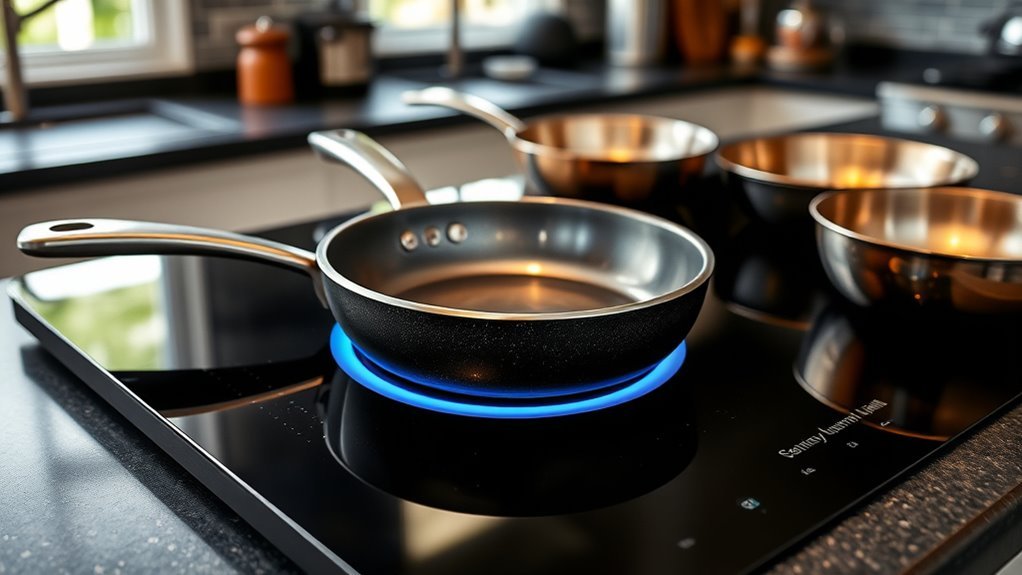
If it conducts magnetism, it conducts heat; if it attracts a magnet, it works on induction. You’ll find carbon steel performs well because it’s ferromagnetic and couples efficiently with induction coils, delivering fast, controllable heating and good thermal response. I’ll explain the material properties, what to look for in cookware design, and practical tips for use and maintenance — so you can choose the best options with confidence.
Does Carbon Steel Work on Induction?
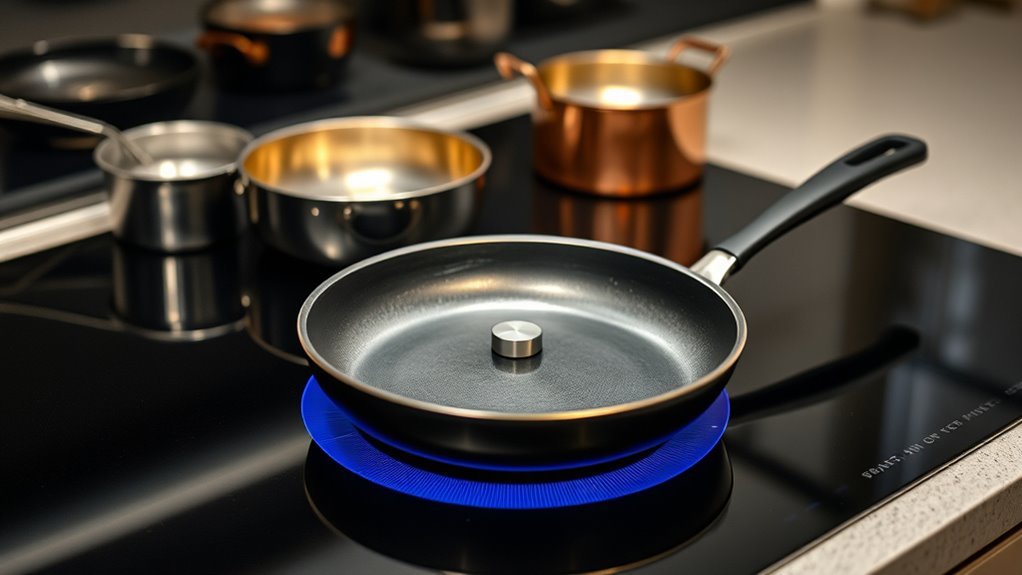
Curious about induction compatibility? You’ll find Carbon Steel performs reliably on induction because its iron-rich composition couples strongly with magnetic fields.
For effective operation, cookware must present a flat, continuous contact surface so induction energy transfers efficiently; a warped base reduces responsiveness. You’ll test compatibility with magnet sticks—if a magnet adheres across the base, induction-compatible cookware is likely.
Expect rapid thermal response and even heating; carbon steel’s low thermal mass and high conductivity let you modulate temperature precisely, which supports liberated cooking techniques that demand control.
Expect quick thermal response and even heat — carbon steel’s low mass and high conductivity let you precisely control temperature.
Pre-seasoned pans offer improved food release out of the box, while unseasoned pieces can be seasoned at home to reach the same functional state. Users report durable construction and long-term value when pairing quality carbon steel with induction tops.
For performance and control, I highly recommend selecting a flat-bottomed, well-finished carbon steel pan and validating it with a simple magnet-stick test before purchase.
Why Carbon Steel Is Induction-Compatible
Because carbon steel’s matrix is iron-rich, it couples directly with an induction cooktop’s alternating magnetic field, so the cookware itself becomes the resistive element that generates heat.
You’ll observe rapid energy conversion because ferromagnetic domains in Carbon Steel align and dissipate magnetic energy as resistive heat, enabling efficient induction cooking and predictable heat transfer.
For peak induction compatibility you must use a flat, stable base to maximize contact area and minimize thermal impedance between hob and pan.
Pre-seasoned surfaces won’t affect magnetic response but improve food release and make the pans more versatile across techniques.
Empirical reports and tests show high-quality carbon steel pans reach set temperatures quickly and respond to power changes with minimal lag, supporting efficient cooking and precise control.
If you’re pursuing culinary autonomy, choose well-manufactured pieces with consistent thickness and flatness; they exploit induction physics to give you rapid, controllable, and durable cookware performance without reliance on complex multi-layer constructions.
Cooking Performance of Carbon Steel on Induction
Having established how carbon steel couples with an induction field, you can expect its cooking performance to reflect that direct energy conversion: pans heat quickly, respond sharply to power changes, and sustain high surface temperatures for techniques like searing and stir-frying.
You’ll exploit Induction Cooktops’ rapid magnetic coupling to achieve precise, repeatable heat flux, which improves control during Sautéing and other High-Heat Cooking. Proper seasoning delivers durable Non-Stick Properties that reduce adhesion without synthetic coatings, supporting liberation from brittle cookware constraints.
The pan’s Lightweight construction enhances maneuverability for tossing and finishing.
- Rapid heat response — efficient iron content converts electromagnetic energy into consistent surface temperature for controlled Sautéing and frying.
- High-heat capacity — sustains searing temps without thermal lag; good for reduction and browning.
- Seasoned surface performance — when maintained, non-stick efficacy matches high-temperature techniques while avoiding coating breakdown.
You’ll get technical reliability and tactile freedom on induction when you pair Carbon Steel with disciplined technique and maintenance.
Choosing, Preheating, and Using Carbon Steel on Induction
When you choose and use carbon steel on an induction cooktop, match pan diameter to the burner and preheat gradually over medium settings to avoid warping and guarantee even magnetic coupling. This disciplined approach preserves flatness, maximizes energy transfer, and yields predictable surface temperatures for searing, sautéing, and reductions.
Choose Carbon Steel cookware with a flat, thick base and minimal taper to maintain consistent contact and heating efficiency. Preheating slowly lets the metal expand uniformly; watch temperature rise and avoid abrupt high-power jumps that create hotspots.
Maintain seasoning to develop reliable non-stick properties and protect the surface from oxidation during repeated induction cycles. During use, monitor pan feel and visual cues—smoke point of oil, bead formation—to judge readiness rather than relying solely on dial numbers.
After cooking, cool gradually and reapply thin oil layers if needed to preserve the seasoned film. These practices free you from uncertainty and extend performance and lifespan on induction.
When to Pick Alternatives : What to Avoid on Induction
You’ve learned how to get the best from carbon steel on induction; now you should also know what to avoid so your cooktop performs reliably and your results stay consistent.
Don’t force Non-ferromagnetic metals — copper, aluminum, glass — onto Induction Cookware expectations: they won’t couple with Induction Burners and waste energy.
Reject pans with pasted-on ferromagnetic bottoms; studies and manufacturer guidance show they provoke uneven heating and hot/cold spots, undermining Cookware Compatibility.
Favor fully compatible designs: Carbon Steel, Stainless Steel, or Enameled Cast Iron with solid magnetic construction and flat bases.
- Test with a magnet: if it doesn’t cling strongly, it’s not induction-ready.
- Avoid warped or uneven bases that reduce contact and transfer efficiency.
- Don’t trust layered or glued magnetic plates—integral ferromagnetism is required.
You’re aiming for liberation from uncertainty: choose cookware proven to magnetically couple, maximize induction efficiency, and deliver repeatable, controlled results.
Frequently Asked Questions
What Are the Downsides of Carbon Steel Pans?
You’ll face durability concerns like scratching and warping if you heat too fast; heat retention is good but less than cast iron, affecting searing consistency.
Non stick issues arise until you build and maintain seasoning. Weight differences make them lighter but feel less robust.
Maintenance requirements are higher—regular seasoning and careful cleaning. They can react with acidic foods, altering flavor.
Price comparison often favors carbon steel for value despite upkeep.
What Is the Healthiest Cookware for Induction Cooktops?
You should choose stainless steel or carbon steel for the healthiest induction cookware; 99% iron cookware reduces contamination risk.
These cookware materials offer clear health benefits, stable food reactions at high cooking temperatures, and superior durability comparisons to coated pans.
For freedom in the kitchen, favor non stick options like seasoned carbon steel over toxic coatings.
Follow maintenance tips—proper seasoning and drying—to preserve performance and prevent rust.
What Cannot Be Cooked on Induction?
You can’t cook with non‑ferromagnetic cookware: glass, pure aluminum, copper, ceramic or pans with pasted-on ferromagnetic bottoms won’t work reliably.
That limits some cooking techniques needing specific pans (round‑bottom woks) unless you use an induction plate.
Prioritize cookware materials that guarantee induction efficiency, even heat distribution and pan compatibility.
Check surface coatings, follow maintenance tips, and adapt cooking techniques to preserve heat distribution and performance.
What Metal Is Best for Induction Cooktops?
Stainless steel with a magnetic core (clad) is the best metal for induction cooktops. You’ll get ideal induction cookware performance: carbon steel also works and offers superior heat conductivity and cooking efficiency, but clad stainless gives balanced metal compatibility and even heat.
For liberation in the kitchen, choose trusted popular brands, follow maintenance tips for seasoning or polishing, and prioritize layered construction for predictable, evidence-driven results.
Conclusion
You can confidently use carbon steel on induction: its ferromagnetic structure and flat, thick base deliver efficient, even heating like a seasoned ship’s bell signaling readiness. Tests with a magnet and observations of rapid, controllable temperature changes confirm predictable performance for searing and sautéing. Preheat briefly, monitor heat, and maintain seasoning for nonstick benefits. Avoid nonferrous cookware (copper, pure aluminum) unless paired with a magnetic base; choose proven, well-constructed pans.