
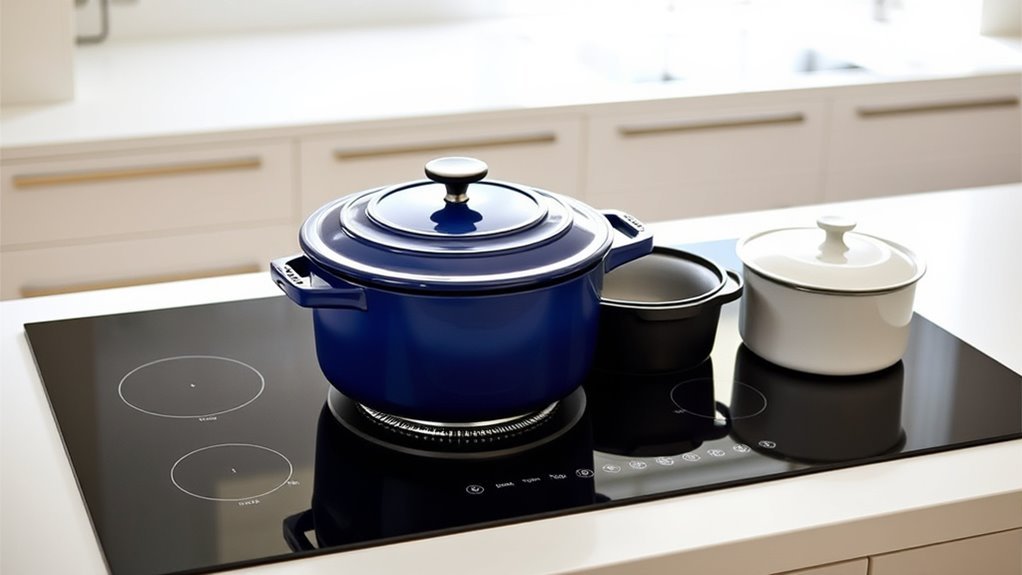
If your Le Creuset braiser heats up instantly on an induction hob, you’re seeing compatible materials at work. You’ll want clear guidance on which Dutch ovens—cast iron, enameled cast iron, or certain stainless bases—will reliably work, how to test them with a magnet and flat bottom, and which tradeoffs affect performance and care. Keep going to compare the best options and practical buying tips.
Do Dutch Ovens Work on Induction? The Short Answer
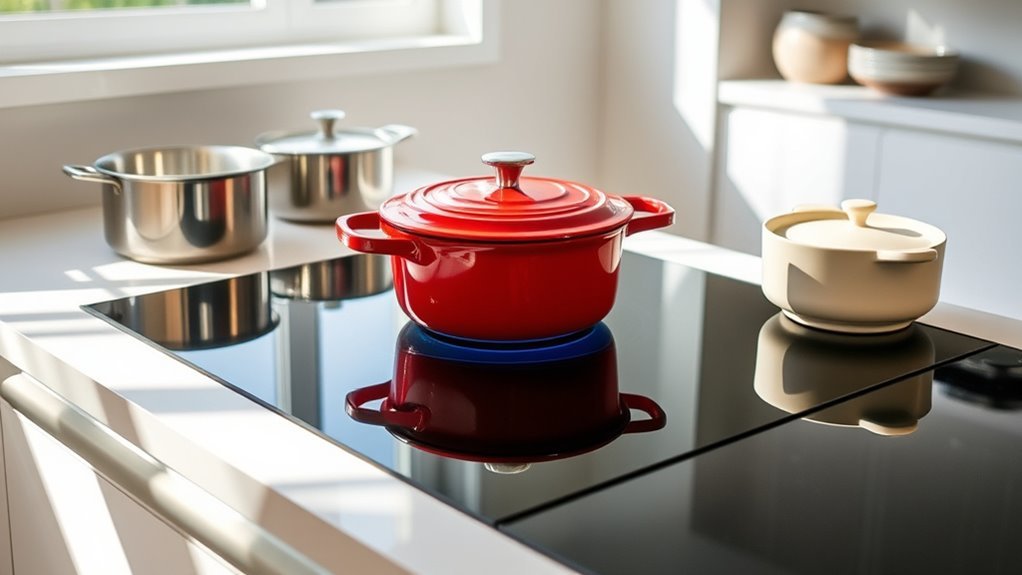
Wondering whether your Dutch oven will work on induction? You’re in luck: induction requires ferrous materials, and many Dutch ovens meet that demand.
If your cookware has a cast iron Dutch oven base or another magnetic construction, the cooktop’s magnetic field will activate it, giving you fast, efficient heating and superior heat retention compared with non-magnetic pots.
Use the magnet test—if a magnet sticks to the bottom, it’s among the compatible materials and will perform on induction.
Beware ceramics or purely nonferrous metals that lack a magnetic layer; they often won’t respond and can’t deliver the same control.
Enameled iron choices pair the practical surface with the magnetic core you need.
Practically speaking, you’ll gain control and economy when you choose induction-compatible materials, and you’ll free yourself from slow, uneven cooking.
Make selections that prioritize magnetic conductivity and thermal mass to liberate your cooking.
Which Dutch Oven Materials Work on Induction? (Cast Iron, Enameled, Stainless)
Because induction relies on magnetism, you’ll find cast iron and enameled cast iron Dutch ovens work reliably—their ferrous bodies couple directly with the cooktop’s magnetic field—while stainless steel only works if the manufacturer has built a ferrous base or layered core; do the magnet test to confirm, since not all stainless or enamel lines guarantee induction compatibility.
Cast iron and enameled Dutch ovens pair flawlessly with induction; test stainless with a magnet—compatibility depends on a ferrous base.
You want predictable heat and freedom from guesswork: cast iron cookware delivers that through raw magnetic responsiveness and excellent heat retention, ideal for braising and slow cooking. Enameled cast iron gives you the same induction performance with a nonreactive, easy‑clean surface—choice without compromise.
Stainless can join the induction kitchen but only when engineered with a magnetic plate or multi‑layered core; otherwise it won’t couple. Compare materials by magnetic behavior, thermal mass, and surface needs to choose induction cookware that liberates your cooking, not limits it.
Verify specifications before buying to confirm true compatibility.
Test Your Dutch Oven: Magnet, Flat Bottom, and What to Do If It Fails
Now that you know which materials typically work on induction, it’s time to check your Dutch oven directly: press a small magnet to the center of the bottom—if it sticks firmly, the cookware will couple with the cooktop’s magnetic field.
The magnet test is the quickest proof of induction compatibility; you’ll free yourself from guesswork. Next, inspect the base: a flat bottom guarantees secure contact, even heat, and higher efficiency compared with warped or rounded bases.
- Use the magnet test at several points; consistent attraction confirms full contact.
- Compare flat bottom versus convex or textured bases; flat wins for stable coupling and predictable heat.
- If the magnet fails, choose an induction interface disk to reclaim functionality without replacing cookware.
- Always cross-check the manufacturer’s induction compatibility specs before buying to avoid false assumptions.
These steps are practical, material-focused, and liberating: they let you control cookware performance and avoid wasted time or resources.
Cast Iron vs Enameled Dutch Ovens on Induction: Pros and Cons
When you compare cast iron and enameled Dutch ovens on induction, you’ll notice traditional cast iron holds heat longer and provides extremely even cooking, while enameled versions heat up a bit faster.
That superior retention of bare cast iron can mean lower, steadier settings on your cooktop, but the heavier mass of either type increases risk of scratching or cracking glass surfaces if you slide or drop them.
Heat Retention Differences
A few key differences in heat retention set cast iron and enameled Dutch ovens apart on induction: solid cast iron holds and distributes heat more evenly thanks to its thick, dense construction, making it better for long braises and steady simmering.
While enameled versions—though induction-compatible and quicker to warm—tend to lose some retained heat due to the enamel’s slight insulating effect, which can shorten carry-over cooking and require more frequent temperature adjustments on an induction cooktop.
You’ll use cast iron when you want sustained, uniform heat; choose enameled for responsiveness and ease. Consider these practical contrasts to free your technique and sharpen results.
- Cast iron: superior heat retention, slower to heat.
- Enameled: faster heat-up, less carry-over.
- Induction cooktops: precise control benefits both.
- Technique: adjust timing for each material.
Cooktop Surface Care
Although both cast iron and enameled Dutch ovens work well on induction, you’ll need different handling to protect a glass cooktop: cast iron’s rougher base can scratch the cooktop surface, so you’ll move and set it with care.
Enameled Dutch ovens present a smoother interface, reducing abrasion and offering safer daily use.
For cast iron, use gradual heat control to avoid thermal shock and uneven cooking; start low and ramp up. You can also place a thin protective layer—parchment or a specialized pad—between cast iron and the cooktop surface when shifting pans, not during active high-heat cooking.
Choose enameled if you want minimal surface risk; pick cast iron if you value maximum heat retention and accept extra precautions.
Protect Your Induction Cooktop: Care Tips for Dutch Ovens
When you use a flat‑bottomed enameled or cast iron Dutch oven on induction, take steps to prevent surface scratches by placing parchment or a paper towel between pot and glass.
Monitor heat closely and avoid blasting high power—cast iron holds heat longer than stainless or aluminum, so lower settings and gradual temperature changes protect both cooktop and cookware.
After each use lift and clean the glass to remove residues that could abrade the surface over time.
Preventing Surface Scratches
Three simple habits will keep your induction cooktop free of scratches when using a Dutch oven: use a protective layer like parchment or a folded paper towel under the pot, choose an enameled Dutch oven instead of raw cast iron, and always lift—don’t slide—the cookware.
You want freedom from worry; choose materials and behaviors that minimize abrasion.
- Use parchment or folded paper towels under Dutch ovens to absorb friction and shield the glass.
- Prefer enameled over raw cast iron; smoother finishes reduce abrasion on the induction cooktop.
- Lift cookware when repositioning; dragging creates scuffs and concentrated wear.
- Select flat-bottom, induction-compatible Dutch ovens for stable, even contact that limits micro-movements and scratch risk.
These precise, material-focused choices let you cook confidently without damaging your surface.
Safe Heating Practices
Because cast iron holds heat and can be rough on glass, protect your induction cooktop by using a flat, magnetic-based Dutch oven, placing a sheet of parchment or folded paper towel beneath it, and watching temperature to avoid overheating.
You’ll value cast iron’s heat retention, but that same property means you must monitor heat more closely than with stainless or aluminum cookware to prevent warping or thermal stress.
Lift rather than drag the Dutch pot to avoid abrasion; the magnetic flat base provides ideal contact and reduces hot spots compared with warped or nonmagnetic pans.
Clean spills promptly so grit won’t scratch the surface.
These precise, material-focused habits let you use durable, liberating cookware without sacrificing the delicate glass of your induction range.
Top Dutch Ovens for Induction (Best Picks by Use Case & Budget)
Picking the right Dutch oven for induction means checking material, base flatness, and budget against how you cook—here’s a concise guide to the best enameled cast iron and magnetic-bottomed options for different uses and price points.
You want durable, magnetic cookware that frees you from compromises: choose enameled cast iron for retention and versatility, or lighter magnetic-bottom steel for speed and budget.
- Le Creuset (enameled cast iron) — premium choice: flawless magnetic base, exceptional heat retention, lasts decades.
- Lodge (enameled cast iron) — value-driven: strong magnetic contact, rugged performance, more affordable than flagship brands.
- Magnetic‑bottom stainless steel Dutch ovens — lightweight option: fast response on induction, cheaper, less heat mass.
- Mid‑range enameled brands (varied) — balanced pick: decent flat bases, reliable induction compatibility, good lifetime value.
Compare material, base flatness, and price against your cooking style.
Prioritize magnetic contact and heat retention to gain freedom from frequent replacements and mediocre results.
Buying Checklist: What to Look For in an Induction-Ready Dutch Oven
You’ve seen which models perform best on induction; now focus on the physical features that make one Dutch oven work better than another on a magnetic cooktop.
Prioritize an induction-compatible marking and verify a true ferrous base—cast iron or magnetic stainless steel—so the pot actually responds to the cooktop’s field.
Compare bottom geometry: a flat, smooth sole contacts the hob fully, boosting transfer and reducing hotspots; avoid domed or textured bases.
Balance weight and handling: heavier cast iron holds heat longer but limits mobility; lighter magnetic stainless blends responsiveness with ease.
Inspect sealing: a tight-fitting lid locks steam and radiative heat, improving braises and energy efficiency on induction.
Check finish durability—enameled interiors resist chipping, raw iron favors seasoning.
Finally, confirm dimensions match your burner size; oversized bases can underperform on small zones.
Choose features that free you from compromises: magnetic conduction, stable contact, and a lid that seals for consistent results.
Frequently Asked Questions
What Cannot Be Cooked on Induction?
You can’t cook with nonmagnetic or warped cookware—so glass, plain aluminum, ceramic, and cookware without a magnetic base won’t work on induction.
You’ll also struggle with specialized microwave-only pieces and some nonstick pans lacking magnetic layers.
For induction cookware, choose flat, ferrous-bottomed pots for induction efficiency and induction safety.
Compared to traditional stoves, induction forces you to pick materials deliberately, which frees you to cook cleaner and more reliably.
Can Le Creuset Work on Induction?
Yes — you can. Like iron anchored to a whisper, Le Creuset’s enameled cast iron gives induction compatibility and bold cookware materials performance.
You’ll get excellent heat distribution compared with thin stainless or nonmagnetic pans, so you’ll sear, simmer and free yourself from uneven cooking.
Check each model’s base for induction-ready marking, but generally Le Creuset delivers durable, efficient cookware that matches your desire for reliable, liberated cooking.
When Should You Not Use a Dutch Oven?
You shouldn’t use a Dutch oven when it risks thermal shock, extreme high heat, or on glass tops if its rough base can scratch; follow safety precautions.
Choose materials wisely: avoid non-magnetic or ceramic pots for stovetop tasks.
For delicate cooking techniques like quick searing or stir-fry, pick alternative cookware such as a seasoned cast-iron skillet or stainless sauté pan.
This frees you to cook boldly while protecting gear and results.
Which Brand of Dutch Oven Is Better, Le Creuset or Lodge?
Le Creuset’s premium finish often makes it better if you want longevity and style, but Lodge gives you great value and rugged performance.
You’ll weigh Dutch oven materials, cooking techniques, and brand durability: Le Creuset’s enamel resists chipping and offers a lifetime warranty, while Lodge’s cast iron retains heat excellently at a lower price point with solid support.
Choose Le Creuset for prestige and finish, Lodge for practical liberation and budget freedom.
Conclusion
You can trust that most cast iron and enameled Dutch ovens will work on induction—try the magnet test and check for a flat base. If a stainless model’s magnetic, it’ll work too. Compare cast iron’s raw heat retention and seasoning quirks with enameled’s nonreactive ease, and prefer flat, smooth bottoms to protect your glass cooktop. If your pot fails the magnet test, replace it or use an induction interface disk for reliable performance.

