
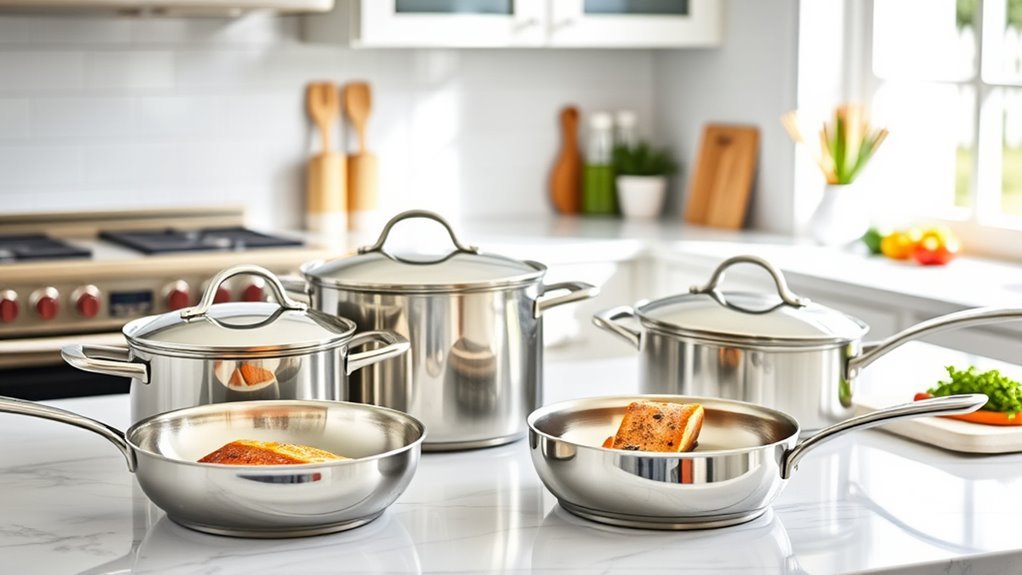
You might think stainless-steel cookware is too finicky for everyday use, but Cuisinart balances durability and performance without demanding pro-level care. Its multiclad builds give reliable heat distribution and searing power, while thinner, disc‑bottom pieces can show pitting and discoloration under heavy use. If you want practical guidance on which lines to buy, which to avoid, and how to maintain them for best results, keep going.
Who Should Read This Guide (And How to Use It)

Who should read this guide and how should you use it? You’re a home cook seeking liberation from mediocre pans and you want technical clarity: compare Cuisinart Stainless Steel Cookware against alternatives by focusing on specs, Pros, Cons, and Best Uses.
Use measured criteria—capacity, heat distribution, construction—to judge fit. You’ll find details like the 12-inch, 6-quart Cuisinart 89336-30H Professional Saute Pan and its PowerBond Disc Bottom performance metrics (overall 4.6/5).
Apply that data when matching cookware to tasks: searing, braising, simmering. Note limitations too—glass lids may restrict high-heat oven use—so factor durability and ease of cleaning into decision-making.
Read this guide to compare objectively, prioritize longevity and versatility, and choose cookware that frees you to cook confidently. Use the comparisons to align Best Uses with your style and kitchen constraints, then act on an informed purchase.
Quick Verdict: Is Cuisinart Stainless Steel Cookware Worth Buying?
Ultimately, is Cuisinart stainless steel cookware worth buying? Yes — if you want reliable, high-performance tools without brand-price surrender. You’ll get consistent even heating that minimizes hot spots and improves cooking results, backed by high performance ratings (4.6/5 overall).
Yes — Cuisinart stainless delivers reliable, high-performance cookware with even heating and great value.
The Professional Series delivers standout value for money: a full 11-piece set around $280 undercuts many competitors while matching functional performance.
You’ll appreciate handles, balance, and cookware that’s easy to clean; it’s dishwasher compatible, though hand washing preserves finish and lifespan.
Practical constraints exist: glass lids limit oven use to about 350°F, so you’ll avoid very-high-heat roasting or searing under those lids.
Construction: Clad vs. Disc‑Bottom (How Materials Affect Performance)
When you’re comparing Cuisinart’s disc‑bottom and clad constructions, think regarding layer geometry and thermal continuity: the PowerBond disc bottoms used in the Professional Series improve heat spread over plain single‑layer bases and reduce temperature discontinuities, but they still can’t match the uniformity of true multi‑layer clad pots like the Multiclad Pro.
You’ll find disc‑bottom construction gives better heat distribution than basic stamped steel, boosting thermal performance for routine tasks, but it can still produce hot spots that harm cooking consistency when you push temperatures.
Clad cookware, by contrast, uses bonded metal layers that promote even heat across the surface and through the body, improving control and reducing the need to micromanage food.
Consider stainless steel thickness too: Cuisinart’s 0.6 mm walls trail commercial 0.8 mm units in heat retention and durability, so if you pursue long-term liberation from uneven results, opt for true clad designs with greater mass and continuous conductive layers.
What Cuisinart Does Best (Sautéing, Boiling, Searing)
Having compared disc‑bottom and clad geometries, we can judge where Cuisinart’s stainless lines actually shine: sautéing, boiling and searing. You’ll find Cuisinart stainless steel lets you push technique without compromise — the PowerBond Disc Bottom minimizes temperature discontinuities so you get consistent heat distribution for a reliable sear and even sautés. The 12‑inch Professional sauté pan (6 qt) handles larger batches, freeing you from small‑pan constraints.
| Skill | Advantage |
|---|---|
| Sautéing | Even heat, minimal sticking |
| Boiling | Rapid, efficient heating |
| Searing | Stable high‑heat surface |
| Capacity | Large 6‑qt sauté pan fits meals |
| Finish | Polished surface eases cleanup |
Because of durable construction, these pans resist warping under high heat, so your searing stays true and your boiling is faster. You’ll appreciate the technical control and practical durability — tools that liberate your cooking, not limit it.
Common Drawbacks (Pitting, Discoloration, Lid & Heat Limits)
Although Cuisinart stainless sets perform well in many kitchens, they do show specific weaknesses you’ll want to reflect on: some users report pitting and discoloration on interior bottoms after minimal use, which directly challenges durability and long-term performance expectations.
The 0.6 mm body thickness is thinner than commercial 0.8 mm, so the pans resist warping less and can suffer uneven heating from the disc base, causing scorching at edges or cooling inconsistently.
You’ll also face lid and heat limits: glass lids supplied are oven‑rated only to 350°F, restricting high heat finishing or broiling techniques.
While dishwasher compatibility is advertised, hand washing is recommended to preserve finish and minimize pitting or staining over time.
Practically, if you’re pursuing culinary freedom, weigh these tradeoffs: affordable, versatile cookware that performs for sautéing and boiling, but that may demand gentler handling and mindful temperature control to protect long‑term performance and maintain appearance.
Do Pro‑Series Pans Fix These Problems? Real Test Results for 89336‑30H
You’ll see whether the Pro‑Series addresses even‑heat shortcomings by testing the PowerBond Disc Bottom’s temperature uniformity under real cooking loads.
Compare build quality and long‑term durability against common pitting and discoloration issues to judge if the 89336‑30H’s construction holds up.
Finally, note practical oven and lid limits (lid oven‑safe to 350°F) so you can match the pan to your roasting and finishing needs.
Even‑Heat Performance
Consistency matters in cookware, and the Cuisinart 89336‑30H Pro‑Series addresses uneven heating with a PowerBond Disc Bottom that spreads heat across the 0.6 mm stainless body far more uniformly than the Chefs Classic line.
You’ll notice even heat during sears and reductions, improving cooking performance and reducing hot spots common in thinner stainless pans. It rates 5/5 for even heating in tests, but you’ll still need to preheat and oil to avoid sticking.
- Heat distribution — PowerBond disc minimizes temperature discontinuity for consistent results.
- Practical tradeoff — 0.6 mm stainless gives good thermal response though it’s below commercial 0.8 mm mass.
- User workflow — preheat/oil routine yields best sear and easier cleanup (4/5).
Durability And Build
Durability is the area where the Pro‑Series makes measurable improvements without matching commercial heavyweights: the 0.6 mm stainless body gives you a lighter, responsive pan that resists warping and daily wear better than Cuisinart’s thinner consumer lines, but it still falls short of the rigidity and mass of 0.8 mm professional cookware.
You’ll get stainless steel strength with noticeable weight savings—lightweight for maneuvering, substantial enough for routine use. The PowerBond Disc Bottom delivers consistent heat distribution and performance, reducing hotspots that accelerate wear.
Users rate the 89336‑30H highly for durability and usability (4.6/5), especially when you follow recommended preheat and oiling to prevent sticking. It won’t replace commercial gear, but it liberates home cooks seeking reliable, efficient cookware.
Oven And Lid Limits
While the Pro‑Series pan is oven‑safe to 500°F, the tempered glass lid tops out at 350°F, so you can’t run high‑heat braises or finishes with the lid in place.
You’ll get improved thermal performance from the PowerBond Disc Bottom and better cooking efficiency than the Chefs Classic, yet the 0.6 mm body trades some durability compared with commercial 0.8 mm.
Preheat and oil the pan to maximize non‑stick results and reduce sticking when using the glass lid.
- Use oven-safe pan alone for 400–500°F finishes; remove glass lid to avoid failure.
- Rely on preheat and even heat distribution for consistent sears and braises.
- Expect practical gains in cooking efficiency, though extreme durability demands a heavier gauge.
Which Cuisinart Sets and Pieces to Buy : and Which to Skip
If you want reliable performance without overspending, pick pieces from the Multiclad Pro and Professional Series lines and skip the Chefs Classic and Cuisinart nonstick pans.
Choose Cuisinart Multiclad Pro for all-around cooking: it heats quickly, cleans easily, and the ergonomics free you to cook confidently. For budget-conscious but serious cooks, the Cuisinart Professional Series Cookware 11 Piece Set gives fast heating and even browning at a sensible price.
Choose Multiclad Pro for speedy, easy-clean performance; or get the Professional 11-piece set for budget-friendly, reliable browning.
Skip Cuisinart Chefs Classic for tasks demanding speed and consistency; it lags on heat responsiveness.
Avoid Cuisinart nonstick pans if you want durable searing or high-heat techniques—their mixed reviews reflect limits versus competitors.
Buy individual pieces when they match your workflow: add a high-quality sauté pan like the Cuisinart 89336-30H Professional Stainless Saute Pan for versatility.
For stainless steel cookware sets, prioritize Multiclad Pro or Professional Series as the best uses for everyday and performance-oriented cooking.
Care & Troubleshooting (Stains, Pitting, Sticking : What to Do)
Start by treating stains, pitting, and sticking as separate, manageable problems rather than a single failure mode, because each has a specific cause and fix.
You can reclaim your stainless steel cookware with targeted action: stains and discoloration from heat or oxidation respond to acid (white vinegar) or a paste like Bar Keepers Friend; stubborn residue yields to soaking, warm soapy water, and a baking soda paste.
- Preheat + oil: For preventing sticking, preheat the pan, add oil, then test temperature—this creates a reliable temporary “nonstick” layer.
- Gentle care: To avoid pitting issues, avoid abrasive scrubbing and prolonged exposure to strong salts or acidic brines; hand-wash when possible.
- Restore & maintain: Use Bar Keepers Friend for rainbow stains; limit dishwasher use to preserve finish and prevent accelerated wear.
Be systematic: diagnose the symptom, apply the specific remedy, and adopt preventive cleaning tips to keep your cookware durable and liberate your kitchen routine.
Alternatives: When to Upgrade (All‑Clad, GreenPan, Other Buys)
If you want crisper temperature control and more even cooking, consider upgrading to a premium clad set like All‑Clad or a copper‑clad option for superior heat distribution.
If you prioritize easy release and lower‑fat cooking, look at ceramic or nonstick lines such as GreenPan, but factor in coating durability and replacement costs.
Weigh the long‑term investment tradeoffs — higher upfront cost often means greater longevity and performance, while midrange picks like Cuisinart Multiclad Pro can hit the sweet spot for value.
Premium Heat Distribution
Because heat transfer is the bedrock of reliable cooking, you should weigh whether Cuisinart’s PowerBond Disc Bottom—which significantly reduces temperature discontinuity and earns a 5/5 for evenness—is sufficient for your needs or if a true premium cladding upgrade like All‑Clad or GreenPan will deliver measurable gains in performance and longevity.
You’ll find the Professional Series Cuisinart set already improves heat distribution and cooking performance over Chefs Classic, delivering consistent even heat for most home liberation-minded cooks.
Consider:
- Cost vs. longevity: All‑Clad (≈$800) offers superior retention and decade-plus durability.
- Responsiveness: GreenPan Reserve Pro (≈$500) balances quick heat changes and stylish build.
- Practical upgrade: If you demand pro-level searing and long-term value, invest in premium stainless steel cookware; otherwise, Cuisinart suffices.
Nonstick Or Ceramic Options
While stainless steel like Cuisinart excels at high-heat searing and durability, you’ll want nonstick or ceramic options when you regularly cook eggs, delicate fish, or low-fat meals that require minimal oil and easy release.
You should assess cooking needs: Cuisinart stainless steel gives superior searing and even heat distribution, but nonstick options and ceramic coatings minimize sticking and simplify cleanup.
If you crave liberation from scrubbing and heavy oils, consider upgrades — All-Clad delivers professional-grade performance with exceptional heat retention and build quality; GreenPan offers ceramic coatings framed as healthier, eco-minded choices.
Match material to task: keep stainless for browning and workhorse durability, choose nonstick or ceramic for delicate, low-fat cooking where release and convenience matter most.
Long‑Term Investment Tradeoffs
When you’re weighing long-term cookware choices, think regarding lifecycle cost and performance tradeoffs rather than just sticker price. You want cookware that frees you from needless replacement cycles while delivering consistent results.
- Compare value: Cuisinart stainless steel cookware gives budget-conscious buyers strong performance and easy cleaning; lifecycle cost is low, though long-term durability trails premium brands.
- Upgrade criteria: If you cook at high heat or pursue restaurant-level control, All-Clad offers superior heat retention and longevity favored by professional chefs; consider GreenPan for reliable nonstick versatility and toxin-free coatings.
- Usage model: For occasional to regular home cooks Cuisinart often suffices; heavy users should invest in premium builds to minimize replacement frequency and maximize sustained performance.
Frequently Asked Questions
Is Cuisinart a Good Brand for Stainless Steel Cookware?
Yes — you’ll find Cuisinart reliable for stainless steel cooking.
You’ll appreciate Cuisinart cookware durability and Cuisinart heat distribution thanks to PowerBond discs; Cuisinart design features favor longevity and versatility.
Compare Cuisinart vs. competitors on price and performance; Cuisinart price comparison usually favors value.
Read Cuisinart customer reviews for real-world feedback, and follow Cuisinart maintenance tips like proper cleaning and avoiding thermal shock to preserve finish and function.
What Grade of Stainless Steel Is Cuisinart?
Cuisinart mainly uses 18/10 and 18/4 stainless steel grades. You’ll find 18/10 for corrosion resistance and 18/4 interiors balancing cookware durability and cooking performance; magnetic 18/0 bottoms enable induction.
Compare heat conductivity and price comparison versus thicker commercial grades; thinner 0.6 mm affects heat spread.
For maintenance tips, dry and polish to resist spots. Read user reviews to gauge long-term durability and practical cooking performance.
What Is the Best Brand for Stainless Steel Cookware?
Measure twice, cut once: you’ll choose All-Clad performance if you want top-tier heat and longevity, but Calphalon cookware gives budget-friendly reliability.
You’ll get T fal durability for everyday use, KitchenAid options for style and function, and Scanpan innovation if nonstick tech matters.
Viking quality serves pros, while Zwilling value fits cost-conscious cooks.
Match brand strengths to your needs and you’ll cook with liberated confidence and lasting results.
Is Cuisinart Stainless Steel Cookware Safe to Use?
Yes — you can safely use Cuisinart stainless steel cookware. You’ll get reliable cooking performance and even heat distribution, with generally positive user reviews.
Compare models for durability concerns and weigh compatibility options like induction. Follow maintenance tips (hand-wash, avoid high heat) to extend life.
Consider the price range versus competitors if you want longevity and freedom from frequent replacements; it’s a practical, empowering choice.
Conclusion
Cuisinart stainless steel is a practical, cost‑effective choice if you value even heat and everyday durability—you’ll get excellent sautéing, boiling, and searing without paying All‑Clad prices. That said, thinner-disc bottoms can pit or discolor, so buy clad Pro lines for tougher use. Remember: “measure twice, cut once”—pick materials to match your cooking. Overall, you’ll get solid performance for daily tasks; upgrade only if you need pro-level longevity or specific nonstick features.
