
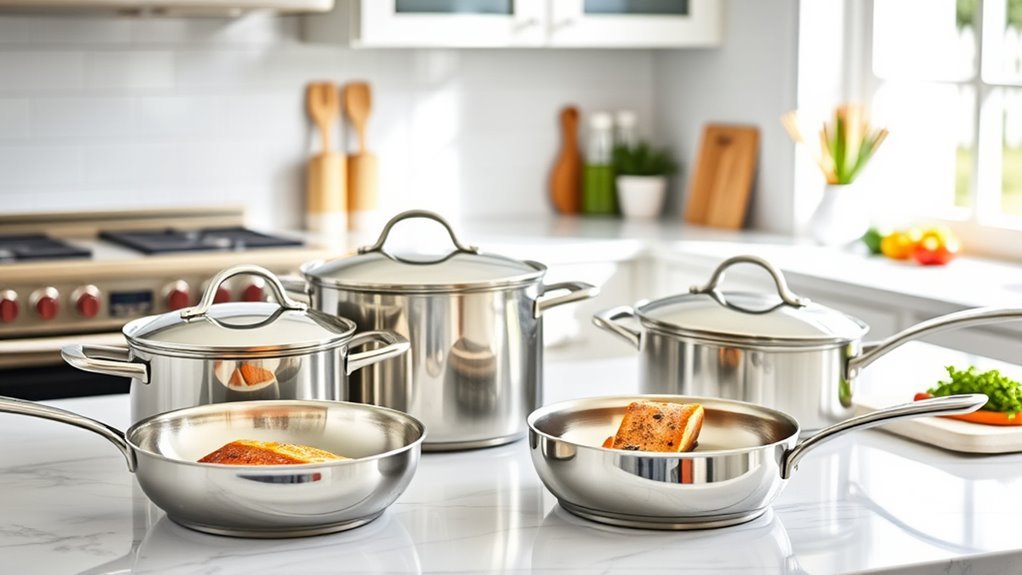
Cuisinart stainless steel cookware offers a practical balance of cooking performance, durability, and price. However, not every Cuisinart stainless steel pan uses the same construction, and that difference affects how evenly it heats. This guide compares the main cookware lines, explains their strengths and weaknesses, and helps you choose the right pieces for your kitchen.
Quick Answer
Yes, Cuisinart stainless steel cookware is worth buying for most home cooks. MultiClad Pro is the strongest choice for even heating and versatile cooking. Professional Series offers excellent value with its PowerBond aluminum base. Chef’s Classic suits tighter budgets. For lasting performance, choose the construction that fits your cooking needs and follow proper stainless steel care.
Last checked: November 14, 2026. Dates and figures were verified against official sources.
Key Takeaways
- MultiClad Pro uses fully clad, triple-ply construction. Its aluminum core extends through the base and sidewalls.
- Professional Series uses a PowerBond aluminum base. It provides strong heat distribution at a lower price than many premium alternatives.
- The Professional Series 6-quart sauté pan is oven-safe to 500°F without its glass lid. Its glass lid has a lower temperature limit.
- Discoloration is often cosmetic, but pitting is permanent surface damage. Proper cleaning and salt handling help prevent problems.
- Stainless steel works well for searing and browning. Ceramic nonstick is more convenient for eggs and delicate foods.
Who Should Read This Cuisinart Stainless Steel Cookware Guide?

This guide is for home cooks who want dependable stainless steel pots and pans without paying more than necessary. It also helps you compare Cuisinart cookware with premium alternatives before replacing an existing set.
You will find the most value here if you want to:
- Choose between Cuisinart MultiClad Pro, Professional Series, and Chef’s Classic.
- Understand how bonded aluminum bases and fully clad construction affect heating.
- Find cookware suitable for sautéing, boiling, searing, and braising.
- Check induction compatibility, oven limits, and lid restrictions.
- Prevent sticking, discoloration, pitting, and cleaning problems.
- Decide whether to buy a complete set or individual pieces.
The most useful comparison starts with construction. Capacity, handle design, weight, and cleaning requirements come next.
You should also consider your cooktop. Gas, electric, and induction burners heat pans differently, so the design of the base matters.
For example, the Cuisinart 89336-30H Professional Series sauté pan has a 6-quart capacity and a bonded aluminum base. Its size makes it useful for larger meals, while its helper handle supports lifting and pouring.
Quick Verdict: Is Cuisinart Stainless Steel Cookware Worth Buying?
Yes. Cuisinart stainless steel cookware is a good investment for everyday home cooking. Its better-performing lines combine durable stainless steel cooking surfaces with aluminum layers that improve heat distribution.
However, the best choice depends on your budget and cooking habits.
The official Cuisinart cookware comparison distinguishes three stainless steel lines: Chef’s Classic, Professional Series, and MultiClad Pro.
Here is how they compare.
| Cookware Line | Construction | Best For | Listed Set Price |
|---|---|---|---|
| Chef’s Classic 11-Piece (77-11G) | Stainless steel with aluminum-encapsulated base | Budget-friendly everyday cooking | $179.95 |
| Professional Series 11-Piece (89C-11) | Stainless steel with PowerBond aluminum base | Value-focused cooks who want stronger heating performance | $279.95 |
| MultiClad Pro 12-Piece (MCPS-12N) | Fully clad triple-ply stainless steel with aluminum core | Frequent cooking, browning, sautéing, and sauces | $299.95 |
These are US manufacturer-listed prices checked in November 2026. Prices and promotions can change.
At these listed prices, MultiClad Pro offers a worthwhile construction upgrade over Professional Series if you will use the extra pieces. Professional Series remains attractive if you prefer its included cookware or want a specific large sauté pan.
Choose MultiClad Pro for fully clad construction, Professional Series for strong everyday value, or Chef’s Classic when a lower initial cost matters most.
The cookware is generally easy to maintain, although stainless steel requires correct preheating and occasional stain removal.
Construction: Clad vs. Disc-Bottom Cookware
The biggest difference between Cuisinart stainless steel cookware lines is how the aluminum layer connects to the steel. Aluminum spreads heat more effectively than stainless steel, so its placement influences cooking consistency.
Disc-bottom cookware has a conductive aluminum layer bonded to the bottom. The steel sidewalls do not have the same continuous aluminum core.
Fully clad cookware bonds layers of metal across the bottom and up the sidewalls.
Disc-Bottom Construction
Cuisinart Chef’s Classic uses an aluminum-encapsulated base. This construction improves heating compared with a plain, thin stainless steel base.
Professional Series takes the idea further with its PowerBond high-impact bonded aluminum base.
The improved base helps distribute heat across the cooking surface and reduces extreme temperature differences near the edges.
However, even a well-designed disc base does not create the same continuous heat-conducting structure as fully clad cookware.
Fully Clad Construction
The Cuisinart MultiClad Pro 12-piece set uses triple-ply construction with an aluminum core between stainless steel layers.
Its Heat Surround design carries the aluminum core through the base and sidewalls.
This design improves heat distribution and gives you greater control when browning food, making reductions, or preparing pan sauces.
MultiClad Pro also has stainless steel lids, induction compatibility, and an advertised oven limit of 500°F.
Does Stainless Steel Thickness Matter?
Thickness matters because it influences rigidity, weight, and resistance to dents or deformation. However, thickness alone does not tell you how evenly cookware heats.
One independent review measured approximately 0.6 mm sidewalls on the Professional Series sauté pan and compared them with thicker commercial stainless steel cookware of around 0.8 mm or more.
That measurement applies to the reviewed pan. It should not be treated as a published specification for every Cuisinart model.
The Professional Series compensates for thinner walls with a substantial bonded base. This helps explain why a relatively lightweight pan can still provide useful heat distribution.
For the best all-around temperature control, fully clad cookware remains the more versatile design.
What Cuisinart Does Best: Sautéing, Boiling, and Searing
Cuisinart stainless steel cookware performs especially well in cooking tasks that benefit from a durable metal surface and steady heat. It is particularly useful for sautéing vegetables, boiling liquids, browning meat, and building flavorful pan sauces.
The exact results depend on the cookware line and your heating technique.
| Skill | Advantage |
|---|---|
| Sautéing | Responsive heating and room to move ingredients |
| Boiling | Efficient heating through the aluminum base |
| Searing | Durable stainless surface for browning meat |
| Capacity | Large 6-quart sauté pan accommodates bigger batches |
| Finish | Smooth stainless surface supports routine cleaning |
Sautéing Vegetables
Stainless steel sauté pans work well for onions, mushrooms, peppers, and similar vegetables.
Preheat the pan over moderate heat, add a little oil, and avoid overcrowding. This helps moisture escape instead of collecting around the food.
A wide sauté pan also gives you more room to stir ingredients without spilling them.
Boiling and Simmering
Cuisinart stainless steel saucepans and stockpots handle pasta, soups, vegetables, and sauces.
The aluminum base distributes burner heat beneath the food. Once liquid reaches a boil, the moving liquid also helps distribute heat.
For long reductions or thick sauces, a fully clad pan offers additional heat control along the sidewalls.
Searing Meat
Stainless steel is useful for searing steak, chicken, and other proteins because its surface tolerates temperatures needed for browning.
Start with a properly heated pan, dry the food, and give the surface time to brown before attempting to flip it.
After cooking, the browned bits left on the pan can be dissolved with stock or another suitable liquid to create a pan sauce.
For delicate fish or eggs, a dedicated nonstick skillet may still be easier to use.
Common Drawbacks: Pitting, Discoloration, and Heat Limits
Cuisinart stainless steel cookware has several drawbacks worth considering before purchase. The most common concerns involve food sticking, surface marks, oven limitations, and differences in construction quality.
These issues do not affect every model equally.
- Pitting: Small, permanent surface cavities can develop when salt remains concentrated against stainless steel.
- Discoloration: Heat can leave rainbow-colored marks, while minerals in water can create pale deposits.
- Sticking: Food can bond to the cooking surface without proper preheating, oil, and temperature control.
- Heat distribution: Basic disc-bottom cookware may develop larger temperature differences than fully clad cookware.
- Lid restrictions: Tempered glass lids generally have lower oven-temperature limits than their matching stainless steel pans.
- Appearance: Dishwasher cycles, strong detergents, and abrasive cleaning can gradually reduce the polished finish.
Stainless steel is corrosion-resistant, not completely immune to corrosion. Pitting should not be confused with ordinary water spots or rainbow discoloration.
Surface discoloration is usually manageable. True pits cannot be removed by polishing because the metal itself has been damaged.
Most importantly, avoid leaving salt sitting on an empty or barely wet hot pan.
Does Professional Series Fix These Problems? A Closer Look at the 89336-30H
The Cuisinart 89336-30H Professional Series sauté pan addresses some heating limitations of basic disc-bottom stainless cookware. Its large PowerBond base delivers better heat distribution while keeping the familiar stainless steel cooking surface.
It does not eliminate sticking, cosmetic staining, or the need to respect glass-lid temperature limits.
The official 89336-30H product specifications confirm a 6-quart capacity, induction compatibility, a stainless steel riveted handle, and oven and broiler use up to 500°F for the pan.
Even-Heat Performance
The PowerBond base is the main strength of this model. Its bonded aluminum layer spreads heat across the cooking surface and helps limit extreme hot spots.
In one independent cookware review, the Professional Series sauté pan received:
- Overall rating: 4.6/5.
- Even-heating rating: 5/5.
- Cleanup rating: 4/5.
- Handling and ease-of-use rating: 5/5.
These are the reviewer’s scores, not standardized industry ratings or testing performed for this article.
The reviewer found that the PowerBond base reduced the sharp temperature differences sometimes seen around the edges of smaller disc-bottom designs.
That makes the pan suitable for sautéing vegetables, browning meat, and cooking dishes that need a broad, heated surface.
However, cooking performance still depends on burner size, temperature, food quantity, and how the pan is used.
Durability and Build
The 89336-30H combines a stainless steel body with a substantial bonded base and a helper handle. This makes it easier to manage a large pan when preparing meals.
Its relatively thin sidewalls keep the pan from becoming excessively heavy, although they offer less resistance to dents than thicker commercial cookware.
The independent review rated durability 4/5 and reported satisfactory resistance to warping during use.
That does not guarantee the pan will never warp. Overheating an empty pan or exposing hot cookware to sudden cold-water cooling can still cause damage.
The riveted handles are sturdy, but the areas around their rivets may require extra cleaning.
For everyday home cooking, the balance of capacity, heat distribution, and manageable weight makes this pan a practical option.
Oven and Lid Limits
The 89336-30H stainless steel pan is rated for oven and broiler use up to 500°F. Its tempered glass lid has a lower oven-safe limit of 350°F.
That distinction matters when moving food from the stovetop into the oven.
Warning: Never assume a glass lid shares the oven rating of its pan. For the Professional Series sauté pan, keep the glass lid at or below 350°F. Remove it before higher-temperature oven cooking, and never place it under a broiler. Always follow the exact model’s instructions.
For example, you can begin browning meat on the stovetop, remove the glass lid, and finish cooking in an oven within the pan’s rated temperature limit.
When transferring hot cookware, use appropriate oven mitts. Stainless steel handles become hot in the oven even when designed to stay cooler during normal stovetop cooking.
The oven ratings of ceramic or coated skillets included in cookware sets may differ from those of uncoated stainless steel pieces.
Which Cuisinart Sets and Pieces Should You Buy or Skip?
For most buyers, MultiClad Pro and Professional Series offer the strongest balance of performance and value. Chef’s Classic remains a reasonable budget choice, especially for basic boiling and simmering.
You should not automatically avoid an entire cookware line. Instead, choose the construction that fits your most common meals.
Best Overall: Cuisinart MultiClad Pro
The MultiClad Pro 12-piece set is the best all-around option if you cook frequently and want dependable temperature control.
Its triple-ply construction spreads heat through the base and sidewalls, which helps with browning, reductions, and sauce preparation.
The set includes useful cookware for frying, boiling, simmering, and sautéing. It also features stainless steel lids, induction compatibility, and dishwasher-safe construction.
Choose MultiClad Pro if you want the advantages of fully clad cookware without moving directly to the most expensive premium brands.
Best Value: Cuisinart Professional Series
The Professional Series 11-piece set, model 89C-11, is a strong choice for cooks who prefer a substantial bonded base at a midrange price.
Its current listed configuration includes a 2-quart saucepan, 3-quart pour saucepan, 3-quart sauté pan, 8-quart stockpot, 10-inch skillet, 8-inch PURELYCERAMIC nonstick skillet, and steamer insert. Matching lids are included with the covered pieces.
The set is induction-compatible, dishwasher-safe, and supported by Cuisinart’s limited lifetime warranty.
One important detail is that the older Professional Series 89-11 set has been discontinued. The newer 89C-11 includes a ceramic nonstick skillet instead of the older set’s different nonstick configuration.
For a single versatile piece, the 6-quart 89336-30H sauté pan is especially useful for family meals and larger batches.
Best Budget Choice: Cuisinart Chef’s Classic
The Chef’s Classic Stainless 11-piece set is worth considering when keeping initial costs low is the priority.
Its aluminum-encapsulated base supports normal boiling, simmering, and everyday cooking.
The set includes an 8-quart stockpot, multiple saucepans, a sauté pan, skillets, and a steamer insert.
It also offers induction compatibility, measurement markings, and dishwasher-safe construction.
Its limitation is the disc-bottom design. For demanding searing or precise pan sauces, Professional Series or MultiClad Pro offers a more appealing upgrade.
Which Pieces Should You Skip?
Skip buying a large cookware set if you already own most of its pieces. A single high-quality skillet or sauté pan may provide more practical value.
Also avoid choosing a basic disc-bottom pan when you specifically need the more consistent heating of fully clad cookware.
Traditional or ceramic nonstick pans are not ideal replacements for durable stainless steel when you regularly use high-heat searing techniques.
However, they can complement stainless steel for eggs and other foods that benefit from easy release.
A well-chosen stainless steel skillet, saucepan, and sauté pan can be more useful than a larger set filled with pieces you rarely use.
Care and Troubleshooting: Stains, Pitting, and Sticking
Most Cuisinart stainless steel cleaning problems are manageable when you identify their cause. Rainbow stains, white deposits, burnt food, and pitting are different problems, so they require different responses.
Start with gentle cleaning before trying stronger methods.
How to Remove Rainbow Discoloration
Rainbow stains usually develop when heat changes the appearance of the thin protective oxide layer on stainless steel.
These marks are generally cosmetic and do not mean the cookware has lost its cooking performance.
- Allow the pan to cool.
- Add a small amount of diluted white vinegar.
- Wipe the affected surface with a soft sponge.
- Rinse thoroughly with clean water.
- Dry the pan with a soft towel.
For persistent discoloration, use a stainless steel cleaner according to its label instructions.
How to Remove Burnt Food
Burnt food needs time to loosen. Scraping aggressively with steel wool can scratch the surface without solving the underlying problem.
- Let the cookware cool to a safe handling temperature.
- Add warm water and a little dish soap.
- Soak the cookware to soften stuck-on residue.
- Use a soft sponge or nylon brush to remove loosened food.
- For stubborn marks, try a baking soda paste or a compatible stainless steel cleaner such as Bar Keepers Friend.
- Rinse thoroughly and dry.
For stubborn residue, simmering a little water in the pan can also help lift cooked-on food.
How to Prevent Stainless Steel Pitting
Pitting is corrosion that creates small cavities in the metal surface. Unlike ordinary discoloration, it is not something you can simply wash away.
To reduce the risk:
- Add salt to boiling water rather than leaving it concentrated on the pan’s surface.
- Stir until the salt dissolves.
- Do not leave salty residue sitting in cookware for extended periods.
- Clean and dry cookware after use.
- Avoid harsh chemical cleaners that are not suitable for stainless steel.
If you find deep or spreading pitting, exposed underlying material, or damage that affects cleaning, stop using the pan until the manufacturer can assess it.
How to Stop Food From Sticking
Stainless steel is not naturally nonstick. Correct heat and oil use make a major difference, especially with meat, fish, and eggs.
Cuisinart’s stainless steel cooking instructions recommend preheating, adding oil at the right time, and allowing food to release naturally.
- Place the stainless steel pan over medium heat.
- Allow it to preheat gradually.
- Add enough cooking oil to lightly cover the surface.
- Let the oil heat until it shimmers without smoking.
- Add dry food without overcrowding the pan.
- Wait for a browned crust to develop before turning the food.
If food sticks immediately, the pan may not have reached the right temperature, or the food may need more time to brown.
Pro Tip: When cooking meat, avoid forcing it away from the stainless steel surface as soon as it sticks. Once a browned crust forms, the food often releases more easily. You can then deglaze the pan with stock to turn the flavorful browned bits into a sauce.
Can You Put Cuisinart Stainless Steel Cookware in the Dishwasher?
Many Cuisinart stainless steel cookware lines are dishwasher-safe, including the listed MultiClad Pro, Professional Series, and Chef’s Classic sets.
However, hand washing is generally better for preserving the polished finish.
Dishwasher detergents and repeated cycles can leave surfaces dull or create cosmetic marks. Use warm soapy water, a soft sponge, and a towel for regular maintenance.
Also avoid sudden temperature changes. Do not place a very hot pan directly under cold running water because thermal shock can contribute to warping.
Alternatives: When Should You Upgrade to All-Clad or GreenPan?
Cuisinart is sufficient for many home kitchens, but other cookware brands may be worth considering for particular needs. All-Clad focuses on premium bonded stainless steel, while GreenPan specializes in ceramic nonstick cooking surfaces.
The right alternative depends on whether you want better heat control, easier food release, or a different long-term ownership experience.
Premium Heat Distribution
All-Clad is a logical upgrade if you want premium fully clad cookware with strong construction and precise heat control.
The All-Clad D3 stainless steel collection uses three bonded layers with an aluminum core. The conductive layer extends through the cooking surface and sidewalls.
Its D3 stainless cookware is compatible with induction cooktops and rated for oven and broiler use up to 600°F.
All-Clad also offers a limited lifetime warranty and recommends hand washing.
However, premium pricing does not automatically mean dramatically better cooking results for every home cook.
MultiClad Pro already provides fully clad construction, so the decision often comes down to handle comfort, weight, finish, warranty terms, manufacturing preferences, and how frequently you cook.
If you mostly boil pasta and prepare simple meals, the difference may not justify a much higher purchase price.
Nonstick or Ceramic Options
Nonstick and ceramic cookware are useful when easy food release matters more than high-heat searing.
They are particularly convenient for eggs, pancakes, delicate fish, and meals prepared with a small amount of oil.
The GreenPan Reserve Pro ceramic nonstick set uses hard-anodized aluminum bodies and a PFAS-free ceramic nonstick coating.
The manufacturer lists oven and broiler use up to 600°F for the cookware, with glass lids rated up to 392°F. This particular set is not intended for induction cooktops.
However, those oven ratings do not mean you should routinely cook on the stovetop at maximum heat.
GreenPan recommends low-to-medium heat for regular ceramic nonstick cooking. Gentle utensils, careful washing, and appropriate oils help protect the surface.
Unlike uncoated stainless steel, ceramic nonstick coatings can gradually lose their easy-release performance with use.
For that reason, a practical kitchen setup often includes stainless steel for browning and one nonstick skillet for delicate foods.
Long-Term Investment Tradeoffs
The best long-term cookware investment depends on how often you cook and how you treat your pans.
Consider three common situations:
- Occasional cooking: Cuisinart Chef’s Classic may provide everything you need for boiling, reheating, and simple meals.
- Regular home cooking: Professional Series offers capable heating and useful cookware sizes without the cost of premium stainless steel.
- Frequent, demanding cooking: MultiClad Pro or All-Clad D3 is worth considering when you regularly sear meat, make pan sauces, and want fully clad construction.
GreenPan is a different kind of investment. It emphasizes nonstick convenience rather than the long-term durability of an uncoated stainless cooking surface.
Before purchasing, compare the actual pan sizes, included lids, induction compatibility, and oven limits rather than relying only on the advertised piece count.
Frequently Asked Questions
Is Cuisinart a Good Brand for Stainless Steel Cookware?
Yes. Cuisinart offers dependable stainless steel cookware at several price levels. MultiClad Pro provides fully clad construction, while Professional Series uses a bonded aluminum base for effective heat distribution. Chef’s Classic is a practical lower-cost option. The best choice depends on your cooking needs and budget.
What Grade of Stainless Steel Is Cuisinart?
Cuisinart uses different stainless steel constructions across its cookware lines, so one grade should not be assumed for every product. Stainless steel grades such as 18/10 and 18/4 describe chromium and nickel content. Check the specifications of your exact model before relying on a particular grade.
What Is the Best Brand for Stainless Steel Cookware?
There is no single best brand for everyone. All-Clad is a strong premium choice, while Cuisinart offers excellent value. Calphalon, T-fal, KitchenAid, Scanpan, Viking, and Zwilling also offer cookware worth comparing. Prioritize construction, heating performance, handle comfort, and warranty coverage over brand reputation alone.
Is Cuisinart Stainless Steel Cookware Safe to Use?
Yes. Cuisinart stainless steel cookware is generally safe when used according to the manufacturer’s instructions. Stainless steel is durable and corrosion-resistant, although some grades contain nickel. People with a nickel allergy should confirm the material composition. Avoid excessive overheating, damaged cookware, and temperatures above the stated limits.
Note: Stainless steel commonly contains chromium and may contain nickel. Health Canada’s cookware safety guidance advises people with nickel allergies to avoid cookware containing nickel. If you have a known metal allergy or specific medical concern, consult a qualified healthcare professional and confirm the cookware’s material composition.
Conclusion
Cuisinart stainless steel cookware is a practical choice if you want reliable everyday performance without paying premium prices. MultiClad Pro is the best all-around option for fully clad heating, while Professional Series offers strong value and useful cooking performance.
Chef’s Classic remains suitable for basic cooking on a tighter budget. If you need greater temperature control or premium construction, consider MultiClad Pro or All-Clad. Choose cookware based on the meals you prepare most often, respect its temperature limits, and maintain it properly for lasting results.
Sources
- Cuisinart, Compare Cookware Lines: Official construction and application differences between Chef’s Classic, Professional Series, and MultiClad Pro.
- Cuisinart, MultiClad Pro Triple Ply Stainless 12-Piece Set: Triple-ply construction, aluminum core, induction compatibility, and oven specifications.
- Cuisinart, Professional Series 11-Piece Set (89C-11): Current set configuration, PowerBond base, listed price, and warranty information.
- Cuisinart, Chef’s Classic Stainless 11-Piece Set (77-11G): Aluminum-encapsulated base, cookware assortment, compatibility, and listed price.
- Cuisinart, Professional Series 6-Quart Sauté Pan (89336-30H): Capacity, bonded base, induction compatibility, and oven rating.
- Cuisinart, How to Prevent Food from Sticking to Stainless Steel Cookware: Preheating, oil use, food release, and cleaning guidance.
- Health Canada, The Safe Use of Cookware and Bakeware: Stainless steel composition, nickel concerns, and pitting prevention.
- All-Clad, D3 Stainless 10-Piece Cookware Set: Fully bonded construction, oven-temperature rating, and maintenance.
- GreenPan, Reserve Pro Ceramic Nonstick 10-Piece Cookware Set: Ceramic coating, stovetop compatibility, oven limits, and care recommendations.
