
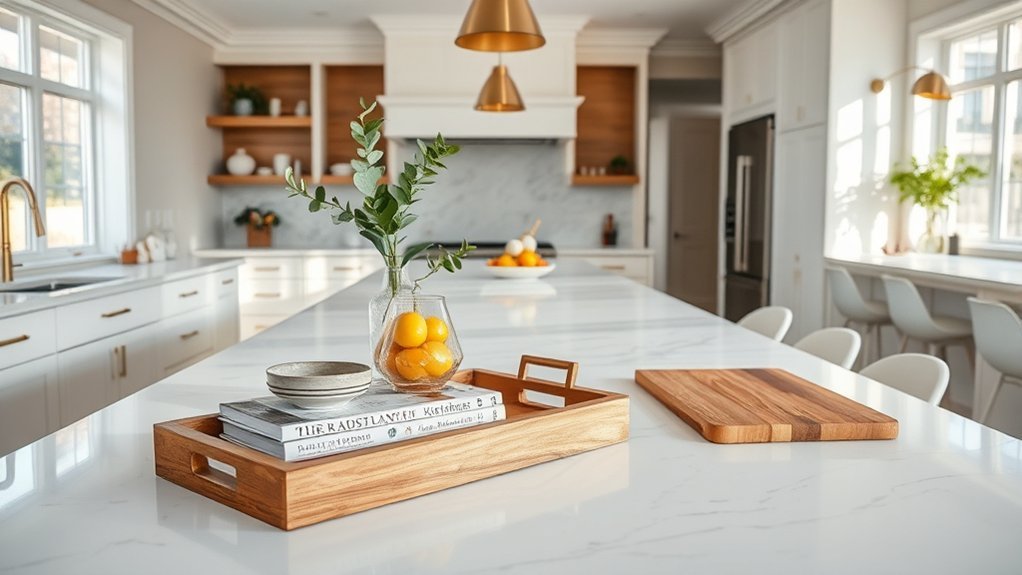
A kitchen island looks best when the decor supports the way you actually use it. Start with one useful focal point—a tray, fruit bowl, vase, plant, cutting board, or attractive piece of kitchenware—then leave generous open counter space for prep, serving, homework, or seating. The goal is not to fill the island; it is to make a hardworking surface look intentional.
Quick Answer
Put one small, movable arrangement on a kitchen island, such as a tray with daily essentials, a bowl of whole fruit, fresh flowers, greenery, attractive cutting boards, or one statement vessel. Keep the main prep and seating areas open, vary height carefully, and choose pieces that are useful, easy to clean around, and proportional to the island.
Key Takeaways
- Decorate around the island’s main job—prep, cooking, eating, entertaining, or a mix of these.
- A tray, fruit bowl, vase, plant, cutting board, or attractive kitchenware can add style without wasting counter space.
- One focal point or a small group of two or three pieces is usually easier to live with than scattered decor.
- Keep sightlines, stools, sinks, outlets, cooktops, and your primary prep zone clear.
- Use seasonal accents sparingly so the island stays easy to clean and ready for daily work.
What Should Go on a Kitchen Island?
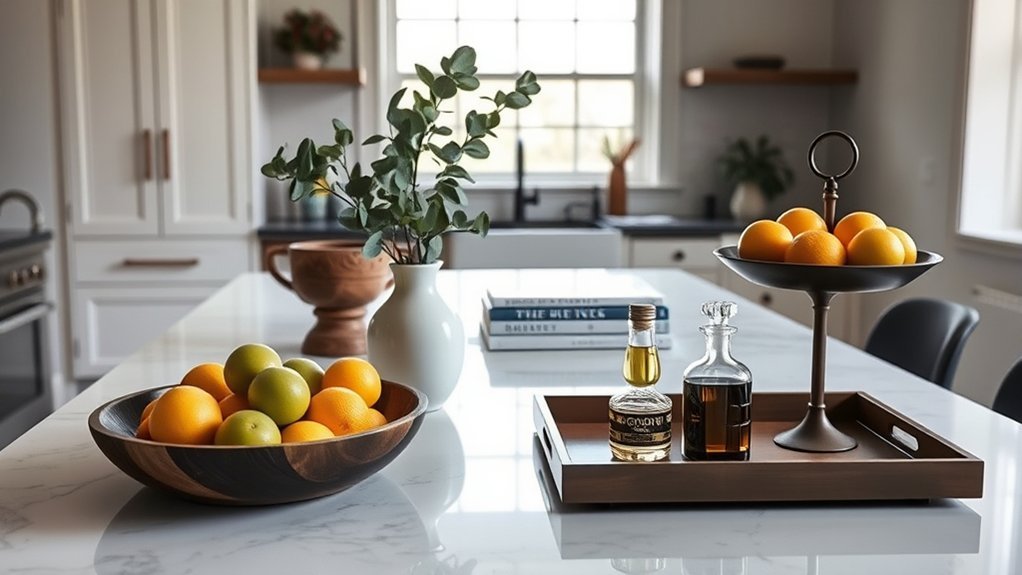
A kitchen island should hold objects that either support everyday use or provide a clear visual focal point. Good choices include a tray for frequently used items, a bowl of whole fruit, fresh flowers, a small plant, attractive cutting boards, cookbooks, or one sculptural vessel.
Before adding anything, decide what the island does most often. An island used for meal prep needs more empty surface than one mainly used for serving or display. An island with stools also needs open sightlines and enough room that decor cannot be knocked over by someone reaching across the counter.
Instead of scattering small accessories from one end to the other, create one deliberate grouping. Varying the height and texture of the pieces can make the arrangement more interesting without increasing the amount of decor.
Pro Tip: Put the decorative grouping at the end of the island farthest from your main prep area. A tray makes the whole arrangement easy to lift away when you need the full counter.
Start With the Island’s Main Job
Kitchen island styling works better when function comes first. Look at what already happens on the surface during a normal day and protect those zones before choosing decor.
- Prep island: Keep the largest uninterrupted section clear for cutting, mixing, rolling, and plating.
- Seating island: Keep decor low enough for comfortable conversation and away from the stool overhang.
- Sink island: Avoid placing decor where it competes with the faucet, dish area, or soap dispenser.
- Cooktop island: Prioritize cooking safety and keep decorative objects away from heat.
- Serving island: Use easily movable decor so platters and dishes can take over when guests arrive.
This simple check prevents the most common styling mistake: decorating the island so thoroughly that it becomes inconvenient to use.
Scale Decor to the Island and Keep Sightlines Open
Decor should look proportional to the island rather than oversized or lost on the surface. A compact island may need only one bowl, vase, or small tray. A long island can support a larger centerpiece or a slightly wider grouping, but it still benefits from generous empty space.
If people sit across from one another, keep the arrangement low enough that it does not become a visual wall. Tall flowers or branches can work on an island without seating, while a low bowl, short vase, or compact planter is often easier to live with around stools.
Also consider pendant lights above the island. Large pendants already provide visual weight, so the countertop may need less decoration than an island under subtle lighting.
Choose Kitchen Island Decor That Works Hard
The best kitchen island decor earns its space. Cookbooks, trays, bowls, cutting boards, utensils, plants, and seasonal fruit can contribute color and texture while still supporting everyday routines.
Current kitchen research also points toward function. The 2026 U.S. Houzz Kitchen Trends Study found strong interest in specialty storage and reported that 53% of renovating homeowners install at least one appliance in their island. That reinforces a useful styling principle: treat the island as working space first and display space second.
In the 2026 U.S. Houzz Kitchen Trends Study, 53% of renovating homeowners installed at least one appliance in the kitchen island—a reminder that island surfaces increasingly support real daily tasks.
Functional Decor First
Start with pieces you already reach for. A tray can hold salt, pepper, or commonly used oils. A bowl can keep suitable whole fruit visible. A cutting board can lean against a low object or sit flat when not in use. A short stack of cookbooks can add height while staying useful.
| Item | Benefit | Effect |
|---|---|---|
| Tray | Corrals essentials | Creates order |
| Bowl | Holds whole fruit | Adds color |
| Board | Supports prep and serving | Adds warmth |
| Books | Keeps recipes handy | Adds height |
| Utensils | Keeps daily tools nearby | Adds function |
You do not need every item on the list. One useful piece may be enough on a small island, while two or three coordinated objects can work on a larger surface.
Style With Purpose
Choose pieces according to what is missing visually. If the kitchen contains many hard, smooth surfaces, wood, greenery, or woven texture can soften the look. If the room already has several colors and finishes, a simple neutral bowl or vase may be enough.
Frequently used oils or utensils can stay within reach when they are safely positioned away from heat and grouped neatly. Decorative cutting boards can add shape without consuming much working space, and a plant or vase can introduce height where it will not block conversation.
The test is simple: if an object regularly gets moved because it is in the way, it probably needs a different location.
Seasonal Swaps Made Easy
Seasonal styling does not require rebuilding the entire arrangement. Keep one neutral foundation—a bowl, vase, board, or tray—and change only what goes inside or around it.
Citrus or other suitable whole fruit can add winter color. Spring flowers can brighten the island for a few days. Fresh greenery, branches, or a small plant can work through several seasons. In fall, a few seasonal produce items can replace the summer arrangement without adding more objects.
A consistent base also makes seasonal decor easier to store because only the accent changes.
Style the Island With a Tray
A tray is one of the most practical kitchen island styling tools because it turns several loose objects into one movable arrangement. Wood can add warmth, metal can echo cabinet hardware, and ceramic or stone can coordinate with the countertop.
Use the tray for items that naturally belong together: salt and pepper, a small oil bottle, a bud vase, napkins, or another frequently used kitchen essential. Keep enough empty space inside the tray that it does not become a container for random clutter.
Tray Groupings
A simple tray grouping can contain two or three items of different heights. For example, combine a medium vase, a low bowl, and one small functional item. The difference in scale creates visual movement without requiring a large number of objects.
- Use two or three coordinated pieces rather than filling every inch of the tray.
- Mix one taller object with one or two lower objects.
- Repeat a material or color already present in the kitchen.
- Leave enough room to pick up and move the tray easily.
If three objects look forced, use two. The so-called rule of three is a styling technique, not a requirement.
Functional Styling
Functional styling works particularly well when the island is used every day. A tray can hold items that would otherwise drift around the countertop and can be moved in seconds when you need space for food preparation.
Varying heights with a short vase, low bowl, or stack of books can add dimension, but the arrangement should never interfere with a stool, sink, appliance, outlet, or active work area.
Regularly remove objects that have migrated onto the tray but do not belong there. A tray should organize essentials rather than hide accumulating clutter.
Add Fruit, Flowers, and Greenery
Fruit, flowers, and greenery bring natural color to a kitchen island without relying on purely decorative objects. A broad fruit bowl works well when it holds whole produce that can safely remain at room temperature. Flowers can create a stronger focal point, while herbs or a compact plant add texture.
Choose a vase or planter that is stable and proportionate to the island. Near seating, shorter arrangements are usually more comfortable because they preserve sightlines across the counter.
Food safety still matters when produce becomes part of the decor. The U.S. Food and Drug Administration advises refrigerating pre-cut produce and fresh produce that requires refrigeration. Use the island bowl for appropriate whole produce rather than leaving cut fruit or refrigeration-required items sitting out for decoration.
- Whole room-temperature fruit for useful color
- Fresh flowers or branches for height
- Small herbs or greenery for natural texture
- Neutral vessels that work through multiple seasons
Display Your Prettiest Kitchenware
Attractive kitchenware can double as decor, especially when it is something you already use. A handmade bowl, a wood cutting board, a favorite serving plate, a ceramic utensil holder, or a small stack of cookbooks can make the island look finished without adding objects that exist only for display.
Limit the display so the pieces remain easy to see and easy to move. Repeating a material, finish, or color found elsewhere in the room helps separate useful display from random countertop storage.
A pedestal bowl or stack of books can create height, but stability matters on a working surface. Avoid arrangements that can tip when someone bumps the counter or pulls up a stool.
Make One Statement Piece the Focus
A single statement piece is often the easiest answer for a large, visually busy kitchen. A substantial vase, sculptural bowl, planter, or handcrafted vessel can create a clear focal point without surrounding clutter.
Choose something large enough to suit the island but not so tall or wide that it blocks conversation, pendant lighting, food service, or your main work zone. A statement bowl can also hold fruit, while a vase can change with the seasons.
- Choose a shape that complements the room’s overall style.
- Let the statement piece provide the visual weight instead of adding many companions.
- Position it away from the primary prep zone.
- Use a board or tray underneath if you want to move the piece quickly.
Arrange Decor in Threes
Groups of three are popular because they make it easy to combine different heights, shapes, and textures. The approach works best as a flexible starting point rather than a strict rule.
| Item | Height | Texture |
|---|---|---|
| Vase | Tall | Smooth |
| Bowl | Medium | Matte |
| Candle or small object | Low | Glossy |
A ceramic vase, wooden bowl, and glass object can create contrast while still reading as one grouping. If the kitchen is small, however, one or two items may look cleaner. Scale and function matter more than the number of pieces.
Where Should Kitchen Island Decor Go?
Placement matters almost as much as the objects themselves. In most working kitchens, decor is easiest to live with when it sits toward one end rather than directly in the center of the main prep area.
- Near a clear end: Good for trays, bowls, flowers, or greenery.
- Between work zones: Works only if the arrangement does not interrupt movement between the sink, cooktop, and prep area.
- Near seating: Keep pieces low, stable, and beyond the normal reach of elbows and plates.
- Beside an outlet: Leave access clear for mixers, chargers, and other devices.
- Near a cooktop: Keep decorative items well away from heat and flame.
Warning: If your island contains a cooktop, do not treat the surrounding counter like a normal decorating zone. The National Fire Protection Association advises keeping items that can catch fire—including wooden utensils, towels, and food packaging—away from stovetops.
How to Decorate Small and Large Kitchen Islands
A small kitchen island usually looks better with one useful focal point than with a complete vignette. Try a bowl, low vase, plant, or compact tray. Avoid tall arrangements if the island is also a dining surface.
A large kitchen island can carry more visual weight, but more surface does not mean every section needs decoration. One substantial vessel, a broad fruit bowl, or a tray with two or three coordinated items can anchor the surface while leaving the rest clear.
On an extra-long island, two widely separated functional zones can work—for example, a low decor grouping at one end and a serving area at the other—but avoid creating a line of small objects across the full length.
What Should Stay Off a Kitchen Island?
A kitchen island works best when it stays free of clutter that competes with cooking, eating, and gathering. Paperwork, packages, keys, charging cables, oversized ornaments, and rarely used appliances can quickly turn the largest working surface in the kitchen into a drop zone.
Mail and school papers are easier to control when they have a dedicated drawer, basket, or command area away from the main food-preparation surface. Bulky decorations should also move elsewhere if they block prep space or conversation.
- Loose mail and paperwork
- Random keys, receipts, and pocket items
- Too many small decorative objects
- Oversized arrangements that block sightlines
- Appliances that are rarely used
- Combustible decor near an island cooktop
- Cut or refrigeration-required produce left out as decoration
A useful test is to clear everything from the island and add back only what improves the way the surface works or looks. If an object constantly needs to be shifted before you can cook or sit down, it probably belongs somewhere else.
Keep Kitchen Island Decor Easy to Clean
Kitchen surfaces collect crumbs, cooking residue, splashes, and dust, so island decor should be easy to lift and wipe around. This is another reason trays and single statement pieces work well: they reduce the number of individual objects you need to move during cleaning.
Wash fruit bowls and utensil containers as needed, refresh water in flower arrangements, remove dead leaves, and wipe the bottoms of decorative objects before returning them to the counter. Avoid placing porous or delicate decor where it regularly comes into contact with food, water, or cooking splatter.
Frequently Asked Questions
What Is the New Trend With Kitchen Islands?
Current kitchen-island trends emphasize function as much as appearance. The 2026 Houzz study reports strong use of specialty storage and appliance-equipped islands, while the NKBA’s 2026 trends research emphasizes personalized, multipurpose kitchens, smarter storage, and streamlined design. In practical terms, islands are increasingly designed as work, storage, dining, and social zones rather than simple empty countertops.
What Are Common Kitchen Island Mistakes?
Common mistakes include overcrowding the countertop, blocking the main prep area, choosing decor that is too tall around seating, covering outlets, placing unstable objects near stools, and leaving combustible decor near an island cooktop. Another mistake is treating the island as a permanent drop zone for mail, keys, bags, and paperwork.
What Are the Trends for Kitchen Islands in 2026?
The clearest 2026 directions are multifunctional layouts, smarter storage, appliance integration, personalized work zones, natural materials, and simpler visual styling. Houzz reports that 53% of renovating homeowners install at least one appliance in their island. NKBA’s industry research also points toward multipurpose kitchens, storage-rich islands, minimalism, and natural materials.
How to Make a Kitchen Island Look Better?
Clear the surface first, then add back one focal point or one small grouping. A tray, fruit bowl, flowers, greenery, cutting boards, or attractive kitchenware can provide color and texture. Match the scale to the island, keep the main work area open, and repeat one or two colors or materials already used elsewhere in the kitchen.
Should a Kitchen Island Centerpiece Be Tall or Low?
Use a low centerpiece when people sit or talk across the island because it preserves sightlines. A taller vase or arrangement can work on an island without seating if it does not interfere with pendant lights, cabinets, cooking, or food preparation. Stability and proportion are more important than a specific height.
What Should You Put in the Center of a Large Kitchen Island?
A large island can handle one substantial vase, sculptural bowl, planter, fruit bowl, or a generous tray containing a few coordinated pieces. You do not need to fill the entire center. Keep enough open surface for food preparation, serving, seating, and anything else the island handles during a normal day.
Conclusion
A kitchen island looks better when style follows function. Start with the way the island is used, keep its busiest zones open, and add only enough decor to create one clear focal point. A tray, fruit bowl, flowers, greenery, attractive kitchenware, or a single statement piece can do the job without turning valuable counter space into a display shelf.
The strongest current kitchen trends support the same practical approach. Storage, appliance integration, multipurpose layouts, and streamlined design are all prominent in 2026 research, so a kitchen island should remain easy to cook at, sit around, serve from, and clean. Thoughtful decor should make that working surface look better—not make it harder to use.
Sources
- 2026 U.S. Houzz Kitchen Trends Study — supports current findings on storage, appliance integration, renovation priorities, and kitchen-island use.
- NKBA | KBIS 2026 Kitchen Trends Report press release — supports current trends involving multipurpose kitchens, smarter storage, minimalism, materials, and personalization.
- U.S. Food and Drug Administration: Selecting and Serving Produce Safely — supports safe storage guidance for fresh and pre-cut produce.
- National Fire Protection Association: Cooking Safety — supports keeping combustible objects away from stovetops and cooking areas.
