
The best robotic lawn mowers under $1,000 in 2027 include the Roborock RockNeo Q110H, ECOVACS Goat O1000 RTK, ECOVACS Goat O1000 LiDAR, MOVA LiDAX Ultra 1000, WORX WR320, and Neomow X SE. Each offers wire-free setup, smart app control, and strong obstacle avoidance. RTK and LiDAR models improve navigation, while battery life and coverage vary by yard size. Their features and limits become clearer when each one is compared closely.
Roborock RockNeo Q110H Wire-Free Robot Lawn Mower
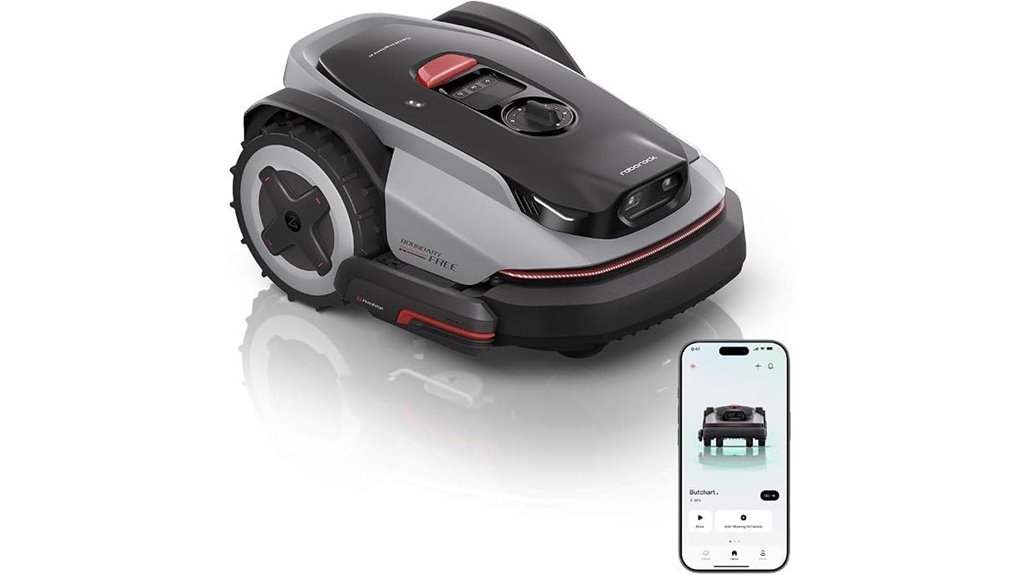
The Roborock RockNeo Q110H stands out for homeowners who want a wire-free mower that can handle a fairly large yard without the hassle of boundary setup. It covers up to 1/4 acre, climbs slopes as steep as 45 percent, and crosses obstacles up to 1.57 inches. Full-Band RTK plus VSLAM supports AI auto-mapping and manual boundary tracing through the app. Dual-camera vision helps it avoid people, pets, and static objects. It also navigates narrow passages, offers multi-zone scheduling, and includes PIN lockout, an alarm, and optional 4G tracking for added security.
Best For: Homeowners with medium-sized, wire-free lawns who want smart mapping, strong obstacle avoidance, and app-based scheduling without installing boundary wires.
Pros:
- Wire-free setup with AI auto-mapping and manual boundary tracing
- Dual-camera vision helps avoid people, pets, and common obstacles
- Handles slopes up to 45% and narrow passages as tight as 2.3 feet
Cons:
- Covers only up to 1/4 acre, so it may not suit larger properties
- Higher-tech features may come with a steeper learning curve
- Optional 4G tracking for enhanced security may require extra cost
ECOVACS Goat O1000 RTK Care Robot Lawn Mower, RTK Navigation, 1/4 Acre
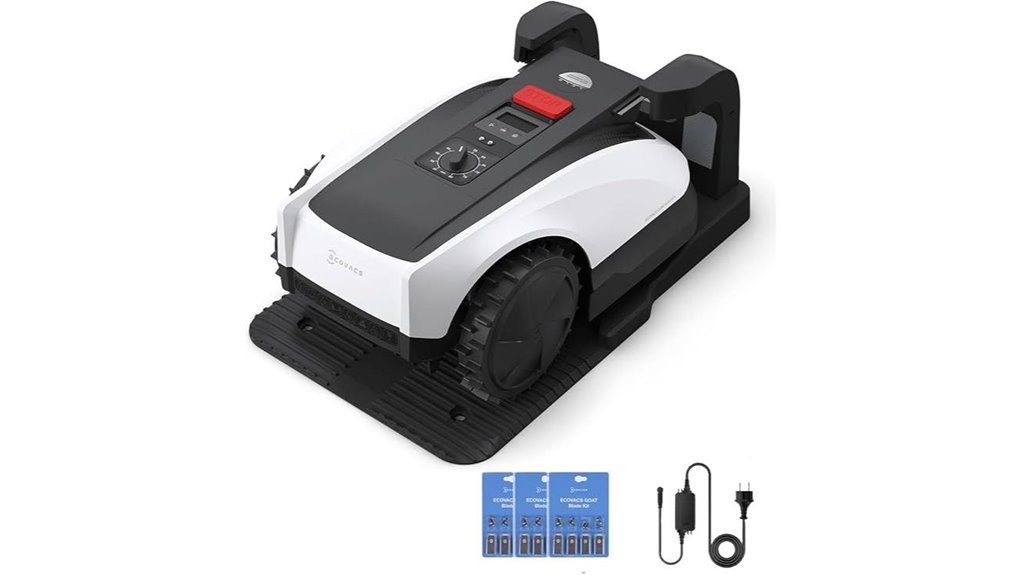
For homeowners wanting wire-free precision on small yards, the ECOVACS Goat O1000 RTK stands out. Built for up to 1/4 acre, this robotic mower uses RTK navigation for centimeter-level positioning without perimeter wires. It moves in systematic paths, producing cleaner lines and more even coverage than random-pattern units. The CARE version adds 36 extra replacement blades, supporting longer maintenance cycles. A 90-minute average runtime, auto mapping, and app-based zone scheduling make it practical for hands-free operation. It also handles automatic recharging, quiet 62dB mowing, and adjustable cutting heights from 1.2 to 3.2 inches.
Best For: Homeowners with small yards up to 1/4 acre who want a wire-free, app-controlled robotic mower with precise RTK navigation and low-noise operation.
Pros:
- Centimeter-level RTK navigation provides accurate, wire-free mowing paths.
- CARE version includes 36 extra replacement blades for longer maintenance intervals.
- Auto mapping, zone scheduling, and automatic recharging make it highly hands-free.
Cons:
- 90-minute average battery life may require multiple charging cycles for larger or complex yards.
- Cutting width of 8.66 inches is relatively narrow, so mowing can take longer.
- Best suited for smaller properties, with coverage limited to up to 1/4 acre.
ECOVACS Goat O1000 LiDAR Robot Lawn Mower
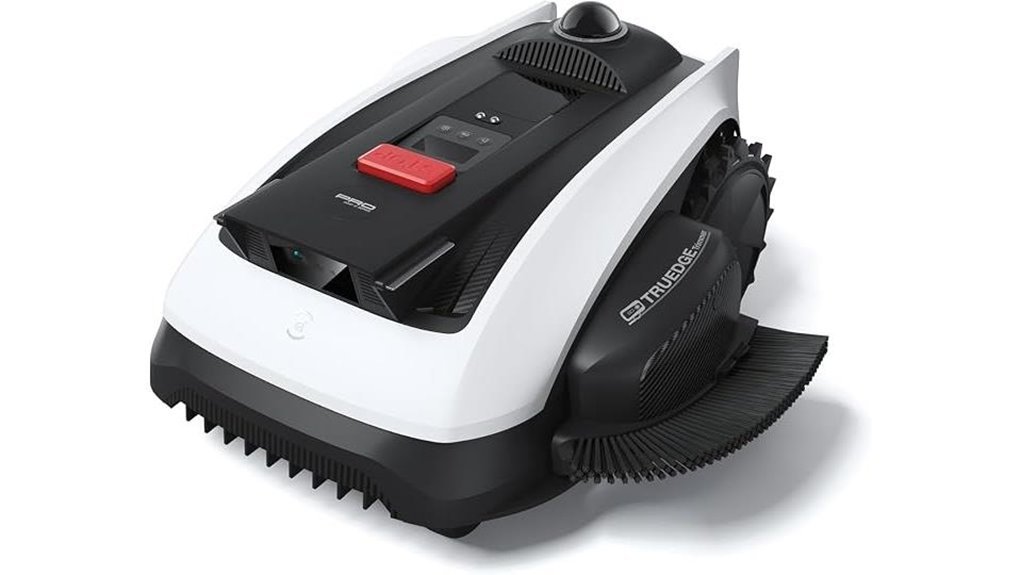
ECOVACS’ Goat O1000 LiDAR PRO suits homeowners wanting wire-free setup and precise, app-based control. Its HoloScope 360° Dual-LiDAR mapping removes the need for perimeter wire or an RTK antenna, while delivering 2 cm positioning that remains reliable in shaded areas. The mower uses AI Vision and 3D ToF LiDAR to detect more than 200 obstacle types with 5 cm precision. A TruEdge trimmer supports cleaner borders, and the slim 0.8 m body helps it reach narrow passages, corners, and raised edges across lawns up to 1/4 acre.
Best For: Homeowners with up to a 1/4-acre lawn who want a wire-free robotic mower with precise app-based control, strong obstacle detection, and cleaner edge trimming.
Pros:
- No perimeter wire or RTK antenna needed, making setup simpler and more flexible
- 2 cm LiDAR positioning and shaded-area reliability improve navigation accuracy
- TruEdge trimming and a slim 0.8 m body help with borders, corners, and narrow passages
Cons:
- Best suited for smaller lawns up to 1/4 acre, so larger yards may need a different model
- Advanced features may require time to learn and configure in the app
- Performance could still depend on yard complexity, despite strong obstacle detection
MOVA LiDAX Ultra 1000 Wire-Free Robot Lawn Mower
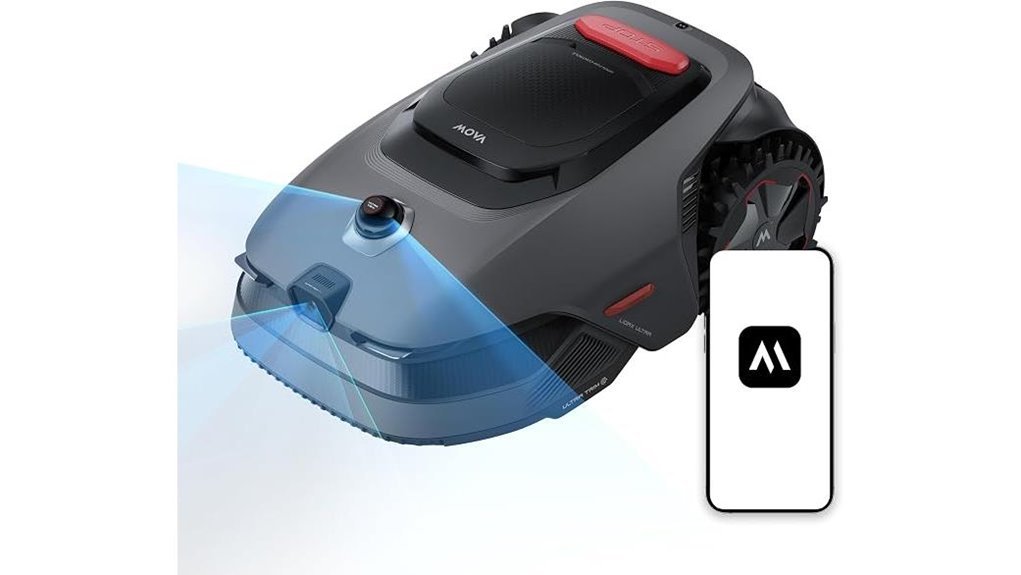
MOVA’s LiDAX Ultra 1000 suits homeowners wanting wire-free setup and precise edge cutting. It uses 360° 3D LiDAR and AI-assisted auto-mapping, avoiding RTK wires while covering lawns up to 1/4 acre. UltraTrim 1.0 cuts within 2 inches of walls, hedges, and raised edges, with blade height adjustable from 1.2 to 3.9 inches. Smart U-shaped mowing supports complete coverage, and the mower resumes after charging. Rear-wheel drive, off-road wheels, and 45% slope handling improve traction. It detects more than 300 obstacles, supports two maps and 150 zones, and includes theft protection, a three-year warranty, and 24/7 support.
Best For: Homeowners with small to medium lawns up to 1/4 acre who want a wire-free, AI-mapped robot mower with precise edge cutting and strong terrain handling.
Pros:
- Wire-free setup with 360° 3D LiDAR and AI-assisted auto-mapping, so there’s no RTK wire installation.
- Strong mowing performance with UltraTrim 1.0, cutting within 2 inches of edges and offering adjustable blade height.
- Handles challenging lawns well, including up to 45% slopes, 300+ obstacle detection, and support for 2 maps and 150 zones.
Cons:
- Best suited for smaller properties, with coverage limited to about 1/4 acre.
- Premium feature set may make it more expensive than basic robot mowers.
- Setup and app-based map management may still take some learning for first-time robot mower users.
WORX Robot Lawn Mower for 1/2 Acre, No Perimeter Wire, WR320
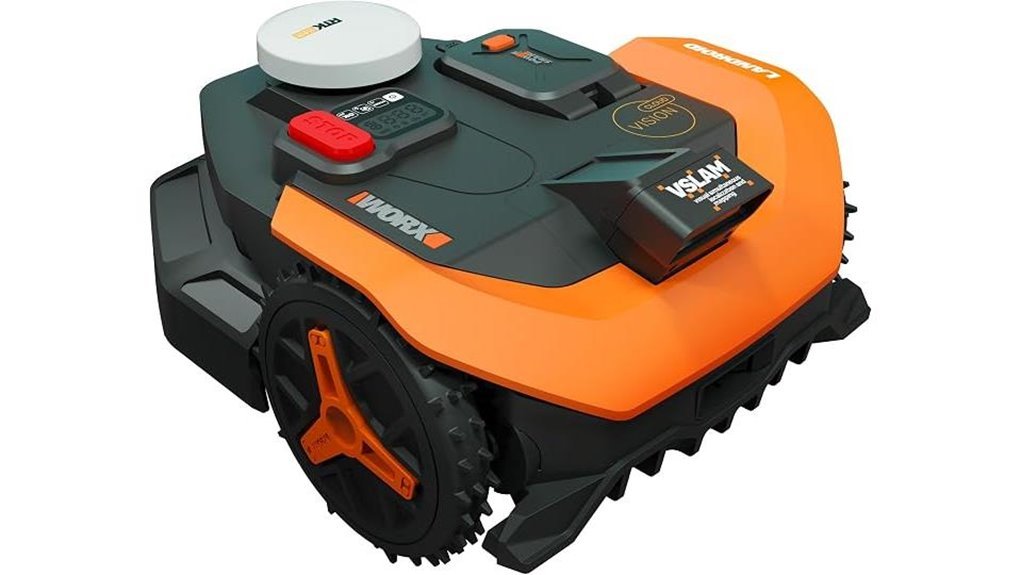
The WR320 suits homeowners wanting wire-free mowing for medium lawns. Its cloud-based RTK positioning provides centimeter-level accuracy without a local antenna or extra subscription charges. V-SLAM sensor fusion helps it stay on course in shaded areas, while Vision AI maps lawns automatically for efficient first-run coverage. Cut-to-edge border recognition reduces stray grass along fixed edges. The mower’s AI obstacle detection improves safety around objects. Through the app, users can set unlimited zones, no-go areas, and mowing patterns. Enhanced Bluetooth, Wi-Fi, and RadioLink extend connectivity across larger properties.
Best For: Homeowners with medium-sized lawns who want a wire-free robot mower with precise cloud-based navigation, automated mapping, and app-based zone control.
Pros:
- Centimeter-level RTK Cloud accuracy delivers precise mowing without a local antenna or extra subscription fees.
- Vision AI auto-mapping, cut-to-edge trimming, and customizable mowing patterns help improve coverage and finish quality.
- Unlimited zones, no-go areas, and extended connectivity via Bluetooth, Wi‑Fi, and RadioLink add flexibility and convenience.
Cons:
- Best suited to medium lawns, so it may be less ideal for very large or highly complex properties.
- Advanced features may require some initial app setup and map management.
- Performance can still vary in especially challenging layouts or heavily obstructed areas despite obstacle avoidance and sensor fusion.
Neomow X SE 360° 3D LiDAR Navigation Robot Lawn Mower for 0.75 Acre

Built for medium yards, the Neomow X SE handles up to 0.75 acres without boundary wires. Its 360° 3D LiDAR system, advanced vision, and spatial fusion enable inch-level positioning with less than 0.8 inches of error. It recognizes over 200 obstacle types, spots objects as small as 5.9 inches high, and crosses 1.6-inch barriers. The 11-inch deck and 13,000 mAh battery support up to two hours per charge. WiFi, Bluetooth, and 4G app control allow mapping, scheduling, and no-go zones. IPX5 cleaning and quiet operation add practical appeal.
Best For: Homeowners with medium-sized yards up to 0.75 acres who want a wire-free, app-controlled robot mower with advanced obstacle detection and precise navigation.
Pros:
- No boundary wires or RTK station needed, making setup quick and convenient.
- 360° 3D LiDAR with vision and spatial fusion provides inch-level positioning and strong obstacle avoidance.
- App features like mapping, scheduling, no-go zones, and remote control via WiFi, Bluetooth, and 4G add flexibility.
Cons:
- Two-hour battery life may require recharging for larger mowing sessions within its coverage range.
- At 38 pounds, it may be relatively heavy to move or handle manually.
- Best suited for medium yards, so it may not be ideal for very large or highly complex lawns.
Factors to Consider When Choosing Robotic Lawn Mowers Under $1,000 in 2026

When choosing robotic lawn mowers under $1,000 in 2026, coverage area limits and navigation technology are among the first factors to compare. Obstacle avoidance and battery runtime also shape how reliably a mower can handle real yard conditions. Cutting height range matters as well, since it determines how well the machine can adapt to different grass types and seasonal needs.
Coverage Area Limits
Coverage area is one of the most important limits to check, since most robotic lawn mowers under $1,000 are designed for yards up to about 1/4 acre. That range suits many small to medium lawns, but larger properties may need a higher-capacity model or more than one unit to keep mowing efficient. Buyers should compare claimed coverage with the actual yard size, including open sections and any areas that must be cut separately. Terrain capability also matters, because slopes, tight corners, and obstacles can reduce practical coverage. Cutting width influences how much ground a mower handles per pass, so wider decks can shorten mowing time. Multi-zone settings can further improve coverage by letting the mower focus on specific sections within a larger yard.
Navigation Technology
Beyond yard size, navigation technology determines how effectively a robotic mower handles that space. RTK navigation offers centimeter-level positioning, helping budget models mow with greater precision without perimeter wires. Auto-mapping functions are also valuable because they generate detailed lawn layouts, supporting systematic routes and more even coverage. App-based controls often let users set multiple mowing zones and no-go areas, which is useful for properties with distinct sections or awkward shapes. Good navigation also improves performance on slopes, narrow passages, and other challenging terrain where less capable machines may struggle. In this price range, buyers should compare how accurately a mower plans its path, how flexibly it adapts to the lawn, and how well it translates maps into consistent cutting patterns across the yard.
Obstacle Avoidance
Obstacle avoidance is one of the most important differentiators in budget robotic mowers, because effective systems can detect and route around both fixed and moving hazards without constant user intervention. Models with dual-camera AI vision or LiDAR can recognize furniture, pets, and garden ornaments, then adjust course smoothly. High-quality units may identify more than 200 obstacle types, helping them maintain consistent mowing patterns in complex yards. Some systems detect objects as small as 1.57 inches, which supports close navigation without unnecessary stops. Others can roll over low obstacles instead of halting, reducing interruptions. Customizable no-go zones add another layer of control, allowing users to block off delicate areas and improve safety. In this price range, stronger obstacle handling usually means fewer collisions and more reliable performance.
Battery Runtime
Battery runtime is another major factor in choosing a robotic lawn mower under $1,000, especially after comparing how well a model handles obstacles and complex yard layouts. Typical operating times fall between 90 and 130 minutes per charge, which can determine whether the mower finishes a yard in one session or needs multiple stops. Longer runtimes are especially useful on lawns larger than 1/4 acre, where frequent interruptions reduce efficiency. Quick recharge cycles also matter, since they let the mower return to work sooner after the battery is depleted. Some models include battery management systems that help maintain performance and extend battery life, which may lower maintenance costs over time. Consistent runtime should consequently be weighed carefully against yard size and mowing demands.
Cutting Height Range
Cutting height range is another important factor when evaluating robotic lawn mowers under $1,000, since most models adjust between about 1.2 inches and 3.9 inches to suit different lawn preferences. A wider range helps match grass type, seasonal growth, and desired lawn appearance. Lower settings create a closely trimmed look, while higher settings support healthier growth by leaving more leaf surface on the grass. Some budget models include fine adjustments in 0.2-inch increments, which improves control over mowing results. This flexibility can also matter on uneven ground, where slightly taller grass may help the mower maintain steadier cutting performance. Buyers comparing these mowers should look for a range that balances appearance, plant health, and the conditions found in their yards throughout the year.
Slope Handling
Slope handling is a key factor when choosing a robotic lawn mower under $1,000, especially for yards with inclines or uneven terrain. Buyers should check the maximum slope percentage listed in the specifications, since some models can manage inclines up to 45%. That capability helps maintain a consistent cut on hilly lawns, where grass height and moisture can make traction harder to preserve. Models with advanced traction systems are better suited to steep sections because they reduce slipping and improve stability. Obstacle-crossing ability also matters, as bumps, ruts, and uneven ground can interrupt mowing on slopes. A mower that combines strong slope performance with reliable movement over rough patches is more likely to finish the job safely and evenly across challenging terrain.
App Control Features
After considering how a mower handles hills and uneven ground, buyers should also look at app control features, which can make day-to-day operation easier and more precise. Scheduling tools let owners set mowing times around work, weather, or quiet hours, reducing the need for manual starts. Mapping functions in many apps help define cutting zones and no-go areas, improving coverage while avoiding delicate landscaping. Real-time tracking shows where the mower has worked and whether it is progressing efficiently. Some apps also permit adjustments to cutting height and mowing patterns, allowing the machine to match grass type and lawn layout. Notifications can report completed jobs, interruptions, or maintenance needs, helping users stay informed without checking the mower directly.
Security Options
Security options deserve close attention, since a robotic mower can be both an outdoor tool and a target for theft. Buyers should favor models with anti-theft safeguards such as PIN code lockout and loud alarms, which can deter unauthorized use. Optional tracking modules add another layer of protection by showing the mower’s location in real time if it is taken. Geo-fencing is also valuable, because it can alert the owner when the unit leaves its designated area. Strong app control matters as well, since remote access makes it easier to monitor security settings and respond quickly. Finally, warranty coverage and responsive customer service can reduce stress if a security problem occurs, protecting the investment and improving long-term confidence in the mower’s reliability.
Frequently Asked Questions
How Noisy Are Robotic Lawn Mowers at Night?
They are usually quite quiet, often around 55 to 65 decibels, similar to light rainfall or a conversation. At night, they may still be noticeable nearby, though less disruptive than traditional mowers.
Can Robotic Mowers Handle Steep Slopes Safely?
Like climbers on a hillside, they can handle steep slopes only within manufacturer limits. Traction, weight, and safety sensors matter. Exceeding rated incline risks slipping, tipping, or blade contact, so careful matching is essential.
Do Robotic Mowers Work in Heavy Rain?
Robotic mowers generally do not work well in heavy rain; many pause automatically to protect electronics and improve traction. Wet grass can cause slipping, uneven cutting, and charging issues, making operation less reliable overall.
How Often Do Blades Need Replacement?
Blades typically need replacement every one to three months, depending on lawn size, grass thickness, and mowing frequency. Duller edges reduce cut quality, so periodic inspection and timely swaps keep performance consistent and efficient.
Are Robotic Lawn Mowers Safe Around Pets?
Generally, yes, robotic lawn mowers are safe around pets when supervised and equipped with sensors. Still, small animals may be at risk if they approach unexpectedly, so keeping pets indoors during mowing is prudent.
Conclusion
In the evolving world of budget-friendly automation, these six mowers suggest that capable lawn care no longer has to ask too much of a homeowner’s wallet. Each model brings its own quietly persuasive strengths, from wire-free navigation to smarter mapping and steadier trimming. For buyers seeking a more effortless weekend, the right choice may feel less like a machine purchase and more like a gentle handoff of a once-demanding chore.
