
Choosing the right ice melt spreader for winter walkways helps you treat slippery paths without scattering excess salt across your lawn. A compact handheld spreader works well near doors and steps. Larger walk-behind and tow-behind models are better for long driveways and open properties.
The Scotts Whirl Hand-Powered Spreader is the best overall choice for typical residential walkways. Its hand-crank mechanism, adjustable arm support, and year-round versatility make it a practical option. For smaller paths where you want a simple shaker, consider the AquaDoc Handheld Salt Spreader.
These five picks cover different property sizes, spreading methods, and material requirements. The comparison focuses on product specifications, manufacturer guidance, and everyday usability rather than unverified performance claims.
Ice Melt Spreaders for Winter Walkways Compared
The main differences are capacity, operating method, and spreading control. Compare those features first, then choose a spreader that matches your walkway width and the ice melt material you use.
| Product | Best for | Capacity | Spreading method |
|---|---|---|---|
|
Budget
|
Best value for short paths and steps | 2.5 L | Handheld shaker with three opening sizes |
|
Budget
|
Best overall for residential walkways | Up to 1,500 sq. ft. of Scotts lawn products | Hand-crank broadcast spreader |
|
Mid-range
|
Best walk-behind for residential driveways | 80 lb | Push broadcast with adjustable baffles |
|
Premium
|
Best for property maintenance crews | 100 lb | Push broadcast with lever and deflectors |
|
Mid-range
|
Best tow-behind for large open areas | 200 lb | Tow-behind broadcast with five gate positions |
Ice Melt Spreaders for Winter Walkways: Our Top Picks
1. AquaDoc Handheld Salt Spreader
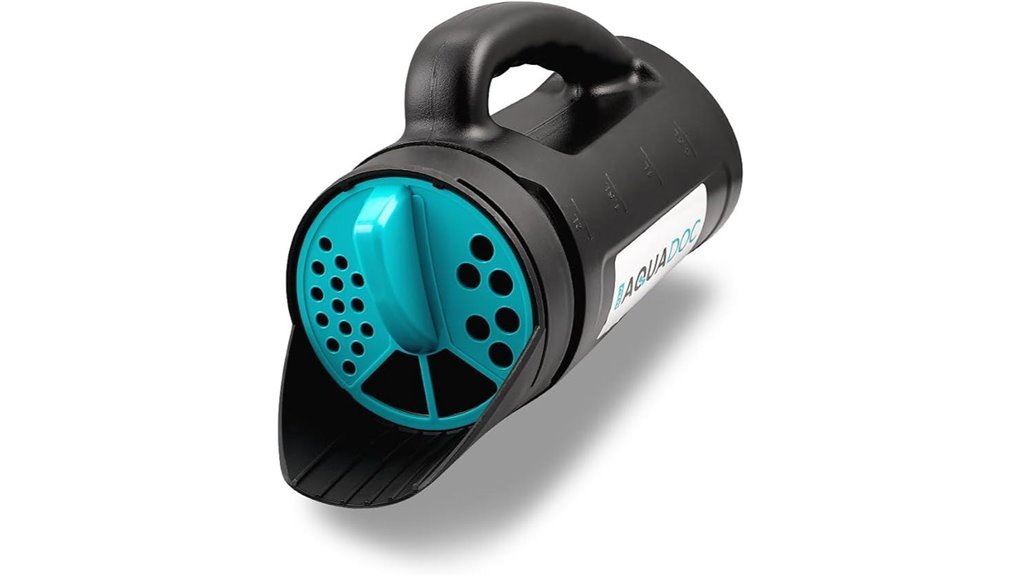
Bottom line: The AquaDoc Handheld Salt Spreader is a good option for short sidewalks, steps, and narrow paths. Its 2.5L container and three opening sizes give you a simple way to apply granular ice melt without wheeled equipment.
- Type: Handheld shaker, easy to carry around small spaces.
- Capacity: 2.5 L, suited to smaller applications.
- Control: Small, medium, and large sieve openings for different granule sizes.
The AquaDoc uses a toggle cap rather than a rotating broadcast mechanism. Choose an opening that fits your material, then distribute the granules along the surface. This makes it practical for entrances where a wide broadcast pattern could scatter salt into nearby plants.
Its ergonomic handle supports a comfortable grip, while the twist-off cap allows straightforward refilling. You can also use it for compatible granular lawn fertilizer, grass seed, and other dry materials outside winter.
However, a handheld shaker requires you to move and distribute the material manually. It is less convenient for long driveways or properties that need frequent treatment. It is also unsuitable for liquids and materials that cannot pass through the selected openings.
- Compact 2.5L container is convenient for small walkways.
- Three sieve openings allow basic control over material flow.
- Twist-off cap simplifies filling and cleaning.
- Small capacity means frequent refills on longer driveways.
- Manual shaking takes more effort over large areas.
- Coarse or damp material may not pass through the openings easily.
2. Scotts Whirl Hand-Powered Spreader
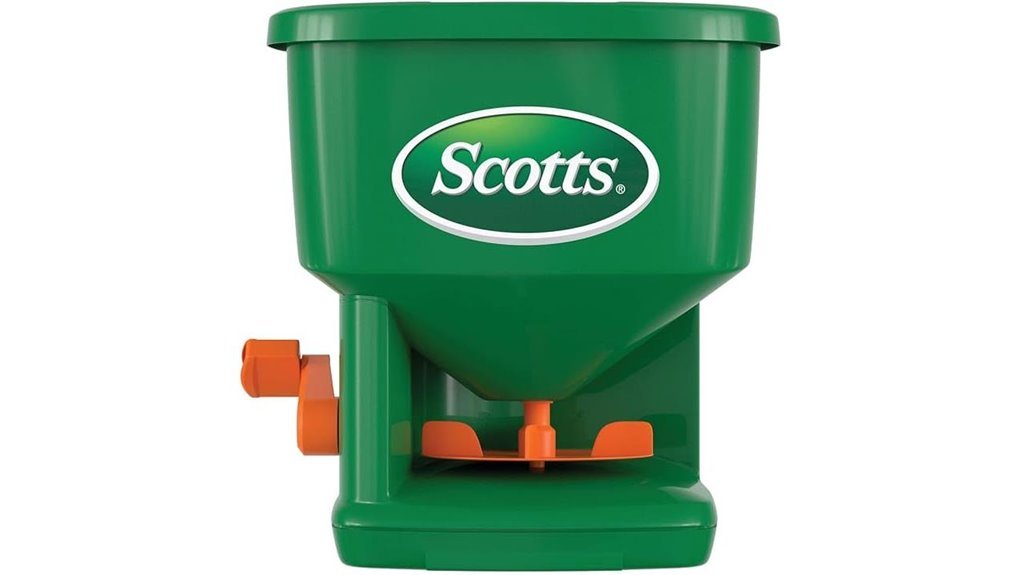
Bottom line: The Scotts Whirl Hand-Powered Spreader is a strong all-around choice for household walkways. Its hand-crank design spreads compatible ice melt in a broadcast pattern, while adjustable arm support makes repeated applications more comfortable.
- Type: Manual hand-crank broadcast spreader for residential use.
- Capacity: Holds enough Scotts lawn products to treat up to 1,500 sq. ft.
- Control: Adjustable settings dial and hand crank for material distribution.
The Scotts Whirl arrives fully assembled, so you can begin using it without putting together a frame or wheels. To operate it, fill the hopper, select a suitable setting, walk steadily, and turn the crank while opening the flow control.
The adjustable arm support and wide handle help distribute the load during use. It is designed for lawn fertilizer and grass seed during warmer months, as well as compatible salt and ice melt in winter.
Scotts specifies coverage of up to 1,500 square feet with its lawn products. That figure should not be treated as a guaranteed ice melt coverage area because de-icer application rates vary.
For very narrow sidewalks, remember that a broadcast spreader can throw material beyond the intended path. Keep the output conservative and avoid spreading onto grass or planting beds.
- Fully assembled and easy to begin using.
- Adjustable arm support improves handling comfort.
- Useful for seed, fertilizer, compatible salt, and ice melt.
- Continuous cranking may become tiring during long jobs.
- Broadcast pattern requires care near lawn edges and plants.
- Large, unscreened rock salt may jam the gate.
3. Chapin 88000A SaltPro
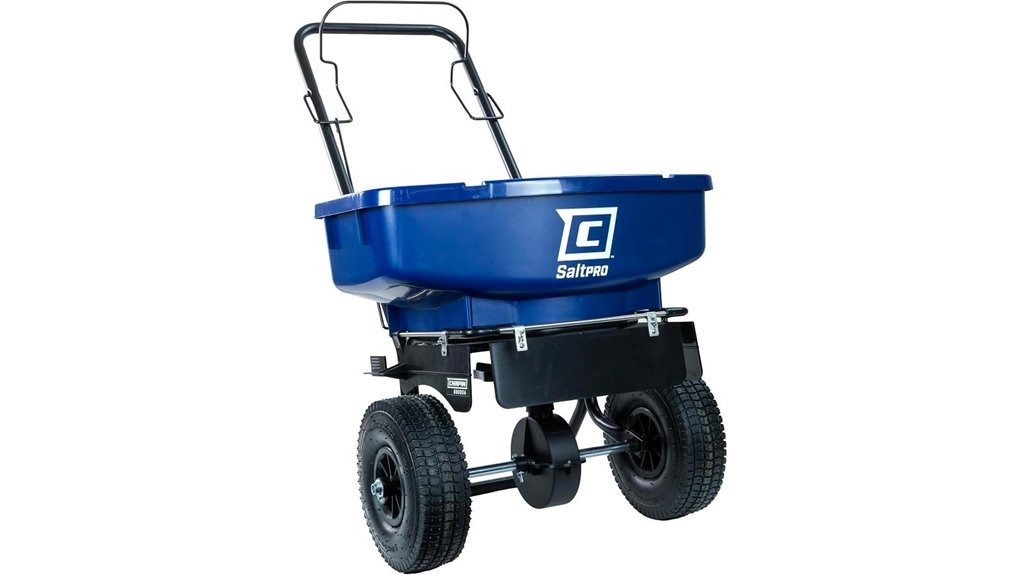
Bottom line: The Chapin 88000A SaltPro is a practical upgrade for homeowners with longer driveways and wider walkways. Its 80 lb hopper, pneumatic tires, and adjustable baffles make it easier to distribute suitable ice melt across larger surfaces.
- Type: Walk-behind broadcast spreader for residential ice melt applications.
- Capacity: 80 lb poly hopper, reducing refill frequency.
- Control: Adjustable gate and front and side baffles for spread direction.
- Wheels: 10-inch pneumatic tires for uneven outdoor surfaces.
The blue, weather-resistant poly hopper sits on a powder-coated steel frame. A plastic spiked auger helps break up clumps and move material through the outlet. The baffles let you direct more material toward the intended surface and reduce unwanted spreading near edges.
The U-shaped flip-up handle and full-bar gate control are designed for comfortable use, including when you wear winter gloves. An included rain and snow cover helps protect the material in the hopper. Chapin backs this model with a two-year limited warranty.
Material compatibility is the main detail to check. Chapin recommends this model for suitable ice melt, halite, and small granular materials. However, its official instructions specifically advise against coarse rock salt, sand, sand mixes, lime, and lime mixtures.
That restriction matters if you usually buy inexpensive bulk rock salt. The Chapin may be an excellent match for compatible processed de-icers, but you should not assume it will handle every salt product.
- 80 lb capacity handles larger residential areas with fewer refills.
- Adjustable baffles help control the spreading direction.
- Pneumatic tires, spiked auger, and included weather cover support winter use.
- Not recommended for coarse rock salt, sand, or sand mixes.
- A loaded hopper requires more pushing effort than a handheld tool.
- Larger frame takes more storage space.
4. Buyers Products 3039632R
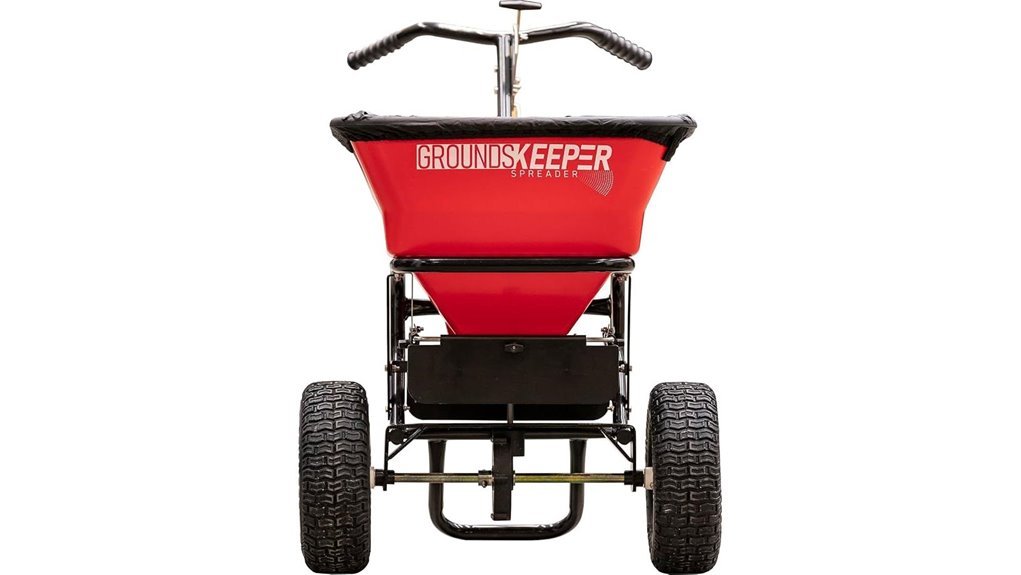
Bottom line: The Buyers Products 3039632R is designed for users who need a larger walk-behind spreader for recurring property maintenance. Its 100 lb hopper, enclosed gearbox, and adjustable spreading controls suit wider driveways, parking areas, and commercial walkways.
- Type: Walk-behind broadcast spreader for all-season maintenance.
- Capacity: 100 lb poly hopper for fewer refills.
- Control: Lever-operated flow control and adjustable deflectors.
- Spread width: Up to 24 feet under suitable operating conditions.
The hopper accepts compatible bagged salt, ice melt, fertilizer, and grass seed. This year-round capability makes the spreader useful for property managers who maintain the same grounds through different seasons.
A welded, powder-coated steel frame supports the hopper, while an enclosed gearbox helps protect moving components. The included screen helps keep larger debris out of the spreading mechanism. The rain cover protects material while you work in wet conditions.
The adjustable deflectors are particularly useful near curbs, landscaped borders, and building edges. Although the spreader can cast material across a broad area, you should reduce the output and pattern around narrow sidewalks.
The main drawback is its size and manual operation. A fully loaded hopper takes effort to move, especially on rough or snowy surfaces. Regular cleaning is also necessary because salt can corrode metal parts.
- 100 lb capacity is useful for recurring larger jobs.
- Adjustable deflectors help limit unwanted spreading.
- Enclosed gearbox, steel frame, screen, and cover support all-season use.
- Requires regular cleaning after handling corrosive materials.
- Heavier and less convenient for small residential sidewalks.
- Manual operation is less practical for very large commercial properties.
5. VELPAX 200LB Tow Behind Broadcast Spreader
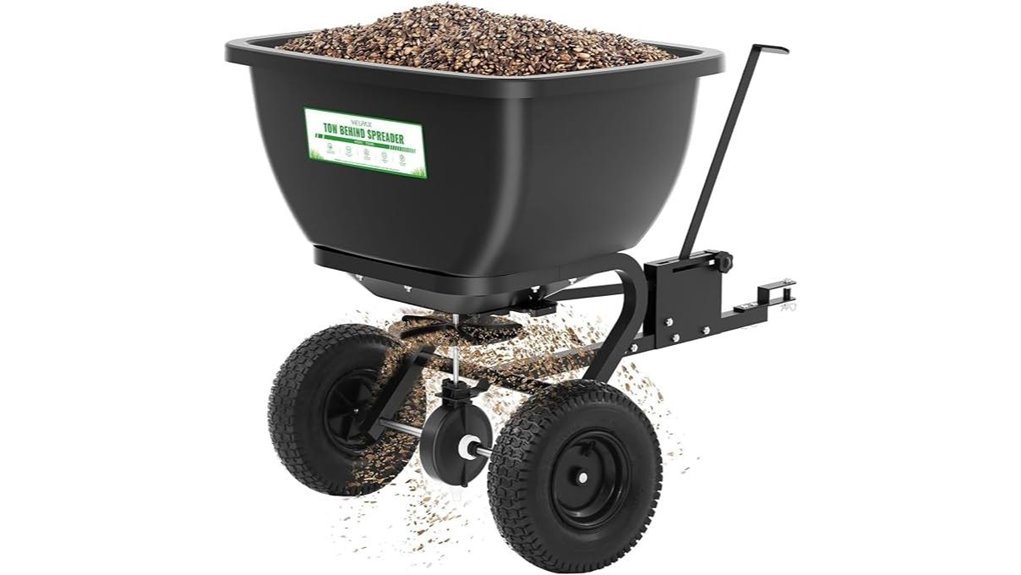
Bottom line: The VELPAX 200LB Tow Behind Broadcast Spreader is for property owners who already have suitable towing equipment. Its large hopper and adjustable flow control make it a potential choice for open driveways, grounds, and extensive seasonal maintenance.
- Type: Tow-behind broadcast spreader requiring compatible towing equipment.
- Capacity: Advertised 200 lb poly hopper.
- Control: Five-position gate with an extended adjustment lever.
- Wheels: 13-inch pneumatic tires for movement over uneven terrain.
The poly hopper is designed to resist rust and dents. A solid steel frame carries the load, while pneumatic tires help the spreader move across uneven ground. The design includes a hitch intended for compatible riding mowers, lawn tractors, ATVs, and zero-turn equipment.
The extended flow-control lever allows adjustments from the towing position. Its five gate positions offer different output rates for compatible granular fertilizer, grass seed, salt, and ice melt.
The product is advertised as covering around 50,000 square feet per full load. Actual ice melt coverage will depend on the product’s application rate, granule size, and conditions. Treat that figure as an advertised estimate rather than a guaranteed result.
Unlike a handheld or walk-behind model, this spreader requires a suitable towing vehicle and enough room to turn. It is not a sensible choice for narrow residential sidewalks or areas with steps, tight corners, or obstacles.
- Large advertised hopper capacity limits refill interruptions.
- Five-position flow control allows output adjustments.
- Universal-style hitch and pneumatic tires support large-area applications.
- Requires compatible towing equipment.
- Unsuitable for narrow walkways and tight turns.
- Assembly is required before the first use.
Scotts Whirl vs AquaDoc Handheld: Which Should You Get?
The main difference is how you distribute the ice melt. Scotts Whirl uses a hand crank to broadcast material, while AquaDoc uses a shaker-style container with selectable openings.
- Spreading method: Scotts Whirl broadcasts material as you turn the crank. AquaDoc dispenses granules through its cap.
- Best surface: Scotts Whirl suits longer residential paths. AquaDoc gives you simpler control for steps and short walkways.
- Comfort: Scotts includes adjustable arm support, while AquaDoc uses an ergonomic handheld grip.
- Storage: Both are compact compared with wheeled models, although AquaDoc has a simpler container design.
Which Ice Melt Spreader Should You Buy?
Start with the size and shape of the area you need to treat. Then consider whether you prefer a handheld tool, a wheeled spreader, or equipment you can tow.
- For steps and short walkways: Get the AquaDoc Handheld Salt Spreader for its simple shaker design.
- For typical residential sidewalks: Choose the Scotts Whirl for hand-crank spreading and year-round use.
- For larger residential driveways: Consider the Chapin 88000A SaltPro if your de-icing material is compatible.
- For recurring property maintenance: Choose the Buyers Products 3039632R for its larger hopper and wide spreading pattern.
- For extensive open grounds: Consider the VELPAX 200LB if you already own compatible towing equipment.
How We Chose These Ice Melt Spreaders
These recommendations are based on published product information and practical buying factors. They are not presented as results from independent hands-on testing.
- Material compatibility: We considered whether each spreader is described as suitable for salt, ice melt, or other winter de-icers.
- Capacity and property size: We compared compact handheld designs with larger walk-behind and tow-behind options.
- Spreading control: We considered adjustable caps, hand cranks, gates, augers, and deflectors that help direct material.
- Durability and maintenance: We considered hopper materials, frames, tires, and exposure to corrosive salt.
- Documentation: Important details were cross-checked with sources including Scotts’ official Whirl specifications and Chapin’s 88000A specifications and usage restrictions. Product claims without equivalent manufacturer confirmation should be checked before purchase.
Factors to Consider When Choosing Ice Melt Spreaders for Winter Walkways and Driveways
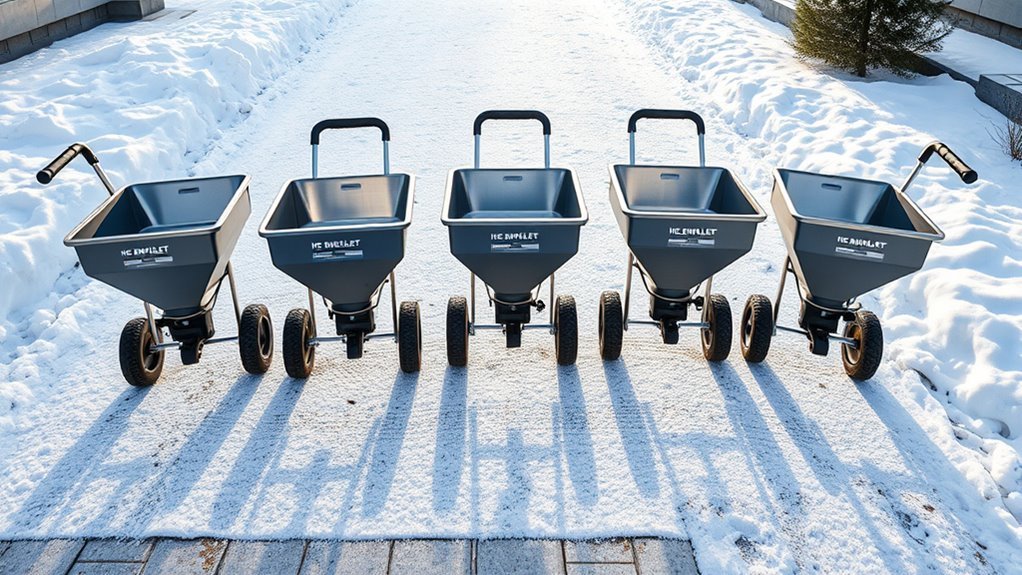
The best ice melt spreader matches your surface area, de-icing material, and ability to handle the loaded equipment. Hopper size matters, but spreading accuracy and material compatibility are just as important.
Before choosing, measure your walkway width, identify the de-icer you use, and consider how often you need to refill or clean the spreader.
Spread Type Options
Handheld, walk-behind, and tow-behind spreaders serve different property sizes. The right type should let you cover the intended surface without wasting material.
Handheld shaker models work well near steps and entrances. Hand-crank broadcast spreaders suit small residential areas where you want to cover more ground with each pass.
Walk-behind spreaders help with larger driveways and commercial paths. Tow-behind spreaders are better for large open areas where a tractor or other compatible vehicle can operate safely.
Broadcast spreaders cast granules over a wider pattern. Drop-style spreaders place material in a narrower area beneath the unit. For paths next to gardens, precise spreading is usually more important than maximum width.
Hopper Capacity
Hopper capacity determines how much material you can carry before refilling. A larger hopper saves stops but increases the load you need to handle.
The AquaDoc holds 2.5 liters, making it suitable for quick jobs. The Chapin and Buyers Products walk-behind models hold 80 and 100 pounds, respectively. The VELPAX is advertised with a 200 lb hopper.
For a short residential path, you may not need a large hopper. If you maintain a long driveway or several buildings, extra capacity can make winter work more convenient.
Remember that maximum hopper capacity does not guarantee a particular coverage area. De-icer application rates vary by product, surface condition, and temperature.
Material Compatibility
Not every salt spreader handles every de-icing product. Rock salt, calcium chloride, magnesium chloride, potassium chloride, and blended ice melts can differ in granule size, moisture content, and flow behavior.
Some materials absorb moisture and form clumps inside the hopper. Large granules can also block narrow gates or dispensing openings.
For example, the Chapin 88000A is designed for compatible granular ice melt but is not recommended for coarse rock salt or sand mixtures. Scotts also advises against large or unscreened rock salt in its spreaders.
Choose a spreader specifically compatible with your de-icer rather than assuming every model can handle all products. Also check whether the hopper, gate, and metal parts can tolerate repeated exposure to corrosive material.
Coverage Width
Coverage width affects how quickly and accurately you can treat a surface. Wider patterns are helpful on open driveways, while narrow patterns reduce waste beside sidewalks and garden beds.
The Buyers Products spreader has a published spreading range reaching up to 24 feet under suitable conditions. That can be helpful for broad paved areas, but it may be excessive for a narrow residential walkway.
For smaller paths, consider a handheld unit or a model with adjustable deflectors. Remember that changing the material flow rate does not always directly change the spread width.
Aim to cover the intended surface evenly without throwing excess de-icer onto lawns, plants, or nearby property.
Build Durability
Ice melt spreaders need materials that can withstand moisture and corrosive salt. Poly hoppers resist rust, while powder-coated steel frames provide structural support.
However, a steel frame still needs cleaning after exposure to salt. Scratches, worn coatings, and trapped residue can allow corrosion to develop over time.
Pneumatic tires can help a loaded spreader move over uneven driveways and rough ground. Check tire condition and pressure as part of regular maintenance.
Other useful features include protected gearboxes, sturdy handles, weather covers, and gates that are easy to rinse. A durable design matters most when you expect to use the spreader throughout several winters.
Ease of Use
A spreader should be manageable when filled and operated in winter clothing. Comfortable handles, accessible controls, and simple refilling can make repeated applications easier.
Handheld shakers have fewer operating parts, although they require manual distribution. Hand-crank spreaders provide a broadcast pattern but need a steady walking and cranking rhythm.
Walk-behind models reduce the need to carry the full load, but pushing a heavy hopper across snow or slush still requires effort. Glove-friendly gates and adjustable handles can improve control.
Consider your storage space, the number of steps around your property, and the distance between treatment areas before buying.
Season-Long Versatility
Some ice melt spreaders also handle seed and fertilizer. This can make a single tool useful throughout winter, spring, and summer.
The Scotts Whirl and Buyers Products 3039632R are examples of spreaders designed for multiple granular materials. The AquaDoc and VELPAX models are also described as suitable for seasonal lawn-care applications.
However, a spreader that handles fertilizer is not automatically suitable for every ice melt product. Each material has its own particle size and recommended application rate.
Before switching between winter and lawn-care tasks, clean and dry the hopper, gate, and moving components. This helps prevent salt residue from contaminating lawn products or damaging the spreader.
Mistakes to Avoid When Buying Ice Melt Spreaders
- Buying only by hopper size: A large hopper offers little benefit if the unit is difficult to maneuver around your property.
- Ignoring granule compatibility: Check the manufacturer’s instructions before using coarse rock salt, sand, or a blended de-icer.
- Choosing an overly wide pattern: Broadcast spreaders can waste material along narrow sidewalks and landscaped borders.
- Assuming lawn coverage equals ice melt coverage: Figures based on fertilizer or seed do not establish how much winter de-icer a hopper will distribute.
- Ignoring cleaning requirements: Salt residue can corrode metal components and affect the gate and gearbox.
FAQs
How Do I Prevent Ice Melt Spreader Clogs in Humid Weather?
Keep your ice melt dry and store unused material in a sealed container. Fill the hopper shortly before use rather than leaving damp granules inside for long periods. Choose material that matches the spreader’s permitted particle sizes. After spreading, empty the hopper, remove residue from the gate and auger, and dry the unit thoroughly before storage.
Can One Spreader Handle Rock Salt and Calcium Chloride?
Yes, a spreader can handle both materials if the manufacturer approves them and their granule sizes fit the mechanism. Compatibility is not universal. Coarse rock salt can jam some spreaders, while calcium chloride may absorb moisture and form clumps. Check the model’s material restrictions and clean the spreader after each use.
What Maintenance Extends a Spreader’s Lifespan After Winter?
Empty the hopper, remove remaining granules, and rinse away salt residue according to the manufacturer’s cleaning instructions. Dry the spreader completely before storing it indoors. Inspect fasteners, moving parts, tires, and any exposed metal for wear or corrosion. Follow the manufacturer’s lubrication guidance rather than applying oil or grease indiscriminately.
Are Tow-Behind Spreaders Suitable for Narrow Residential Walkways?
No, tow-behind spreaders are generally unsuitable for narrow residential walkways. Their towing vehicles need space to turn, and broad spreading patterns can scatter material beyond the path. A handheld shaker or compact push spreader is usually easier to control around steps, doors, and landscaping. Reserve tow-behind models for large open areas.
How Do I Calibrate Spreader Settings for Different De-Icing Materials?
Start with the application rate printed on the de-icer packaging. Measure a small test area, collect or weigh the material applied, and compare the result with the product’s directions. Adjust the gate opening and maintain a consistent walking speed. Repeat the test when switching materials because granule size, density, and moisture can change the discharge rate.
Can I Use My Lawn Fertilizer Spreader for Ice Melt?
Yes, many lawn fertilizer spreaders can also handle ice melt, but only when the manufacturer permits it. Scotts identifies several of its spreaders as suitable for winter use. Avoid oversized granules that could block the mechanism, and clean the spreader thoroughly afterward. Salt residue can corrode components and contaminate fertilizer used later.
Should I Spread Ice Melt Before or After Shoveling Snow?
For routine snow removal, clear loose snow first, then apply the ice melt according to its label. This lets the product contact the remaining ice rather than sitting on top of deep snow. Some products are also labeled for pretreatment before a storm. Follow the specific de-icer instructions and avoid applying more than recommended.
Can I Use Sand in an Ice Melt Spreader?
Only use sand if your spreader’s manufacturer specifically allows it. Sand can be abrasive, may bridge or clog dispensing openings, and does not melt ice. Chapin explicitly advises against sand and sand mixes in the 88000A. If you need traction material, choose equipment designed for the particle size and type you plan to distribute.
Final Verdict
The best ice melt spreader for winter walkways depends on the surface you need to treat. For most residential paths, a compact hand-powered model offers a useful balance of control, convenience, and easy storage.
For larger properties, choose a walk-behind or tow-behind model only when its capacity, spreading pattern, and material compatibility fit your needs.
If you mainly treat steps and short paths, the AquaDoc Handheld Salt Spreader is a simpler option. For a larger driveway that needs a wheeled unit, consider the Chapin 88000A SaltPro, provided your de-icing material is compatible.
