
In 2027, water dispensers with automatic measured dispensing are becoming more precise, compact, and easier to use. From countertop RO systems with hot and cold output to portable pumps for five-gallon bottles, the options now cover both home convenience and on-the-go needs. Some models add smart controls, while others focus on simple, reliable volume control. The real question is which features matter most, and the answer is not always obvious.
iSpring Hot & Cold Countertop Reverse Osmosis Dispenser

The iSpring RCD100HCG is a strong pick for households, offices, or RV users who want countertop convenience without plumbing, along with advanced filtration and hot-and-cold dispensing. It uses reverse osmosis to reduce more than 99% of 1,000-plus contaminants, including PFAS, chlorine, fluoride, lead, and arsenic, while producing pH-balanced alkaline water. Nine temperature settings and six dispensing volumes support precise serving control. Thermoelectric cooling keeps operation quiet and efficient. The smart panel shows TDS, temperature, and reminders. Dual pitchers, a child lock, and a twist-and-lock filter system add everyday practicality.
Best For: Households, offices, or RV users who want a no-plumbing countertop reverse osmosis dispenser with hot-and-cold water, precise dispensing, and strong contaminant reduction.
Pros:
- Removes over 99% of 1,000+ contaminants, including PFAS, chlorine, fluoride, lead, and arsenic.
- Offers 9 temperature settings and 6 dispensing volumes for flexible use.
- Includes helpful convenience features like dual pitchers, a smart monitoring panel, child lock, and easy twist-and-lock filter changes.
Cons:
- Requires counter space and is fairly heavy at 22 pounds.
- Needs electricity to run, so it’s not usable during power outages.
- Lower water output and a drain ratio may be less efficient than some traditional systems.
PHILIPS Countertop RO Water Filter, Instant Hot and Cold Dispenser

Ideal for small households, PHILIPS’ countertop RO dispenser delivers both instant hot and cold water. Its compact 9.1 x 16.9 x 17.5-inch footprint suits kitchens serving two to five people, while the 6L tap tank and 1.8L filtered jug support regular use. A 6-stage reverse osmosis system with Aquaporin Inside removes chlorine, lead, calcium, and fine impurities, then remits minerals for better taste. The touch panel offers 8-32 oz presets and temperatures from 40°F to 203°F. Real-time TDS readings, NSF certification, and a 12-month filter add confidence.
Best For: Small households of 2–5 people who want a compact countertop RO system with instant hot and cold water, real-time TDS monitoring, and easy preset dispensing.
Pros:
- 6-stage reverse osmosis with Aquaporin Inside removes chlorine, lead, calcium, and other fine impurities.
- Instant hot and cold water with convenient touch controls and 8–32 oz volume presets.
- Compact design with a 6L source tank, 1.8L filtered jug, and a 12-month filter life.
Cons:
- Better suited to small households, so larger families may find capacity limited.
- Requires regular maintenance, including daily tank refills and monthly self-cleaning.
- Countertop unit may take up noticeable kitchen space compared with under-sink systems.
5 Gallon Bottle USB Charging Water Dispenser Pump

This USB-charging 5-gallon pump suits users who want portable, measured dispensing without manual lifting. The Water Dispenser for 5 Gallon Bottle delivers automatic 600ml portions through a simple countertop setup and silicone hose installation. Its 100% FDA-grade silicone tube and high-density ABS shell support durability, while the compact 12.8-ounce frame fits home, kitchen, office, or camping use. Compatible with 2-5 gallon jugs using a 2.16-inch neck, it runs on a 1200 mAh battery for 30-40 days per charge. A 1-year warranty and 30-day return guarantee add assurance.
Best For: People who want a portable, easy-to-use water dispenser for 2-5 gallon bottles with automatic measured dispensing for home, office, camping, or kitchen use.
Pros:
- Automatic 600ml dispensing helps reduce manual pouring and provides consistent portions.
- USB charging with a 1200 mAh battery offers long runtime, lasting about 30-40 days per charge.
- Compact, lightweight design with FDA-grade silicone and ABS construction makes it durable and portable.
Cons:
- Only compatible with bottles that have a 2.16-inch neck, which may limit fit.
- Battery-powered operation means it will need periodic recharging.
- Countertop setup may not be ideal for users wanting a fully built-in or hands-free water system.
GentleJet 5 Gallon Bottle Water Dispenser Pump

With real-time battery tracking and measured pours, GentleJet suits users who value control and convenience. The GentleJet Automatic Water Dispenser, model GJ-WD-0001, offers 200 ml, 600 ml, and 800 ml presets plus continuous dispensing for bottles, cooking, and pet bowls. Its USB-C rechargeable battery supports chargers, power banks, laptops, and car ports. The compact 2.5-inch body and foldable spout help reduce dust and drips. BPA-free, food-grade parts and a removable silicone hose aid hygiene. Quiet operation, quick setup, and auto-stop protection make it practical for kitchens, dorms, RVs, and camping.
Best For: Households, dorm residents, RV travelers, campers, and office users who want a compact, rechargeable water pump with measured pours and easy portability.
Pros:
- Offers 200 ml, 600 ml, 800 ml presets plus continuous dispensing for flexible use.
- USB-C rechargeable with real-time battery tracking for convenient everyday charging.
- BPA-free, food-grade materials with a removable silicone hose for better hygiene.
Cons:
- Requires charging, so it may not be ideal if you want a purely manual dispenser.
- Best suited for standard bottle setups, so compatibility may vary with some containers.
- Limited preset sizes may not suit users who want more precise volume options.
USB-C Rechargeable Water Pump for 5 Gallon Bottles

The USB-C rechargeable pump suits anyone who wants effortless dispensing from heavy 5-gallon bottles. This electric dispenser uses a built-in battery and dual motors to deliver a steady flow with minimal effort. Measured settings of 200ml, 800ml, and 1200ml support accurate pouring, while continuous mode handles larger needs. An auto-stop function helps prevent overflow. Its compact 4.92×4.8×2.76-inch, 9-ounce build is portable and easy to store. A high-density plastic body and silicone hose support durability. It fits 2-, 3-, and 5-gallon jugs without cap removal, making it practical for home, office, camping, or RV use.
Best For: People who want an easy, portable way to dispense water from 2-, 3-, or 5-gallon bottles at home, in the office, or on trips.
Pros:
- USB-C rechargeable with a built-in battery for cordless use
- Dual motors provide strong, steady water flow with measured and continuous modes
- Compact, lightweight design fits standard jugs without removing the cap
Cons:
- Requires charging, so it is not fully maintenance-free
- Best suited for bottled water jugs rather than broader water-pumping tasks
- Plastic construction may feel less premium than metal alternatives
ecozy Smart Nugget Ice Maker Dispenser Countertop with App & Voice Control
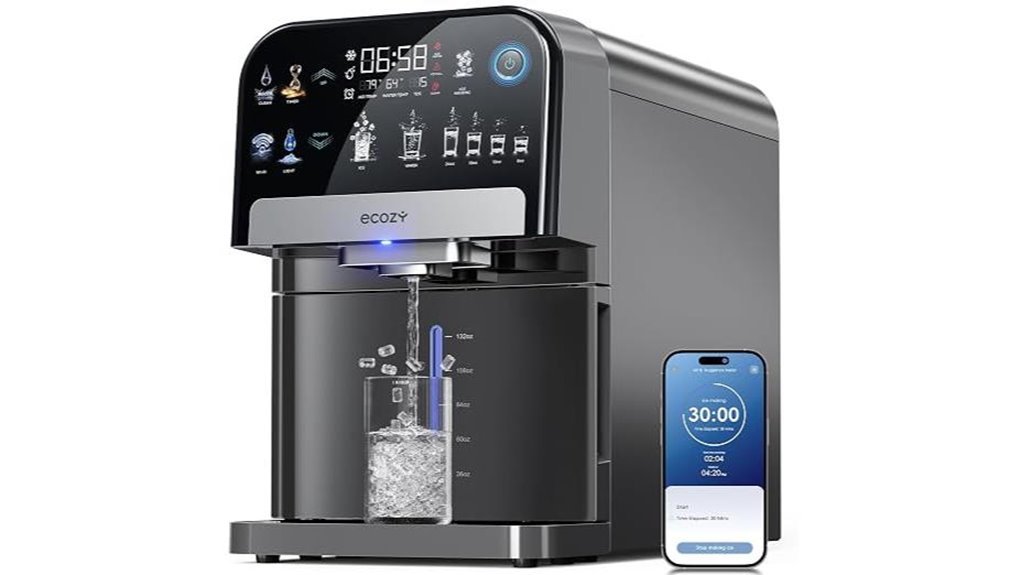
ecozy’s Smart Nugget Ice Maker Dispenser suits users who want touchless nugget ice and water in one countertop unit. Model IM-ND481B produces up to 33 pounds daily and stores 4.5 liters, while the fixed-quantity dispensing supports measured servings. Its IceLumix display tracks TDS, ambient temperature, and tank temperature in real time. App control through EcozyHome, Alexa, and Google Assistant adds remote convenience. One-touch self-cleaning and a pull-out tank simplify upkeep. The countertop design fits kitchens, bars, and offices, though it requires a drain connection and is not direct plumb-in compatible.
Best For: Users who want a countertop nugget ice and water dispenser with touchless dispensing, smart app/voice control, and easy daily use in kitchens, bars, or offices.
Pros:
- 2-in-1 design combines nugget ice making and water dispensing in one compact countertop unit.
- Smart features include EcozyHome app control plus Alexa and Google Assistant compatibility.
- Easy maintenance with one-touch self-cleaning and a pull-out water tank.
Cons:
- Requires a drain connection and does not support direct plumb-in installation.
- Countertop size may still be bulky for very small spaces.
- Needs proper tank placement; the panel may show “OPEN” if not seated securely.
Factors to Consider When Choosing Water Dispensers With Automatic Measured Dispensing in 2026
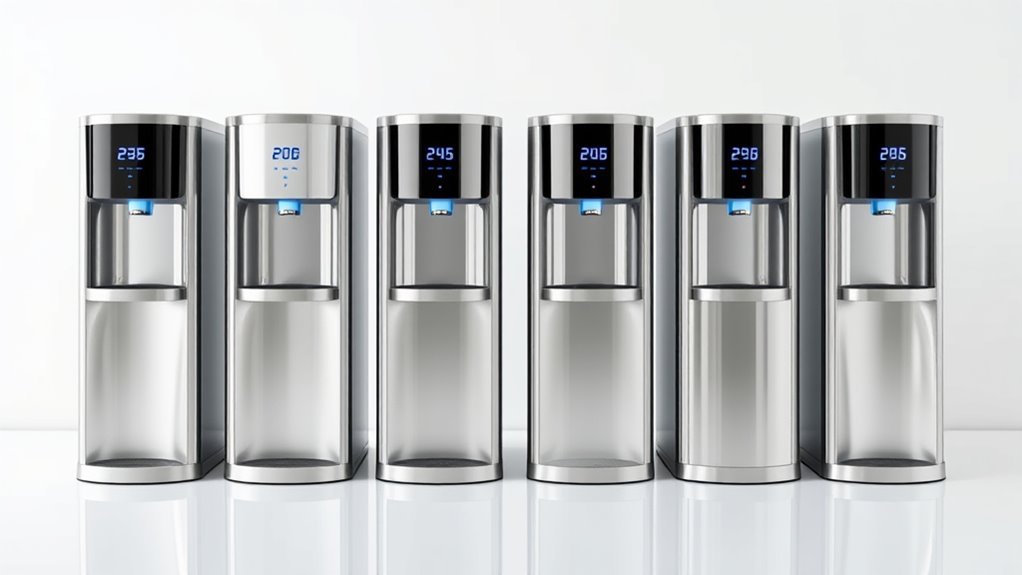
When selecting a water dispenser with automatic measured dispensing in 2026, attention should first go to dispense volume options and flow rate speed, since both affect convenience and accuracy. Temperature control settings and filtration performance also matter, as they shape water quality and usability for different needs. Tank capacity size should be considered as well, because it influences how often the unit needs refilling and how well it suits daily demand.
Dispense Volume Options
Dispense volume options are a key factor in choosing a water dispenser with automatic measured dispensing, since users may need anything from a small 200ml serving to larger fills of 800ml or 1200ml. Multiple presets help match varied hydration needs and make the dispenser easier to use in shared homes. Measured settings also improve accuracy, reducing spills and unnecessary waste by delivering only the selected amount. Some models add a continuous flow mode, which can be useful for filling larger containers or preparing food. Customizable volume presets further streamline operation, letting users choose common amounts quickly during busy routines. Overall, flexible volume selection increases convenience, supports different household preferences, and makes the dispenser more practical in everyday use.
Flow Rate Speed
Flow rate speed determines how quickly a water dispenser delivers measured amounts, usually expressed in ounces per minute or milliliters per minute. In measured-dispensing models, this setting affects how fast a cup, bottle, or pitcher is filled. A higher rate, such as 6.8 oz/min or 200 ml/min, can reduce waiting time, which is useful in busy kitchens, offices, or homes with several users. Some dispensers offer multiple flow modes, letting users choose fixed amounts like 200 ml or 600 ml, or switch to continuous flow when needed. Consistent speed matters because it supports accurate dispensing and lowers the risk of overflow or waste. In high-demand situations, efficient flow rate performance can improve convenience and overall user satisfaction.
Temperature Control Settings
Temperature control settings play a major role in automatic measured-dispensing water dispensers because they let users select precise hot or cold output for different needs. Many models provide adjustable ranges, so households can tailor water for drinking, cooking, or beverages without guesswork. Advanced units often include presets, such as chilled water near 40°F and hot water reaching about 203°F, which broadens usefulness. Some dispensers also display live temperature readings through simple interfaces, helping users confirm selections quickly. This feature is especially valuable in homes with mixed preferences, where one person may want iced water and another may need hot water. Efficient controls, including thermoelectric cooling, can keep operation quiet while supporting lower energy use and stable temperatures throughout daily use.
Filtration Performance
Filtration performance is one of the most important factors in choosing a water dispenser with automatic measured dispensing, since a strong system can remove over 99% of contaminants such as chlorine, lead, and fluoride. Effective models often use multi-stage filtration to improve purity and taste, and some add a final mineralization stage for a cleaner profile. Real-time TDS displays help users check water quality instantly and decide when maintenance is needed. A durable filter that lasts up to 12 months can reduce upkeep while keeping output consistent. Compatibility with different water sources is also important, because a reliable dispenser should maintain high purity even when supplied with tap water. In practice, filtration quality directly influences safety, flavor, and long-term convenience.
Tank Capacity Size
Tank capacity size plays a major role in how conveniently a water dispenser with automatic measured dispensing fits into daily use, since it determines how much water can be stored before refills are needed. Smaller units, often holding 1.8 to 6 liters, suit apartments, compact kitchens, and households with light water use. Larger dispensers, with tanks of 5 gallons or more, better support families, shared homes, and offices where demand is higher. The right capacity helps prevent frequent interruptions while avoiding unnecessary bulk. It also reduces waste by matching storage to actual consumption. Selecting an appropriately sized tank improves practicality, keeps hydration accessible, and supports smoother daily routines without overcommitting space or capacity.
Maintenance Requirements
Beyond choosing the right tank size, maintenance requirements also shape how practical a water dispenser with automatic measured dispensing will be over time. Regular care typically begins with daily water replacement to preserve freshness and limit bacterial growth. Monthly cleaning matters as well; a self-cleaning cycle can reduce mineral scale buildup and help maintain accurate dispensing. Some models include removable hoses or tanks that can be boiled for deeper sanitation, improving hygiene in high-use settings. Filter upkeep is equally important, since many systems signal when replacements are due, usually every 6 to 12 months depending on water quality and use. Following manufacturer instructions for installation and routine care helps prevent malfunctions, protect internal parts, and extend overall service life.
Portability And Placement
Placement is easiest when the dispenser’s dimensions match the intended space, whether that is a countertop, small office corner, or travel setup. Compact models are often preferred because they fit tight areas without crowding surfaces, and they store more easily between uses. Lightweight construction also improves portability, especially when the unit needs to move between homes, offices, or outdoor gatherings. Battery-powered designs add flexibility by reducing dependence on nearby outlets. Setup matters as well; dispensers that require no plumbing and only minimal installation can be positioned quickly wherever needed. Compatibility with standard 2- to 5-gallon bottles further increases usefulness, since it allows the dispenser to work across different settings without extra adjustments or specialized containers.
Frequently Asked Questions
How Accurate Are Automatic Measured Dispensing Settings?
Automatic measured dispensing settings are usually fairly accurate, often within a small margin of error, but they are not exact. Their precision depends on calibration, water pressure, temperature, cup placement, and machine quality. Higher-end units tend to perform more consistently than budget models. Over time, sensors and valves can drift, so occasional testing and recalibration help maintain reliability. For everyday use, they are generally accurate enough for convenience.
Can Measured Dispensing Work With Different Cup Sizes?
Absolutely, measured dispensing can work with different cup sizes. The system usually delivers a set volume, so a smaller cup may be filled in stages or a larger cup may require multiple cycles. It is not magic, but it can seem close when the settings are well calibrated. Accuracy depends on nozzle placement, sensor design, and user adjustment, especially when containers vary widely in height and capacity.
Do Automatic Dispensers Require Frequent Calibration?
Automatic dispensers do not usually require frequent calibration, but periodic checks are sensible. Most units keep their measured output stable through normal use, though mineral buildup, sensor drift, or wear can cause small inaccuracies over time. Recalibration is typically needed only after maintenance, filter changes, or if dispensing volumes seem inconsistent. In well-maintained systems, calibration tends to be occasional rather than routine, helping preserve accuracy without much effort.
Are Measured Dispensing Features Safe for Children?
Measured dispensing features are generally safe for children when controls are simple and outputs are limited. Nearly 70% of household water-related child injuries involve slips, spills, or burns, so reducing overfilling can help. Safety improves with lockout settings, cool-water output, and clear markings. However, supervision remains important, because small hands may still press buttons repeatedly or spill water while learning to use the device responsibly.
Will Measured Dispensing Increase Energy Usage?
Measured dispensing usually adds only a small amount of energy usage. The extra power comes from sensors, control boards, and, in some models, a pump or display, but these draw little electricity compared with heating or chilling water. In practice, overall consumption is typically close to standard dispensers. If the unit is efficient and used lightly, the impact is often negligible. Usage patterns matter more than the measuring feature itself.
Conclusion
Ultimately, the best water dispensers with automatic measured dispensing turn a simple pour into a polished experience. They blend precision, convenience, and modern design, whether for a busy kitchen, a shared office, or life on the go. Like a steady hand behind every glass, these machines deliver exactly what’s needed, when it’s needed. As technology keeps improving, choosing the right dispenser means choosing cleaner water, smarter control, and greater ease every day.
