
Countertop water dispensers have become a practical choice for households seeking cleaner water without major installation. In 2027, the range includes advanced reverse osmosis systems, compact models, and higher-capacity dispensers suited to different needs. Some focus on purification, while others emphasize temperature control or convenience. The best options are not always the most expensive, and the key differences often appear in the details that follow.
Bluevua RO100ROPOT Countertop Reverse Osmosis Water Filter System
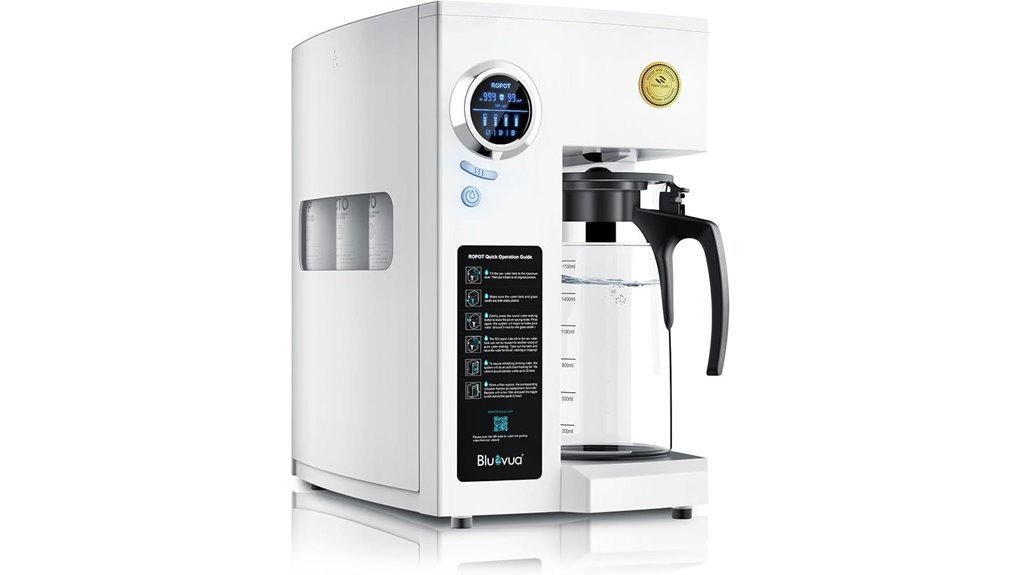
The Bluevua RO100ROPOT is a strong choice for buyers who want reverse osmosis filtration without the hassle of plumbing, since this countertop system simply plugs in and delivers 6-stage purification with UV light and remineralization. Its 0.0001-micron membrane targets TDS, fluoride, arsenic, lead, chlorine, PFOA, and PFOS, while mineral balancing improves taste. The borosilicate glass carafe helps limit secondary contamination. WQA certification against NSF/ANSI/CAN 372 supports lead-free claims, and SGS testing adds confidence. A display tracks filter life and water quality, with a standby mode that supports efficiency.
Best For: Buyers who want effective countertop reverse osmosis filtration with UV purification and remineralization, without needing plumbing installation.
Pros:
- Easy countertop setup with no plumbing required.
- 6-stage filtration with UV light and a 0.0001μm RO membrane helps reduce a wide range of contaminants.
- Borosilicate glass carafe, water-quality display, and standby mode add convenience and efficiency.
Cons:
- It takes up noticeable counter space and weighs 17.8 pounds.
- Requires electricity to operate, so it is not fully passive like a pitcher filter.
- Replacement filters and maintenance add ongoing cost over time.
Bluevua RO100ROPOT-Lite Countertop Reverse Osmosis Water Filter
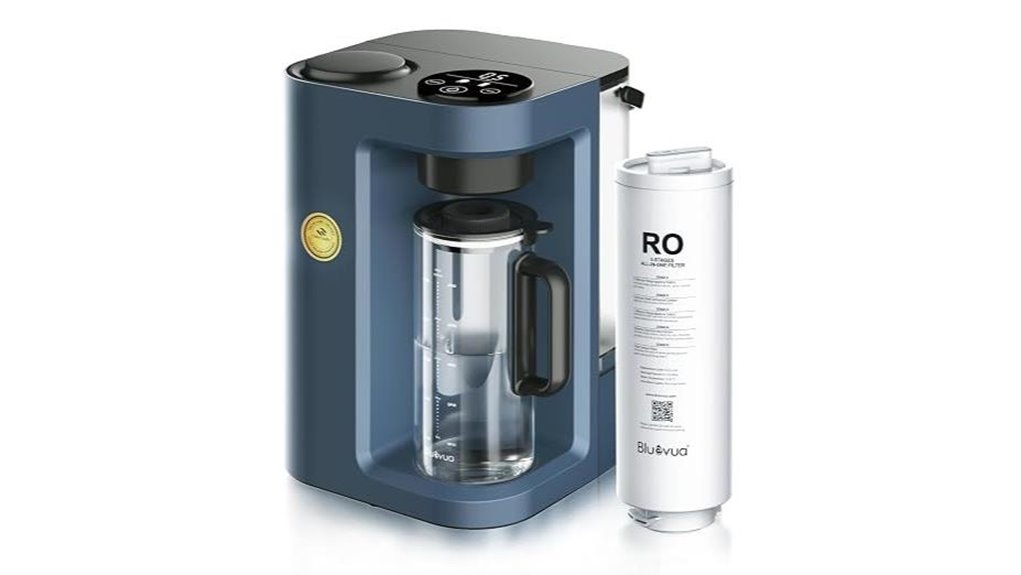
Ideal for small households, the Bluevua RO100ROPOT-Lite suits users who want compact, high-level filtration. This countertop reverse osmosis system uses a 5-stage process and a 0.0001μm membrane to reduce TDS, PFOA, PFOS, chlorine, fluoride, arsenic, lead, and other contaminants. It holds 12 liters, weighs 5 kg, and requires no plumbing, only a power outlet. A borosilicate glass carafe supports safe storage, while the LED display tracks filter life and water quality. It dispenses water in under three minutes, offers automatic volume selection, and uses a 3:1 efficiency ratio.
Best For: Small households or individuals who want a compact, easy-to-use countertop RO system with strong contaminant reduction and no plumbing required.
Pros:
- Compact 12-liter countertop design is ideal for 1–2 people.
- 5-stage RO filtration with a 0.0001μm membrane reduces a wide range of contaminants.
- No plumbing needed, with smart LED monitoring and automatic volume dispensing.
Cons:
- Best suited for smaller households, so capacity may be limited for larger families.
- Requires power to operate, so it is not fully manual.
- Filter replacements are needed annually, adding ongoing maintenance.
Avalon Touchless Bottleless Water Cooler with Filters
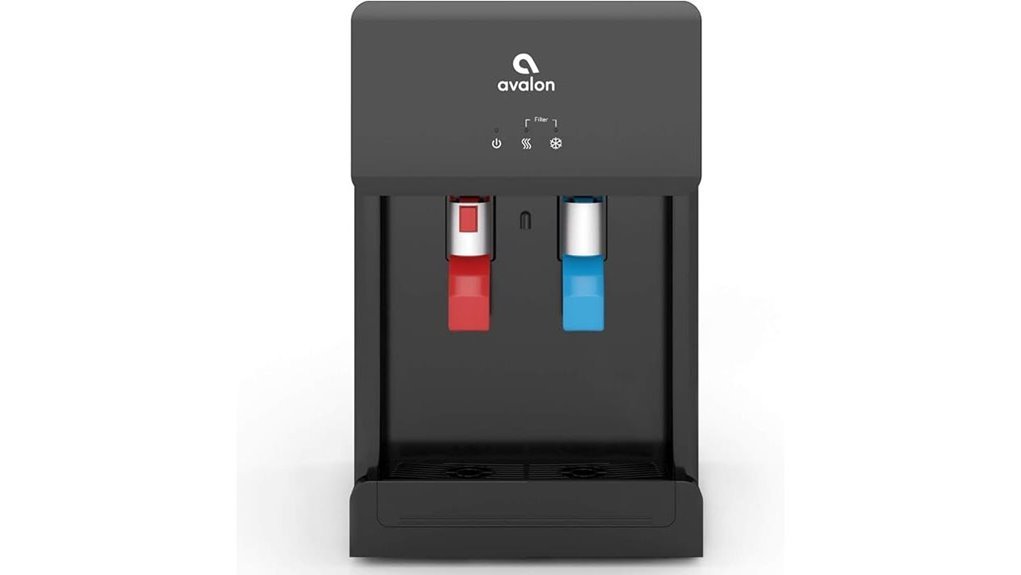
For homes wanting a compact, filtered dispenser, the Avalon B8BLK fits neatly on the countertop. This black, bottleless cooler is NSF certified and UL approved, pairing touchless convenience with a small 12 x 13 x 19 inch footprint. Its dual filtration system uses Avalon A5FILTER sediment and A4FILTER carbon block cartridges, each rated for six months or 1,500 gallons. The unit dispenses hot water up to 185°F and cold water down to 47°F, while a child safety lock protects the hot spout. Installation includes tubing, adapters, a flushing tool, and illustrated instructions.
Best For: Homes or small kitchens that want a compact, touchless, bottleless water cooler with both hot and cold filtered water on the countertop.
Pros:
- Dual filtration with sediment and carbon block filters helps improve water quality.
- Compact countertop size fits neatly in smaller spaces.
- Includes hot and cold dispensing plus a child safety lock for the hot spout.
Cons:
- Countertop footprint may still be too large for very limited spaces.
- Filters need replacement about every 6 months or 1,500 gallons.
- Installation may be more involved than a standard bottled dispenser.
Brio 800 Bottleless Countertop Water Cooler, 3-Temp
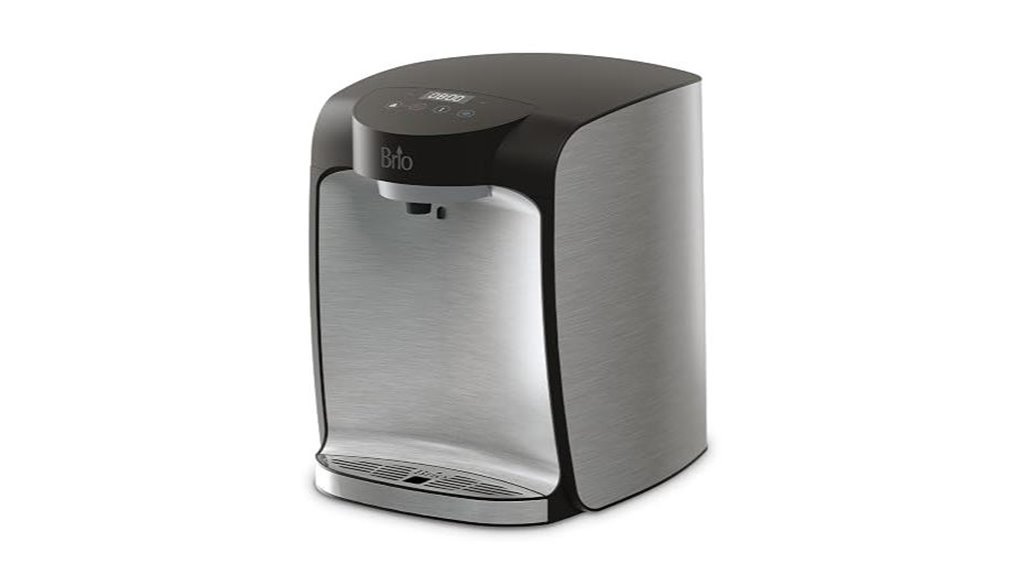
Brio’s 800 bottleless countertop cooler suits households or offices wanting hot, cold, and room-temperature water on demand. The stainless steel unit, model CLCTPOU820UVF2, measures 17.5 by 12.5 by 17.4 inches and weighs 35 pounds, making it substantial yet still countertop-friendly. Its 2-stage filtration targets dust, rust, particles, PFAS, and microplastics. A self-cleaning cycle circulates hot water through the reservoirs, while the larger solenoid valve speeds filling. The 11-inch dispense height accommodates pitchers and tall bottles. Customer feedback averages 4.4 stars.
Best For: Households or small offices that want a countertop, bottleless water cooler with hot, cold, and room-temperature dispensing plus solid filtration and self-cleaning convenience.
Pros:
- 2-stage filtration helps reduce dust, rust, particles, PFAS, and microplastics.
- Self-cleaning function circulates hot water through the internal system for easier maintenance.
- 11-inch dispense height and faster solenoid valve make it convenient for pitchers and larger bottles.
Cons:
- Countertop footprint and 35-pound weight may be bulky for smaller spaces.
- Bottleless installation may require more setup than a standard bottled cooler.
- Only 27 reviews, so customer feedback is somewhat limited.
SimPure Y7P-BW UV Countertop Reverse Osmosis Water Filter, 5 Stage RO
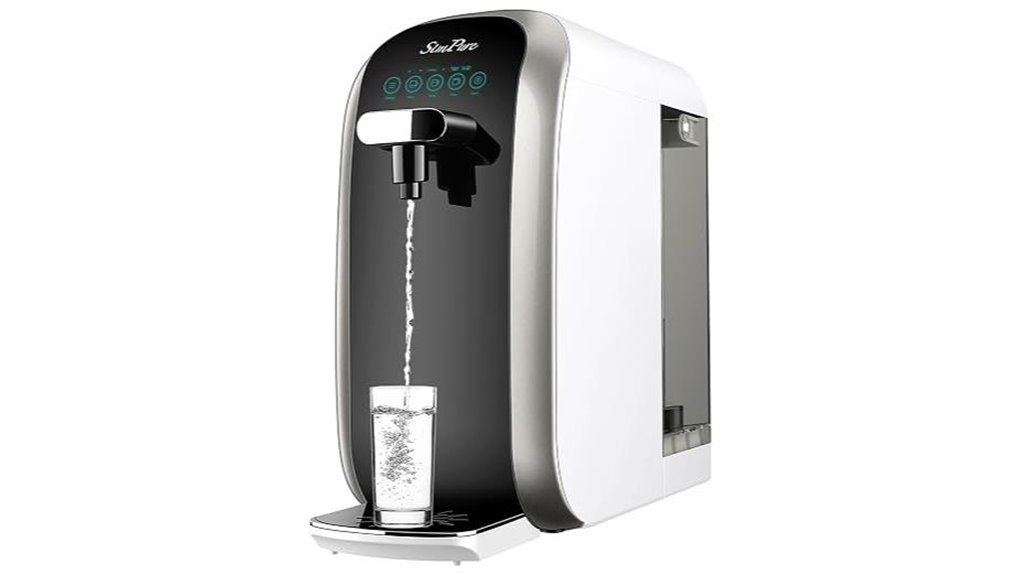
The SimPure Y7P-BW suits users who want advanced purification without any installation. This countertop reverse osmosis unit uses a 5-stage system with UV treatment to remove 99.99% of more than 1,000 contaminants, including PFAS, heavy metals, chlorine, fluoride, and nitrates. It delivers water in about 15 seconds at room temperature, with a 418 GPD flow rate and a 4:1 pure-to-drain ratio. The plug-and-play design, quick-change filters, and BPA-free build make upkeep simple. Its 528-gallon capacity supports sustainable hydration while reducing plastic waste.
Best For: users who want a no-install countertop reverse osmosis purifier with strong contaminant removal, quick dispensing, and easy maintenance.
Pros:
- Removes 99.99% of 1,000+ contaminants, including PFAS, heavy metals, chlorine, fluoride, and nitrates
- Plug-and-play countertop design with quick-change filters makes setup and upkeep easy
- Fast 15-second dispensing with a 4:1 pure-to-drain ratio helps save water
Cons:
- Only dispenses room-temperature water
- Countertop size and 13-pound weight may take up noticeable space
- Requires filter replacements over time, adding ongoing maintenance costs
AquaTru Glass Carafe Reverse Osmosis Water Filter
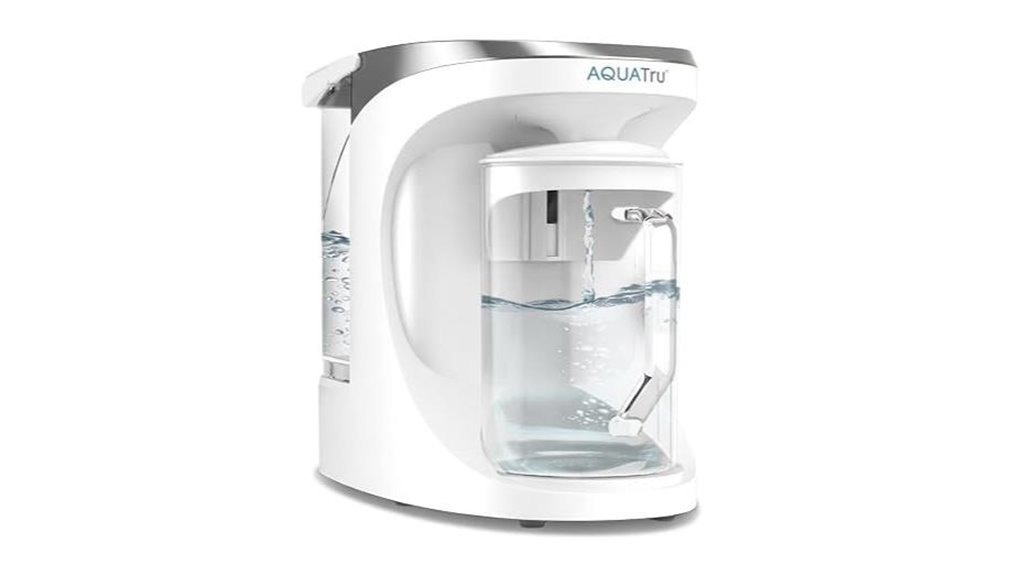
AquaTru’s glass carafe model suits households wanting reverse osmosis purification without installation hassles. This countertop system uses a four-stage process to reduce 84 contaminants, including lead, PFOA, PFOS, fluoride, arsenic, chromium-6, and microplastics. It plugs into a standard outlet, requires no plumbing or tools, and fills a borosilicate glass carafe from tap water. Compact dimensions help it fit smaller kitchens. Filter life reaches six months to one year, depending on stage. Buyers also receive a one-year warranty and a 30-day money-back guarantee, supporting its health-focused appeal.
Best For: Households looking for a compact countertop reverse osmosis system with a glass carafe and no-installation setup for cleaner, safer-tasting water.
Pros:
- Removes 84 contaminants, including lead, fluoride, PFOA, PFOS, arsenic, chromium-6, and microplastics
- No plumbing, drilling, or tools required; just plug it into a standard outlet
- Includes a borosilicate glass carafe and comes with a 1-year warranty plus 30-day money-back guarantee
Cons:
- Filter replacements are ongoing and can add to long-term ownership cost
- Slower maximum flow rate than non-RO filtration systems
- Best suited for smaller households or countertops due to its compact, but still dedicated, footprint
Brita XL 27 Cup Water Pitcher Dispenser, Includes 1 Elite Filter, Black
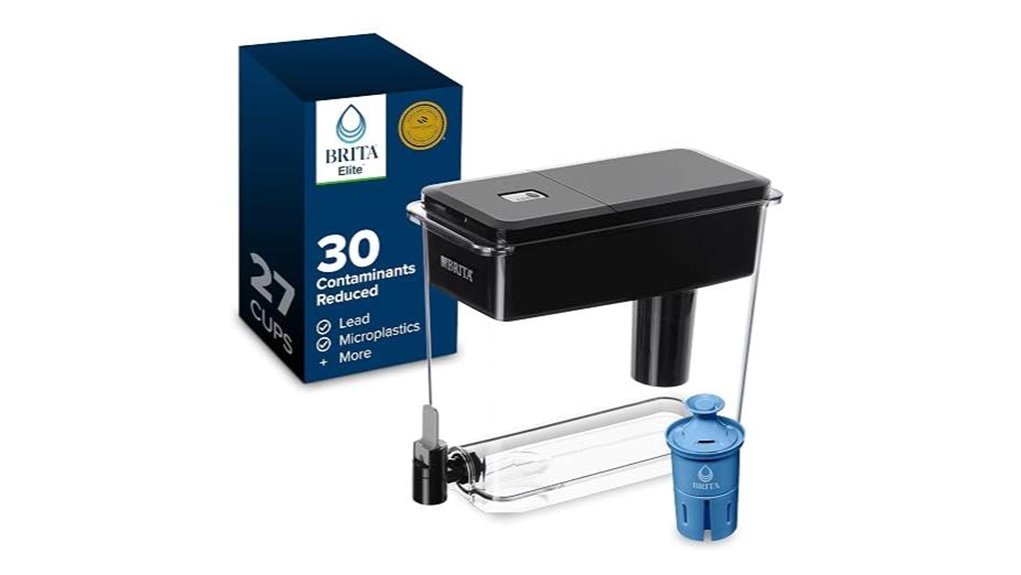
Brita’s XL 27-cup countertop dispenser suits households wanting filtered water with minimal plastic waste. The BPA-free UltraMax design includes a convenient spigot and a single Elite filter, making it a freestanding option for kitchens needing high capacity without installation. Its Advanced Carbon Core Technology reduces 99% of lead and more than 30 contaminants, including microplastics, chlorine, pharmaceuticals, and pesticides. WQA NSF/ANSI certification supports its safety claims. Each filter lasts about 120 gallons, or six months, and can replace up to 900 bottles, with substantial annual savings and waste reduction for larger households.
Best For: Households or small kitchens that want a high-capacity, freestanding water dispenser with effective filtration and reduced plastic waste.
Pros:
- Large 27-cup capacity is convenient for families or frequent water drinkers.
- Elite filter reduces 99% of lead and 30+ contaminants, including microplastics and chlorine.
- Filter lasts up to 120 gallons or about 6 months, helping cut down on bottle waste.
Cons:
- Takes up countertop space due to its larger freestanding design.
- Requires regular filter replacement to maintain performance.
- No installation flexibility since it is designed as a countertop dispenser only.
Culligan ZeroWater 40-Cup Glass Water Filter Dispenser
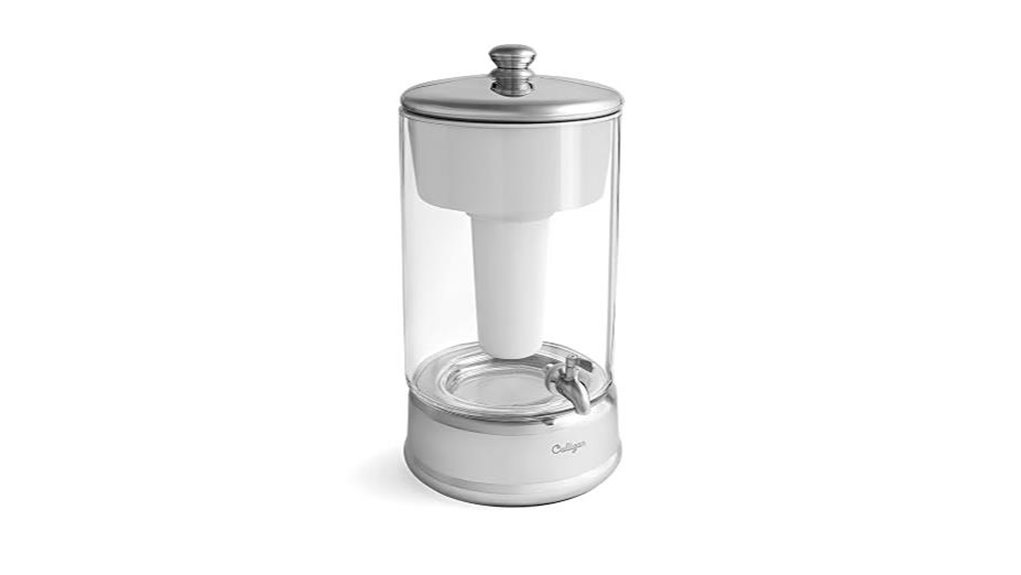
With its 40-cup glass design, this dispenser suits hosts needing stylish, high-volume countertop filtration. Its five-stage filter removes 99.9% of dissolved solids and is IAPMO certified to reduce lead, Total PFAS, chlorine, mercury, and other contaminants. Culligan with ZeroWater Technology reportedly removes five times more contaminants than leading filters. A built-in TDS meter tracks dissolved solids and signals filter replacement; a reading of zero indicates effective filtration. The drop-in filter and spigot simplify use. It can save up to 150 plastic bottles, though it is only compatible with new Culligan with ZeroWater Technology filters.
Best For: Hosts, families, and eco-conscious users who want a stylish high-capacity glass water dispenser with advanced filtration and easy contamination monitoring.
Pros:
- 5-stage filtration removes 99.9% of dissolved solids and is IAPMO certified to reduce lead, PFAS, chlorine, mercury, and more.
- Built-in TDS meter makes it easy to know when the filter needs replacing.
- Large 40-cup glass design is attractive, reusable, and can help reduce up to 150 single-use plastic bottles.
Cons:
- Only compatible with new Culligan with ZeroWater Technology filters, not legacy ZeroWater filters.
- Glass construction may be heavier and more breakable than plastic dispensers.
- Requires regular filter monitoring and replacement to maintain performance.
Factors to Consider When Choosing Countertop Water Dispensers in 2026
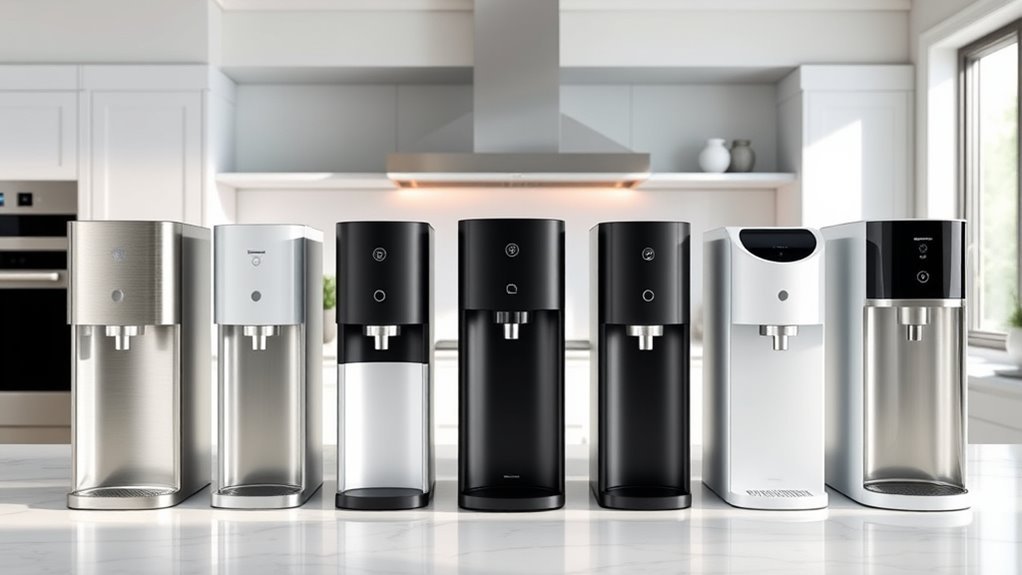
Selecting a countertop water dispenser in 2026 begins with filtration performance, since the system should match household needs for contaminant reduction and taste improvement. Capacity and size also matter, along with installation requirements, because the unit must fit the available space and setup without creating inconvenience. Water waste efficiency, maintenance demands, and filter life complete the decision, as these factors affect long-term cost, convenience, and overall value.
Filtration Performance
Filtration performance should be one of the first considerations when comparing countertop water dispensers in 2026, since the best systems can remove a broader range of contaminants without sacrificing efficiency. Systems with five or six filtration stages often capture more impurities, including heavy metals and industrial chemicals. Advanced technologies such as reverse osmosis and UV purification can eliminate up to 99.99% of pollutants, helping reduce PFAS and microplastics. Efficiency also matters; a pure-to-drain ratio of 2:1 or better reflects stronger water conservation during purification. Independent certification from NSF or WQA offers added confidence that specific contaminants are being reduced effectively. Monitoring tools like TDS meters and service-life indicators further support consistent performance by showing when water quality changes or filters need replacement.
Capacity and Size
Capacity and size play a major role in choosing a countertop water dispenser, since models now range from compact units for 1–2 people to larger systems that hold up to 40 cups. Buyers should match capacity to daily use, since larger tanks reduce refill frequency and better serve families or gatherings. Physical dimensions also matter, as the unit must fit comfortably on the countertop with room for normal operation and upkeep. Weight can influence both portability and stability; lighter models are easier to reposition, while heavier ones often suggest sturdier construction and added features. Space-saving designs are especially useful in smaller kitchens, where efficient use of counter area is essential. A well-sized dispenser balances convenience, storage, and practical fit without sacrificing performance.
Installation Requirements
After size and capacity are narrowed down, installation requirements become the next practical check for a countertop water dispenser. Many countertop models need no plumbing at all, which makes plug-and-play setup simple with a standard power outlet. This can be appealing for renters or anyone seeking minimal disruption. Some bottleless units include installation kits with adapters and tubing, easing connections without demanding extensive setup work. Compact reverse osmosis systems can still fit small kitchens while offering advanced filtration stages. Weight and dimensions also matter, since heavier or bulkier dispensers may be harder to place or move once positioned. User-friendly features like automatic dispensing and LED filter indicators can improve day-to-day use, but they should complement, not complicate, the installation process.
Water Waste Efficiency
Water waste efficiency has become a key consideration for countertop water dispensers in 2026, especially as more systems are designed to deliver a strong pure-to-drain ratio that reduces unnecessary runoff. Some efficient models achieve ratios of 2:1 or even 3:1, far better than traditional units that may waste four parts of water for every one purified. Advanced filtration can preserve this efficiency while removing contaminants, so clean output does not require excessive discard. Certain systems also include power-saving modes, lowering overall environmental impact during use. In addition, some units recycle leftover water for secondary tasks, which further limits waste. Ongoing filter monitoring and simple replacement options help sustain performance, keeping water use economical over time and supporting a more sustainable countertop setup.
Maintenance and Filter Life
Maintenance and filter life are important considerations when choosing countertop water dispensers in 2026, since filter replacement intervals can range from about 6 months to as long as 24 months, affecting both upkeep and long-term cost. Shorter-lived filters require more frequent attention, while longer-lasting cartridges reduce disruption and replacement expense. Monitoring displays can help track remaining filter life and support timely changes, which helps preserve water quality and performance. Regular cleaning of reservoirs and internal parts also matters, because buildup can reduce contaminant removal and shorten dispenser lifespan. Models with quick-change cartridges simplify servicing by allowing fast, tool-free replacement. Some units also include self-cleaning functions, which automate routine cleaning and lessen manual maintenance demands.
Temperature and Features
Temperature and feature sets often shape whether a countertop water dispenser feels practical day to day. Hot and cold output matters, especially when a unit can reach 185°F for tea or instant meals and drop to 47°F for chilled drinks. Safety is equally important; child locks on hot spouts reduce risk in family kitchens. Smart functions also add value. LED displays can track filter life and water quality, helping users maintain performance without guesswork. Some dispensers include automatic volume dispensing, which is useful when exact amounts are needed quickly. Material choices matter as well. High borosilicate glass carafes can help limit secondary pollution and preserve water quality. Together, these temperature ranges and features determine convenience, safety, and long-term usefulness.
Frequently Asked Questions
How Often Should Countertop Water Dispensers Be Sanitized?
Countertop water dispensers should generally be sanitized every one to three months, depending on use and water quality. If the dispenser is used heavily, or if signs of buildup, odor, or slime appear, cleaning should happen sooner. Bottles, spouts, drip trays, and internal reservoirs should all be included. Regular sanitizing helps reduce bacteria, maintain taste, and keep the dispenser functioning properly over time. Manufacturer instructions should always guide the schedule.
Do Countertop Dispensers Work During Power Outages?
Most countertop dispensers rely on electricity, so they usually stop dispensing chilled or heated water during a power outage. Gravity-fed or manual-pump models can still work, but only if they do not need powered refrigeration or heating. About 85% of modern countertop units depend on electricity for some function, making backup power or stored water useful in emergencies. A detached assessment would note that performance varies by design and features.
Can These Dispensers Remove Microplastics Effectively?
They can remove microplastics effectively, but only if they include filtration stages capable of trapping very small particles, such as activated carbon plus fine membrane or reverse osmosis systems. Simple dispensers without advanced filters usually reduce larger debris, not microplastics reliably. Performance depends on filter pore size, certification, and maintenance. When filters are changed on schedule, their removal ability stays much more consistent, making them far more dependable overall.
Are Replacement Filters Easy to Find Internationally?
Replacement filters are often easy to find internationally, but availability depends on the brand and model. Widely sold dispensers from global manufacturers usually have cartridges stocked through major retailers and online marketplaces in many regions. Less common systems can be harder to source, with longer shipping times or regional compatibility issues. It is generally wise to confirm filter part numbers, local distributors, and subscription options before buying a dispenser.
What Countertop Materials Best Support Heavy Water Dispensers?
Granite and reinforced quartz best support heavy water dispensers, because they combine high compressive strength with good resistance to cracking; a thick butcher block can also work if it has a sturdy base. Some may object that laminate is easier, yet it can flex under concentrated loads. Picture a wide, immovable platform versus a thin shelf: the former holds weight steadily, while the latter risks sagging, wobbling, or damage over time.
Conclusion
Ultimately, the best countertop water dispenser depends on more than price or appearance; it hinges on how much purity, convenience, and capacity a household truly needs. From advanced RO systems to sleek, high-capacity pitchers, each model answers a different demand. Yet the most interesting choice may be the one that quietly solves tomorrow’s water concerns before they become visible. In the end, the smartest pick is not just practical—it is the one that leaves the fewest questions unanswered.
