

Like finding an old favorite record in a new high-end stereo, enameled cast iron can finally sing on induction—if you know what to check. You’ll want to confirm the cookware’s magnetic core, flat polished base, and lack of chips or warps so heat transfers efficiently and your cooktop stays protected. Keep going to see simple tests, care tips, and the best induction-ready Dutch ovens worth your money.
Quick Answer: Does Enameled Cast Iron Work on Induction?
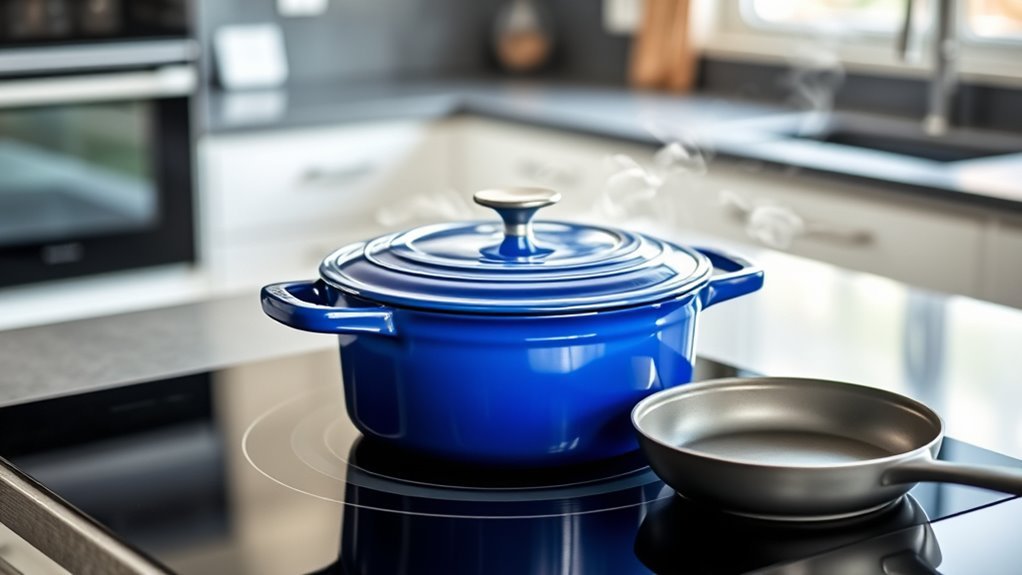
Wondering if enameled cast iron will work on your induction cooktop? Yes — enameled cast iron performs well on induction cooktops because its magnetic core interacts with the cooktop’s field, delivering efficient heating and reliable performance.
Enameled cast iron works great on induction—its magnetic core ensures efficient, reliable heating for versatile cooking.
You’ll find it’s compatible cookware alongside raw cast iron, giving you broader cooking options from searing to slow braises. The enamel coating protects the surface and helps minimize scratches on the glass top, while many high-quality pieces have flat, polished bases that improve contact and energy transfer.
To keep that performance, follow proper care: avoid sudden temperature shocks, lift rather than slide cookware, and clean gently to preserve the enamel. That maintenance preserves both the finish and the magnetic connection that makes it work.
If you want cookware that’s durable, versatile, and empowers you in the kitchen, enameled cast iron is a practical, freedom-minded choice for induction cooking.
Why Enameled Cast Iron Heats Well on Induction
You’ll notice enameled cast iron heats well on induction because its magnetic core couples strongly with the cooktop’s field, delivering efficient, targeted energy.
That magnetic efficiency gives you a fast thermal response so the pan heats quickly while remaining controllable.
Combined with the enamel-smoothed surface and thick iron body, heat spreads evenly and stays put—ideal for steady braising and slow cooking.
Magnetic Core Efficiency
Because induction cooktops rely on magnetic fields to generate heat, enameled cast iron performs so well: its dense, highly magnetic core couples strongly with the cooktop’s coils and induces currents that heat the vessel directly.
You’ll feel that efficiency immediately—induction cookware made from cast iron converts more of the cooktop’s energy into usable heat in the pan instead of losing it to the air.
The enamel aids even cooking by smoothing heat distribution and protecting food, while a flat polished base maximizes contact for consistent performance.
That combination of magnetic responsiveness and heat retention gives you precise temperature control for slow braises or steady simmering.
Choose induction-compatible cookware with quality construction to free your cooking from guesswork.
Fast Thermal Response
When you adjust the heat on an induction cooktop, enameled cast iron responds quickly because its ferromagnetic core couples directly with the cooktop’s magnetic field, generating heat inside the metal rather than relying on surface conduction. You’ll feel control: the magnetic core and ferromagnetic properties drive rapid heating, so searing and browning reach target temperatures fast. The enamel adds smoothness and heat retention, letting you hold temperatures with less fuss. That combo frees you to experiment with cooking methods from braising to baking without clumsy lag. Compared with stainless steel cookware on induction, enameled cast iron gives swifter rise and steadier hold. Embrace its responsiveness to reclaim time and precision at the stove.
| Feature | Benefit |
|---|---|
| Magnetic core | Rapid heating |
| Enamel | Heat retention |
| Ferromagnetic properties | Induction coupling |
| Cooking methods | Versatile use |
| Vs stainless steel | Faster response |
Even Heat Distribution
Having seen how quickly enameled cast iron responds on induction, it’s worth looking at how that responsiveness turns into uniform heat across the pan.
You get even heat distribution because the cookware’s magnetic core couples directly with the induction cooktop, converting energy precisely under the cooking surface. Thick walls retain and spread that energy, minimizing hot spots so you can trust uniform cooking from edge to center.
A flat, polished base guarantees ideal contact, improving heat efficiency and cooking precision whether you’re slow-simmering or searing at high heat. The smooth enamel keeps food from sticking and doesn’t impede heat transfer, so your techniques stay effective.
Use steady, consistent heat and this pan rewards you with reliable, liberated results.
How to Test Enameled Cast Iron for Induction Compatibility
Start by doing the simple magnet-stick test: if a magnet clings to the bottom, the cookware will work on an induction hob.
Then check that the base is flat and fits the burner—good contact and a polished surface improve efficiency.
Finally, inspect the enamel and base for chips or warping, since damage can reduce induction performance and scratch the cooktop.
Magnet Stick Test
Wondering if your enameled cast iron will work on an induction cooktop? Use the simple magnet stick test to free yourself from guesswork.
Clean the flat bottom, place the pan on a stable surface, and press a small strong magnet to the metal.
- If the magnet clings firmly, the magnetic core will respond to induction heat and the cookware is compatible.
- If attraction is weak or intermittent, the pan may cook poorly on an induction cooktop — don’t rely on it.
- If the magnet won’t stick, the cookware isn’t suitable for induction and won’t generate heat efficiently.
This quick, practical test lets you reclaim control of your kitchen choices without fuss.
Check Flatness And Fit
Once you confirm magnetic attraction with the magnet test, check the bottom’s flatness and fit to guarantee your enameled cast iron will sit evenly on the induction burner.
After the magnet test proves compatibility, inspect bottom surfaces for warping or irregularities that break contact with the cooktop.
Lay the cookware on a known-flat surface or run a straightedge across the cookware base to spot gaps.
Ascertain the cookware base diameter matches your induction cooking zone so you get even heat distribution and efficient performance.
Look for a smooth, polished base to protect the cooktop and enhance induction responsiveness.
Regularly inspect bottom condition; warped or damaged bases reduce compatibility and undermine your ability to cook freely and effectively.
Inspect Enamel And Base
Before placing your enameled cast iron on the cooktop, closely inspect the enamel and base so you can spot defects that compromise safety or induction performance.
You’ll want to verify both coating integrity and magnetic contact to liberate your cooking: run a magnet test on the base of the cookware—if it sticks firmly, it’s compatible with induction and will allow efficient heat generation.
Check the enamel for chips or cracks; damaged coating can affect performance and safety. Ascertain the base is flat and even so the pot makes full contact with the induction surface for consistent heating.
- Look for chips, hairline cracks, or exposed iron on the enamel.
- Perform a magnet test across the entire base.
- Place on a flat surface to confirm flat and even contact.
Protect Your Induction Cooktop When Using Cast Iron
1 simple habit will keep your induction cooktop looking new: lift your enameled cast iron cookware instead of sliding it, and always check and clean the base before use.
Enameled cast iron is induction compatible thanks to its magnetic core and delivers exceptional heat retention, but grit or rough movement can scratch an induction cooking surface. Before you set a pot down, inspect the flat base for stuck food, crumbs, or hardened oils and clean and care for it with a soft cloth or nonabrasive pad.
Enameled cast iron works on induction, but always wipe and lift—remove grit to prevent scratches and protect the glass.
To further protect your induction cooktop, consider a thin parchment sheet or silicone mat between pan and surface when practical; these reduce micro-scratches without interfering with contact.
Confirm the base is truly flat to avoid rocking and uneven heating, which stresses both pan and cooktop.
Adopt these simple rituals and you’ll preserve performance and freedom in your kitchen — tough cookware, gentle handling, maximum liberation.
Caring for Enameled vs. Raw Cast Iron on Induction
Having the habit of lifting enameled cast iron and checking the base protects your cooktop, but caring for enameled versus raw cast iron on induction requires different daily routines.
You’ll appreciate that enameled cast iron is induction compatible and offers a non-reactive surface, so you don’t need seasoning and you can cook acidic foods without metallic taste.
Still, care for enameled cast iron means avoiding very high heat, using soft cleaners, and preventing chips that could expose the metal underneath.
- Lift, don’t slide: always lift cookware to prevent scratches and prevent damage to your cooktop; this applies to both enameled and raw cast iron.
- Clean deliberately: wipe enameled surfaces with a soft sponge; for raw cast iron, rinse, dry, and rub with oil to maintain seasoning.
- Heat control: use moderate induction settings for enameled pieces; for raw cast iron, preheat slowly to protect the seasoning and the cooktop.
Induction Converter Discs: Pros and Cons
If you want to use non-magnetic pans on an induction cooktop, an induction converter disc can bridge the gap by acting as a magnetic plate that the cooktop heats and then transfers to your cookware.
You’ll appreciate that induction converter discs let you use non-magnetic cookware—aluminum, glass—without immediately replacing everything. They’re simple: a flat metal plate sits between hob and pan, creates magnetic induction, then passes heat up to your pot or pan.
Induction converter discs let you use non-magnetic cookware—aluminum or glass—by heating a flat magnetic plate that transfers heat to your pan.
Be aware of trade-offs. Converter discs reduce heat transfer efficiency, so heating is slower and can produce uneven cooking compared with induction compatible pots.
That matters if you crave precision or run a cast iron skillet’s steady, direct response. Professional chefs rarely rely on discs for consistent results; manufacturers likewise recommend induction-compatible cookware for regular use.
Use discs for occasional flexibility or liberation from a full kitchen overhaul, but don’t expect the same speed, control, or even cooking you get from native induction-ready pieces.
What to Look For When Buying Induction-Ready Enameled Cast Iron
Wondering what really matters when buying induction-ready enameled cast iron? You want cookware that frees you to cook confidently on induction without worry.
Start by checking the manufacturer’s specifications to confirm it’s labeled induction compatible. Then verify the base: it should be flat and smooth for ideal contact and a polished magnetic base will guarantee even heat distribution and efficient induction response.
- Test the bottom with a magnet — a true magnetic base confirms induction compatibility and ideal contact.
- Look for a polished, flat and smooth base to protect your cooktop and promote even heat distribution.
- Consider weight and size; heavier enameled cast iron demands careful handling to avoid scratching or cracking the glass surface.
Choose pieces that balance durability with usability so you can liberate your cooking routine while protecting your cooktop and getting consistent results.
Best Induction-Ready Enameled Cast Iron Picks and Why
Looking for the best induction-ready enameled cast iron? You want pieces that let your cookware work reliably on induction, hold heat, and free you to cook boldly. Start with the Le Creuset Enameled Cast Iron Round Dutch Oven — it’s compatible with induction cooking, has a flat polished base that protects cooktops, and offers exceptional heat retention for long braises and stews. The enamel gives a non-stick surface feel and resists rust, so you’ll spend less time cleaning and more energy to create.
| Model | Why it’s liberating |
|---|---|
| Le Creuset Enameled Cast Iron Round | Flat base, top induction efficiency, durable |
| Other branded Dutch ovens | Often similar heat retention and enamel finish |
| Affordable enameled pots | Good induction response, budget freedom |
| Versatile skillets | Great for searing, maintain heat well |
Choose pieces with polished bases and sturdy enamel. They make induction cooking precise, durable, and joyful — real tools for creative, liberated cooking.
Frequently Asked Questions
Can You Use Le Creuset With Induction?
Yes—you can use Le Creuset with induction. You’ll enjoy Le Creuset benefits like reliable Induction compatibility and superior Heat retention from Enameled cast iron, boosting your Cooking performance for braises and slow cooks.
Maintenance tips are simple: avoid thermal shock and wipe the smooth enamel base to protect cooktops.
For Brand comparisons and Price considerations, expect premium cost but lasting quality and freedom to cook creatively without compromise.
Does Lodge Enameled Cast Iron Work on Induction?
Yes — Lodge enameled cast iron works on induction.
You’ll enjoy Lodge durability and Lodge heat retention for even cooking, plus Lodge versatility across stovetop and oven.
Your Lodge cooking performance benefits from flat bases; Lodge cleaning ease keeps maintenance simple.
Consider Lodge price comparison, Lodge color options, and Lodge size selection to match needs and values.
You’ll feel liberated choosing sturdy, practical cookware that lasts and performs reliably.
What Are the Disadvantages of Enameled Cast Iron Pans?
They’re heavy, have weight considerations that limit mobility, and cost more—price comparison favors cheaper alternatives.
You’ll love the heat retention but you won’t need seasoning requirements, yet scratch resistance is lower so avoid metal utensils.
Color options and cooking versatility are great, but maintenance tips include gentle cleaning and avoiding thermal shock to prevent chips.
If you want freedom in the kitchen, accept careful handling and higher upfront cost.
What Cookware Cannot Be Used on Induction?
Like a locked door, cookware without magnetic properties won’t work on induction. You won’t use pure aluminum, glass, ceramic, or pure copper for induction cookware because their cookware materials lack ferromagnetism, harming heat distribution and cooking efficiency.
Surface compatibility requires a magnetic base or converter discs (less responsive). Don’t buy into induction myths; compare brands for multi-layer magnetic bases and prioritize flat bottoms for consistent performance and liberation in your kitchen.
Conclusion
You can confidently use enameled cast iron on induction — it’s like putting a reliable old friend on a modern dance floor. When the base is flat, magnetic, and chip-free, heat locks in fast and steady, giving you even braises, sears, and stews. Test with a magnet, protect your glass top with care, and choose polished, well-made pieces. With the right pot, your stove and cookware will move in perfect, efficient rhythm.

