
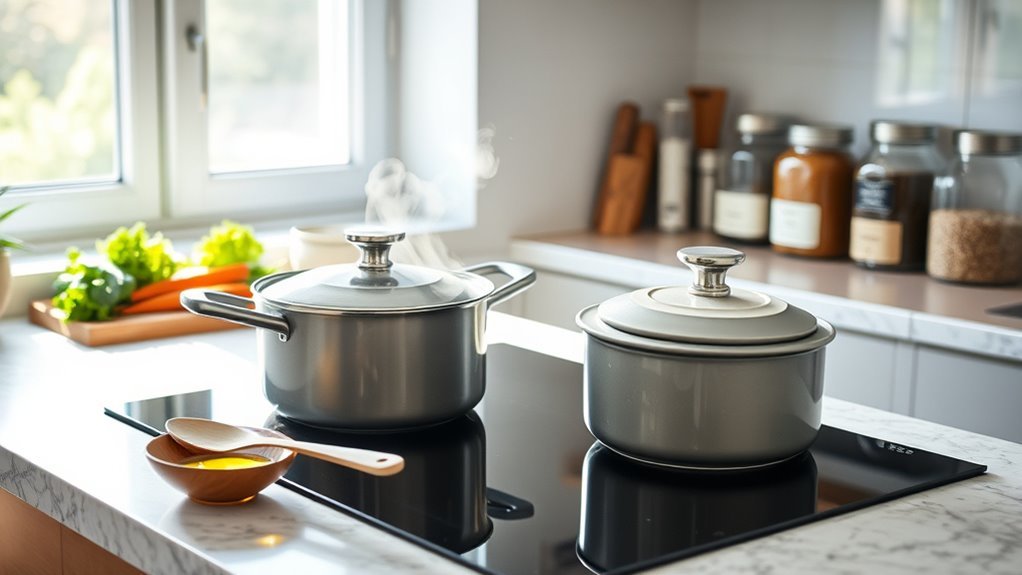
Imagine you switched to Caraway pans after learning your old nonstick shed flakes; you noticed no off‑smell and food released cleanly. You’ll want clear facts: Caraway uses an aluminum core with a ceramic-based, PFAS/PTFE/PFOA-free coating, has SGS testing and Prop 65 compliance, and is oven‑safe to 550°F. There are tradeoffs in durability and heat behavior, so keep going to see what to expect and how to protect the finish.
Quick Verdict: Is Caraway Cookware Safe and Worth Buying?
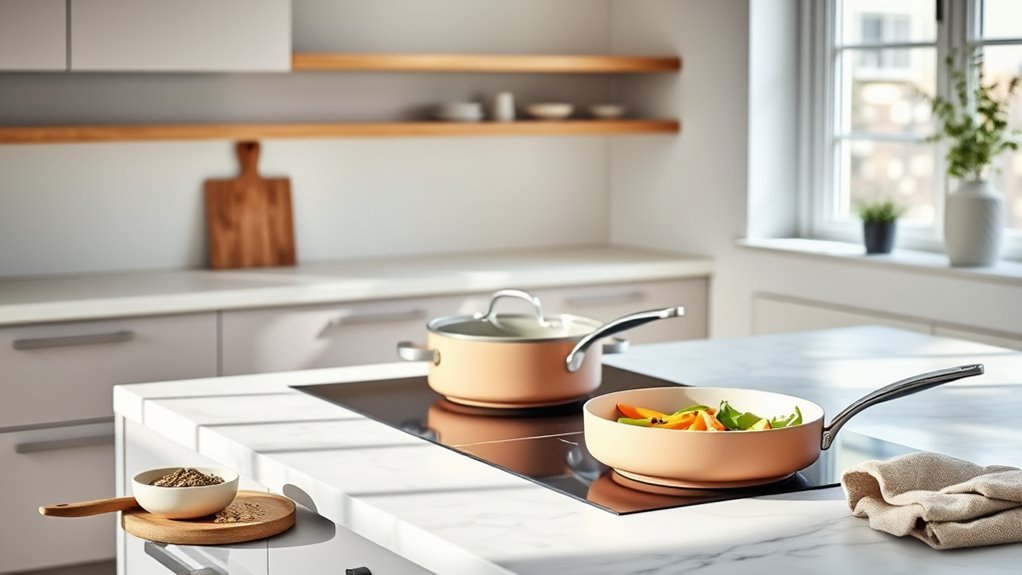
Wondering if Caraway cookware is a safe buy? You can confidently choose it as non-toxic cookware: its ceramic coating is free from PFAS, heavy metals, and fluorinated substances, and the formula uses 100% FDA-approved inorganic natural ingredients.
Independent testing — SGS certification and California Prop 65 screening — backs its safety claims, so you’re not relying on marketing alone. The set’s non-stick properties hold up in everyday use, and its oven-safe rating to 550°F adds functional versatility.
With a 4.8-star average from over 26,000 reviewers, usability and design resonate with real cooks. Yes, it costs more upfront, but the durability, eco-friendly manufacturing, and documented safety make it a pragmatic investment for your health-focused kitchen.
If you value liberation from toxic cookware and want evidence-based reassurance, Caraway delivers a clear balance of safety, performance, and long-term value.
What Caraway Is Made Of: Materials, Coating, and Temperature Limits
Materials matter: Caraway pairs an aluminum core for fast, even heating with a ceramic, inorganic coating made from 100% FDA‑approved ingredients, so you get nonstick performance without PTFE, PFOA, PFAS, lead, or cadmium.
That combination gives you materials engineered for reliability: the aluminum core resists warping and rust while distributing heat quickly, and the ceramic coating provides a durable, non-toxic cookware surface for everyday use.
You’ll appreciate that the non-stick ceramic coating means you can cook with less oil and clean up faster, supporting healthier habits and more freedom in the kitchen.
Caraway pieces are oven safe up to 550°F, so you can sear on the stovetop then finish in the oven without swapping pans.
In short, the materials and design prioritize safety, performance, and convenience—letting you cook boldly while minimizing exposure to harmful substances.
Caraway Cookware: PFAS, PTFE, PFOA, Lead & Cadmium – The Facts
You’ll want clear answers about PFAS and other fluorinated chemicals, and Caraway reports their ceramic coating is free of those substances.
Independently tested for lead and cadmium and certified by SGS and California Prop 65, their cookware meets recognized safety benchmarks.
Caraway also markets the line as PTFE- and PFOA-free, so you can choose cookware designed to avoid those legacy nonstick chemicals.
PFAS And Fluorinated Chemicals
Because Caraway uses a ceramic, inorganic coating rather than fluorinated chemistries, you won’t be exposed to PFAS, PTFE, or PFOA during normal cooking. Its non-toxic, ceramic coated surfaces give you an alternative to traditional non-stick cookware that relies on harmful chemicals. SGS certification and Prop 65 testing back those claims, and FDA-approved inorganic ingredients further reduce risk.
| Feature | What it means | Benefit |
|---|---|---|
| Coating | Ceramic, inorganic | No PFAS/PTFE/PFOA |
| Certification | SGS, Prop 65 tested | Verified safety |
| Oven-safe | Up to 550°F | Stable at high heat |
| Health | Requires less oil | Cleaner cooking |
| Materials | Non-toxic formulation | Liberation from toxic pans |
You can choose cookware that’s evidence-based, practical, and aligned with safer living.
Lead And Cadmium Testing
Having covered ceramic coatings and fluorinated-chemical avoidance, let’s look at lead and cadmium testing for Caraway cookware.
You’ll find Caraway explicitly tests for lead and cadmium and meets regulatory limits, including California Prop 65 screenings and SGS certification.
Their non-toxic ceramic coating uses 100% FDA-approved inorganic natural ingredients, reducing risk of metal leaching and supporting product safety.
This testing record means you can choose cookware that aligns with both personal health and environmental liberation—lower CO2 manufacturing and eco-friendly practices reinforce that choice.
In short, Caraway’s documented lead and cadmium testing, combined with third-party verification, gives clear, evidence-based assurance that the products are safer for everyday use and free from those toxic heavy metals.
PTFE/PFOA Free Claims
When you choose Caraway, you’re opting for cookware that’s explicitly formulated without PTFE, PFOA, or other PFAS compounds, reducing the risk of toxic fumes or leaching associated with traditional nonstick pans.
Their ceramic, FDA-approved inorganic coating and third-party certifications (SGS, Prop 65 screenings) provide documented evidence that the surface is free from those fluorinated chemicals.
You get a non-stick option that prioritizes health without sacrificing performance. The claims are backed by testing and materials disclosure, so you can break from harmful legacy coatings and cook with confidence.
- Free from PTFE, PFOA, and broader PFAS classes
- Ceramic, FDA-approved inorganic coating
- Verified by SGS testing and Prop 65 compliance
- No lead or cadmium in the non-stick surface
- Designed as a healthier alternative to traditional non-stick
Lab Certifications & Real‑World Safety Evidence
If you want cookware that’s backed by both lab data and real-world use, Caraway makes that easy to verify: lab certifications include SGS testing and California Prop 65 compliance, showing adherence to strict safety standards.
You’ll also see that the non-toxic ceramic coating is free from PFAS, PTFE, PFOA, lead, and cadmium, and that materials use FDA-approved inorganic natural ingredients for food contact. These certifications reduce chemical risk, while the aluminum core construction minimizes temperature variation without leaching.
Beyond lab reports, real-world safety evidence matters: customer feedback consistently praises the non-stick properties and reports no health concerns after extended use, reinforcing lab findings.
That combination—transparent testing, clear material lists, and positive user experiences—lets you make an informed choice without guesswork.
If you value liberation from hidden toxins and want cookware that passes both regulatory and everyday scrutiny, Caraway’s documented profile supports that decision.
How Caraway Cooks: Non‑Stick Performance, Heat Distribution, Durability
Because Caraway pairs an aluminum core with a sol‑gel ceramic coating, you’ll get even heat distribution and reliable food release with less oil or butter. You’ll notice consistent browning and fewer hot spots, which helps you cook confidently and waste less.
The non-stick performance stems from that sol‑gel non-stick coating and smooth surface, making flipping and cleaning quicker.
- Aluminum core promotes fast, uniform heat distribution for predictable results.
- Sol‑gel non-stick coating reduces sticking and lowers oil needs.
- Oven-safe to 550°F, so you can finish dishes in high heat when needed.
- Durability depends on proper tool choice; avoid metal utensils to prevent abrasion.
- Not dishwasher-safe, but the non-stick surface simplifies gentle hand washing.
This combination gives you functional freedom: efficient heat control, dependable release, and reasonable longevity.
You get cookware designed for practical use, provided you respect limits that preserve the coating’s long-term performance.
Care Rules to Protect the Coating and Extend Lifespan
Although Caraway cookware is built for everyday use, you’ll protect its sol‑gel ceramic coating and extend its life by following a few simple care rules: always use silicone, wooden, or plastic utensils to avoid scratching the non-stick ceramic surface.
Hand wash each piece—Caraway isn’t dishwasher safe—so your cookware sets stay easy to clean and the coating remains intact.
Cook on low to medium heat; although oven-safe to 550°F, routine high heat wears the finish faster.
For stubborn residues, soak in warm, soapy water and lift softened food with a nonabrasive sponge instead of scrubbing with steel wool or harsh pads.
When storing, avoid stacking pans directly; use protective layers or pan protectors to prevent contact scratches.
These evidence-based, consumer-focused practices reduce wear, maintain release performance, and keep your kitchen efficient.
Follow these care rules and you’ll preserve performance without sacrifice—freeing you to cook confidently and sustainably with your Caraway cookware.
Is Caraway Worth It? Price, Alternatives, and Who Should Buy
Now that you know how to protect Caraway’s ceramic finish for longer use, you’ll want to weigh whether the set itself is worth the price. At $395 for a complete set (discounted from $545), Caraway cookware bundles non-toxic materials, strong performance, and a cohesive aesthetic. Reviews average 4.8 stars from 26,000+ users, supporting durability claims and real-world satisfaction.
You should consider budget, values, and alternatives before buying.
- Cost-effective as a set vs. buying pieces individually
- Non-toxic materials (PFAS-, PFOA-, lead-free) for health-focused cooks
- Higher price than standard stainless steel but justified by design and safety
- Solid customer ratings indicate long-term usability and resale potential
- Alternatives: traditional stainless, cast iron, or lower-priced ceramic non-stick
If you prioritize reducing chemical exposure and want a modern kitchen that supports freedom of choice, Caraway is a compelling option.
If price constrains you, explore alternatives that balance safety and cost.
Frequently Asked Questions
What Are the Negative Reviews of Caraway Pans?
You’ll find customer complaints about performance issues like peeling non‑stick coating, sticking with sugary foods, and limits on dishwasher use.
Reviewers flag durability concerns when metal utensils scratch surfaces and coatings wear over time.
Many cite price comparisons as a drawback, saying similar stainless options cost less.
You’ll want evidence-based reviews and hands-on testing to liberate your choice, weighing long-term use against upfront cost and care requirements.
What Is the Lawsuit Against Caraway?
You’ll want facts: the lawsuit details allege Caraway misled buyers by marketing cookware as completely non-toxic while trace PFAS were found, prompting consumer reactions claiming deception and health concerns.
Plaintiffs seek damages for purchases made under those claims.
Product safety is central, and the company response stresses testing and transparency.
You’ll judge risks and remedies based on evidence, regulatory standards, and any settlement or court findings.
What Brand Is the Safest Non-Toxic Cookware?
Caraway is among the safest non-toxic cookware brands you can choose. You’ll get eco friendly materials, ceramic coatings free of PFAS and heavy metals, and cookware longevity that resists wear and high heat.
You’ll gain clear health benefits from reduced exposure to toxic chemicals.
For broader choices, consider GreenPan or Lodge—each emphasizes safe materials and sustainable production so you can cook freely and confidently.
Is There Teflon in Caraway?
No — Caraway materials don’t include Teflon. Ironically, you’ll ditch the fear of flaky PTFE and embrace a ceramic sol‑gel coating that’s PFAS‑free.
You’ll get reliable cooking performance and cookware durability from an aluminum core, backed by SGS and Prop 65 testing.
You’ll follow simple care instructions to preserve the non‑toxic finish. You’re choosing a liberating, evidence‑based alternative that prioritizes health and lasting usability.
Conclusion
Quick verdict: Caraway is a safe, evidence-backed nonstick option—its ceramic coating is free of PFAS, PTFE, PFOA, lead, and cadmium and meets SGS and California Prop 65 standards. You’ll get even heating from the aluminum core and oven safety to 550°F. With simple care to avoid metal tools and high heat, the coating holds up well. It’s a smart, health-conscious buy—practical, eco-minded, and yes, almost outrageously user-friendly for everyday cooks.
