
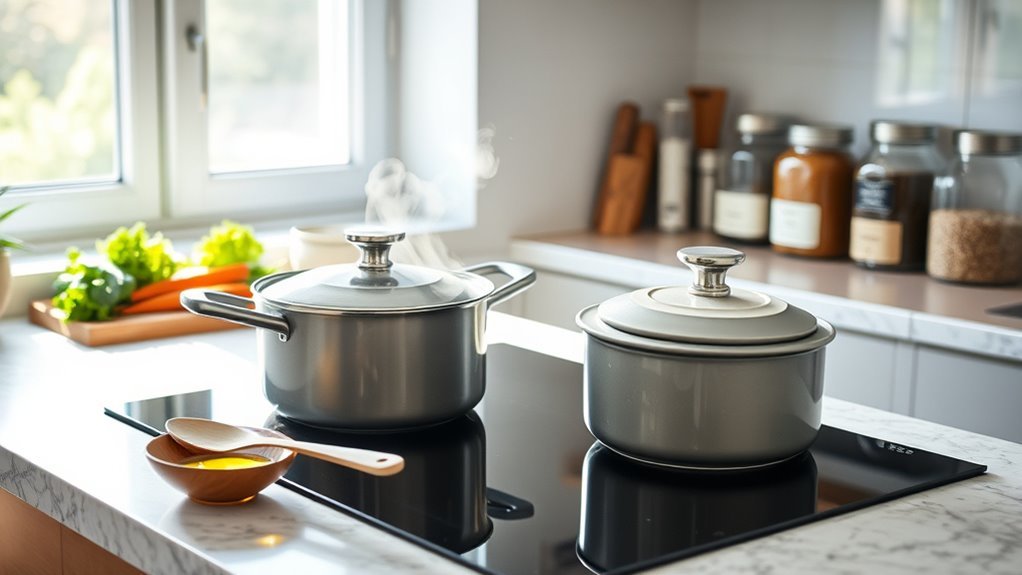
Is Caraway cookware safe, and does its ceramic coating offer a good alternative to traditional nonstick pans? If you’re replacing scratched cookware or trying to avoid PFAS, the materials and testing matter more than the marketing. Caraway has several strengths, but its long-term performance depends on how you use and maintain the pans.
Quick Answer
Yes, Caraway ceramic-coated cookware is a reasonable choice for everyday cooking. Its aluminum pans use a coating made without PTFE, PFOA, or intentionally added PFAS. Published laboratory results support its chemical safety claims within tested detection limits. The main tradeoff is a ceramic nonstick surface that requires gentle heat and careful handling.
Last checked: November 14, 2026. Key dates, prices, product specifications, and testing figures were verified against official sources.
Key Takeaways
- Caraway’s published ceramic cookware report lists lead below 0.002 mg/kg and cadmium below 0.001 mg/kg in the tested material.
- The ceramic cookware is oven-safe to 550°F, but low-to-medium stovetop heat helps preserve its nonstick performance.
- Caraway works with gas, electric, and induction cooktops. Its ceramic cookware should be washed by hand.
- Ceramic nonstick coatings can lose their food-release properties over time, even with careful use.
- The 2026 advertising lawsuit does not establish that Caraway cookware contains PFAS.
Quick Verdict: Is Caraway Cookware Safe and Worth Buying?
)
Caraway is worth considering if you want ceramic nonstick cookware without PTFE-based coating. Its smooth cooking surface, attractive colors, and included storage accessories make it appealing for everyday kitchens.
The cookware performs well for eggs, vegetables, sauces, and other foods that benefit from easy release. Its aluminum construction also helps food heat evenly without requiring a high burner setting.
However, a higher purchase price does not guarantee a longer-lasting nonstick coating. Ceramic-coated pans can gradually lose their slippery finish, even when the underlying cookware remains usable.
Caraway is a good match if you:
- Prefer cookware made without PTFE, PFOA, and intentionally added PFAS.
- Usually cook on low or medium heat.
- Want coordinated cookware with storage organizers.
- Do not mind washing pans by hand.
- Value design and easy everyday cleanup.
If you frequently sear steaks over intense heat or want cookware that lasts for decades, stainless steel or cast iron may provide better value.
What Caraway Is Made Of: Materials, Coating, and Temperature Limits
Caraway’s signature ceramic cookware combines an aluminum body, ceramic-based nonstick coating, and stainless steel components. These materials serve different purposes, from heat distribution to food release.
The aluminum body transfers heat efficiently. The ceramic-coated cooking surface helps reduce sticking, while a magnetic stainless steel base makes the cookware compatible with induction burners.
The coating uses sol-gel technology, which forms a thin, ceramic-like layer over the metal. Unlike traditional PTFE-based nonstick coatings, this surface does not rely on fluoropolymer chemistry for food release.
Caraway describes its coating ingredients as inorganic minerals approved for food-contact applications. However, approval of individual ingredients should not be confused with FDA approval of an entire cookware product.
The company markets its ceramic formulation as free from PTFE, PFOA, PFAS, lead, and cadmium. Laboratory testing provides additional information about substances detected in the finished surface.
Temperature limits matter. Caraway rates its ceramic cookware for oven temperatures up to 550°F (288°C). This allows you to move a pan from the stovetop into an oven for suitable recipes.
However, that oven rating is not a recommendation to use maximum stovetop heat. Routine overheating can shorten the useful life of the nonstick coating.
Also, do not assume the broiler is safe simply because the pan has a high oven-temperature rating. Caraway’s ceramic cookware should not be used under direct broiler heat unless the specific product instructions expressly permit it.
Caraway Cookware: PFAS, PTFE, PFOA, Lead & Cadmium – The Facts
Caraway cookware is designed to avoid several chemicals that shoppers commonly investigate in nonstick pans. Its published third-party testing supports these claims, although laboratory results must be understood within their testing limits.
Here is what the available evidence says about the coating’s chemical composition.
PFAS and Fluorinated Chemicals
Caraway says its ceramic coating is manufactured without intentionally added PFAS, including PTFE and PFOA. These substances belong to a broad family of fluorinated chemicals.
PFAS stands for per- and polyfluoroalkyl substances. Some members of this chemical family have been associated with environmental persistence and adverse health effects.
PTFE, commonly associated with Teflon, is a fluoropolymer used in conventional nonstick cookware. PFOA is a different chemical that was historically used in some fluoropolymer manufacturing processes.
These chemicals should not be treated as identical. Their properties, exposure pathways, and associated health risks differ.
Caraway’s published testing indicates that the selected PFAS substances were not detected above the laboratory’s reporting limits.
| Feature | What it means | Practical benefit or limitation |
|---|---|---|
| Ceramic coating | Inorganic, sol-gel-based surface | Nonstick cooking without PTFE |
| PFAS testing | Specified substances tested against detection limits | Evidence supporting PFAS-free claims |
| Heavy-metal testing | Includes lead and cadmium | Documents measured levels in tested materials |
| Oven rating | Up to 550°F | Suitable for many stovetop-to-oven recipes |
| Cooking performance | Smooth ceramic nonstick surface | Easy initial food release; performance may decline |
An important distinction is that not detected does not mean a substance is guaranteed to be absent at every possible concentration. Laboratory instruments have measurable detection limits.
This is why published test results are more useful than a broad promise that cookware is completely free from every potentially harmful chemical.
Lead and Cadmium Testing
Caraway’s ceramic cookware has undergone testing for lead, cadmium, and other heavy metals. Its public reports provide specific measurements rather than relying entirely on packaging claims.
According to the Light Labs comprehensive testing report for Caraway ceramic cookware, the published heavy-metal results include:
- Lead: Below 0.002 mg/kg.
- Cadmium: Below 0.001 mg/kg.
- Arsenic: Below 0.0004 mg/kg.
- Mercury: Below 0.0005 mg/kg.
The report identifies March 2, 2026, as the heavy-metal testing date. These figures describe the tested material and its reporting limits. They should not be mistaken for measurements of metal transfer into food during cooking.
Caraway also reports SGS certification and California Proposition 65 testing. These are relevant claims, but the scope of each test or certification matters.
California’s official Proposition 65 guidance explains that the law focuses on consumer warnings about exposures to listed chemicals.
Proposition 65 compliance is not a universal certification that a product contains no hazardous substances.
Likewise, a laboratory certificate supports only the materials, substances, methods, and conditions covered by that specific test.
PTFE/PFOA Free Claims
Caraway’s PTFE-free and PFOA-free claims are consistent with its ceramic coating design and the available testing results.
The Light Labs report lists PTFE and PFOA as not detected in its January 26, 2026, testing. It also includes screening for other PFAS substances.
In addition, the report lists total fluorine as not detected in testing dated January 22, 2026. This provides another way to investigate fluorinated compounds beyond individually targeted chemicals.
However, Caraway’s statement about FDA-approved ingredients needs context.
The FDA’s explanation of product approvals distinguishes between approval of certain food-contact ingredients and approval of complete consumer products.
Therefore, FDA-approved ingredients do not mean that the FDA has independently certified Caraway pans as completely non-toxic.
The practical benefit is straightforward: you can choose cookware designed without traditional PTFE-based nonstick chemistry while still considering durability, cooking habits, and other product characteristics.
Lab Certifications & Real-World Safety Evidence
Caraway offers more supporting information than a simple non-toxic label. Its third-party testing, material disclosures, and published chemical results help you evaluate its claims.
However, laboratory evidence and marketing statements are not interchangeable. Tests establish results for defined samples and conditions, while broad health claims may require substantially more evidence.
That distinction became important in a 2025 advertising review.
On August 14, 2025, the National Advertising Division of BBB National Programs determined that Caraway had a reasonable basis for its PFAS-free and non-toxic cookware claims.
However, the National Advertising Division decision recommended changing or discontinuing certain claims suggesting that competing traditional nonstick cookware was inherently harmful or less safe.
This is a useful distinction for buyers. Evidence supporting Caraway’s formulation does not automatically establish that every PTFE-coated pan is unsafe during normal use.
Caraway also promotes environmentally conscious manufacturing, thoughtful packaging, and lower CO2 impact. Its materials information describes supplier practices and packaging choices, although a directly comparable carbon-emissions figure was not established in the sources reviewed here.
Real-world cooking performance also matters. A pan can meet chemical testing standards while still developing scratches, staining, or reduced nonstick performance with use.
Neither positive owner reviews nor the absence of reported symptoms can independently prove that cookware presents zero health risk.
Note: If you believe damaged cookware has caused an unusual exposure or health problem, stop using the affected pan and consult a qualified healthcare professional. You can also contact the manufacturer about product defects and available support.
How Caraway Cooks: Non-Stick Performance, Heat Distribution, Durability
Caraway performs best as everyday ceramic nonstick cookware for moderate-temperature cooking. Its aluminum body heats efficiently, while the smooth coating helps foods release with relatively little added fat.
For eggs, pancakes, vegetables, and sauces, the coating can make preparation and cleanup easier.
Its cooking performance has also been evaluated independently.
In Good Housekeeping’s cookware testing published in May 2026, the pans generally distributed heat well. However, repeated egg cooking revealed increasing sticking, and the exterior surfaces developed stains.
This shows why initial nonstick performance and long-term durability should be considered separately.
Caraway’s main strengths include:
- Efficient heating: The aluminum body helps distribute heat across the cooking surface.
- Initial food release: The ceramic coating makes many sticky foods easier to cook.
- Cooking versatility: The pans work with gas, electric, and induction stovetops.
- Oven compatibility: The 550°F rating supports many recipes that finish in the oven.
- Convenient cleaning: Most ordinary food residue can be removed with gentle washing.
The primary weakness is that ceramic nonstick performance is not permanent.
Repeated overheating, abrasion, and everyday wear can reduce food release. Even careful owners may eventually need to replace a pan when its coating becomes difficult to use.
Caraway’s exterior appearance can also change over time. Discoloration does not necessarily mean the cookware has become unsafe, but peeling or substantial damage to the cooking surface deserves attention.
If your main priority is intense browning, stainless steel and cast iron are generally better suited to repeated high-temperature cooking.
Care Rules to Protect the Coating and Extend Lifespan
Proper care can help Caraway’s ceramic coating retain its food-release properties for longer. The most important habits are controlling heat, avoiding rough utensils, and cleaning the surface gently.
Caraway’s official ceramic cookware care instructions provide specific guidance for routine use.
- Wash before first use. Clean the pan with warm, soapy water and dry it with a soft towel.
- Preheat gently. Caraway recommends preheating for up to 90 seconds on low-to-medium heat before adding oil.
- Add a little oil or butter. A light coating helps prevent sticking. The pan does not need seasoning like cast iron.
- Use gentle utensils. Choose silicone, wood, nylon, or suitable plastic instead of sharp metal tools.
- Avoid aerosol cooking sprays. Residue buildup can make the surface harder to clean and reduce food release.
- Let the pan cool. Avoid placing a very hot pan directly under cold running water.
- Wash by hand. Use dish soap and a soft sponge rather than a dishwasher or abrasive scrubber.
- Protect the surface during storage. Use pan protectors or the included storage organizers to avoid direct contact between pans.
Warning: Avoid leaving an empty Caraway pan on a hot burner. Excessive heat can damage the ceramic coating and reduce its nonstick performance. Sudden temperature changes can also affect the cookware’s durability.
If food becomes stuck, avoid trying to remove it with steel wool or a metal scraper.
Instead, Caraway recommends gently simmering soapy water over low heat to soften residue. Once the pan cools, remove the loosened food with a nonabrasive sponge.
For stubborn exterior discoloration, the manufacturer’s cleaning guidance allows stronger cleaning methods on certain exterior surfaces. Keep harsh abrasives away from the ceramic cooking surface.
Finally, watch for changes in the coating. If you notice significant peeling, chips, or exposed underlying metal, discontinue using the damaged pan until the manufacturer evaluates the problem.
These precautions will not make the nonstick surface last forever, but they can prevent avoidable wear.
Is Caraway Worth It? Price, Alternatives, and Who Should Buy
Caraway cookware can be worth its higher price if you value its PFAS-free ceramic formulation, modern design, and convenient storage system. However, it is not necessarily the most economical option for every cooking style.
On November 14, 2026, Caraway’s official 12-piece ceramic cookware set listing displayed a promotional price of $356, compared with a listed original price of $675.
The listing also showed an approximately 4.7-star rating based on more than 86,000 aggregated reviews of the included products. These ratings are not a guarantee that the coating will remain nonstick for a particular number of years.
Promotional prices and review totals can change.
The standard 12-piece bundle includes four main cooking vessels:
- 10.5-inch frying pan
- 3-quart saucepan
- 4.5-quart sauté pan
- 6.5-quart Dutch oven
- Three matching lids
- Storage organizers and a lid holder
The cookware is designed to work as a coordinated set. However, you may spend less by buying only the individual pieces you actually need.
Caraway also provides a one-year limited warranty for qualifying US purchases. The official warranty terms cover qualifying defects in materials, construction, and workmanship.
Normal coating wear, cosmetic scratches, overheating damage, and damage from improper care are excluded from coverage.
This matters because a warranty against manufacturing defects is not a promise of permanent nonstick performance.
Before buying, compare the main cookware options:
| Cookware type | Main advantage | Main limitation |
|---|---|---|
| Caraway ceramic nonstick | Easy initial release and PFAS-free coating design | Nonstick performance can decline |
| Stainless steel | Durability and high-heat versatility | Food may stick without proper technique |
| Cast iron | Strong heat retention and long service life | Heavy and requires seasoning care |
| Carbon steel | Excellent high-heat cooking with a renewable seasoning layer | Needs maintenance to resist rust |
| Lower-priced ceramic nonstick | Similar cooking style with less upfront spending | Coating durability and testing transparency vary |
Other ceramic cookware brands, such as GreenPan, may also suit buyers looking for alternatives to traditional PTFE coatings. Lodge offers cast iron options for those who prioritize long service life and high-temperature cooking.
If you mainly cook delicate foods and appreciate Caraway’s appearance, its ceramic set may justify the expense.
If you want a single cookware collection to handle everything from eggs to very high-heat searing, a combination of stainless steel or cast iron and one ceramic nonstick pan may be more practical.
Frequently Asked Questions
What Are the Negative Reviews of Caraway Pans?
Negative reviews commonly mention declining nonstick performance, scratches, exterior staining, and the relatively high purchase price. Some owners also dislike the hand-washing requirement. These complaints do not affect every user, but they highlight the maintenance and durability tradeoffs associated with ceramic-coated cookware.
What Is the Lawsuit Against Caraway?
Groupe SEB USA and Meyer Corporation filed a federal lawsuit against Caraway on February 13, 2026. The case concerns allegations involving advertising claims and comparisons with competing cookware. The federal case docket identifies the dispute as case 1:26-cv-01237. The allegations are not findings that Caraway cookware contains PFAS.
What Brand Is the Safest Non-Toxic Cookware?
No single cookware brand can be proven safest for every use. Caraway and GreenPan offer ceramic-coated options designed without PFAS, while Lodge cast iron and quality stainless steel avoid synthetic nonstick coatings. The best choice depends on material quality, verified testing, correct use, and maintenance.
Is There Teflon in Caraway?
No, Caraway’s signature ceramic nonstick cookware is made without Teflon, the brand name associated with PTFE. Its cooking surface uses a ceramic-based coating instead. Published testing reports list PTFE as not detected, supporting the manufacturer’s formulation claim within the limits of the laboratory testing.
Does Caraway Work on Induction Cooktops?
Yes, Caraway’s signature ceramic cookware is compatible with induction cooktops because it has a magnetic stainless steel base. It also works on gas and electric burners. Use low-to-medium heat as recommended, since induction can heat cookware quickly and excessive heat can affect nonstick performance.
What Should You Do If a Caraway Pan Is Scratched?
A minor surface mark does not automatically establish a health hazard. However, deep scratches, peeling, or chipped coating may indicate damage that needs attention. Stop using a pan with substantial coating damage and contact Caraway about replacement options. Normal scratches and coating wear are generally excluded from its limited warranty.
Conclusion
Caraway is a credible ceramic nonstick option if your priorities include avoiding PTFE-based coatings, convenient everyday cooking, and modern design. Its published third-party test results support its chemical safety claims within defined laboratory limits.
However, its high price does not eliminate the normal durability limitations of ceramic nonstick cookware. Use gentle heat, avoid abrasive tools, and protect the coating during cleaning and storage.
Before buying, consider whether you need a complete matching set or just one dependable nonstick pan. The best long-term choice is the cookware that fits your cooking habits, maintenance preferences, and budget.
Sources
- Light Labs: Caraway Third-Party Testing Report: PFAS, PTFE, PFOA, total fluorine, lead, cadmium, other chemical results, and testing dates.
- California OEHHA: Proposition 65 Frequently Asked Questions: Regulatory purpose and limitations of Proposition 65 warnings.
- U.S. Food and Drug Administration: Is It Really FDA Approved?: Distinctions between ingredient approval and whole-product approval.
- BBB National Programs: Caraway Advertising Decision: August 2025 findings on Caraway’s PFAS-free claims and comparative safety advertising.
- Caraway: Care & Cleaning: Oven-temperature limit, heat settings, washing, utensils, and coating maintenance.
- Good Housekeeping: Caraway Cookware Testing: Independent evaluations of cooking performance, food release, staining, and durability.
- Caraway: Ceramic Cookware Set: Set contents, pricing, customer ratings, materials, and compatibility.
- Caraway: Limited Warranty: One-year warranty coverage, eligibility, and exclusions.
- Justia: Groupe SEB USA and Meyer Corporation v. Caraway Home: Federal lawsuit filing date, parties, case number, and recorded proceedings.
