
Finding a water dispenser for a small space in 2027 is less about compromise and more about choosing the right fit. Compact countertop RO systems, slim bottleless coolers, and space-saving pumps now offer filtration and convenience without crowding apartments, offices, or kitchens. Some models prioritize capacity, others focus on touchless use or easy storage. The real question is which option quietly does the most with the least room.
Bluevua RO100ROPOT-Lite Countertop Reverse Osmosis Water Filter

The Bluevua RO100ROPOT-Lite is a strong fit for singles or couples who need clean water without sacrificing counter space, thanks to its compact countertop design and no-plumbing setup. It uses a five-stage reverse osmosis system and a 0.0001μm membrane to reduce TDS, PFOS, PFOA, chlorine, fluoride, arsenic, and lead. A 12-liter capacity, under-three-minute dispensing, and 3:1 waste ratio support efficient daily use. The glass carafe and LED display add practicality, while annual filter changes keep maintenance simple. WQA certification and SGS testing further support its safety claims.
Best For: Singles or couples looking for a compact, no-plumbing countertop reverse osmosis system with strong contaminant reduction and easy everyday use.
Pros:
- Compact countertop design saves space and is easy to set up without plumbing
- Five-stage RO filtration with a 0.0001μm membrane reduces many common contaminants
- Efficient operation with under-three-minute dispensing and a 3:1 waste ratio
Cons:
- 12-liter capacity may be limiting for larger households
- Annual filter replacement adds ongoing maintenance cost
- Needs a power outlet, so it is not fully off-grid or portable in every setting
Bluevua RO100ROPOT-Travel Reverse Osmosis Countertop Water Filter

Compact and portable, the Bluevua RO100ROPOT-Travel suits small-space dwellers needing serious filtration. Its 6-stage reverse osmosis system uses a 0.0001μm membrane to reduce TDS, PFOA, PFOS, chlorine, fluoride, arsenic, lead, and other contaminants. SGS testing and WQA certification support its safety claims. Measuring 10 by 5 by 13.5 inches, it fits countertops, dorms, offices, and travel setups. The included borosilicate glass bottle helps cut plastic waste. With plug-and-play use, self-cleaning, twist-and-lock filters, and purified water in under three minutes, it balances convenience and efficiency.
Best For: Compact living, travel, and office users who want strong reverse osmosis filtration without installation hassles.
Pros:
- 6-stage RO system with a 0.0001μm membrane reduces a wide range of contaminants.
- Portable, compact design fits small spaces and includes a glass bottle to reduce plastic waste.
- Plug-and-play setup with quick purification, self-cleaning, and easy filter replacement.
Cons:
- Requires electricity to operate, so it’s not usable during power outages.
- Countertop footprint may still be too large for very tight spaces.
- Reverse osmosis systems produce wastewater, even though this one is more efficient than many others.
Waterdrop WFD-40L Water Filter Dispenser, 35-Cup Capacity, Black
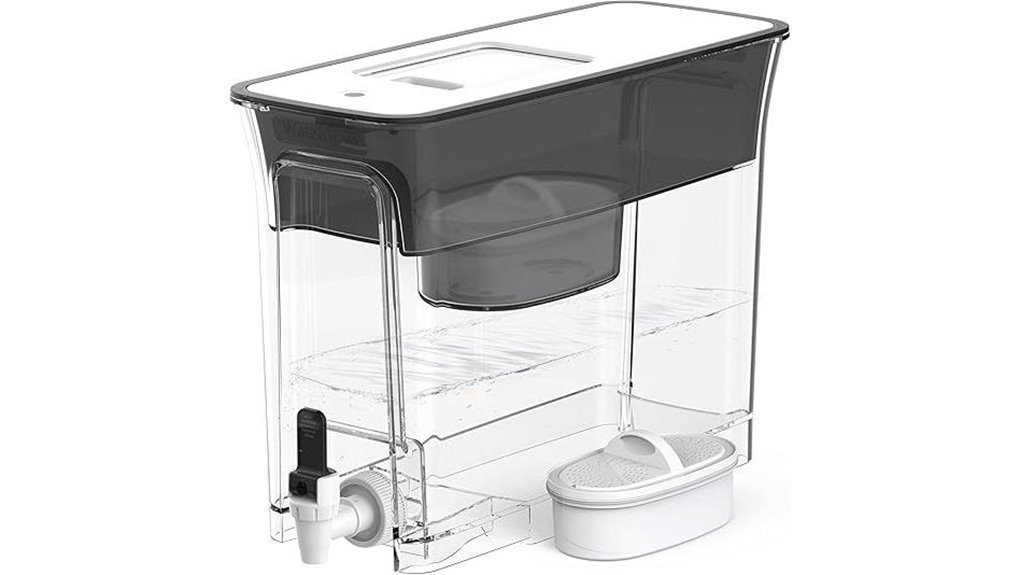
With its slim profile, the Waterdrop WFD-40L suits users who need efficient filtration in tight refrigerator spaces. This 35-cup dispenser holds 19 cups in the body, measures 14.37 x 5.55 x 9.95 inches, and weighs 4.2 pounds. Activated carbon filtration removes up to 97.4% of chlorine and handles water up to 600 PPM TDS. It is NSF42 and 372 certified, made from food-grade, lead-free, BPA-free materials, and reduces odors, metals, and minerals. A handle, sliding cover, arc base, and filter indicator improve everyday use.
Best For: People looking for a slim, fridge-friendly water filter dispenser with strong chlorine reduction, easy handling, and certified materials.
Pros:
- Slim 35-cup design fits well in tight refrigerator spaces.
- Removes up to 97.4% of chlorine and is NSF42/372 certified.
- Includes convenient features like a handle, sliding cover, arc base, and filter replacement indicator.
Cons:
- Best suited for relatively low TDS water since it supports up to 600 PPM.
- Filter lifespan is limited to about 200 gallons or 2 months.
- Gravity filtration is slower than powered filtration systems for larger households.
Avalon Touchless Bottleless Water Cooler with Filters
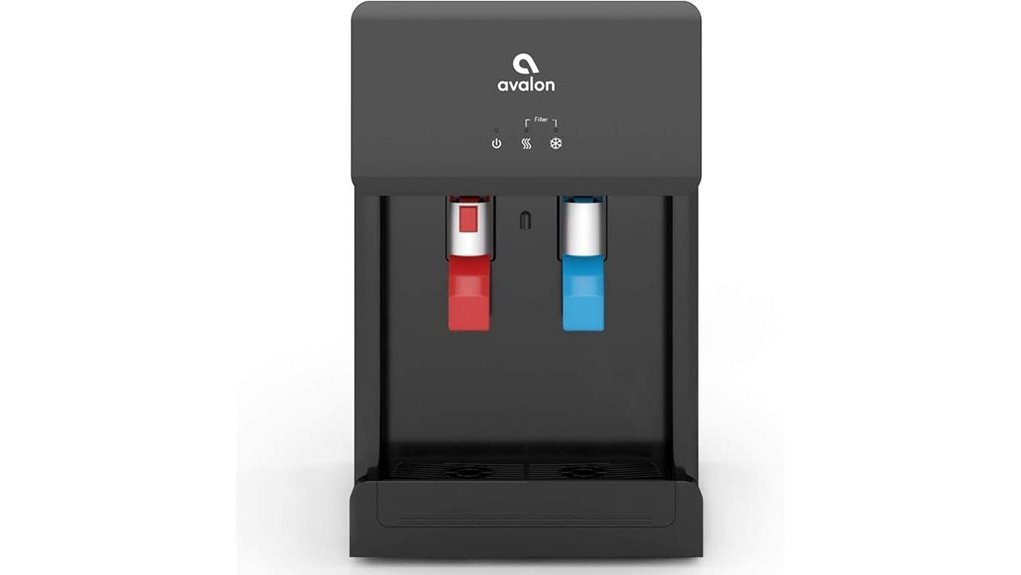
If countertop space is tight, the Avalon B8BLK offers a bottleless solution that fits neatly in small kitchens. This black countertop cooler is NSF certified and UL approved, combining compact dimensions of 12 by 13 by 19 inches with touchless operation. Its dual filtration system uses Avalon A5FILTER sediment and A4FILTER carbon block cartridges, each rated for 6 months or 1,500 gallons. Installation includes tubing, adapters, a flushing tool, and illustrated instructions. The unit dispenses hot water up to 185°F and cold water down to 47°F, with a child safety lock on the hot spout.
Best For: Small kitchens or offices that need a compact, touchless bottleless water cooler with both hot and cold water and easy under-sink installation.
Pros:
- Compact countertop design fits well in tight spaces.
- Dual filtration with sediment and carbon block filters helps improve water quality.
- Touchless dispensing with hot and cold water options and a child safety lock adds convenience and safety.
Cons:
- Requires installation and plumbing access, so it is not as portable as a traditional water cooler.
- Filters need to be replaced every 6 months or 1,500 gallons.
- Countertop capacity may still be limited for larger households or high-traffic areas.
5 Gallon Bottle Electric Water Dispenser Pump
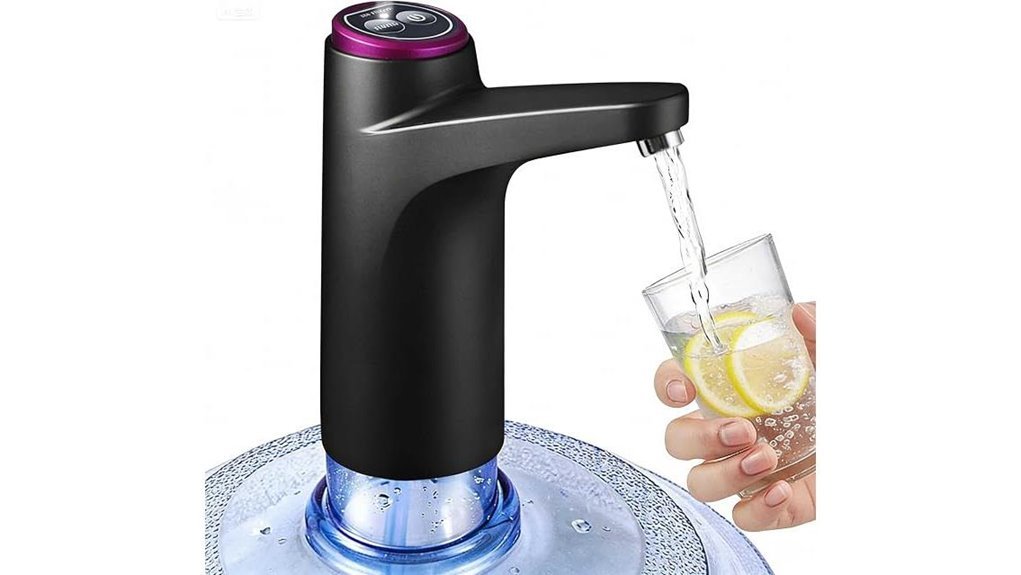
The 5-gallon bottle electric water dispenser pump suits small kitchens, offices, and campers needing easy hydration. This countertop unit dispenses a set 600 ml amount automatically, reducing spills and guesswork. Its USB rechargeable 1200 mAh battery can last 30 to 40 days per charge, while the 4-watt system remains energy efficient. A 100% FDA-grade silicone hose and high-density ABS shell support durability. It fits 2- to 5-gallon jugs with a 2.16-inch neck, installs easily, and weighs only 12.8 ounces. A one-year warranty and 30-day return policy add reassurance.
Best For: People who want a portable, easy-to-use electric water pump for 2- to 5-gallon bottles at home, in the office, or while camping.
Pros:
- Automatically dispenses a set 600 ml amount, reducing spills and guesswork.
- USB rechargeable 1200 mAh battery lasts 30 to 40 days per charge.
- Compact, lightweight design with durable FDA-grade silicone and ABS materials.
Cons:
- Only fits bottles with a 2.16-inch neck, so compatibility is limited.
- Requires charging, so it may not suit users who want a completely manual option.
- Best for countertop use, which may be less convenient in some setups.
Waterdrop ED04B-L Mega Electric Water Filter Dispenser, Large 27-Cup, Blue
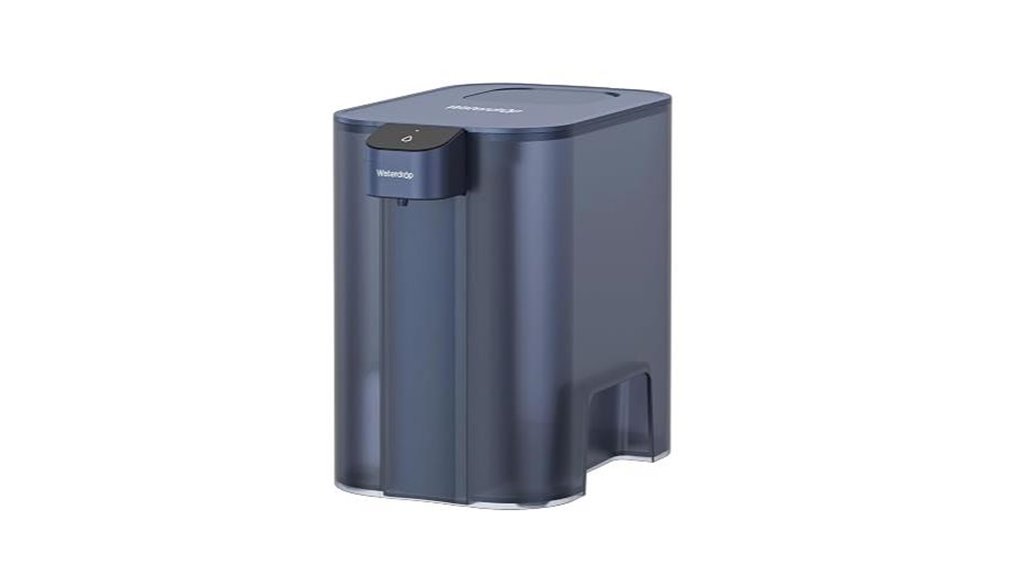
Waterdrop ED04B-L suits small-space users who want a roomy dispenser without bulky lifting. This 27-cup blue countertop model measures 7.1 by 12 by 10.2 inches and weighs 2.72 kilograms, so it fits compact layouts while still serving several people. Electric one-key dispensing simplifies daily use, and the 30-day battery supports cordless convenience. Its NSF/ANSI 42, 53, 401, and 372 certifications back filtration that reduces more than 45 substances, including chlorine, lead, mercury, benzene, and BPA. The carbon block filter lasts about 200 gallons, roughly three months, and flows at 0.8 liters per minute.
Best For: Small-space households, RV users, and anyone who wants a roomy 27-cup countertop water dispenser with easy electric, one-key filtration and no heavy lifting.
Pros:
- Large 27-cup capacity fits multiple users while still staying compact for countertop use.
- Electric one-key dispensing and cordless operation make it convenient and easy to use.
- NSF/ANSI 42, 53, 401, and 372 certifications support broad contaminant reduction.
Cons:
- Requires battery charging, so it is not completely maintenance-free.
- Filter life is about 200 gallons or 3 months, which means periodic replacements.
- As an electric dispenser, it may be less simple than a non-electric pitcher-style filter.
AquaTru Glass Carafe Countertop Reverse Osmosis Water Filter

AquaTru’s glass carafe makes powerful purification fit neatly on a small countertop. This countertop reverse osmosis system uses a 4-stage process to remove 84 contaminants, including PFOA, PFOS, lead, microplastics, fluoride, chromium-6, and arsenic. It requires no plumbing, drilling, or tools, and simply plugs into a standard outlet. The compact 14 x 7.5 x 13-inch design suits tight kitchens. Its borosilicate glass carafe, 0.5-gallon-per-minute flow, and replaceable filters support practical daily use, while 98% of surveyed customers report cleaner, safer, healthier water.
Best For: People who want a compact, no-install reverse osmosis water filter for cleaner drinking water in small kitchens or apartments.
Pros:
- Removes 84 contaminants, including lead, fluoride, PFOS, PFOA, microplastics, chromium-6, and arsenic
- No plumbing, drilling, or tools required; plugs into a standard outlet
- Glass carafe and compact countertop design make it convenient and space-saving
Cons:
- Filter replacements add ongoing maintenance and cost
- Requires electricity to operate
- Maximum water TDS support is limited to 300 PPM
Factors to Consider When Choosing Water Dispensers for Small Spaces in 2026
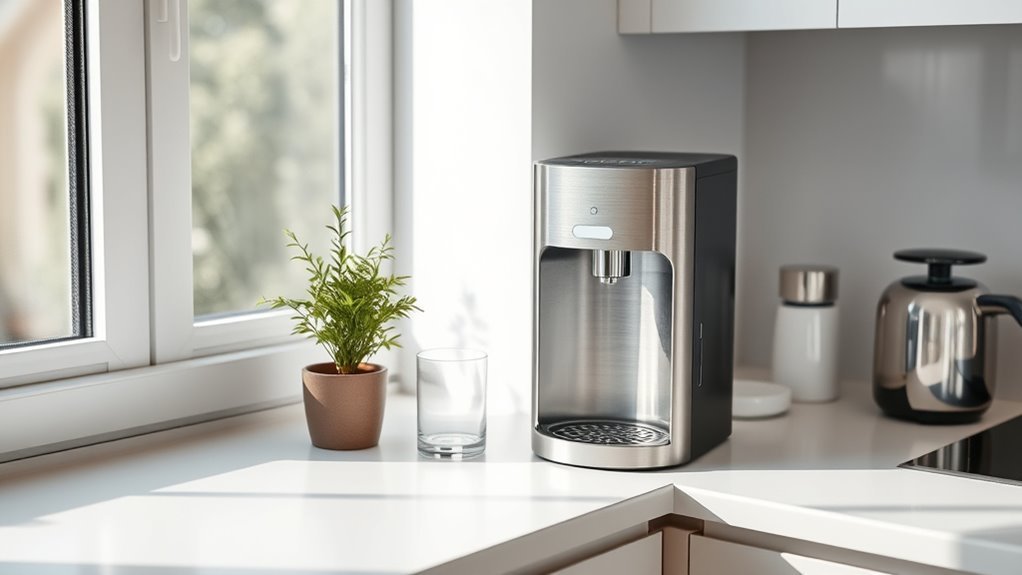
When selecting a water dispenser for small spaces in 2026, buyers will likely prioritize a space-saving footprint and a compact countertop design that fits neatly into limited areas. Installation simplicity and water capacity needs also remain important, since a unit should be easy to set up while still meeting daily use demands. Filtration stage count can further influence the choice, as more stages may offer added purification without sacrificing convenience.
Space-Saving Footprint
For small kitchens and compact offices, footprint is often the deciding factor, and the best water dispensers for these spaces stay under 15 inches in height and width while remaining easy to place on a counter or move as needed. Slim, lightweight models, often around 5 kg or less, reduce strain during setup and repositioning. A modest capacity, such as 12 liters or 35 cups, can meet daily demand without crowding limited surfaces. Ergonomic handles and plug-and-play operation support practical use where installation space is scarce. Some designs also integrate filtration, removing the need for separate bottles and further lowering clutter. In tight environments, a compact footprint should balance capacity, portability, and efficiency without sacrificing convenience.
Compact Countertop Design
Beyond footprint alone, compact countertop design becomes the next deciding factor for small-space buyers in 2026. Dispensers under 15 inches in height and width fit neatly on crowded counters, especially in small kitchens where every inch matters. A slim profile allows placement beside sinks or appliances without creating visual or physical clutter. Models weighing about 5 kg or less add flexibility, since they can be shifted when layouts change or cleaning is needed. Many also rely on plug-and-play operation, avoiding plumbing demands in tight areas. Aesthetics matter too: materials such as high borosilicate glass lend a refined look while preserving utility. In confined rooms, the best countertop dispenser balances scale, portability, and visual restraint.
Installation Simplicity
Installation simplicity is a major advantage in small spaces, where a dispenser should work immediately with minimal setup. Models that require no plumbing or complex assembly are especially practical, because they can be placed, plugged into a power outlet, and used right away. Compact construction supports this ease by fitting neatly into kitchens, break rooms, or office corners without rearranging the area. Plug-and-play controls further improve convenience for users who prefer straightforward operation. Features such as self-cleaning cycles and filter lifespan alerts also reduce routine effort, helping maintain reliable performance with less attention. Quick purification is another benefit, with some dispensers delivering filtered water in under three minutes, which suits busy environments and keeps daily use efficient.
Water Capacity Needs
How much water a small space actually needs should be one of the first considerations when choosing a dispenser in 2026. Capacity varies widely, from 12 liters to 35 cups, and that range directly affects how often refills are required. For one or two people, a compact unit often provides enough water without consuming valuable floor or counter area. Smaller models can suit apartments, offices, or dorm rooms where storage is limited. Units with lighter builds are easier to reposition when layouts change or cleaning is needed. It is also useful to note delivery speed, since some dispensers supply purified water in under three minutes, reducing waiting time in compact settings. Matching capacity to actual use keeps the dispenser practical, efficient, and unobtrusive.
Filtration Stage Count
Filtration stage count is another key factor when selecting a water dispenser for a small space, since it determines how effectively the unit removes contaminants. Systems with four stages or more are generally preferred because they can reduce common tap water impurities while improving taste and safety. Five- or six-stage reverse osmosis units usually offer broader protection, combining activated carbon, reverse osmosis, and other methods to address chlorine, lead, microplastics, and similar substances. Multi-stage models may also extend filter life, reducing how often replacements are needed, which is useful in compact homes. However, more stages can increase the dispenser’s size, so the benefits should be weighed against available floor or counter space. A balanced design gives strong filtration without overwhelming the room.
Energy And Power Use
Energy use matters just as much as size when choosing a dispenser for a compact home. Energy-efficient dispensers often draw very little power; some countertop models operate at about 4 watts, which suits households aiming to limit ongoing electricity use. Battery-powered units can be practical too, with 1200 mAh designs lasting roughly 30 to 40 days per charge and avoiding constant plugging in. Efficient electric filters with flow rates near 0.8 liters per minute can deliver fast purification without excess demand. Modern eco-friendly models further reduce the energy burden tied to bottled water alternatives. Self-cleaning functions also help by cutting manual upkeep and the energy associated with frequent cleaning, making operation simpler and more efficient overall for small-space living.
Portability And Weight
Portability and weight become especially important once energy use is settled, because a dispenser that is efficient but awkward to move still creates problems in a compact home. In small spaces, lighter units under 5 kg are easier to carry, reposition, and fit into narrow corners or shared surfaces. Compact models with ergonomic handles improve handling and suit travel, dorm rooms, and office desks. A space-saving footprint also matters, since slim dimensions help the dispenser sit neatly on a countertop without crowding other items. Many portable designs work without plumbing or installation, which simplifies setup and supports plug-and-play use. Quick delivery of filtered water, often in under three minutes, adds convenience by reducing waiting time in tight environments where every minute and inch count.
Maintenance And Filter Life
Maintenance and filter life are key considerations in small spaces, where frequent upkeep can quickly become inconvenient. A dispenser with a longer filter lifespan, such as six months or 200 gallons, reduces replacement frequency and suits compact homes. Easy replacement systems, including twist-and-lock cartridges, simplify servicing when access is limited. Filter lifespan alerts add another layer of convenience by signaling when capacity is nearing exhaustion, helping prevent interruptions. Self-cleaning features further lessen manual effort, which is valuable for busy users in tight quarters. Flow rate also matters; systems that filter in under five minutes provide quicker access to clean water without adding clutter or delay. Together, these features support reliable performance and lower maintenance demands in confined living spaces.
Frequently Asked Questions
How Often Should Small-Space Dispensers Be Cleaned?
Small-space dispensers should typically be cleaned every one to two weeks, with a thorough sanitizing monthly. More frequent cleaning is advisable if the water tastes off, the dispenser is used heavily, or the room is warm and humid. Exterior surfaces should be wiped regularly to prevent dust buildup. If the unit uses removable parts, those components benefit from washing whenever bottles are changed or spills occur, reducing contamination risk.
Do Countertop Dispensers Need Electricity?
Countertop dispensers do not always need electricity. Many gravity-fed models operate without power, using simple tanks and taps to deliver water. Electric versions, however, are common when features like chilling, heating, filtration, or carbonation are desired. A buyer should check the dispenser’s design and intended functions before purchase. In small spaces, non-electric units often offer greater placement flexibility, while powered models provide added convenience and temperature control.
Are Small Water Dispensers Noisy During Use?
Yes, small water dispensers can be noisy during use, though often only as a brief whisper. Their pumps, compressors, or bubbling flow may hum, click, or gurgle, depending on design and build quality. Models with refrigeration tend to sound louder than simple countertop units. In quieter rooms, the noise can feel like a ticking clock in an otherwise calm space, noticeable but usually not disruptive.
Can These Dispensers Fit Under Standard Kitchen Cabinets?
Yes, many compact dispensers can fit under standard kitchen cabinets, but height varies by model. A clearance of about 18 to 20 inches is often needed, though some low-profile units require less. Depth and access to the water reservoir also matter, especially when opening lids or loading bottles. Careful measurement of cabinet space and dispenser dimensions is essential before purchase to guarantee a proper fit and easy everyday use.
What Water Pressure Is Needed for Bottleless Models?
Bottleless water dispensers generally need about 40 to 80 psi, with many models humming best near 60 psi, like a steady river finding its course. If pressure falls below that range, flow may weaken and cooling performance can lag. Higher pressure is usually manageable if the unit includes a regulator. Because requirements vary, the specification sheet remains the most reliable compass before installation, especially in compact spaces.
Conclusion
Choosing the right water dispenser for a small space comes down to compact design, filtration quality, and convenience. In 2027, countertop and bottleless models continue to stand out because they deliver clean water without demanding much room. One striking statistic is that compact filtration systems can save over 70% more usable space than traditional bulky coolers. That makes models like the Bluevua, Waterdrop, Avalon, and AquaTru especially practical for apartments, dorms, and offices.
