
A washing machine leak can damage your flooring, walls, and nearby cabinets before you notice a problem. The best washing machine leak alarms detect water early and warn you through a loud siren, phone notification, or both.
Our top pick is the X-Sense SWS0A41 Ultra-Slim Water Leak Detector Kit. Its four compact sensors, 100 dB base alarm, and app alerts make it a practical choice for laundry rooms and other leak-prone areas. For simple, loud protection without Wi-Fi, the Topvico TP-206W-3 Water Leak Alarm is our value pick.
These five options were compared using manufacturer specifications, sensor placement, alarm volume, notification methods, battery requirements, and setup limitations.
Washing Machine Leak Alarms Compared
The biggest difference between these alarms is how they notify you. Some sound a siren near the leak, while others rely on a powered hub or internet connection for remote alerts. Compare the sensor count, audible warning, and connectivity before choosing.
| Product | Best for | Audible alert | Remote alerts | Included sensors |
|---|---|---|---|---|
| Best overall; tight spaces | 100 dB at base station | App via included Wi-Fi base | 4 | |
| Long-range, whole-home coverage | Sensors silent; separate sounder needed | App via included hub | 4 | |
| Loud smart alerts across several rooms | 105 dB adjustable | App, email, SMS via gateway | 3 | |
| Behind-washer probe placement | 100 dB built-in alarm | App and email via direct Wi-Fi | 1 with 1 m cable | |
| Best value; simple local warning | 120 dB claimed alarm | None | 3 wired probe units |
Best Washing Machine Leak Alarms: Our Top Picks
For most laundry rooms, an alarm should be easy to place, loud enough to notice, and capable of warning you when you’re away. These three picks cover different needs without requiring every buyer to invest in a full smart-home system.
1. X-Sense SWS0A41 Ultra-Slim Water Leak Detector Kit
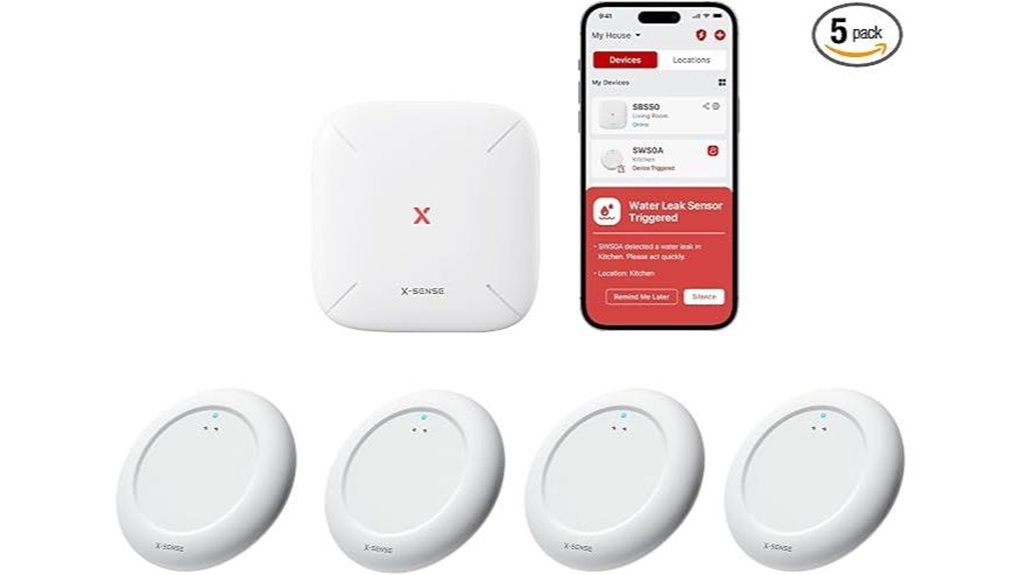
Bottom line: The X-Sense SWS0A41 Ultra-Slim Water Leak Detector Kit is our top choice if you want to monitor your washer and several other plumbing areas. Its thin sensors fit narrow spaces, while the base station provides an audible warning and smartphone alerts.
The package includes four SWS0A sensors and an SBS50 base station, making it suitable for homes with multiple potential leak points.
Key specs:
- Detection: Water-contact probes, including top and bottom sensing points.
- Alarm: 100 dB at the base station, so the warning comes from a central location.
- Connectivity: Wireless sensors and a 2.4 GHz Wi-Fi base for app alerts.
- Power: Two AAA batteries per sensor, with a powered base station.
- Coverage: Four sensors, each approximately 0.68 inches thick.
The low-profile design is the main advantage. Each sensor measures roughly three inches across and can sit in the narrow floor space beside or behind a washing machine. The original product specifications describe detection of water as shallow as 0.4 mm.
For notification coverage, the sensors communicate with the base over a separate wireless connection. X-Sense specifies an open-air range of up to 1,640 feet, although walls and other obstacles can reduce the working distance. The base connects to your home network and provides remote alerts through the X-Sense Home Security app.
There is an important distinction: the base station sounds the audible alarm, not each individual sensor. Place the base where someone can hear it. The app can also show alarm events and support remote muting when connectivity is available.
The sensors use replaceable batteries, with X-Sense specifying up to three years of battery life under its stated conditions. Actual replacement intervals will depend on use and operating conditions.
- Thin sensors fit under and behind appliances.
- Four sensors cover multiple plumbing areas.
- Central audible alarm and remote app notifications.
- Top and bottom probes detect different leak directions.
- Individual sensors do not provide their own loud sirens.
- The base station needs power and suitable Wi-Fi coverage for connected alerts.
- Battery replacement is required over time.
2. YoLink Water Leak Sensor 1 Starter Kit
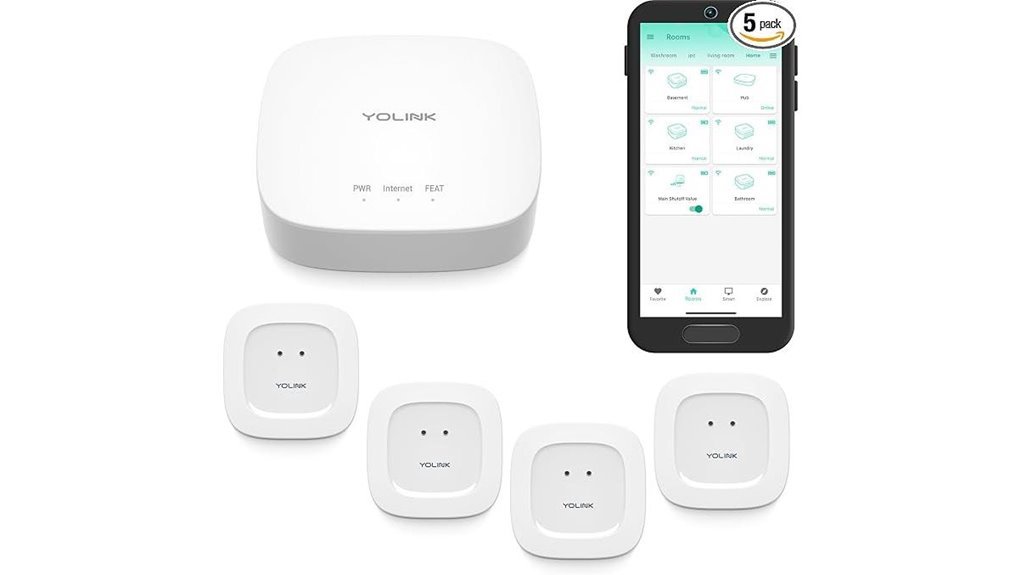
Bottom line: The YoLink Water Leak Sensor 1 Starter Kit is designed for homes needing several sensors connected over a long distance. It is especially useful when a washing machine sits in a basement or utility area far from the main router.
The standard starter kit includes four Water Leak Sensor 1 devices and a compatible YoLink hub.
Key specs:
- Detection: Top and bottom water-contact electrodes for drips and pooling water.
- Alarm: Silent sensors, with optional separate audible accessories.
- Connectivity: LoRa-based wireless communication through a YoLink hub.
- Power: Two AAA batteries per sensor, rated for up to five years of use.
- Coverage: Four sensors for different leak-prone locations.
YoLink uses LoRa, a low-power, long-range wireless technology, for communication between its sensors and hub. This can help in large homes where a direct Wi-Fi connection is less dependable.
You can name sensors by location in the YoLink app. For example, one can be called “Laundry Room,” while others monitor the kitchen, basement, and water heater.
With the hub powered and online, the app can send remote leak notifications. The system also supports additional notification methods and compatible smart-home automations.
A key benefit is YoLink Control-D2D. After you pair compatible devices, a leak sensor can trigger a supported siren or valve controller without an internet connection. However, those accessories are separate, and the paired devices must remain powered and within wireless range.
The included Water Leak Sensor 1 units have no built-in sirens. If you want an immediate audible warning in the laundry room, plan for a compatible sounder or choose a detector with its own alarm.
- Long-range wireless technology suits large properties.
- Four sensors and a hub provide a multi-room starting point.
- Battery life is rated for up to five years.
- Optional local device-to-device automation can work without internet.
- The supplied Sensor 1 devices do not sound an audible alarm.
- Remote app alerts depend on the hub, internet, and power.
- Automatic shutoff and local siren functions require compatible extra devices.
3. GoveeLife Water Leak Detector 1s
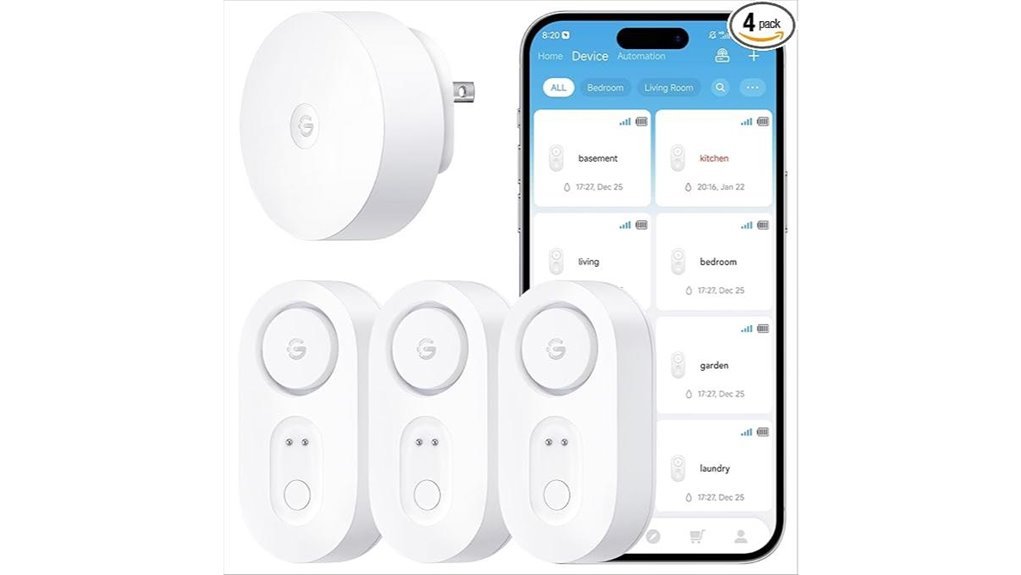
Bottom line: The GoveeLife Water Leak Detector 1s is a strong option if you want both an audible alarm and remote notifications. Its adjustable 105 dB alarm and long-range wireless connection suit laundry rooms, garages, and basements.
The listed three-sensor kit is intended to provide protection at several water-risk locations.
Key specs:
- Detection: Dual water-contact probe arrangements for leak detection.
- Alarm: Up to 105 dB, with adjustable volume settings.
- Connectivity: Sub-1G wireless communication through a compatible Wi-Fi gateway.
- Power: Replaceable batteries, with a manufacturer-rated life of up to five years.
- Coverage: Three sensors, IP67-rated protection, and up to 1,804 feet of stated open-area wireless range.
GoveeLife uses Sub-1G wireless communication between the sensors and its gateway. The manufacturer lists a maximum connection distance of 1,804 feet, although actual range depends on walls, floors, and other obstacles.
Unlike silent sensor systems, the GoveeLife 1s can sound a local alarm when its probes detect water. You can adjust the volume through the app when the device is connected to a compatible gateway.
Remote monitoring is another advantage. The connected system supports app notifications, email, and SMS alert features, allowing you to monitor the washing machine when away from home.
Its IP67 rating gives the sensor housing protection against dust and temporary water immersion under the rating’s test conditions. After a leak, follow the manufacturer’s drying and maintenance instructions before returning it to service.
The gateway requirement matters. The H5059 sensors cannot connect directly to Wi-Fi or provide remote app control by themselves. They require a compatible H5044 gateway, so confirm that it is included with the exact bundle you purchase.
- Loud 105 dB alarm with adjustable volume.
- Supports app, email, and SMS notification features.
- Long-range wireless technology supports distant rooms.
- IP67-rated sensors and long advertised battery life.
- Remote alerts require a compatible GoveeLife gateway.
- The gateway needs suitable 2.4 GHz Wi-Fi and power.
- Battery life and wireless range depend on operating conditions.
4. SwitchBot Water Leak Detector with Sensor Cable
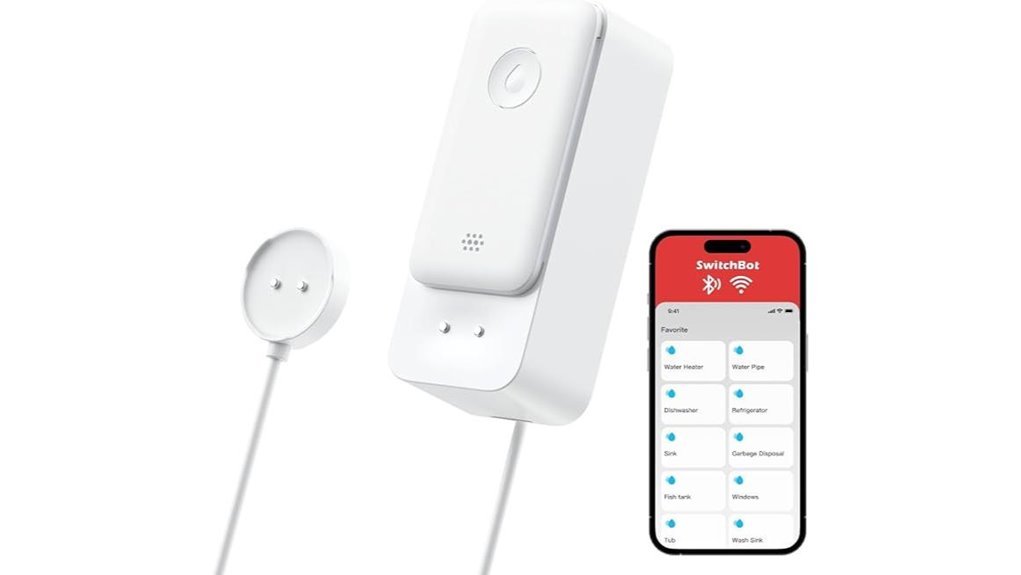
Bottom line: The SwitchBot Water Leak Detector with Sensor Cable is particularly useful behind washing machines. Its 1-meter cable lets you position the sensing probe in a difficult-to-reach area while keeping the main alarm unit accessible.
It also connects directly to Wi-Fi, so you do not need to buy a separate hub for basic remote notifications.
Key specs:
- Detection: Built-in water sensing plus an extended 1-meter probe cable.
- Alarm: 100 dB built-in siren for nearby audible warning.
- Connectivity: Direct 2.4 GHz Wi-Fi and Bluetooth, with app and email notifications.
- Power: Two AAA batteries, rated for up to two years.
- Coverage: One IP67-rated detector with an extended sensor cable.
The extended probe is the standout feature. You can place the sensing end close to a washer’s supply hoses, drainage connection, or another likely leak location without moving the whole alarm unit there.
SwitchBot describes detection of water levels as low as 0.5 mm under appropriate conditions. Its local siren helps warn someone nearby, while the app provides remote notifications when the detector connects successfully.
There is one limitation worth understanding. SwitchBot conserves battery power by activating Wi-Fi when a leak is detected. The manufacturer says establishing the connection can take 30 to 120 seconds, so remote notifications and automations may be delayed even though the local detector has already sensed water.
The unit supports smart-home services and SwitchBot integrations, but some advanced platform connections require compatible hubs or additional setup. Basic Wi-Fi alerts do not require a SwitchBot hub.
Its IP67 rating and included batteries make it practical for damp laundry areas. The app can also help you monitor battery status over time.
- 1-meter probe cable reaches behind appliances.
- Direct Wi-Fi connection without a separate hub.
- 100 dB local alarm plus app and email notifications.
- IP67-rated housing and replaceable AAA batteries.
- Remote notifications may take longer than the local alarm.
- Requires 2.4 GHz Wi-Fi for direct cloud connectivity.
- Advanced smart-home integrations can require extra equipment.
5. Topvico TP-206W-3 Water Leak Alarm
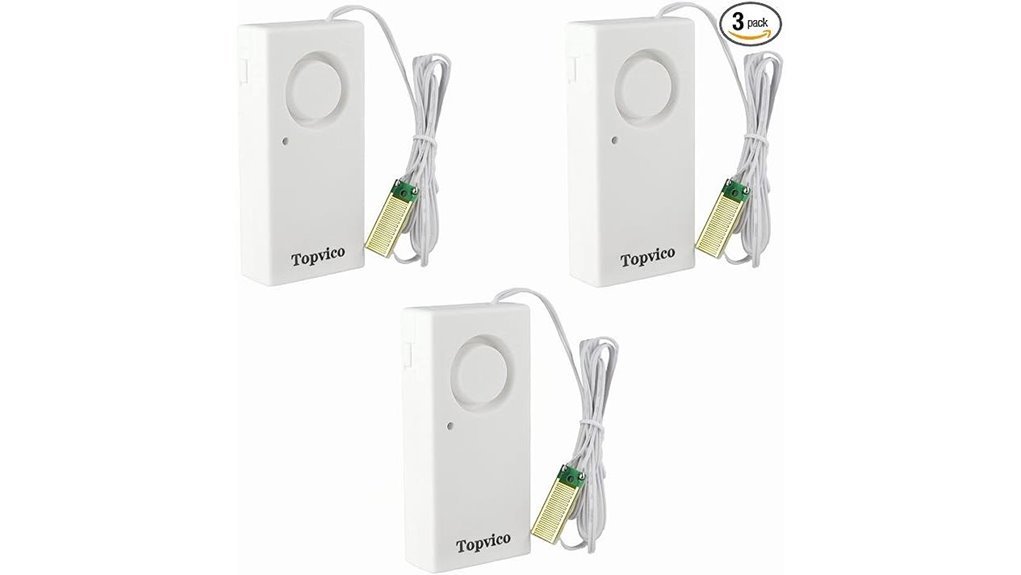
Bottom line: The Topvico TP-206W-3 Water Leak Alarm is a practical value choice if you need loud, uncomplicated water detection. Its three independent alarms work without Wi-Fi, a hub, or a smartphone.
Each alarm has a wired sensing board, allowing you to position the probe in a narrow location while mounting the alarm unit elsewhere.
Key specs:
- Detection: Water-contact sensing board with gold-plated contacts.
- Alarm: Manufacturer-claimed 120 dB audible warning.
- Connectivity: Standalone operation without Wi-Fi or a hub.
- Power: One 9V battery per alarm, not included.
- Coverage: Three alarms, each with a 37.8-inch sensor cable.
Topvico’s design emphasizes simplicity. Install a suitable 9V battery, place the sensing board where water may collect, and mount the alarm unit using the provided adhesive.
The 37.8-inch cable lets you reach behind a washing machine or near a water heater without placing the sounder directly on the floor. The sensor board can be reused after drying, provided it remains in good condition.
The brand advertises a 120 dB alarm. It continues sounding while the sensing contacts remain wet or until you switch the unit off. This is useful for getting attention, although it can be disruptive if you cannot reach the device quickly.
Topvico also describes options for extending the probe cable with separate wire. For most laundry installations, the supplied cable is a simpler choice because custom wiring introduces another potential source of trouble.
This is a local-only alarm. It cannot send a phone notification, detect whether you are home, or activate a remote shutoff valve by itself.
- Very loud manufacturer-rated alarm.
- Three independent units cover multiple leak locations.
- Wired probes allow flexible placement.
- No network, app, or hub setup required.
- No smartphone or email notifications.
- Requires separate 9V batteries.
- Persistent alarm sounds can be disruptive until the sensors dry or are switched off.
X-Sense SWS0A41 vs Topvico TP-206W-3: Which Should You Get?
The X-Sense SWS0A41 and Topvico TP-206W-3 offer different approaches to leak detection. X-Sense is better for connected, multi-room monitoring, while Topvico suits buyers who only need a loud warning at home.
- Remote alerts: X-Sense sends app notifications through its base. Topvico does not connect to the internet.
- Audible warning: X-Sense uses a 100 dB central base alarm. Topvico uses independent sounders with a claimed 120 dB output.
- Placement: X-Sense provides slim floor sensors. Topvico uses wired detection boards that can be positioned away from their alarm units.
- Setup: X-Sense needs a powered base and network setup. Topvico needs batteries and suitable probe placement.
Which Washing Machine Leak Alarm Should You Buy?
Choose based on where your washing machine sits and how you want to receive warnings. A loud alarm may be enough in a small home, but remote alerts are more useful when you travel or spend time away.
- For most homes: Get the X-Sense SWS0A41 for slim, multi-location sensors and a central alarm.
- For large properties: Choose the YoLink Water Leak Sensor 1 Starter Kit for long-range connected monitoring.
- For a louder connected system: Consider the GoveeLife Water Leak Detector 1s with its adjustable local alarm.
- For hard-to-reach washer connections: Pick the SwitchBot Water Leak Detector with Sensor Cable.
- For simple protection without an app: Get the Topvico TP-206W-3.
How We Chose These Washing Machine Leak Alarms
We compared the products using documented features rather than claiming hands-on testing. The main goal was to identify practical differences that affect early leak detection and warning delivery.
- Sensor design: We considered whether the alarm detects pooling water, dripping water, or moisture at the end of an extended probe.
- Warning methods: We separated local audible alarms from smartphone and email notifications. A smart detector does not always have a built-in siren.
- Connectivity: We checked whether the product needs direct Wi-Fi, a hub, or a separate wireless gateway.
- Placement and maintenance: Slim designs, cable length, waterproof ratings, and battery replacement requirements influenced the recommendations.
- Product information: We compared published details from X-Sense, YoLink, GoveeLife, SwitchBot, and Topvico.
Manufacturer performance figures are useful for comparing features, but they are not a substitute for independent performance testing in the same conditions. Actual alarm audibility, wireless range, and battery life can vary.
Factors to Consider When Choosing Washing Machine Leak Alarms in 2026
The right washing machine leak alarm depends on more than how loud it sounds. Sensor sensitivity, installation location, wireless reliability, battery life, and remote notifications all affect how useful the device will be when water starts leaking.
Use the following factors to match an alarm to your laundry room rather than choosing solely by its advertised specifications.
Leak Sensitivity
Leak sensitivity determines how quickly a detector reacts once water reaches its sensing contacts. Some compact detectors can respond to shallow puddles, helping identify a problem before a larger amount of water accumulates.
The X-Sense SWS0A41 is advertised to detect water as shallow as 0.4 mm. SwitchBot describes detection from approximately 0.5 mm under suitable conditions. These figures describe sensing conditions, not a guarantee that every drip anywhere near the washing machine will trigger an alarm.
Water must reach the electrodes or sensing surface for a standard contact detector to activate. A slow drip falling several inches away can remain unnoticed until it spreads to the sensor.
That means placement is as important as sensitivity. Choose a device whose probes can sit where leaking water is likely to travel.
Alarm Volume
A loud local alarm helps warn people who are home when a washing machine hose, valve, or drain starts leaking. The products compared here include manufacturer-rated audible warnings from 100 dB to 120 dB, while YoLink’s Sensor 1 units are silent.
Actual loudness at your listening position depends on room layout, closed doors, insulation, and distance. A sensor under a washer may be harder to hear than an alarm mounted outside the laundry room.
Consider how the sound is produced. X-Sense uses a central base alarm, GoveeLife and SwitchBot have local audible alerts, and Topvico uses standalone alarm units.
If loud sounds are disruptive in your home, an adjustable-volume model may be more suitable. The GoveeLife 1s lets you change its alarm volume through the connected app.
Wireless Range
Wireless range matters when your laundry room is far from the router or the main living area. A sensor with an excellent advertised range can still have connection problems if walls, concrete floors, or metal appliances block its signal.
Some systems avoid relying on direct Wi-Fi between each sensor and the router. X-Sense uses a separate wireless link to its base, while YoLink uses LoRa communication. GoveeLife uses Sub-1G communication through a compatible gateway.
The manufacturer-listed ranges are measured under favorable conditions. Test the system in its intended position rather than assuming the maximum published distance applies inside your home.
For a detached utility room or basement, the YoLink Water Leak Sensor 1 Starter Kit is worth considering because long-range communication is central to its design.
Battery Life
Battery life matters because a leak detector may remain idle for months before it is needed. A sensor with depleted batteries may not provide the warning you expect.
The products reviewed here use different batteries and replacement schedules:
- X-Sense SWS0A41: Two AAA batteries per sensor, with up to three years of stated battery life.
- YoLink Sensor 1: Two AAA batteries per sensor, rated for up to five years.
- GoveeLife 1s: Replaceable batteries rated for up to five years.
- SwitchBot: Two AAA batteries, rated for up to two years.
- Topvico: One 9V battery per alarm, with a stated standby life of up to two years.
These are manufacturer estimates, not guaranteed service intervals. Battery age, temperature, network conditions, and alarm activity can change actual battery life.
Follow the battery type specified by the manufacturer, and keep replacement batteries available.
App Alerts
App notifications allow a connected alarm to warn you when nobody is home to hear a siren. This is especially useful for washing machines installed in basements, rental properties, and homes that are frequently empty.
Before buying, check the exact types of notifications supported by the model. They may include push alerts, email, SMS, or configurable notifications through a compatible smart-home service.
An alarm history can also help you identify recurring moisture events. For example, repeated warnings near the end of a wash cycle may point you toward the drain hose or its connections.
Remote alerts depend on working communication paths. A battery-powered sensor may still detect water during an internet outage, but its notification cannot reach your phone if the required gateway or network is offline.
Smart Home Compatibility
Smart-home compatibility is useful if you want a water detector to work alongside existing alarms, voice assistants, or shutoff devices.
However, support for a smart-home platform does not guarantee that every advertised function works directly. Some products require extra hubs, compatible accessories, or a specific automation setup.
For example, YoLink supports local device-to-device actions between compatible sensors and controllers, but those devices must be paired first. SwitchBot supports wider smart-home integrations, although some require a compatible SwitchBot hub.
Check whether your preferred system can perform the action you actually want. A phone warning, audible siren, and automatic water shutoff are three different functions.
Sensor Placement
A washing machine leak detector works best where escaping water will reach it quickly. Common locations include the floor behind the washer, near supply hose connections, and beside the drain hose or standpipe.
For a front-loading washer in a tight space, a slim detector or cabled probe may be easier to position. The SwitchBot Water Leak Detector with Sensor Cable is particularly suitable when the sensing point is difficult to access.
Do not place the probe where ordinary cleaning water or condensation will repeatedly trigger false alarms. Avoid locations where the machine’s vibration could knock the sensor away from the intended area.
Whenever possible, leave the detector accessible enough to inspect, dry, test, and replace its batteries.
Hub and Gateway Requirements
A Wi-Fi water leak alarm does not always connect directly to your router. Many use a separate radio system between the detector and a powered hub or gateway.
That design can improve wireless coverage and battery efficiency, but it also changes what you need to install.
- X-Sense: The SWS0A sensors need the compatible SBS50 base for connected notifications.
- YoLink: Sensor 1 requires a compatible YoLink hub for normal app monitoring.
- GoveeLife: H5059 sensors need a compatible H5044 gateway for smart notification features.
- SwitchBot: Direct Wi-Fi monitoring does not require an additional hub.
- Topvico: Standalone alarms need neither a hub nor Wi-Fi.
When comparing kits, make sure the package contains every component required for your intended use.
Automatic Water Shutoff
Most standalone water leak alarms only detect moisture and warn you. They do not close the washing machine’s water supply automatically.
Automatic protection requires compatible control hardware, such as a motorized water valve or valve operator, along with the appropriate automation setup.
Even when a sensor supports automation, you should confirm that the connected system can operate during an internet or power outage if that matters to your household.
For a property where water damage could go unnoticed for a long time, an appropriately installed shutoff system may provide a useful additional safeguard.
How to Install and Test a Washing Machine Leak Alarm
Most portable leak alarms can be installed without altering the washer or its plumbing. The goal is to position the sensing contacts where water will arrive first and confirm that the warning reaches you.
- Identify the likely leak points. Inspect the floor near the supply hoses, drain hose, and rear connections.
- Prepare the surface. Clean and dry the intended sensor location before applying adhesive or positioning the detector.
- Install the sensor. Place the probe flat where escaping water is likely to collect.
- Set up connectivity. Pair smart detectors with their app, hub, or gateway according to the manufacturer’s instructions.
- Test the alarm. Apply a small amount of water to the sensing contacts as directed by the manufacturer, then check the siren and remote notifications.
- Dry and reset the detector. Confirm that it returns to normal monitoring after the test.
For a connected model, test both the local alert and the notification that reaches your phone. If you use a remote probe, test the sensing end rather than assuming the main unit is monitoring the correct location.
Mistakes to Avoid When Buying Washing Machine Leak Alarms
- Buying a sensor without its required hub: Check the exact bundle contents before purchasing.
- Confusing app alerts with an audible siren: Some smart sensors are silent and need a separate sounder.
- Relying on advertised wireless range alone: Test connectivity through the walls and floors of your actual home.
- Placing the probe too far from the leak path: Position sensing contacts where the first escaping water is likely to collect.
- Assuming a notification stops water flow: A detector alone does not replace a suitable automatic shutoff system.
FAQs
How Often Should Washing Machine Leak Alarms Be Tested?
Test your washing machine leak alarm about once a month, or according to its manufacturer’s instructions. Confirm that the sensor responds to water and that the audible or remote warning works. Test it again after replacing batteries, moving the appliance, or changing the network configuration. Clean the contacts and inspect the battery compartment when needed.
Can Leak Alarms Work During a Power Outage?
Yes, battery-powered leak alarms can continue detecting water during a power outage. Standalone audible models can generally sound as long as their batteries work. However, smart systems may lose remote alerts if their hubs, gateways, routers, or internet connection fail. Some compatible device-to-device automations can continue working if their components remain powered.
Are Smart Leak Alarms Compatible With All Phone Apps?
No, smart leak alarms are not compatible with every phone app. Most use their manufacturer’s app, while some offer additional integration with Alexa, Google Home, or other platforms. Compatibility can also depend on a particular hub or gateway. Check supported operating systems, notification methods, and connected-device requirements before buying.
Where Is the Best Place to Install a Washing Machine Leak Alarm?
The best place is on the floor where leaking water is most likely to collect first. Behind the washer, close to supply hoses, and near the drain connection are practical starting points. In an uneven laundry room, water may flow toward one side. A second sensor can cover another likely leak path if the first cannot detect it.
Do Leak Alarms Detect Slow Drips as Well as Sudden Floods?
Yes, many leak alarms can detect both slow drips and larger spills once water reaches their sensing contacts. Sensitivity differs by product, and a small drip may not trigger a detector positioned away from it. Some models use top-facing probes for falling drops, while others mainly detect pooling water underneath the sensor.
Do Washing Machine Leak Alarms Shut Off the Water Automatically?
No, most washing machine leak alarms only detect moisture and issue warnings. Automatic shutoff requires a compatible valve controller or another supported water-control device. Some smart-home systems allow a leak sensor to trigger that equipment, but the components must be installed and configured correctly. A standard audible detector cannot stop a leaking supply hose by itself.
Do Smart Water Leak Detectors Need Wi-Fi?
Not all water leak detectors need Wi-Fi. Standalone models such as the Topvico TP-206W-3 operate without internet connectivity. Some connected systems use long-range wireless signals between sensors and a gateway, which then connects to your network. Others, including the SwitchBot model reviewed here, connect directly to a compatible Wi-Fi network for remote alerts.
Why Does My Water Leak Alarm Go Off When There Is No Leak?
False alarms can happen when moisture, condensation, cleaning water, or conductive surfaces contact the sensing electrodes. Inspect the location and dry the contacts before resetting the alarm. Keep sensing boards away from bare metal unless the manufacturer provides a suitable installation method. If warnings continue, inspect the battery, sensor condition, and installation instructions.
Final Verdict
The best washing machine leak alarm is the one that detects water in your actual laundry room and delivers a warning you can respond to. For most households, the X-Sense SWS0A41 offers a useful balance of compact sensors, multi-room coverage, remote notifications, and a central audible alarm.
Its four-sensor kit suits homeowners who want connected leak monitoring without placing a bulky alarm beside every appliance.
For a simpler setup, choose the Topvico TP-206W-3. If you need a flexible probe and direct Wi-Fi alerts, the SwitchBot Water Leak Detector with Sensor Cable is another practical option.
