
Low-wattage rice cookers continue to draw attention in 2027 for households that want efficiency without giving up convenience. From compact single-serving models to small cookers with steaming functions, the options now cover a useful range of needs. Some focus on simplicity, while others add presets and keep-warm features. The differences may seem minor at first, but the right choice depends on more than size alone.
GreenLife Digital Rice Cooker, 2-Cups Uncooked/4-Cups Cooked, White
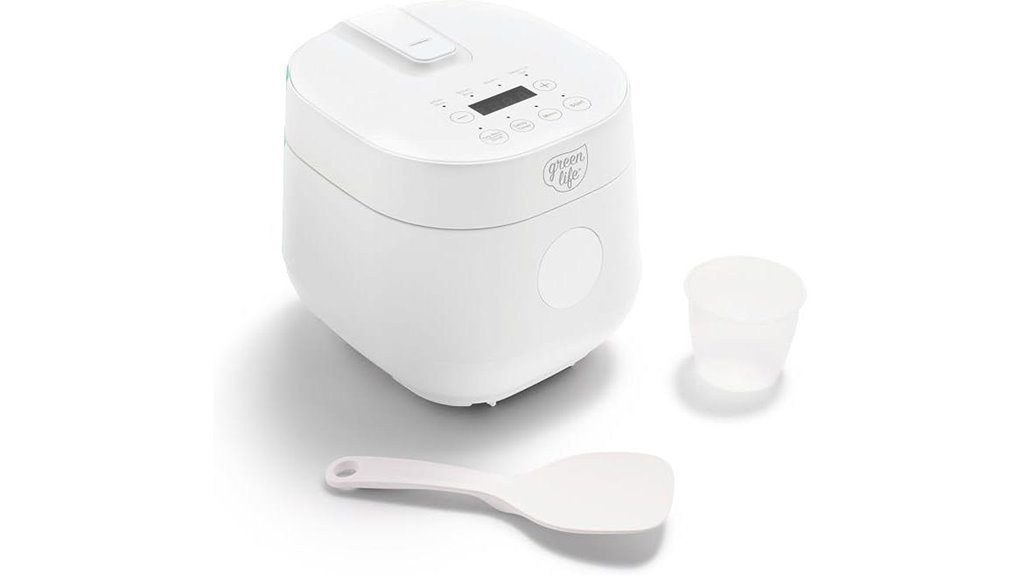
The GreenLife Digital Rice Cooker is a strong choice for singles, couples, or anyone who needs a compact, low-wattage cooker for small batches. Its 2-cup uncooked capacity yields 4 cups cooked, while the 240-watt corded design suits modest kitchens. Digital presets handle white rice, brown rice, quinoa, and steel cut oats, and fuzzy logic fine-tunes heat and timing. A delay timer and auto-warm mode add convenience. The ceramic nonstick bowl is PFAS-free, dishwasher-safe, and paired with a cool-touch exterior. Measuring cup, spatula, and bright LED controls complete the package.
Best For: Singles, couples, or anyone looking for a compact, low-wattage rice cooker for small-batch grain cooking with easy cleanup and convenient preset controls.
Pros:
- Compact 2-cup uncooked capacity is ideal for small households and limited counter space.
- Smart fuzzy logic, delay timer, and auto-warm features make cooking more flexible and consistent.
- PFAS-free ceramic nonstick bowl is dishwasher-safe and comes with useful accessories.
Cons:
- Small capacity may not be suitable for larger families or batch cooking.
- At 240 watts, it may cook more slowly than higher-powered models.
- Limited to basic grain presets, so it may not meet the needs of users wanting more advanced cooking functions.
Dash Mini Rice Cooker with Keep Warm Function
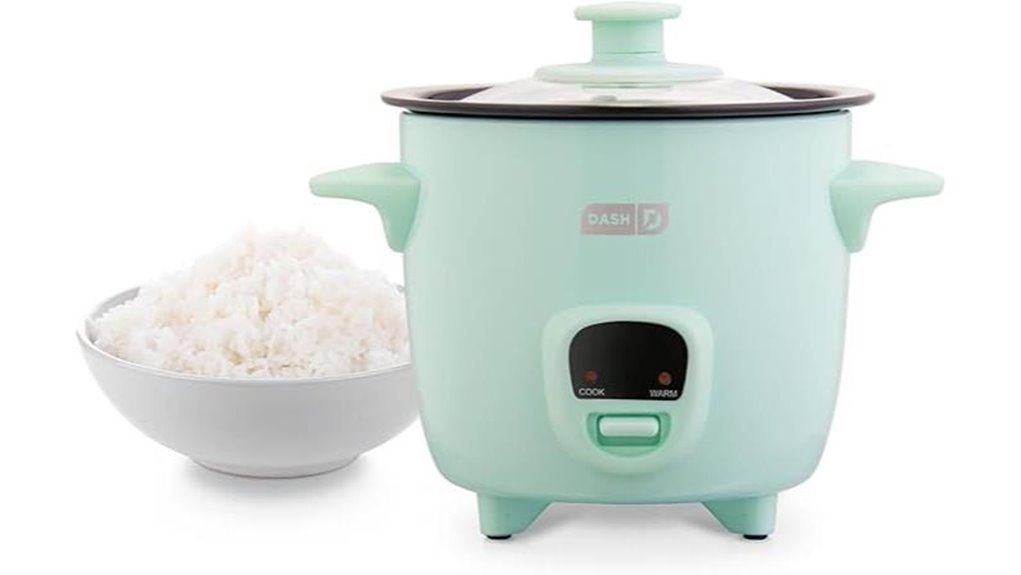
Dash Mini Rice Cooker with Keep Warm Function suits solo cooks needing a compact, low-wattage option. The sleek, single-serve design in Aqua fits small kitchens and travel bags alike. It cooks fluffy rice and simple breakfasts, while the indicator light and keep warm function help prevent overcooking. A PTFE-coated nonstick removable pot makes cleanup straightforward, and the included rice paddle and measuring cup add convenience. Lightweight and easy to use, it supports quick meals on the go. Dash’s design also encourages relaxed, home-style cooking and shared mealtimes for small households.
Best For: Solo cooks, students, or small households looking for a compact, easy-to-clean rice cooker for quick meals and simple breakfasts.
Pros:
- Compact, single-serve design fits small kitchens and travel bags
- Keep warm function and indicator light help prevent overcooking
- PTFE-coated nonstick removable pot makes cleanup easy
Cons:
- Small capacity may not suit larger families or batch cooking
- Limited cooking versatility compared with full-size multicookers
- Best suited for simple meals rather than complex recipes
Aroma Housewares 6-Cup Rice Cooker & Steamer
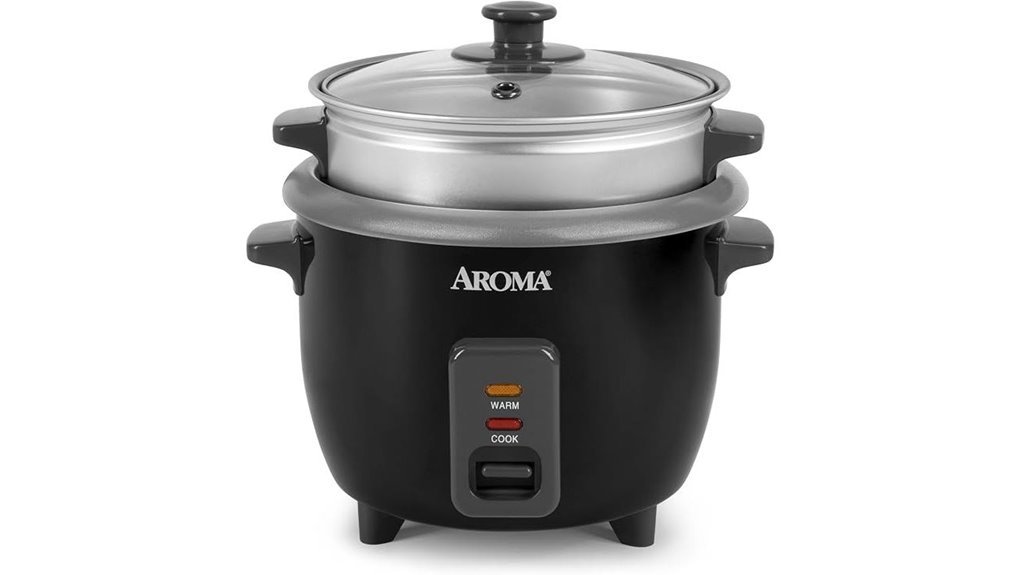
Aroma Housewares’ ARC-363-1NGB suits small households needing a simple 300-watt rice cooker. It offers 3 cups uncooked capacity, yielding 6 cups cooked, and works as a rice cooker, steamer, and multicooker. The one-touch control keeps operation straightforward, while the automatic keep warm function helps preserve serving temperature after cooking. A steam tray allows vegetables or other foods to cook alongside rice. The nonstick inner pot and tempered glass lid support easy use. At 3 pounds, it remains compact, includes useful accessories, and carries a two-year warranty for added confidence.
Best For: Small households, students, or first-time cooks who want a compact, easy-to-use rice cooker that can also steam vegetables and handle simple one-pot meals.
Pros:
- Simple one-touch operation makes it very easy to use.
- Compact 3-cup uncooked capacity is ideal for small servings.
- Includes a steam tray and automatic keep warm function for added convenience.
Cons:
- Small capacity may not be enough for larger families or meal prep.
- Basic feature set offers fewer advanced cooking options than higher-end models.
- 300W power is modest, so cooking may take longer than on more powerful cookers.
GreenLife Rice Cooker, 3-Cups Uncooked/6-Cups Cooked, Gray
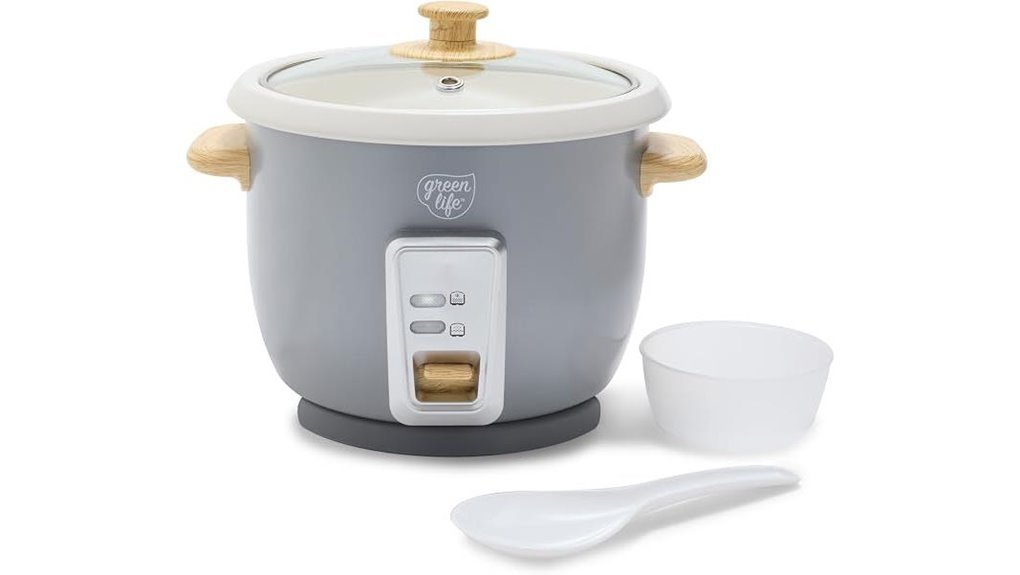
With 300 watts and a compact 3-cup capacity, the GreenLife Rice Cooker suits small households best. Its 6-cup cooked yield can still handle family meals, while interior measuring lines help maintain an accurate water-to-rice ratio. A one-touch control lets users choose white or brown rice, and the auto keep warm function preserves serving temperature after cooking. The PFAS-free ceramic nonstick pot supports easier release and cleanup. Removable, dishwasher-safe parts add convenience, while the included measuring cup, rice paddle, and handles make storage and transport straightforward in tight kitchen spaces.
Best For: Small households, apartment dwellers, or anyone who wants a simple, compact rice cooker for everyday white or brown rice.
Pros:
- Compact size and 3-cup uncooked capacity make it ideal for small kitchens and easy storage.
- One-touch controls with auto keep warm add convenience and simplify cooking.
- PFAS-free ceramic nonstick pot and dishwasher-safe parts make cleanup easy.
Cons:
- 3-cup uncooked capacity may be too small for larger families or meal prep needs.
- Limited to basic rice cooking functions, so it lacks advanced features or versatility.
- Corded electric design means it needs a nearby outlet and isn’t portable for off-grid use.
AROMA Mini Rice Cooker (ARC-302NGMT)
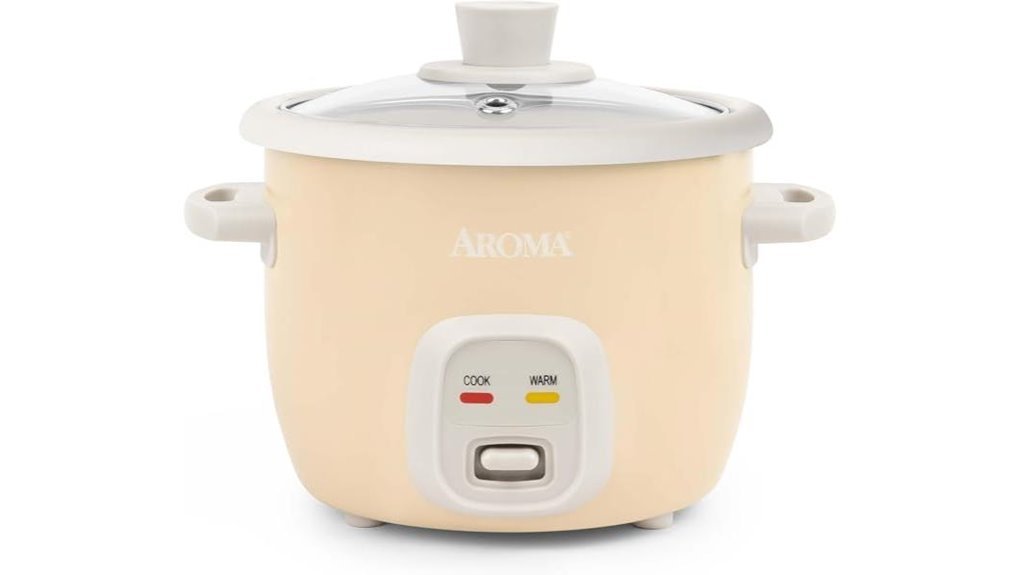
Compact and efficient, the AROMA Mini Rice Cooker suits solo cooks or small households needing simple meals. The ARC-302NGMT holds 2 cups uncooked, yielding 4 cups cooked, and measures 8.5 by 7 by 6.5 inches while weighing just 2.1 pounds. Its 250-watt corded design supports rice, oatmeal, soups, chili, jambalaya, and cakes. One-touch operation simplifies use, and it automatically shifts from Cook to Keep Warm. The ceramic-coated, PFAS-free nonstick pot eases cleanup, while the included measuring cup and spatula add convenience. A digital recipe booklet offers 17 ideas after registration, and customer service can provide warranty details.
Best For: Solo cooks or small households looking for a compact, easy-to-use rice cooker for simple everyday meals.
Pros:
- Compact size and lightweight design make it easy to store and move.
- One-touch cooking with automatic Keep Warm adds convenience.
- Ceramic-coated, PFAS-free nonstick pot makes cleanup easier.
Cons:
- Small capacity may not be suitable for larger families or batch cooking.
- Limited to basic cooking needs compared with more advanced multi-cookers.
- Warranty details require contacting customer service instead of being clearly included.
Factors to Consider When Choosing Rice Cookers With Low Wattage in 2026
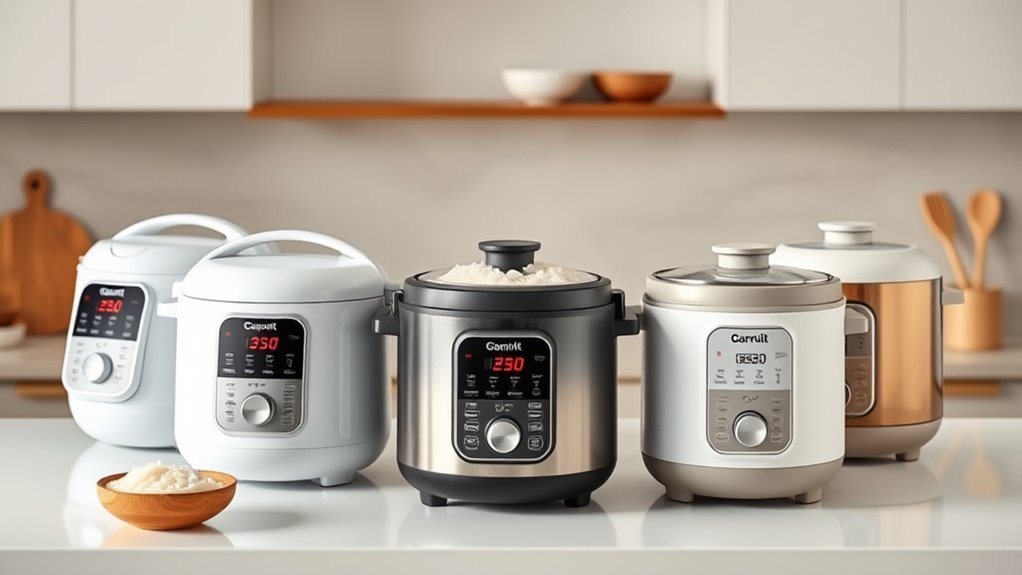
When choosing a low wattage rice cooker in 2026, wattage and overall efficiency remain important because they affect both energy use and cooking speed. Cooking capacity, preset functions, keep warm features, and pot material safety also help determine how well the appliance fits daily needs. These factors together shape whether a model is practical, convenient, and reliable for regular use.
Wattage And Efficiency
Wattage plays a central role in how efficiently a rice cooker uses electricity, and lower-wattage models in the 200 to 300 watt range are often enough to cook rice and grains effectively while consuming less power. These appliances are designed to balance energy use and performance, often relying on fuzzy logic or similar smart controls to regulate heat and timing with precision. Although reduced wattage can mean slightly longer cooking cycles, many units offset this with automatic keep warm settings that preserve serving temperature without constant high draw. Their compact, efficient operation also supports sustainability goals and may help reduce utility costs over time. For users seeking dependable cooking with minimal energy use, wattage and efficiency remain key priorities.
Cooking Capacity Needs
Capacity is a practical starting point for anyone choosing a low-wattage rice cooker in 2026, since the right size depends on whether it is meant for one person, two people, or a larger household. A 2-cup uncooked model, yielding about 4 cups cooked, usually suits single servings or small homes. Larger families often need 3 cups uncooked, or 6 cups cooked, and beyond. Those who host guests or prepare bigger meals may benefit from extra capacity, because it reduces repeat batches and saves time. Daily rice preparation also favors a larger cooker, provided it matches household demand. However, bigger models may draw more wattage, so capacity should be balanced against energy efficiency and actual usage patterns to avoid excess power consumption.
Preset Cooking Functions
Preset cooking functions are a key advantage in low-wattage rice cookers, especially for households that cook more than plain white rice. These presets let users choose the correct setting for white rice, brown rice, quinoa, and other grains, helping achieve better texture with little effort. Many models also use smart fuzzy logic, which fine-tunes cooking time and temperature according to the selected program. That adaptability reduces the chance of undercooking or overcooking. Some cookers include a delay timer, allowing the cooking cycle to begin later for added convenience in meal planning. Multiple presets also expand the appliance’s usefulness beyond rice, supporting breakfast grains and similar dishes. This versatility makes preset-rich models more practical for varied kitchens.
Keep Warm Features
Keep Warm features are a practical priority in low-wattage rice cookers, since they automatically switch on after cooking to hold food at a safe serving temperature without drying it out. Many models use only about 20 to 50 watts in this phase, helping reduce energy use while preserving texture. Duration matters as well; some units can maintain warmth for several hours, giving users more flexibility around meal timing. This is useful for households that prepare rice ahead of serving or need staggered mealtimes. Advanced cookers may also adjust holding temperatures according to the food type, which can improve both efficiency and quality. A reliable Keep Warm function should maintain heat evenly, avoid excessive moisture loss, and support convenient serving without requiring immediate attention after cooking.
Pot Material Safety
Pot material safety is another important factor when choosing a low-wattage rice cooker in 2026, especially since the inner pot comes into direct contact with food during cooking and warming. Many conventional nonstick coatings may contain PFAS or similar chemicals that can migrate into food if the surface is damaged or poorly maintained. Ceramic-coated pots are often preferred because they offer nonstick performance without relying on those substances. Buyers should also look for food-safe certifications or labels that confirm the materials are free from harmful compounds. Durable metals and ceramics are less likely to scratch, chip, or wear down, which helps limit particle release over time. Routine cleaning and careful handling further support long-term safety and preserve coating performance.
Size And Portability
Size and portability play a major role when selecting a low-wattage rice cooker in 2026, since the right capacity should match actual cooking needs, whether that means a 2-cup model for one person or a 6-cup unit for family use. Compact units are often easier to carry, store, and place in small kitchens, dorms, or travel settings. Models measuring about 7 to 9 inches in height and width can help preserve counter space without sacrificing usefulness. Weight also matters, because cookers in the 2 to 4 pound range are simpler to move. Many portable designs use a sleek profile that blends well with minimalist kitchens while remaining practical for everyday cooking and occasional gatherings.
Easy Cleaning Design
Easy cleaning design remains a practical priority when choosing a low-wattage rice cooker in 2026, especially for frequent use in compact kitchens. Models with removable inner pots that are dishwasher-safe can cut cleanup time and reduce effort after each meal. Nonstick coatings also matter, since they help rice release smoothly and limit stubborn residue. Smooth exterior surfaces are preferable because they can be wiped down quickly without trapping splashes or crumbs. Designs with few seams, hinges, or small parts are easier to maintain and less likely to collect food particles. It also helps when the cooker includes simple accessories, such as a spatula or measuring cup, that are easy to wash and keep the cooking area organized.
Frequently Asked Questions
Can Low-Wattage Rice Cookers Work on a Camping Generator?
Yes, low-wattage rice cookers can often work on a camping generator, provided the generator can supply enough continuous power and handle the startup surge. A cooker rated around 300 to 700 watts is usually manageable for many portable generators. It is prudent to check both wattage ratings carefully, use a stable power source, and avoid overloading other appliances. If the generator is small, performance may become unreliable or inefficient.
Do Low-Wattage Rice Cookers Increase Cooking Time Significantly?
Yes, low-wattage rice cookers can increase cooking time somewhat, but usually not dramatically. They draw less power, so they may heat more slowly and take a few extra minutes to reach the boil and finish steaming. The difference is often small for rice, though denser grains or larger batches may take longer. The tradeoff is improved energy efficiency and easier use with limited-power outlets or generators.
Are Low-Wattage Rice Cookers Safe for Dorm Room Use?
Yes, low-wattage rice cookers are generally safe for dorm room use if the dorm permits cooking appliances and the unit has automatic shutoff, overheat protection, and a stable plug connection. Safety depends more on following dorm rules, keeping the cooker on a clear, heat-resistant surface, and avoiding extension cords. A compact model with low power draw can be a practical choice, but electrical limits and fire policies should be checked first.
Can These Rice Cookers Cook Quinoa or Oatmeal?
Yes, these rice cookers can usually cook quinoa and oatmeal. Their gentle heating suits both grains, provided the right water ratio is used and the appliance has a suitable grain, porridge, or cook setting. Quinoa generally cooks well and stays fluffy, while oatmeal may require closer attention to prevent overflow or sticking. The user manual should be checked, since wattage limits and pot size can affect performance and texture.
How Much Electricity Do Low-Wattage Rice Cookers Save?
Low-wattage rice cookers can slash electricity use dramatically, sometimes trimming consumption by half or more compared with larger, high-power models. A 300-watt cooker running for an hour may use only 0.3 kWh, costing mere cents in many places. Over weeks of frequent use, the savings can feel almost magical, especially for small households. Actual savings depend on cooking time, wattage, and local electricity rates.
Conclusion
In 2027, low-wattage rice cookers prove that small appliances can still deliver big results. From the 240-watt Dash Mini to the 300-watt Aroma models, each option balances energy efficiency with dependable performance. Choosing the right cooker is like packing a compact suitcase for a weekend trip: the essentials matter most, and there is no wasted space. For singles, couples, and small households, these rice cookers offer convenience, consistency, and smarter power use.
