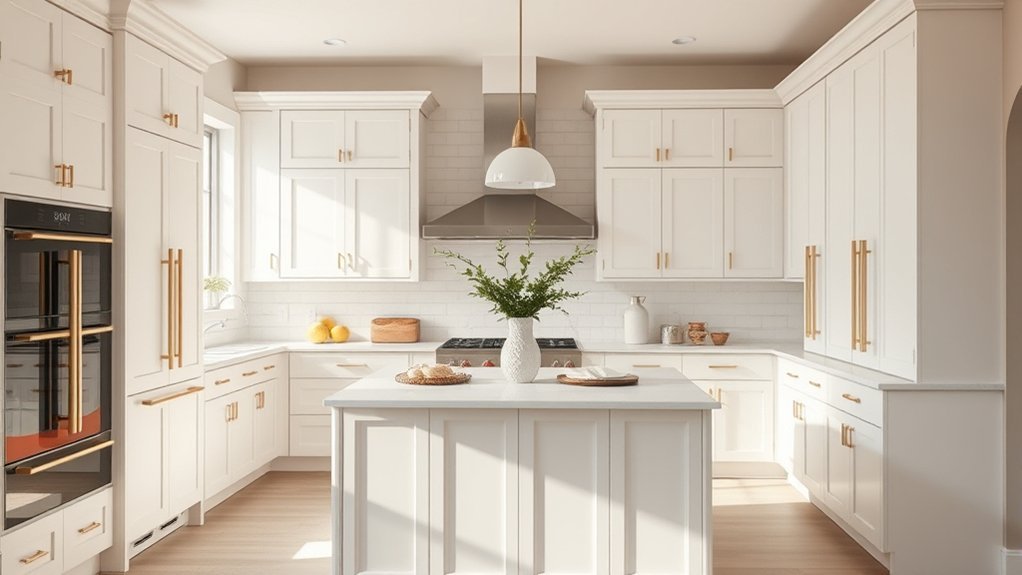
The best kitchen cabinet color depends on the room’s natural and artificial light, countertops, backsplash, walls, flooring, and the mood you want to create. Whites and off-whites remain versatile, while muted greens, light grays, navy, teal, brown, and other deeper hues can add character. The most reliable choice is one that works with the kitchen’s fixed finishes and still looks good under changing light throughout the day.
Quick Answer
For most kitchens, start with the undertones already present in the countertops, backsplash, flooring, and nearby walls. Soft whites, warm off-whites, muted greens, light grays, navy, and brown can all work well. Test the final color on the actual cabinetry before committing, because daylight, bulbs, sheen, and surrounding finishes can noticeably change how a paint color appears.
Key Takeaways
- Choose cabinet color after considering countertops, backsplash, flooring, walls, and lighting together.
- Whites and off-whites are versatile, while greens, blues, grays, browns, and near-black shades can add more depth.
- Match warm undertones with compatible warm finishes and cool undertones with compatible cool finishes unless you are intentionally creating contrast.
- Test samples on the actual cabinet surface and check them in morning, afternoon, evening, and artificial light.
- Satin and semi-gloss cabinet finishes balance appearance, durability, and cleaning ease for many kitchens.
How to Choose Kitchen Cabinet Paint Colors
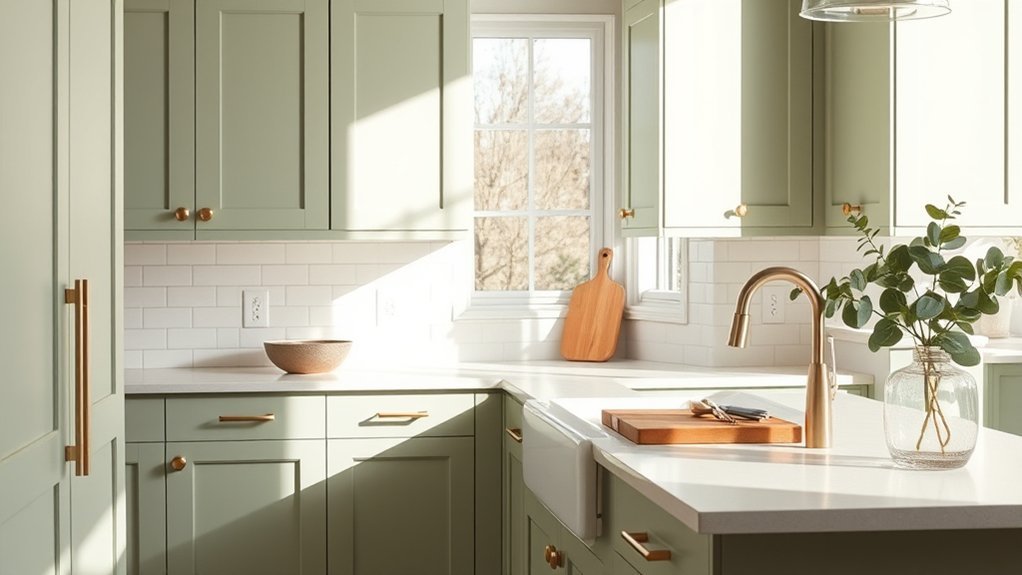
Choosing kitchen cabinet paint colors begins with the room as a whole, not the cabinets alone. Countertops, backsplash tile, flooring, appliances, wall color, hardware, and natural light all affect how the finished cabinetry will look.
Start with the surfaces that are hardest or most expensive to replace. If the countertop has creamy, beige, gold, or warm-gray undertones, a warm white, cream, muted green, taupe, or warm gray may coordinate more easily than an icy white. If the counters lean blue-gray, charcoal, or crisp white, cooler whites, blue-greens, grays, and navy can be easier to balance.
Benjamin Moore’s current kitchen cabinet color guidance includes classic whites such as Chantilly Lace OC-65 and White Dove OC-17 along with more saturated options such as Aegean Teal 2136-40 and Char Brown 2137-20. Cloud Cover OC-25, Simply White OC-117, Silver Satin OC-26, Hale Navy HC-154, and Lush AF-475 are additional examples that can suit different palettes.
Check the Light Before Choosing a Color
Paint can look different from one side of the kitchen to another. Strong daylight can make colors appear brighter, while low natural light can deepen muted or dark shades. Warm bulbs may emphasize yellow, beige, or red undertones; cooler bulbs can make whites, grays, and blues appear crisper.
Do not judge a cabinet color from a phone screen or small digital swatch alone. Apply a real sample to the cabinet or a movable sample board and look at it beside the countertop and backsplash throughout the day.
Pro Tip: Compare your final two or three colors on separate doors or sample boards. View them in daylight and after the kitchen lights are turned on. A color that looks perfect at noon can read much warmer, cooler, darker, or grayer at night.
Best Kitchen Cabinet Colors for Your Style
The best kitchen cabinet colors balance personal style with the kitchen’s existing finishes. No single shade works in every room, but several color families are consistently useful.
- White and off-white: Shades such as Simply White OC-117, Cloud Cover OC-25, White Dove OC-17, and Silver Satin OC-26 can keep a kitchen bright and visually simple. Warmer off-whites generally pair more naturally with cream, beige, warm stone, and many wood floors.
- Soft green: Muted or earthy greens can complement wood, brass, cream stone, and natural textures. Lush AF-475 is a deeper green with blue undertones, so it should be sampled beside surrounding surfaces before use.
- Light gray and greige: These can bridge cool and warm finishes, but undertones matter. Some grays shift blue, violet, green, or beige depending on the room.
- Navy and deep blue: Hale Navy HC-154 and similar shades can create strong contrast against pale countertops, white walls, or light backsplashes.
- Teal and blue-green: Aegean Teal 2136-40 provides more color than gray while remaining muted enough for many traditional and transitional kitchens.
- Brown and espresso: Deep brown is not automatically a color to avoid. Used with adequate light and contrasting counters, it can create a warm, grounded look.
A two-tone scheme is another option. Many kitchens use lighter upper cabinets with darker lower cabinets, or keep perimeter cabinetry neutral while giving the island a stronger color. Repeating the darker shade in hardware, lighting, furniture, or nearby decor can make the contrast feel deliberate.
How to Match Cabinets With Countertops
Cabinets and countertops should relate through either shared undertones or intentional contrast. Neither approach requires both surfaces to be the same color.
- White or pale countertops: These can support white cabinets for a low-contrast look or navy, green, charcoal, brown, and other darker cabinets for stronger definition.
- Cream and beige countertops: Warm whites, cream, taupe, muted green, warm gray, and many wood tones usually coordinate more naturally than very cool blue-whites.
- Gray countertops: Identify whether the gray leans blue, green, violet, or warm beige before selecting the cabinet color.
- Black countertops: Black can work with white, warm neutral, green, blue, wood-tone, or pastel cabinetry. The backsplash and flooring help determine whether the overall palette feels balanced.
- Busy stone: If granite, quartzite, or another stone contains several strong colors or veins, pulling one quieter undertone from the stone is often easier than adding another unrelated color.
Benjamin Moore likewise recommends paying attention to countertop undertones when coordinating cabinet colors. A shared undertone can make the surfaces feel connected even when their lightness and saturation differ.
Should Cabinets and Countertops Match?
They do not need to match exactly. Contrast is often useful. Dark cabinets beside pale counters can add depth, while similarly light cabinets and counters create a quieter, more continuous look. What matters most is that the undertones do not fight each other.
Timeless Kitchen Cabinet Colors That Work
Timeless cabinet colors tend to be adaptable rather than tied to one short-lived decorating trend. Classic whites and off-whites remain useful because they can work with many countertop, hardware, and wall-color changes.
Light grays and greiges can provide gentle contrast without becoming the strongest feature in the room. Soft greens introduce color while still relating to wood and other natural materials. Navy and near-black cabinetry can also age well when balanced by adequate light and lighter surrounding surfaces.
Aegean Teal 2136-40 offers a middle ground between blue, green, and gray. Silver Satin OC-26 is a lighter choice with gray undertones. Lush AF-475 provides a much deeper green. These colors differ substantially in depth and undertone, so sampling remains more useful than choosing from a name alone.
A cabinet color is more likely to feel lasting when it coordinates with the kitchen’s permanent finishes rather than simply copying the strongest trend of the year.
What About 2026 Cabinet Colors?
There is no single official 2026 kitchen-cabinet color across the paint industry. Benjamin Moore named Silhouette AF-655 its Color of the Year 2026. The company describes it as a rich espresso hue with charcoal notes. Its wider 2026 palette also includes Swiss Coffee OC-45, Narragansett Green HC-157, Sherwood Tan 1054, Southwest Pottery 048, Raindance 1572, First Crush CSP-310, and Batik AF-610.
For cabinetry specifically, that broader movement means warm neutrals, brown, green, muted color, classic white, blue-green, and deeper shades can all be current choices. The best one still depends on the room rather than the calendar year.
Best Paint Finishes for Kitchen Cabinets
For kitchen cabinets, satin and semi-gloss are practical choices because they provide noticeable sheen without the mirror-like appearance of a full high-gloss finish. Benjamin Moore currently lists satin, semi-gloss, and high-gloss as suitable cabinet finishes.
- Satin: Provides a softer sheen and can be a good choice when you want cabinets to look less reflective.
- Semi-gloss: Reflects more light and gives doors, rails, and trim details a crisper appearance. Its smoother surface is practical for frequently cleaned cabinetry.
- High-gloss: Produces the strongest shine and a dramatic modern effect, but careful preparation matters because reflected light can make dents, sanding marks, or other surface irregularities more noticeable.
Matte or very low-sheen cabinetry can suit a particular design style, but for frequently handled kitchen doors, choose a coating specifically rated for cabinets or trim rather than relying on wall paint simply because the sheen looks attractive.
How to Paint Cabinets Smoothly
A smooth cabinet finish comes from preparation more than from any single applicator. Cleaning, degreasing, sanding when appropriate, priming, using compatible cabinet paint, applying thin coats, and respecting the manufacturer’s recoat time all contribute to the final result.
At a Glance
| Time Required | Usually several days when cleaning, preparation, primer, multiple coats, product-specific recoat times, and final drying are included. |
| Difficulty | Moderate; preparation and patience matter more than advanced painting skill. |
| Tools Needed | Cleaner/degreaser, drop cloths, tape, screwdrivers, sanding supplies, primer, cabinet paint, and a quality brush plus microfiber or high-density roller; a sprayer is optional. |
| Cost | Varies with kitchen size, cabinet condition, primer and paint choice, and whether you already own sanding and application tools. |
Warning: If you are working in a U.S. home built before 1978, do not assume old painted cabinetry is safe to sand. Disturbing lead-based paint can create hazardous dust. Follow EPA lead-safe guidance or use an appropriately qualified lead-safe professional. Also provide plenty of fresh-air ventilation and follow all product-label precautions while painting.
Prep for Smoothness
For a smooth cabinet finish, preparation is as important as the final coat. Remove doors, drawers, and hardware when practical so edges and flat surfaces are easier to reach. Label doors and hinges so each piece returns to the correct location.
Clean every paintable surface thoroughly. Kitchen cabinetry often holds grease that can interfere with adhesion even when the surface looks clean. Let the cabinets dry before sanding or priming.
Sand only as required for the existing coating and the product system you are using. The goal is usually to dull glossy surfaces and smooth defects, not to remove sound material unnecessarily. After sanding, remove all dust.
Apply a compatible bonding or cabinet primer where required. Benjamin Moore’s current cabinet painting procedure calls for cleaning, sanding, primer, another fine sanding, paint, a final light sanding, and a second paint coat.
- Remove or protect hardware and surrounding surfaces.
- Clean and degrease the cabinetry.
- Sand or degloss as appropriate.
- Remove sanding dust.
- Prime with a compatible product.
- Lightly sand dried primer if the coating system calls for it.
- Apply the first finish coat.
- Respect the full recoat time.
- Lightly smooth imperfections if needed.
- Apply the final coat and allow adequate drying before heavy use.
Best Tools and Methods
A sprayer can produce a very smooth appearance when the painter has the correct equipment, spray area, masking, ventilation, technique, and product setup. It is not the only route to good cabinets.
Benjamin Moore’s cabinet instructions recommend a quality nylon/polyester brush for detailed areas and a microfiber roller for flat portions of the doors and cabinet boxes. ADVANCE can also be applied by brush, roller, or spray according to its current product specifications.
For a brush-and-roller method, use the brush for profiles, corners, rails, stiles, and narrow edges, then use the roller across broader flat panels. Avoid repeatedly working paint once it has begun to set, because overworking can create texture.
When spraying, follow the coating manufacturer’s equipment and pressure recommendations and protect the surrounding room from overspray.
Finish With Even Coats
Thin, even coats are more reliable than trying to achieve full hiding with one heavy application. Allow each coat to dry for the time specified on the exact paint label or technical data sheet.
For example, Benjamin Moore ADVANCE Interior Semi-Gloss currently specifies a 16-hour recoat time. That number should not be treated as the universal drying time for every cabinet paint.
Benjamin Moore’s cabinet guide also recommends fine 220-grit sanding between appropriate stages to smooth imperfections. Do not sand simply because a generic article says to do so; follow the primer and paint manufacturer’s preparation instructions for the exact coating and cabinet material.
- Apply thin, even coats.
- Use the product-specific recoat time.
- Correct drips or roughness only after the coating has dried sufficiently.
- Keep freshly painted doors separated so painted surfaces do not stick together.
- Allow the finish to dry adequately before reinstalling hardware or subjecting cabinets to heavy cleaning and daily wear.
Note: “Dry,” “ready to recoat,” and “fully cured” are not always the same thing. Always use the instructions for the specific primer and cabinet paint rather than assuming one manufacturer’s timing applies to another product.
Frequently Asked Questions
What Is the Most Popular Color for Painted Kitchen Cabinets?
White and off-white remain among the most widely recommended cabinet colors because they are adaptable and can brighten many kitchens. Benjamin Moore currently lists whites such as Chantilly Lace OC-65 and White Dove OC-17 among its popular kitchen cabinet colors. However, there is no single color that is best for every kitchen.
What Is the Best Color to Paint Kitchen Cabinets?
The best cabinet color is the one that coordinates with the countertops, backsplash, flooring, walls, lighting, and your preferred style. Soft white is versatile, but muted green, warm gray, blue-green, navy, brown, and other deeper colors can work equally well in the right room. Test the final choice on the actual cabinet before painting the whole kitchen.
What Colors Should You Avoid on Kitchen Cabinets?
There is no universal list of cabinet colors to avoid. The greater risk is choosing a shade whose undertone clashes with the countertops, backsplash, flooring, or lighting. Very saturated colors can dominate a small room, while very dark cabinetry can reduce perceived brightness if the kitchen has little natural light. Even black and deep brown can work well when the surrounding finishes provide enough contrast.
What Is the 2026 Color for Kitchen Cabinets?
There is no single official 2026 cabinet color across the industry. Benjamin Moore named Silhouette AF-655, a deep espresso-and-charcoal shade, its Color of the Year 2026. Its broader 2026 palette also includes Swiss Coffee, Narragansett Green, Sherwood Tan, Southwest Pottery, Raindance, First Crush, and Batik, showing that both warm neutrals and muted colors remain relevant.
Should Cabinets Be Lighter or Darker Than Countertops?
Either approach can work. Light cabinets with light counters create a low-contrast look, while dark cabinets with pale counters create stronger definition. Focus on compatible undertones and sufficient visual contrast rather than following a rule that cabinets must always be lighter or darker.
Is Satin or Semi-Gloss Better for Kitchen Cabinets?
Both are practical choices when used in a cabinet-rated coating. Satin has a softer glow, while semi-gloss reflects more light and gives cabinet details a crisper appearance. Benjamin Moore currently lists satin, semi-gloss, and high-gloss finishes as suitable options for kitchen cabinetry.
Conclusion
Choosing the right kitchen cabinet color is less about finding one universally perfect shade and more about coordinating color, undertone, light, and the kitchen’s permanent finishes. Soft whites and warm neutrals remain flexible, while greens, blues, grays, browns, and darker shades can add character when they are balanced with countertops and surrounding surfaces. Test samples before committing, choose a cabinet-appropriate finish, and give preparation and drying as much attention as the color itself.
Sources
- Benjamin Moore — Kitchen Cabinet Paint Colors — current cabinet color, finish, and countertop-undertone guidance.
- Benjamin Moore — How to Paint Kitchen Cabinets — preparation, priming, sanding, application, and coating steps.
- Benjamin Moore — ADVANCE Interior Semi-Gloss — application methods and 16-hour recoat specification.
- Benjamin Moore — Color of the Year 2026 — Silhouette AF-655 and the official Color Trends 2026 palette.
- U.S. EPA — Steps to Lead-Safe Renovation, Repair and Painting — lead-safe practices for projects that may disturb older painted surfaces.
- U.S. EPA — Care for Your Air — fresh-air and ventilation guidance during painting and remodeling.

1 thought on “What Color to Paint Kitchen Cabinets? Best Ideas & Tips”