
Smarter watering is becoming less about guesswork and more about timely data. In 2027, a new group of irrigation moisture sensors promises easier app control, clearer readings, and better coverage for gardens of different sizes. From deep-soil monitoring to multi-zone automation, each option brings a different advantage. The challenge is not finding a sensor, but choosing which features matter most for a given setup.
THIRDREALITY Smart Soil Moisture Sensor Gen2 3-Pack
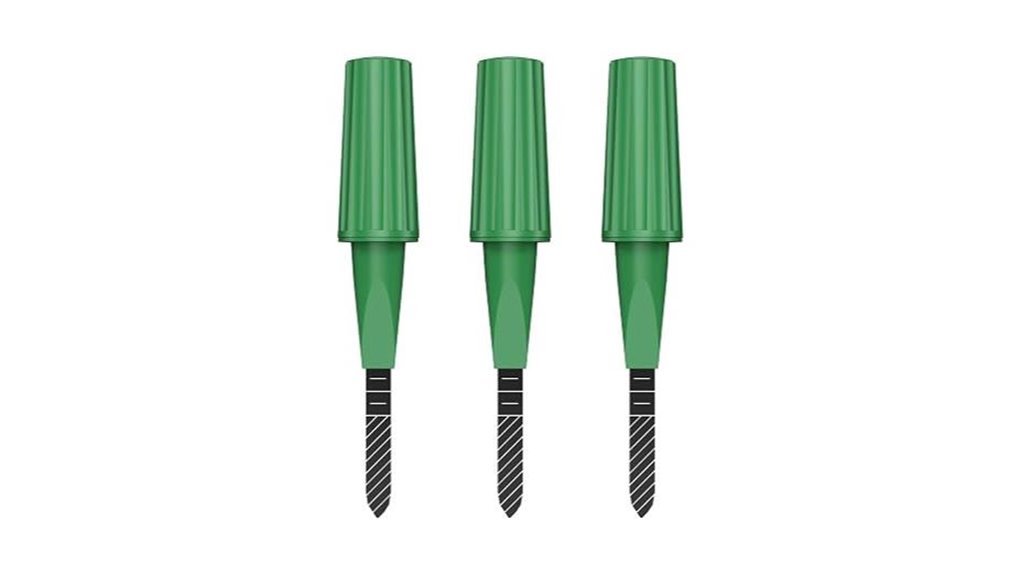
The THIRDREALITY Smart Soil Moisture Sensor Gen2 3-Pack is best suited for gardeners who want reliable, app-connected moisture tracking across multiple spaces, from potted plants and balconies to greenhouses and small farms. It requires a Zigbee hub and works with major platforms, including Echo, SmartThings, Home Assistant, and Hubitat. Its capacitive sensing is less vulnerable to salinity and pH shifts than traditional probes. Stable readings and stronger signal performance support clearer watering decisions, while smartphone alerts and automation features help schedule irrigation. Reinforced antenna design and OTA updates add practical durability.
Best For: Gardeners and plant owners who want reliable, app-connected soil moisture monitoring across multiple plants or spaces and already use a Zigbee hub or compatible smart home platform.
Pros:
- Stable capacitive readings are less affected by soil salinity and pH than traditional probes.
- Works with major Zigbee ecosystems like Echo, SmartThings, Home Assistant, and Hubitat.
- Smartphone alerts, automation support, reinforced antenna, and OTA updates add convenience and durability.
Cons:
- Requires a Zigbee hub to function, so it’s not a standalone sensor.
- Apple Home and Google Home need the separately sold Smart Bridge MZ1.
- Best suited for users already invested in smart home automation, which may be more complex than a basic moisture meter.
ECOWITT WH51L Soil Moisture Sensor with LCD Display
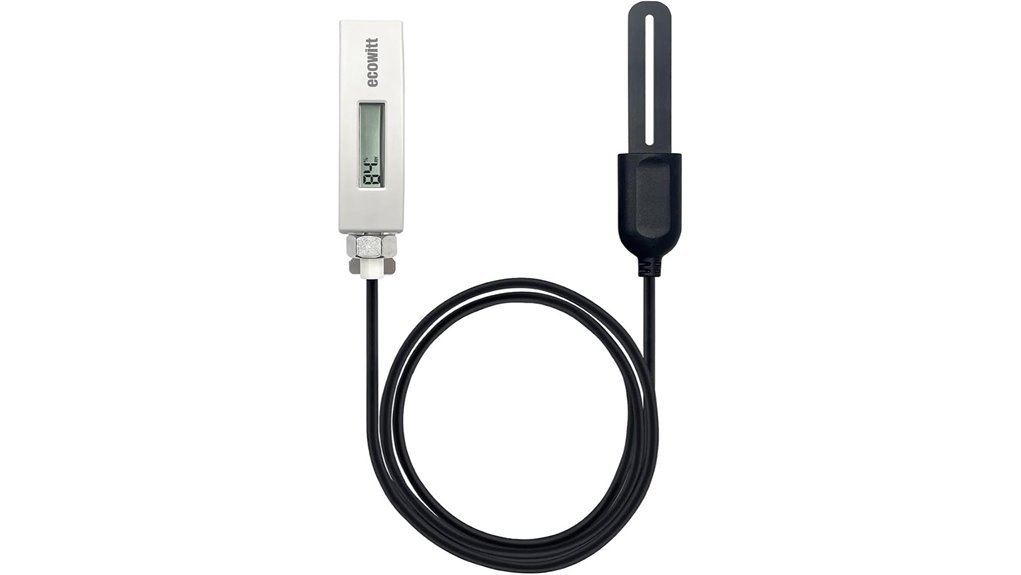
With an LCD readout and deep-soil sensing, the ECOWITT WH51L suits growers needing visible, reliable moisture data. Its 1 m PVC probe measures moisture to 80 cm, while the LCD provides real-time readings at the sensor itself. The IP68-rated body exceeds the WH51’s protection and supports up to eight channels through an Ecowitt Gateway or compatible console. When paired with GW1100, GW2000, or GW1200, data reaches the Ecowitt app after Wi-Fi setup. It also works with HP2550, HP2560, HP3500, WN1820, and WN1821 displays. Installation requires positioning the body at least 20 cm above soil.
Best For: Growers and gardeners who want a deep-soil moisture sensor with an on-device LCD readout and Ecowitt app or console integration.
Pros:
- Measures moisture deep in the soil, up to 80 cm.
- LCD screen provides real-time readings directly at the sensor.
- IP68 waterproof rating and support for up to 8 channels.
Cons:
- Requires an Ecowitt gateway or compatible console for app connectivity.
- Installation needs the sensor body placed at least 20 cm above soil.
- Best performance depends on calibration and proper setup.
RAINPOINT Smart Digital Wireless Plant Moisture Meter (Two-Pack)
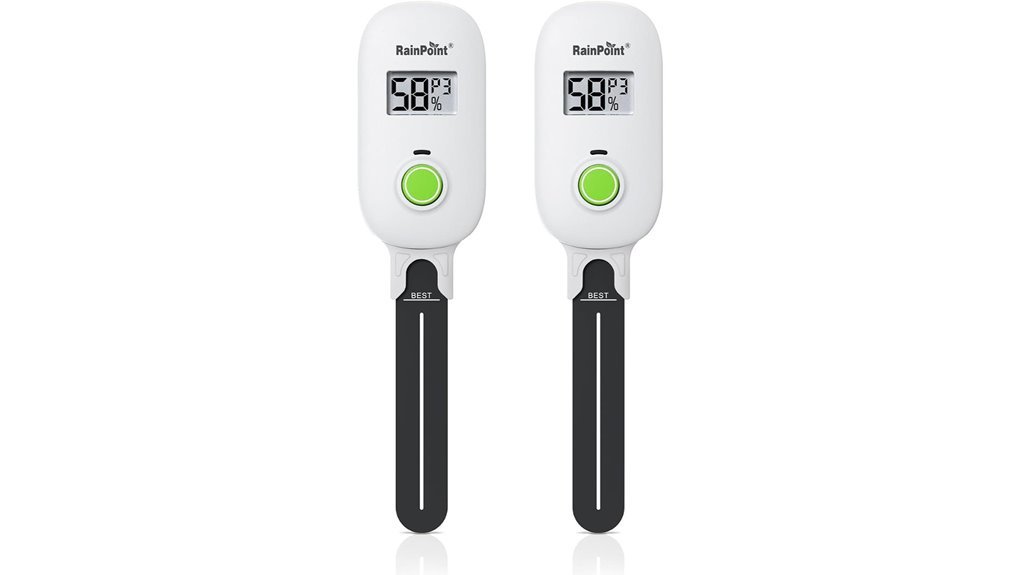
For gardeners seeking continuous moisture tracking, the RAINPOINT Smart Digital Wireless Plant Moisture Meter offers practical precision. This two-pack indoor-outdoor system pairs with a separate 2.4 GHz WiFi hub for app-based monitoring through the RAINPOINT Home platform. Its sensors check soil every three minutes and keep LCD readings visible around the clock, while a manual button delivers instant results. The capacitive probe resists rust, supporting long-term accuracy. With IPX5 waterproofing, it suits greenhouses, raised beds, and houseplants. The package includes two meters, pH strips, and a screwdriver, making setup straightforward for targeted watering.
Best For: Gardeners who want continuous, app-connected moisture monitoring for indoor or outdoor plants, especially those using a compatible 2.4 GHz WiFi hub.
Pros:
- Automatically checks soil moisture every 3 minutes for hands-free tracking.
- Capacitive probe helps resist rust and maintain long-term accuracy.
- IPX5 waterproof design works well for greenhouses, raised beds, and houseplants.
Cons:
- Requires a separate compatible WiFi hub, which is sold separately.
- Only works with 2.4 GHz WiFi, limiting network compatibility.
- Remote monitoring depends on the RAINPOINT Home app and hub setup.
Ambient Weather WH31SM Soil Moisture Sensor
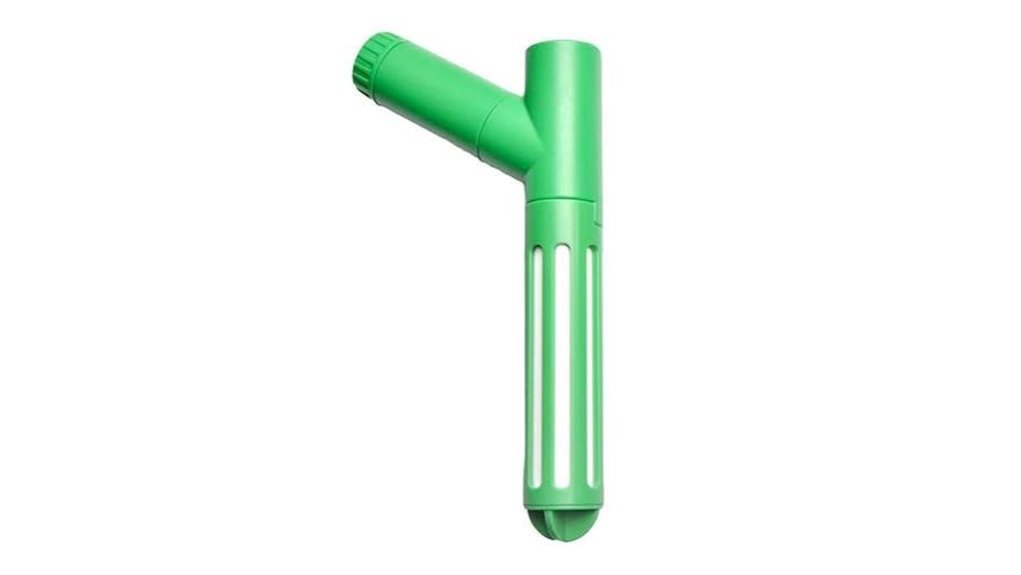
Ambient Weather’s WH31SM suits gardeners who need dependable outdoor moisture tracking. It pairs with WS-2000 and WS-5000 consoles, giving users access to up to eight channels for broader yard monitoring. The ceramic, rectangular sensor measures 6 x 3.5 x 1 inches and uses 915 MHz wireless transmission, reaching up to 300 feet in ideal conditions. Readings refresh every 71 seconds, and the unit operates in temperatures from 14 °F to 122 °F. Battery powered and requiring one AA battery, it includes an LCD display and is intended for outdoor soil moisture monitoring.
Best For: Gardeners and outdoor homeowners who want a wireless soil moisture sensor for monitoring multiple areas with compatible Ambient Weather consoles.
Pros:
- Integrates with WS-2000 and WS-5000 consoles
- Supports up to 8 channels for broader monitoring
- Wireless range up to 300 feet in ideal conditions
Cons:
- Requires a separate AA battery, which is not included
- Works only with compatible Ambient Weather consoles
- Range may be closer to 100 feet in typical conditions
Eden 4-Zone Programmable Digital Water Timer
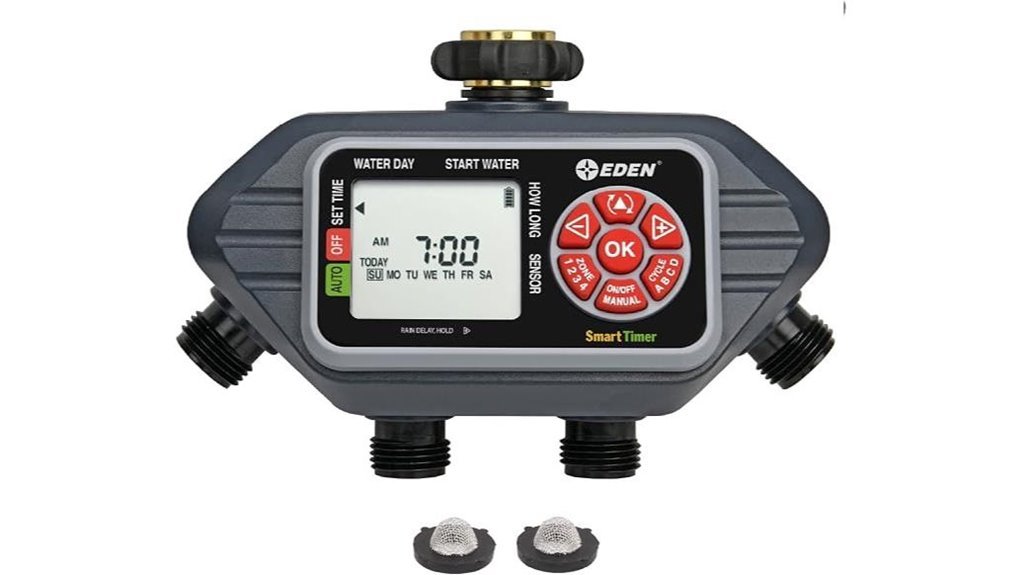
Eden’s 4-zone digital timer suits growers needing separate watering schedules and moisture-sensor compatibility. The Eden 93413 offers four independent zones, each with its own program, making it useful for mixed planting areas. A large LCD and raised buttons simplify setup, while custom schedules allow specific days, multiple start times, and runtimes from one minute to six hours. Manual watering works without altering saved settings. Rain delay helps during wet periods. It pairs with the Eden Moisture Sensor 25417-EDAMZ. A leakproof zinc inlet, TPR connector, metal filter, and two-year warranty support durability.
Best For: Gardeners and growers who need four separate watering zones, easy scheduling, and moisture-sensor compatibility for mixed planting areas.
Pros:
- Four independent zones with separate programs for flexible irrigation control
- Easy-to-use large LCD screen and raised buttons for straightforward setup
- Compatible with a wireless soil moisture sensor and includes rain delay for smarter watering
Cons:
- Moisture sensor is sold separately
- Limited to timer-based control rather than fully app-based smart automation
- Multiple zones and scheduling options may be more than casual users need
Factors to Consider When Choosing Irrigation Moisture Sensors for Smarter Watering in 2026
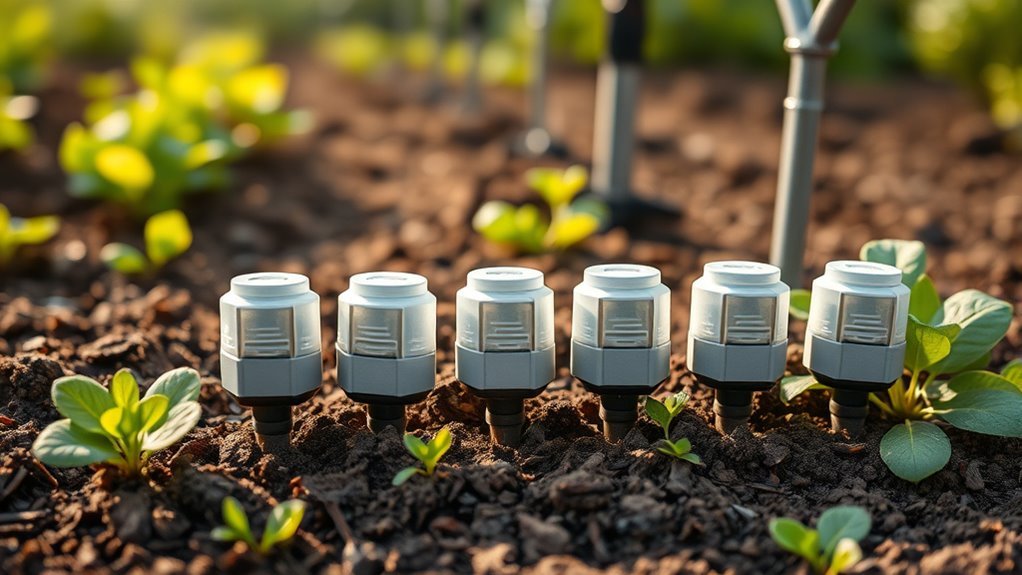
Selecting irrigation moisture sensors in 2026 depends on how accurately they measure soil conditions and how reliably they connect with a hub. Wireless range, waterproof rating, and multi-zone support also shape whether the system can handle real-world outdoor use across different planting areas. A careful comparison of these factors can help guide smarter, more efficient watering choices.
Sensor Accuracy
Accuracy sits at the center of effective irrigation management, because moisture readings only improve watering decisions when the sensor data is dependable. In irrigation moisture sensors, precise measurement determines whether watering is timely or excessive. High-quality models often use capacitive technology, which resists interference from soil salinity and pH, producing steadier results across varied conditions. Real-time monitoring strengthens this value by showing changes quickly enough for prompt schedule adjustments. A stable refresh rate also matters, since uneven updates can create misleading spikes or drops in reported moisture. When paired with smart home automation, accurate sensors support controlled irrigation responses that reflect actual soil needs. The result is more efficient water use, fewer errors, and healthier plants maintained with less guesswork.
Hub Compatibility
Hub compatibility determines how smoothly irrigation moisture sensors connect with a broader smart watering setup. Many sensors depend on specific hubs, including Zigbee or Wi-Fi gateways, to transmit readings reliably. Choosing a model that works with an existing smart home ecosystem can simplify setup and improve daily use. Zigbee-based sensors are often valued for stable signals and dependable coordination in busier homes. Multi-channel hub support also matters, since it lets several sensors report at once, giving a clearer picture of moisture conditions across different zones. Compatible hubs can further enable firmware updates and smart assistant integration, helping the sensor stay current and fully functional over time.
Wireless Range
Wireless range is another important factor when comparing irrigation moisture sensors, especially after confirming hub compatibility. It determines how far a sensor can reliably send data to a hub or smartphone, which matters in large gardens, orchards, or farms. Zigbee-based sensors often provide stronger stability and ranges reaching about 300 feet in open areas, making them practical for complex layouts. Frequency also matters; 915 MHz models may penetrate obstacles better than systems using other bands. Placement affects performance too, and positioning a sensor at least 20 cm above the soil surface can improve transmission. Soil composition, moisture content, and physical barriers can reduce effective range, so planning sensor locations carefully helps maintain dependable communication and accurate watering control.
Waterproof Rating
A sensor’s waterproof rating is a key measure of how well it can endure outdoor exposure, from rain and splashing to wet soil and irrigation runoff. In practice, the rating helps determine whether the device can keep working when conditions turn damp, muddy, or stormy. Higher standards such as IP68 signal strong dust protection and resistance to submersion, which suits harsh weather and saturated ground. Lower ratings like IP66 may handle splashes, yet they are less appropriate for prolonged moisture or heavy rainfall. Selecting a sensor with a stronger waterproof rating generally improves durability, reduces the risk of moisture ingress, and supports steadier readings over time. That reliability matters where irrigation is frequent and environmental exposure is unavoidable.
Multi-Zone Support
Multi-zone support lets irrigation moisture sensors tailor watering schedules across different parts of a garden or landscape, improving both water efficiency and plant health. Systems with this capability can track several soil moisture readings at once, helping each area receive irrigation matched to its own conditions. That precision is especially useful where sun exposure, soil type, and plant needs vary from zone to zone. Some timers also offer zone-specific programming, allowing distinct watering durations and frequencies for beds, lawns, and shrubs. In more advanced setups, readings from multiple locations help maintain balanced soil moisture and support conservation. The result is less overwatering, fewer dry spots, and healthier growth across mixed plantings.
Automation Features
Modern irrigation moisture sensors increasingly emphasize automation features that simplify watering while improving precision. The most useful models support automated irrigation scheduling, so watering can begin at preset times triggered by live soil moisture readings. Integration with smart home platforms adds remote monitoring and control through smartphone apps, making adjustments possible from anywhere. OTA update support is also valuable, as it delivers new functions and refinements without manual maintenance. Reliable sensors should maintain stable readings, since inconsistent data can lead to poor watering decisions. Compatibility with multiple channels or devices extends coverage across several garden beds or farm zones. Together, these capabilities create a responsive, efficient system that conserves water, reduces guesswork, and supports healthier plants through timely irrigation management.
Frequently Asked Questions
How Often Should Moisture Sensors Be Recalibrated?
Like a compass that drifts, a moisture sensor should be recalibrated whenever readings seem inconsistent, after installation changes, or at least once per season. In stable conditions, annual recalibration may suffice; in harsh soils or frequent use, quarterly checks are wiser. The interval depends on sensor type, soil variability, and environmental wear. Regular verification against known moisture levels keeps measurements trustworthy and irrigation decisions precise, avoiding silent errors that can waste water.
Can Sensors Work Accurately in Clay or Sandy Soil?
Yes, they can, but accuracy depends on sensor type, installation, and calibration. Clay soil often holds water unevenly and may require careful placement to avoid false readings. Sandy soil drains quickly, so sensors must respond fast and be positioned consistently. When properly matched to soil texture and recalibrated as needed, sensors can deliver reliable moisture data in both soil types, though no sensor is perfectly universal.
Do Irrigation Sensors Need Wi-Fi to Function?
No, irrigation sensors do not need Wi-Fi to function. Many operate independently, measuring soil moisture locally and triggering irrigation through wired controllers or onboard settings. Wi-Fi mainly enables remote monitoring, alerts, and data logging rather than basic sensing. Some systems use wireless links instead, but connectivity is optional, not essential. Practical performance depends more on sensor quality, placement, and calibration than on internet access, especially in simple irrigation setups.
How Long Do Sensor Batteries Usually Last Outdoors?
Sensor batteries outdoors usually last from 1 to 5 years, depending on transmission frequency, battery type, temperature swings, and moisture exposure. Devices that send data often or use cellular radios tend to drain faster, while low-power models can run much longer. Cold weather and poor sealing can shorten life. Regular checks are advisable, since a declining battery may cause missed readings or unreliable watering decisions before total failure occurs.
Are Moisture Sensors Compatible With Drip Irrigation Systems?
Yes, moisture sensors are generally compatible with drip irrigation systems, though the marriage is not always effortless. Properly placed sensors can help drip lines deliver water only when soil truly needs it, which sounds almost suspiciously sensible. Compatibility depends on controller type, sensor wiring, and system pressure. Some setups use wireless probes, while others connect directly to valves. Installation quality matters, or the “smart” system may become merely decorative.
Conclusion
Choosing the “best” irrigation moisture sensor in 2027 may sound like a quest for precision, yet the real achievement is how effortlessly these tiny devices remind gardeners to stop guessing. The THIRDREALITY, ECOWITT, RAINPOINT, Ambient Weather, and Eden timer each promise smarter watering, and, ironically, the smartest move may be simply letting technology do what tradition never quite mastered: watering only when the soil actually needs it.
