
The best tow-behind lawn spreaders for 2027 include the Agri-Fab 130 lb and 85 lb models, HVDI 130 lb, Garvee 130 lb, and AugFir 130 lb options. These spreaders suit medium lawns, large yards, and small farms with useful features like universal hitches, adjustable flow control, rust-resistant builds, and 10- to 12-foot coverage. They handle seed, fertilizer, and ice melt efficiently. More details below can help narrow the right choice.
Agri-Fab Pull Behind Broadcast Spreader, 130 lb Hopper
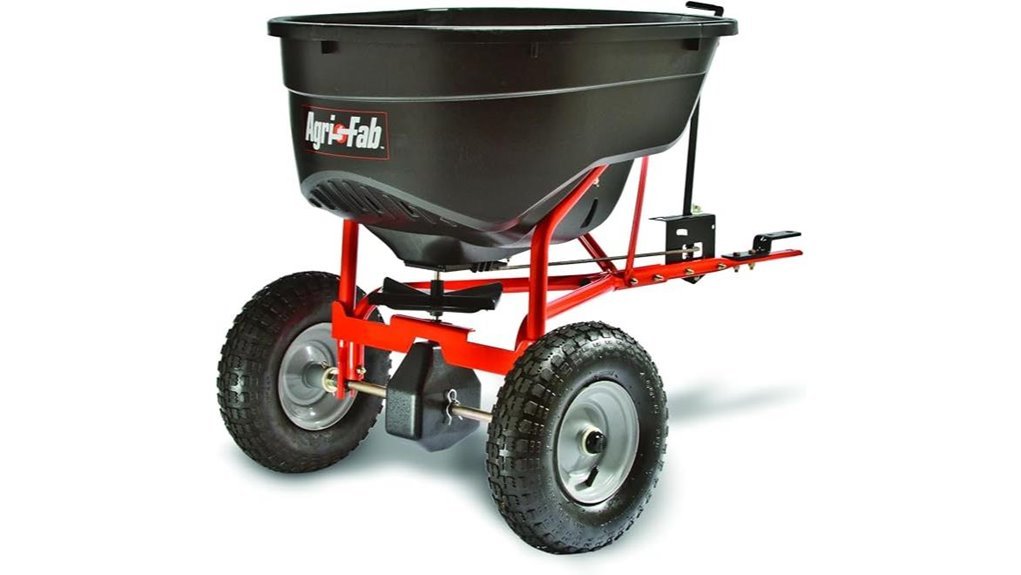
The Agri-Fab Pull Behind Broadcast Spreader is a strong option for homeowners who want a versatile, tow-behind spreader for year-round lawn care, especially on medium-sized properties up to 1/2 acre. Its 130-pound hopper handles seed, fertilizer, salt, and ice melt, reducing refill stops on areas up to 25,000 square feet. A universal hitch fits many riding mowers and lawn tractors, while the 10- to 12-foot spread width promotes even coverage. Steel rod flow control lets the operator adjust output from the seat. Durable tubing, pneumatic tires, and a 3-year warranty add practical value.
Best For: Homeowners with medium-sized lawns up to 1/2 acre who want a durable tow-behind spreader for seed, fertilizer, salt, and ice melt.
Pros:
- 130 lb hopper reduces refill stops and covers up to 25,000 sq ft.
- Universal hitch and seat-controlled flow lever make it easy to use with many riding mowers.
- Durable construction with steel tubing, pneumatic tires, and a 3-year warranty.
Cons:
- Tow-behind design requires a riding mower or lawn tractor, so it’s not ideal for walk-behind use.
- 130 lb capacity may be limiting for larger properties or heavy-duty commercial jobs.
- Broadcast spreaders can be less precise than drop spreaders in tight or narrow areas.
Pull Behind Broadcast Spreader, Fertilizer Spreaders for Lawn Seed Spreader
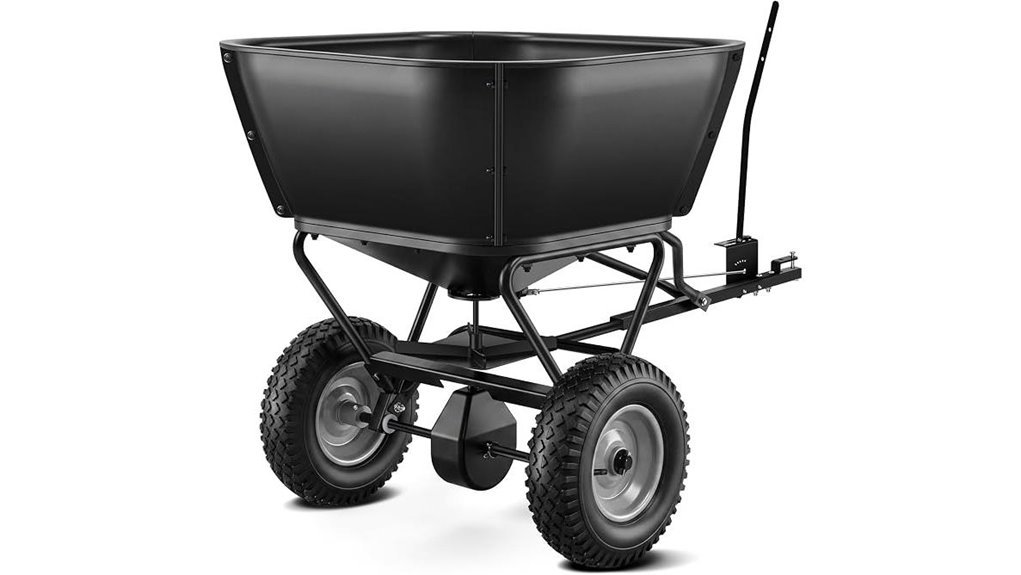
Built for large yards and small farms, this pull-behind spreader handles heavy-duty seeding and fertilizing with ease. HVDI’s Pull Behind Broadcast Spreader, model HVTBBS00001, carries up to 130 lbs in a trapezoidal hopper that promotes steady flow. Five adjustable discharge ports help spread material across a 12-foot width for even coverage. A heavy-duty powder-coated steel frame and sealed gearbox support durability, while 12.5-inch pneumatic tires improve traction. The universal hitch fits most lawn tractors, ATVs, and UTVs. It also includes a hitch extender and handle extension rod for convenient control from the seat.
Best For: Large yards, small farms, and property owners who need a durable pull-behind spreader for efficient seeding, fertilizing, and year-round material spreading.
Pros:
- 130 lb hopper capacity helps cover larger areas with fewer refills.
- 12-foot spreading width and 5 adjustable discharge ports support even distribution.
- Universal hitch, hitch extender, and handle extension rod add convenience with lawn tractors, ATVs, and UTVs.
Cons:
- Manual, hand-powered operation may require more effort than powered spreaders.
- Large capacity and tow-behind design may be less practical for small residential lawns.
- Pneumatic tires and steel construction can add weight and maintenance compared with lighter-duty models.
Agri-Fab Tow Behind Broadcast Spreader, 85 lb Capacity
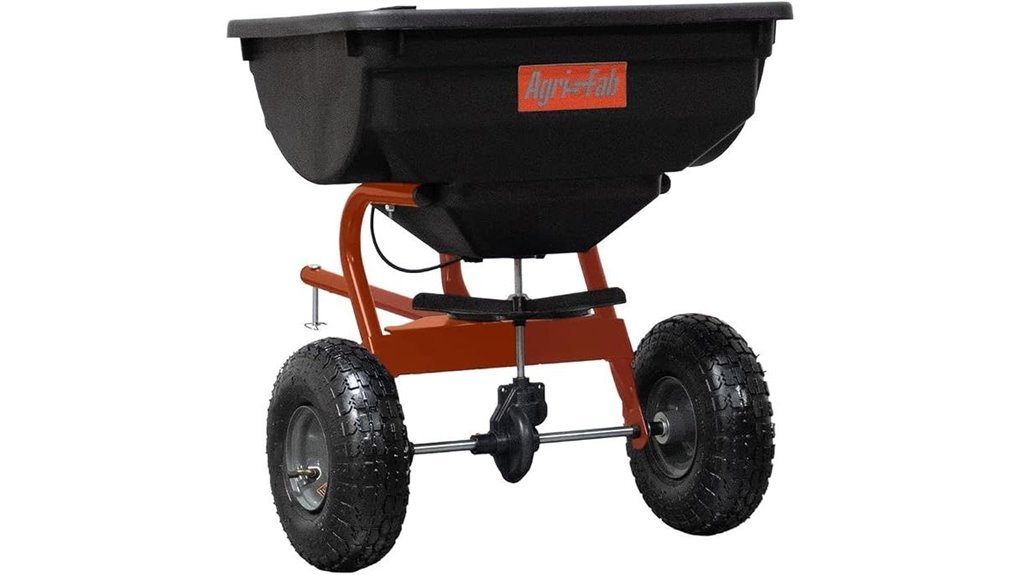
Ideal for small-to-medium lawns, this Agri-Fab spreader balances an 85-pound hopper with precise broadcast control. It is built for seed and fertilizer, covering up to 14,000 square feet with a spread width reaching 10 feet, depending on material and speed. A cable flow system lets operators adjust output without leaving the tractor seat. Ten-inch pneumatic tires improve movement over grass and uneven ground, while an enclosed gearbox supports reliable performance. Optional hopper cover, deflector, and grate add versatility. Built in Sullivan, Illinois, with global materials, it is made in the USA.
Best For: Small-to-medium lawn owners who want a tow-behind spreader for seed and fertilizer with easy tractor-seat control and even coverage.
Pros:
- 85 lb hopper is a practical size for small to medium properties.
- Cable flow control lets you adjust spreading without getting off the tractor.
- 10-inch pneumatic tires and an enclosed gearbox help with smoother, more reliable operation.
Cons:
- 85 lb capacity may require frequent refills for larger jobs.
- Spread width varies by material and speed, so results may take some dialing in.
- Optional hopper cover, deflector, and grate are not included.
Garvee Tow-Behind Spreader, 130LBS Capacity Pull Salt Broadcast Spreader
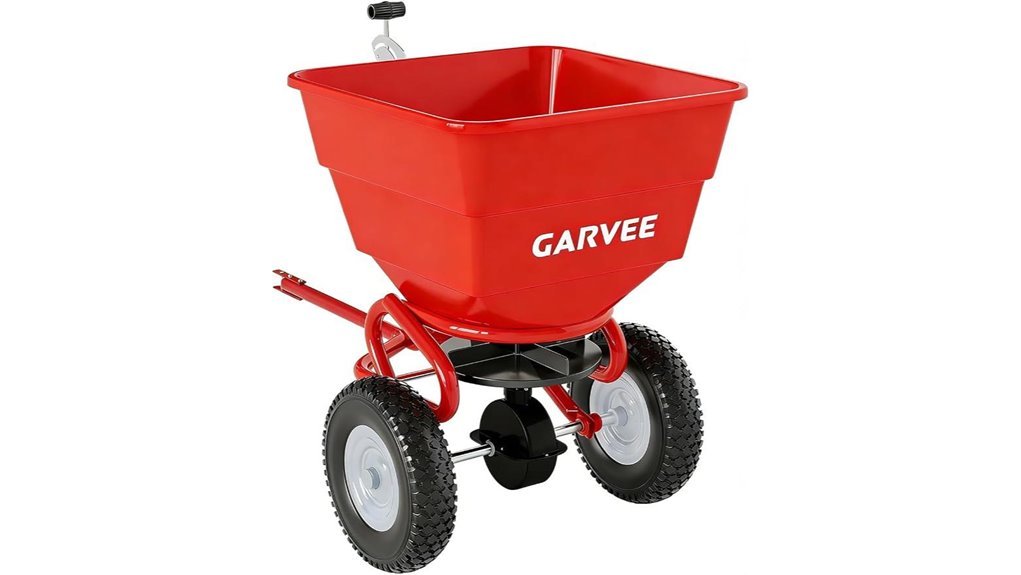
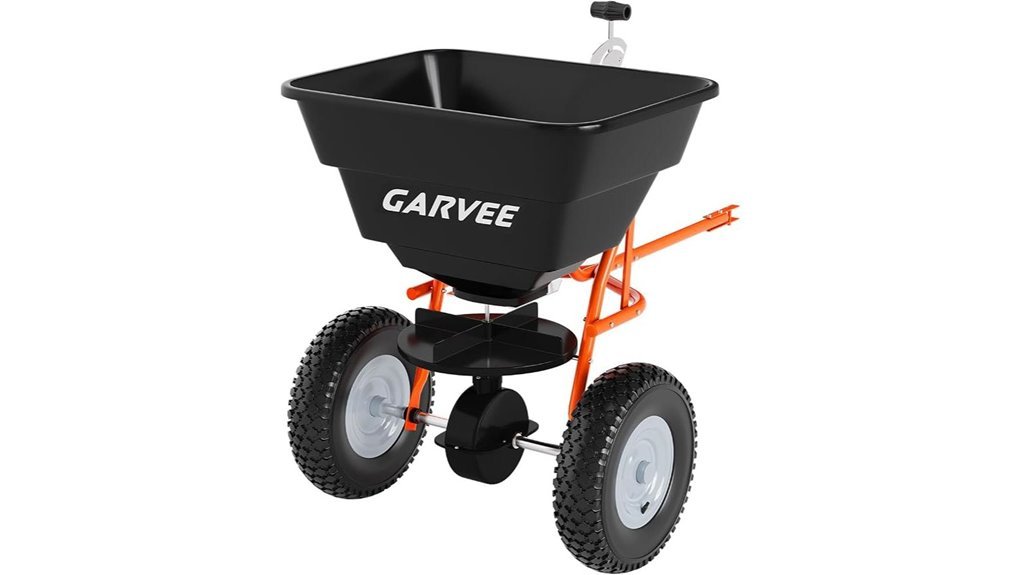
Garvee’s 130-pound tow-behind spreader suits homeowners needing year-round material application. Its rust-resistant poly hopper and powder-coated steel frame support durability through repeated seasonal use, while the included waterproof cover and sieve add practical protection and filtration. All-terrain 10 pneumatic tires improve traction across uneven ground, and the long tow bar connects easily to lawn tractors, ATVs, or UTVs. An adjustable flow handle promotes even coverage from 0 to 10 feet wide. The reliable spreader plate handles grass seed, fertilizer, ice melt, and sand for spring, summer, and winter tasks.
Best For: Homeowners who need a durable, tow-behind spreader for year-round lawn, garden, and snow-melt applications across tractors, ATVs, or UTVs.
Pros:
- Rust-resistant poly hopper and powder-coated steel frame offer solid durability and corrosion resistance.
- All-terrain 10 pneumatic tires and a long tow bar improve traction and easy towing on uneven ground.
- Adjustable flow control and reliable spreader plate provide even coverage for seed, fertilizer, ice melt, and sand.
Cons:
- 130 lb capacity may be limiting for larger properties or heavy-duty commercial use.
- Tow-behind design requires compatible equipment like a lawn tractor, ATV, or UTV.
- Coverage up to 10 feet wide may be slower for broad-area spreading compared with larger units.
AugFir Tow Behind Broadcast Spreader, 130 LBS Capacity
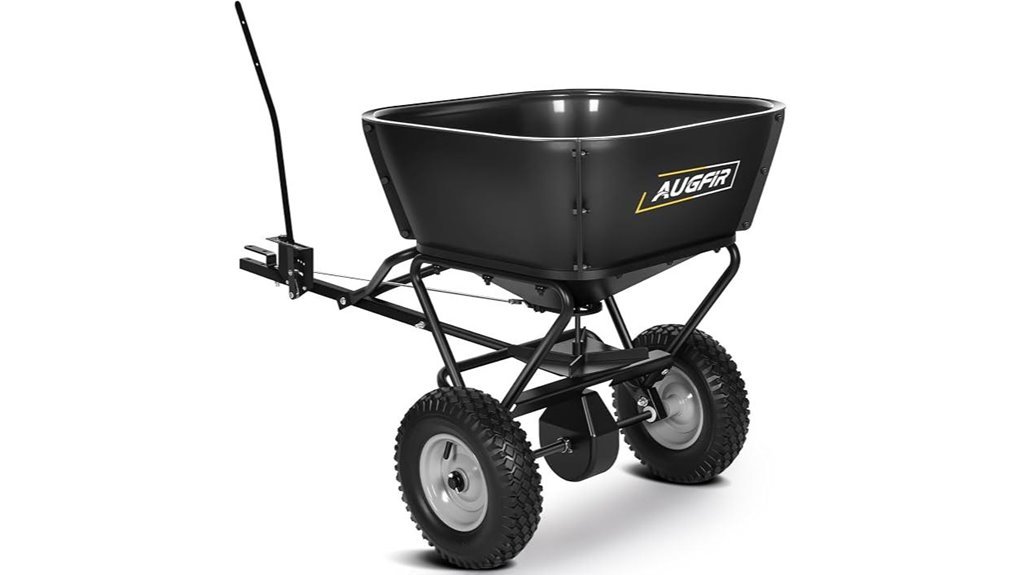
The AugFir tow-behind spreader suits homeowners and small-farm operators needing year-round lawn care. Its 130-pound hopper handles fertilizer, grass seed, salt, and ice melt, while the trapezoidal design limits refills and supports efficient coverage. A rugged powder-coated steel frame and durable gearbox add reliability, and 12.5-inch pneumatic tires improve flotation and traction on uneven ground. Five discharge ports help control flow for more even distribution, with a spread width reaching 12 feet. A universal hitch, extender, and handle rod simplify use from the seat, and included instructions assist assembly.
Best For: Homeowners and small-farm operators who need a durable, easy-to-use tow-behind spreader for year-round spreading of fertilizer, seed, salt, or ice melt.
Pros:
- 130 lb hopper capacity reduces refill frequency for larger jobs.
- Five discharge ports and up to 12-foot spread width support more even coverage.
- Universal hitch, handle extension, and pneumatic tires make it versatile and easier to use on varied terrain.
Cons:
- Tow-behind design requires a compatible lawn tractor, riding mower, ATV, or UTV.
- Assembly is required, even though instructions and a video are included.
- Large capacity may be more spreader than needed for small yards or occasional use.
Agri-Fab Tow Behind Broadcast Spreader, 185 lb Capacity
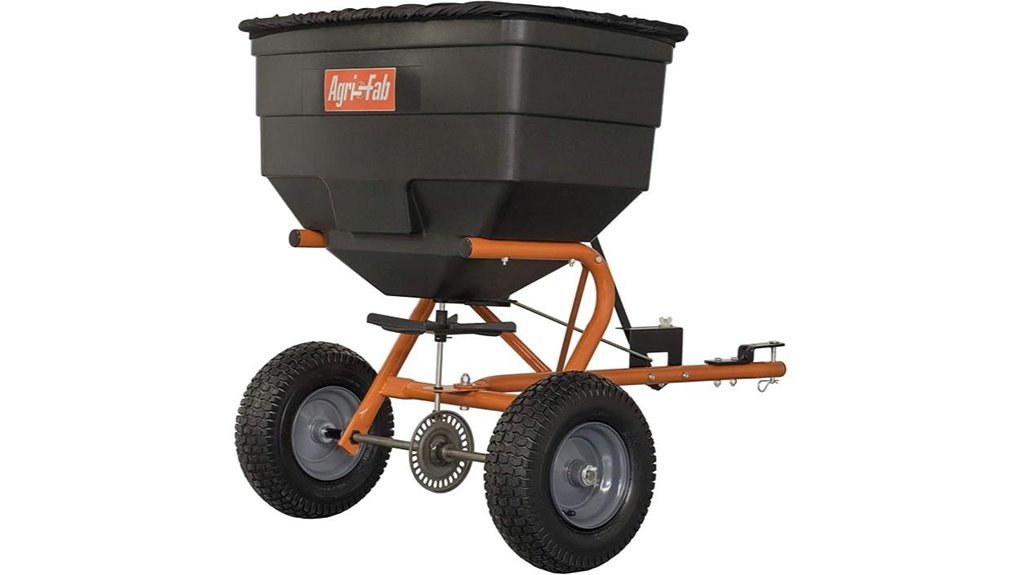
With a 185-pound hopper, the Agri-Fab Tow Behind Broadcast Spreader suits larger lawns and fewer refill breaks. It handles seed, fertilizer, salt, sand, grit, and ice melt, covering up to 1 acre or 40,000 square feet with a broadcast width reaching 12 feet. The rust-proof poly hopper and heat-treated steel gears support durable use, while 13-by-5-inch turf tread pneumatic tires aid transport over uneven ground. Flow control is reachable from the mower seat, improving convenience. Assembly is required, and a 3-year limited warranty backs the unit.
Best For: Homeowners with larger lawns who want a durable tow-behind spreader for seed, fertilizer, salt, sand, and ice melt with fewer refill stops.
Pros:
- Large 185 lb hopper reduces the need for frequent refills
- Broadcasts material up to 12 ft and covers up to 1 acre
- Rust-proof hopper, steel gears, and pneumatic tires add durability and ease of transport
Cons:
- Assembly is required
- Tow-behind design requires a riding mower or compatible towing equipment
- Heavier, bulkier unit may be less convenient for smaller yards or tight storage spaces
GarveeLife Tow-Behind Spreader, 85 Lbs Capacity Salt Broadcast Spreader
Built for small-to-medium properties, GarveeLife’s 85-pound tow-behind spreader suits versatile year-round yard care. Its rust-resistant poly hopper and powder-coated steel frame improve durability, while the waterproof cover and included sieve add practical protection and material control. All-terrain 10-inch pneumatic tires support steady movement across varied ground, and the adjustable handle manages spread widths from 0 to 10 feet. The long tow bar connects easily to lawn tractors, ATVs, or UTVs. It handles grass seed, fertilizer, ice melt, and sand with consistent distribution, making it useful for spring, summer, and winter tasks.
Best For: Homeowners with small-to-medium properties who want a durable tow-behind spreader for year-round use with lawn tractors, ATVs, or UTVs.
Pros:
- Rust-resistant poly hopper and powder-coated steel frame improve durability and corrosion resistance.
- Adjustable spread width from 0 to 10 feet offers versatile control for different materials and tasks.
- All-terrain 10-inch pneumatic tires and long tow bar make it easy to move across varied terrain.
Cons:
- 85-lb capacity may be too small for larger properties or heavy-duty jobs.
- Tow-behind design requires a compatible tractor, ATV, or UTV for use.
- Best suited for light-to-moderate spreading tasks rather than frequent high-volume commercial work.
Factors to Consider When Choosing Tow-Behind Lawn Spreaders in 2026
When choosing a tow-behind lawn spreader in 2026, hopper capacity and spread width remain key factors because they affect coverage and refill frequency. Flow control also matters, since it helps regulate application rates for seed, fertilizer, or salt. Tow compatibility and build materials should be checked as well to guarantee the spreader matches the tractor or mower and withstands regular use.
Hopper Capacity
Hopper capacity is one of the most important factors in choosing a tow-behind lawn spreader, since models typically range from 85 lbs to 185 lbs and can cover roughly 14,000 sq ft to 1 acre before needing a refill. Larger hoppers reduce downtime, which benefits users maintaining big lawns, acreage, or farm properties. A 130 lb model often offers a practical middle ground, handling about 1/2 acre, or 25,000 sq ft, while remaining manageable for many residential settings. Hopper shape also matters; a trapezoidal design can improve material movement and help maintain steady output. Selecting the right capacity affects refill frequency, overall productivity, and day-to-day convenience, making it a key decision point before comparing other spreader features.
Spread Width
Spread width is a major performance factor because it determines how much ground a tow-behind lawn spreader can cover in a single pass. Typical widths of 10 to 12 feet suit many residential applications, offering efficient coverage without excessive overlap. On larger lawns, a wider pattern can reduce application time for fertilizer or seed, making the task more efficient. Material type also affects performance, since different products may disperse more or less evenly across the same width. Adjustable spread widths add versatility by letting users adapt coverage to specific materials and lawn conditions. Choosing a spreader with a width matched to the area helps minimize gaps and overlaps, supporting more consistent results across the property.
Flow Control
Beyond coverage width, flow control plays a major role in how effectively a tow-behind lawn spreader applies material. Precise adjustment helps distribute seed, fertilizer, or ice melt at the intended rate, reducing waste and improving results. Many models include multiple discharge ports that let operators narrow or widen spread patterns, sometimes from 0 to 12 feet, depending on the product and task. Cable systems and manual handles add convenience by allowing real-time changes without leaving the tractor or mower seat. Consistent control also promotes even application, minimizing streaking and patchy coverage across the lawn. When flow is managed well, over-application and under-application are less likely, supporting healthier turf and more reliable seasonal maintenance.
Tow Compatibility
Tow compatibility is a key selection factor because a spreader must connect securely to the machine doing the towing. A universal hitch improves flexibility, allowing the unit to attach to lawn tractors, ATVs, and UTVs without complicated adapters. The spreader’s weight capacity should align with the towing vehicle’s limits to support safe, steady operation. Adjustable tow bars or hitch extenders can simplify hookup and help the operator manage the unit from the seat. It is also important that the design suits the size and type of the towing vehicle, since a poor match can reduce stability on uneven terrain. Lighter models may be easier to handle and position while still delivering consistent spreading performance across lawns, driveways, and other property areas.
Build Materials
Durable construction shapes both the lifespan and performance of a tow-behind lawn spreader. Rust-resistant poly hoppers are common because they withstand moisture, fertilizer residue, and seasonal exposure without quickly degrading. A heavy-duty, powder-coated steel frame adds structural strength while helping resist corrosion, which is especially valuable for equipment stored outdoors. Many models also use enclosed gear systems, shielding moving parts from dirt and moisture to support dependable operation over time. Adjustable flow controls, built from robust materials, improve accuracy and let the user regulate distribution with confidence. Together, these build materials determine whether a spreader remains reliable through repeated use or becomes vulnerable to wear, rust, and inconsistent output. Buyers should favor designs that combine resilience, protection, and precision in the main components.
Tire Performance
After sturdy construction, tire performance becomes a major factor in how well a tow-behind lawn spreader handles real yard conditions. Larger pneumatic tires, such as 12.5-inch models, usually offer better flotation and stability on uneven ground, helping the spreader stay level while moving across bumps and ruts. All-terrain tires improve maneuverability across grass, gravel, and muddy patches, making the unit easier to control on varied surfaces. Tread design also matters, since deeper or more aggressive patterns increase grip on inclines and rough terrain. Good tire performance can reduce slippage, which supports smoother spreading and more consistent material flow. Proper tire pressure remains essential, because under-inflated tires may cause uneven distribution, raise rolling resistance, and accelerate wear on the spreader.
Year-Round Use
Year-round use is a key consideration when choosing a tow-behind lawn spreader in 2026, since the same unit may need to handle grass seed in spring, fertilizer in summer, and ice melt in winter. A versatile spreader supports these seasonal tasks without requiring separate equipment. Models with hoppers up to 130 lbs can cover about 1/2 acre or more before refilling, which suits larger properties. Spread widths of 10 to 12 feet help distribute material evenly across broad areas. Adjustable flow control improves accuracy, allowing users to match application rates to each material and season. Designs that accept seed, fertilizer, herbicides, and ice melt provide stronger year-round value and reduce storage clutter.
Frequently Asked Questions
How Do I Calibrate a Tow-Behind Spreader Accurately?
He calibrates by checking the spreader settings, measuring a known area, weighing product before and after, making test passes, then adjusting until coverage matches the label. Repeating on level ground improves accuracy and consistency.
Can Tow-Behind Spreaders Handle Wet Fertilizer Safely?
About 40% of fertilizer clumps form in humid conditions. Tow-behind spreaders can handle slightly damp product, but not wet fertilizer safely; moisture causes clogging, uneven distribution, and corrosion, so dry material is strongly preferred.
What Tire Type Works Best on Uneven Lawns?
Pneumatic tires work best on uneven lawns, because they absorb bumps and maintain traction. Wide, treaded tires can reduce sinking and improve stability, while solid tires usually transmit more vibration and bounce.
How Often Should I Clean the Hopper After Use?
Like a grain silo after harvest, the hopper should be cleaned after every use, especially with fertilizer or seed. Regular rinsing prevents corrosion, clogging, and residue buildup, preserving performance and extending service life.
Are Tow-Behind Spreaders Compatible With All Riding Mowers?
No, tow-behind spreaders are not compatible with all riding mowers. Compatibility depends on hitch type, towing capacity, ground clearance, and turning radius. A user should verify mower specifications and spreader attachment requirements before purchase.
Conclusion
Choosing the right tow-behind lawn spreader can feel like selecting a trusted tool from a well-stocked shed—one that must match terrain, capacity, and season with quiet reliability. The models reviewed here offer options for small yards and larger properties alike, from compact 85-pound units to heavier 185-pound workhorses. In the end, the best choice is the one that rolls like a well-tuned cart and spreads with the steady hand of an old gardener.
