
Choosing the best AC Infinity grow tent starts with matching the tent’s floor space, height, and ventilation options to your indoor garden. The CLOUDLAB series offers six practical sizes, from compact 2×2 tents to spacious 5×5 enclosures.
Our top pick is the AC Infinity CLOUDLAB 844. Its 4×4 footprint, 80-inch nominal height, and sturdy frame offer a useful balance of growing space and equipment flexibility. For a narrower room, the CLOUDLAB 642 is our value pick.
We compared manufacturer specifications, plant capacity, construction, ventilation openings, and practical space requirements. The six models below suit different room layouts and growing needs.
Best AC Infinity Grow Tents Compared
All six tents use heavy-duty Oxford canvas, reflective Mylar interiors, and steel frames. The biggest differences are footprint, height, plant capacity, and equipment clearance. This table compares the manufacturer’s nominal dimensions and suggested capacity for 5-gallon plant containers.
| Product | Best for | Footprint | Height | Plant capacity |
|---|---|---|---|---|
|
Premium
|
Best overall | 4 x 4 ft | 80 in. | 4 plants |
|
Mid-range
|
Best value for narrow rooms | 4 x 2 ft | 72 in. | 2 plants |
|
Budget
|
Single-plant setups needing height | 3 x 2 ft | 72 in. | 1 plant |
|
Premium
|
Large growing areas | 5 x 5 ft | 80 in. | 6 plants |
|
Mid-range
|
Balanced 3×3 growing | 3 x 3 ft | 72 in. | 3 plants |
|
Budget
|
Compact plants and tight spaces | 2 x 2 ft | 48 in. | 1 plant |
Size note: These are nominal product sizes. AC Infinity’s current technical specifications list slightly smaller assembled dimensions for several models. Measure your available room and allow space for doors, ducts, and maintenance access. Plant counts are manufacturer recommendations, not guaranteed limits or yields.
Best AC Infinity Grow Tents: Our Top Picks
1. AC Infinity CLOUDLAB 844
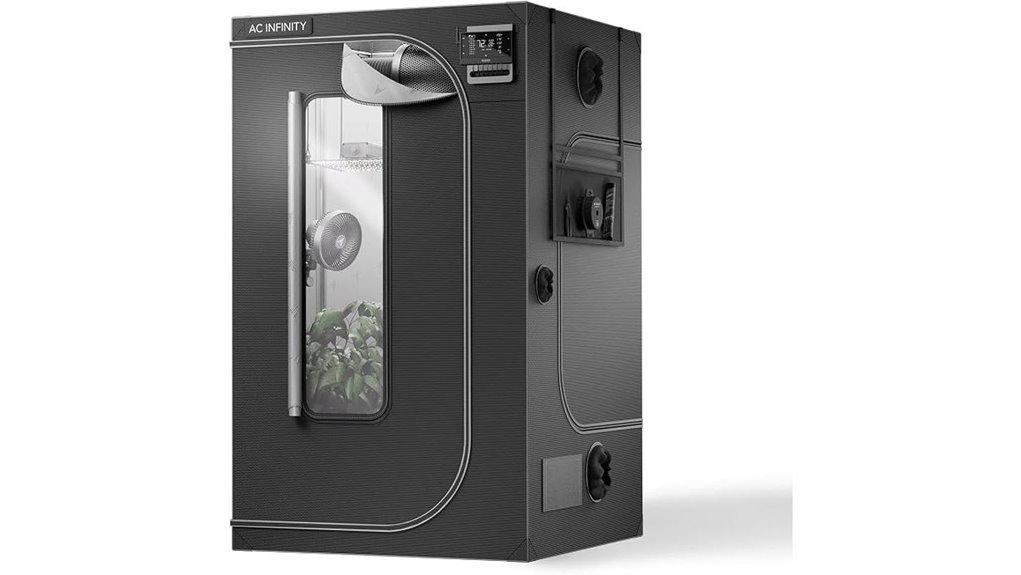
Bottom line: The AC Infinity CLOUDLAB 844 is our best overall choice for growers who need a balanced 4×4 tent. It gives you room for multiple plants, taller equipment, and a flexible ventilation setup without requiring a 5×5 footprint.
- Footprint: 48 x 48 inches nominal, providing a square growing area.
- Height: 80 inches nominal, leaving room for lighting and plant growth.
- Plant capacity: 4 plants in 5-gallon containers, according to AC Infinity.
- Pole diameter: 22 mm steel, supporting a sturdy frame.
- Rated beam load: Up to 250 lb on current manufacturer specifications, not a per-pole allowance.
The CLOUDLAB 844 uses 2000D Oxford canvas and a diamond-patterned Mylar interior. AC Infinity says the reflective lining helps return light toward the growing canopy. Its reinforced corners, SBS zippers, and front zipper flaps help protect the enclosed environment from unwanted light.
Its large viewing window lets you inspect your plants without fully opening the tent. Two side doors, additional duct openings, and a lightproof cable passthrough give you several ways to arrange ventilation and controllers. The setup also includes hanging bars, a removable catch tray, and a detachable tool bag.
The main trade-off is its square footprint. You need room not only for the tent but also for opening its doors and reaching the plants. If you cannot spare that floor area, a 4×2 model may be easier to live with.
- Roomy 4×4 footprint with 80-inch nominal height
- Heavy-duty canvas, steel frame, and reinforced corners
- Side doors, viewing window, and multiple ventilation openings
- Controller mounting plate, catch tray, and hanging accessories
- Requires a substantial amount of floor space
- More enclosure than a single compact plant needs
- Ventilation and lighting equipment require separate planning
2. AC Infinity CLOUDLAB 642
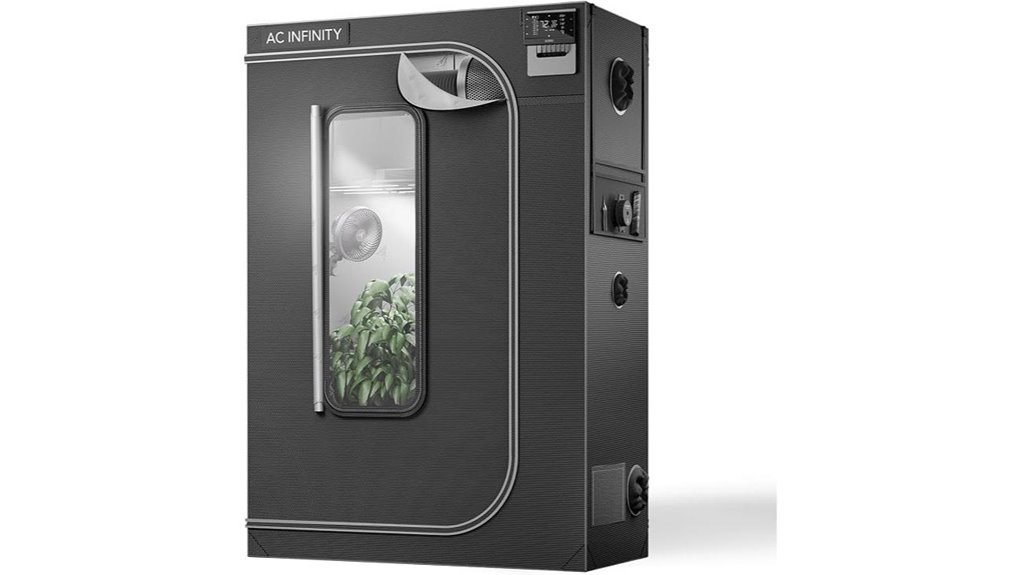
Bottom line: The CLOUDLAB 642 is the best value option for a narrow growing space. Its 4×2 shape fits along a wall while providing more horizontal room than a small square tent.
- Footprint: 48 x 24 inches nominal, suitable for long, narrow spaces.
- Height: 72 inches nominal, allowing more vertical space than the CLOUDLAB 422.
- Plant capacity: 2 plants in 5-gallon containers, according to AC Infinity.
- Pole diameter: 22 mm steel, with reinforced frame corners.
- Rated beam load: Up to 250 lb on current manufacturer specifications, subject to proper installation.
The CLOUDLAB 642 uses the same 2000D canvas and diamond Mylar construction found across this range. Its reflective lining helps make better use of grow lighting, while the zipper flaps limit unwanted light entering the enclosure.
Four-inch, six-inch, and eight-inch duct openings give you flexibility when arranging ventilation. The controller mounting plate includes a lightproof cable passthrough, which helps keep wiring organized without leaving a large opening in the canvas.
Three hanging bars, a catch tray, and a detachable tool bag add convenience. The main limitation is the 24-inch depth. Large containers, wide plants, and floor-mounted equipment can compete for the same narrow space.
- Space-efficient 4×2 layout
- 72-inch height for plants and suspended equipment
- Multiple duct sizes for ventilation planning
- Thick canvas, reflective lining, and reinforced frame
- Narrow depth limits the width of mature canopies
- Lower vertical clearance than the 80-inch models
- Less room for equipment on the floor
3. AC Infinity CLOUDLAB 632
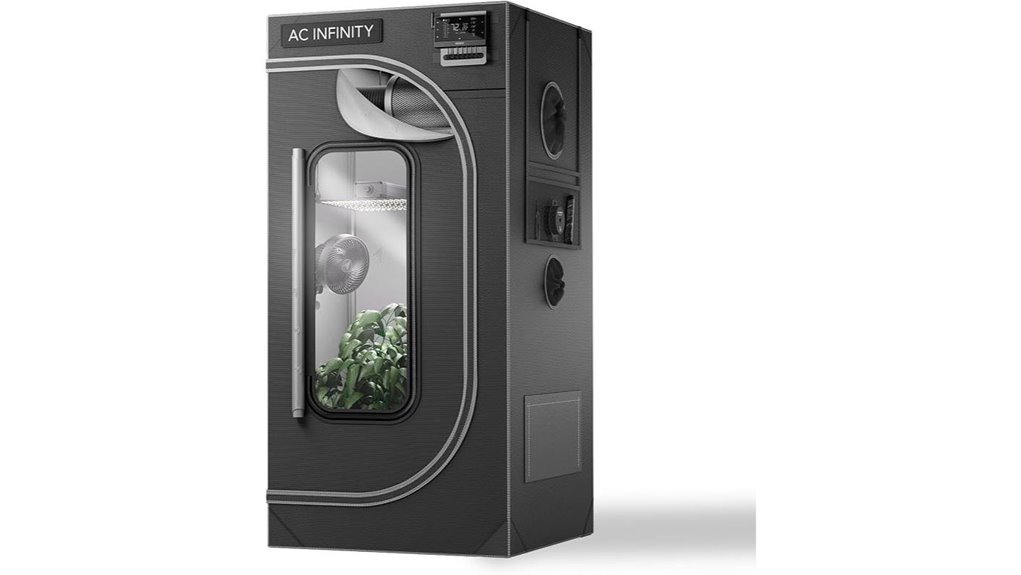
Bottom line: The CLOUDLAB 632 is a smart choice for a single-plant garden that needs more height than a short 2×2 tent provides. Its 3×2 footprint gives you space for lighting and ventilation without moving up to a larger enclosure.
- Footprint: 36 x 24 inches nominal, suitable for a compact rectangular garden.
- Height: 72 inches nominal, offering useful vertical clearance.
- Plant capacity: 1 plant in a 5-gallon container, according to AC Infinity.
- Pole diameter: 22 mm steel, supporting the reinforced frame.
- Rated beam load: Up to 250 lb on current manufacturer specifications, with proper load distribution.
This model combines 2000D Oxford canvas with a reflective Mylar lining. SBS zippers, front flaps, and reinforced corners help create a sturdy enclosure with controlled light exposure.
The CLOUDLAB 632 also provides a viewing window, controller mounting plate, lightproof cable passthrough, and additional duct openings. Hanging bars, a stain-resistant catch tray, and a tool bag help keep the growing area organized.
Its main limitation is width. The 3×2 design works best when one plant has enough room to develop within the available canopy area. If you plan to expand to several large plants, a 3×3 or 4×4 model is the more practical starting point.
- Compact 3×2 footprint with 72-inch nominal height
- Heavy-duty canvas and reinforced steel frame
- Reflective interior and light-blocking zipper flaps
- Useful accessories for ventilation and organization
- Limited room for multiple mature plants
- Less floor area than a 3×3 tent
- Narrow layout may restrict larger lighting fixtures
4. AC Infinity CLOUDLAB 866
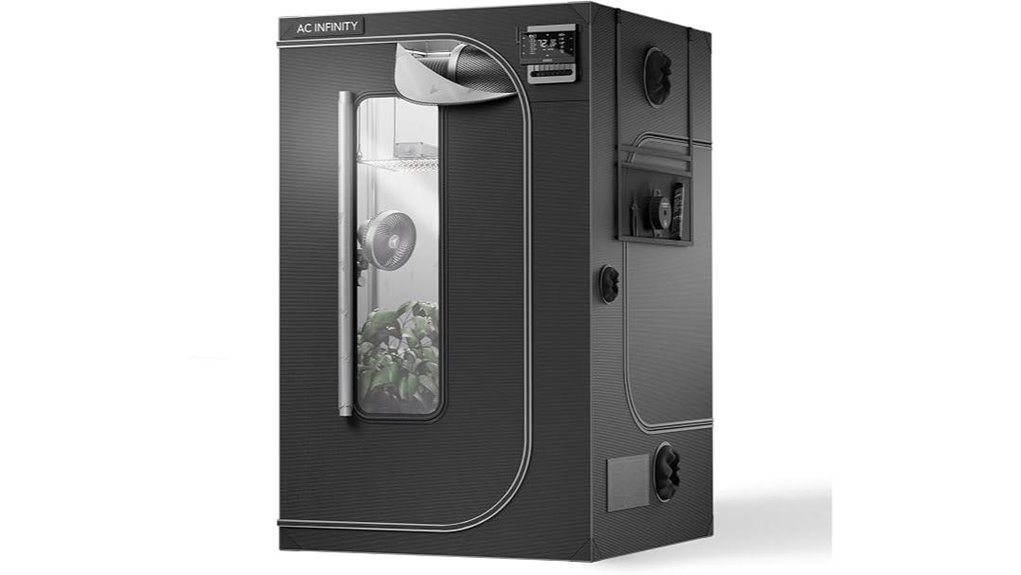
Bottom line: The CLOUDLAB 866 is the premium option for growers who need a larger enclosed garden. Its 5×5 floor area and 80-inch nominal height provide room for wider canopies, more plants, and a more elaborate equipment layout.
- Footprint: 60 x 60 inches nominal, providing a large square growing area.
- Height: 80 inches nominal, allowing room for taller setups.
- Plant capacity: 6 plants in 5-gallon containers, according to AC Infinity.
- Pole diameter: 22 mm steel, with reinforced structural corners.
- Rated beam load: Up to 250 lb on current manufacturer specifications, not per hanging bar.
The CLOUDLAB 866 combines a steel frame with 2000D canvas and reflective Mylar. Its SBS zippers, zipper flaps, and viewing window help you manage light exposure and inspect plants without opening the enclosure unnecessarily.
The manufacturer lists seven duct openings, including two 4-inch and five 8-inch openings. Three hanging bars plus an additional bar help organize lights and other suspended equipment. The tent also includes a controller mounting plate, cable passthrough, side access, and a catch tray.
However, the extra growing area brings practical challenges. You need adequate space around the tent for assembly, ventilation, and maintenance. Its larger structure can also be harder to position and move than smaller CLOUDLAB models.
- Large 5×5 footprint with 80-inch nominal height
- Manufacturer capacity of six plants in 5-gallon containers
- Seven duct openings for equipment routing
- Heavy-duty frame, reflective lining, and multiple hanging bars
- Needs considerable floor space
- More demanding to assemble and reposition
- Can be excessive for a small garden
5. AC Infinity CLOUDLAB 733
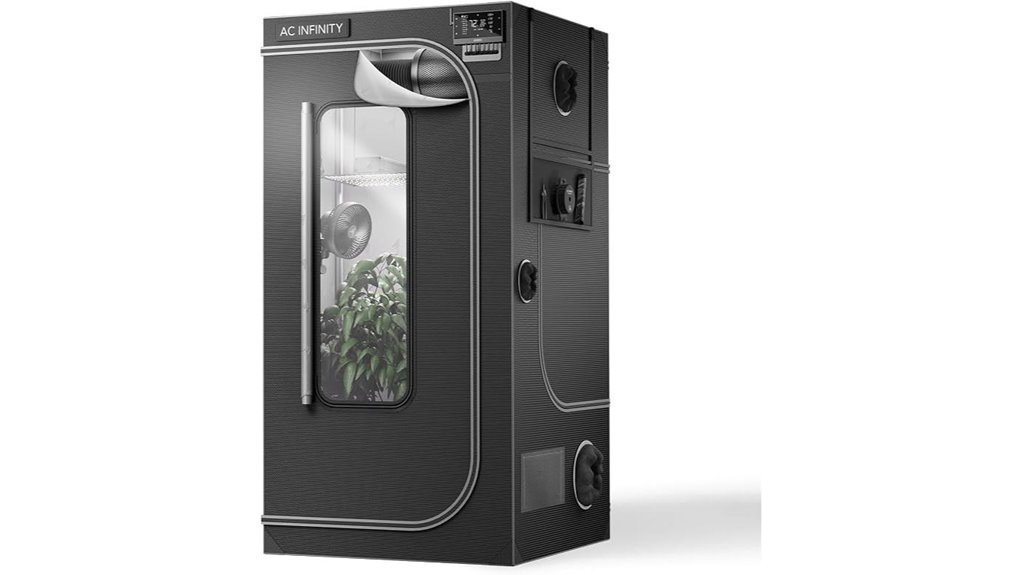
Bottom line: The CLOUDLAB 733 offers a useful middle ground between compact tents and larger 4×4 models. Its square 3×3 floor area makes it a practical choice for growers who want more canopy space without giving up too much room.
- Footprint: 36 x 36 inches nominal, providing a balanced square layout.
- Height: 72 inches nominal, suitable for suspended lighting and plant growth.
- Plant capacity: 3 plants in 5-gallon containers on current manufacturer specifications.
- Pole diameter: 22 mm steel, with reinforced corners.
- Rated beam load: Up to 250 lb on current manufacturer specifications, subject to proper mounting.
The CLOUDLAB 733 uses 2000D Oxford canvas, diamond Mylar, and SBS zippers. Front zipper flaps help control stray light, while the viewing window lets you check the garden without fully opening the tent.
Its duct openings support several ventilation arrangements, and the controller mounting plate keeps compatible control equipment organized. The manufacturer specifies two main hanging bars and two additional bars. A side door and detachable tool bag add convenience during maintenance.
This is a good option for a modest square canopy. However, the 72-inch height offers less vertical clearance than the CLOUDLAB 844. Growers using tall lighting systems or expecting substantial plant height may prefer a taller enclosure.
- Balanced square footprint
- Space for up to three plants under manufacturer guidance
- Heavy-duty canvas and reinforced steel construction
- Flexible ventilation ports and multiple hanging bars
- Less floor area than a 4×4 model
- Shorter than the 80-inch CLOUDLAB tents
- Equipment placement needs planning with multiple plants
6. AC Infinity CLOUDLAB 422
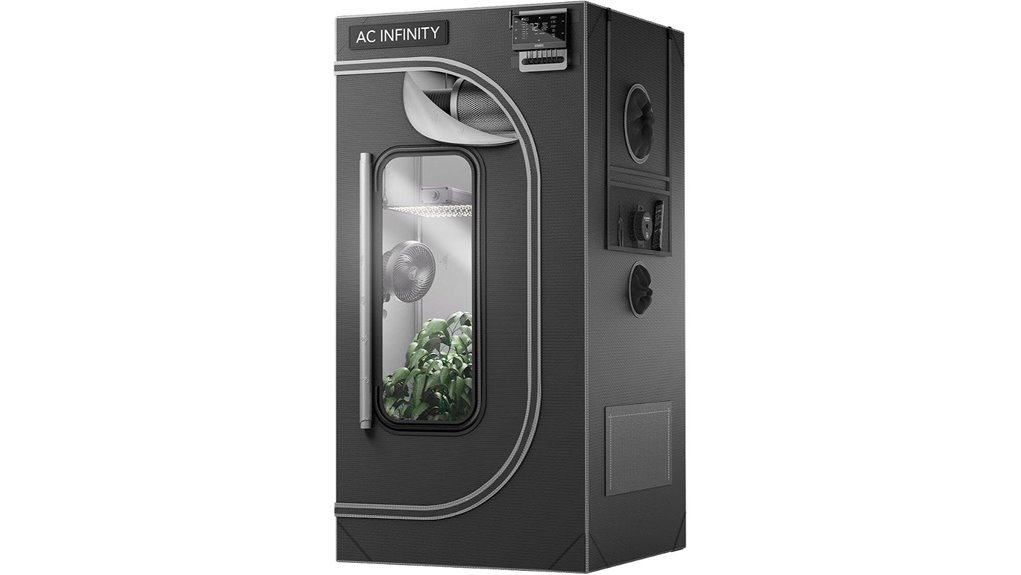
Bottom line: The CLOUDLAB 422 is best for growers who need a small, short enclosure. Its 2×2 floor area works for a compact single-plant setup, but its 48-inch nominal height requires careful planning.
- Footprint: 24 x 24 inches nominal, suitable for compact locations.
- Height: 48 inches nominal, best for shorter plants and equipment.
- Plant capacity: 1 plant in a 5-gallon container, according to AC Infinity.
- Pole diameter: 22 mm steel, using the same reinforced frame concept.
- Rated beam load: Up to 250 lb on current manufacturer specifications, not a per-bar limit.
Despite its small size, the CLOUDLAB 422 uses 2000D canvas and a reflective Mylar interior. Its SBS zippers, viewing window, and front flaps help protect the growing environment while allowing convenient access.
The tent includes hanging bars, a controller mounting plate, a lightproof cable passthrough, duct openings, reinforced corners, and a catch tray. These features make the small enclosure useful for organized indoor growing rather than just basic plant storage.
Its biggest limitation is vertical space. Once you account for hanging lights, safe light clearance, pots, and ventilation accessories, the space available for plant growth becomes smaller. Taller plants may quickly outgrow this model.
- Compact 2×2 floor area
- Heavy-duty canvas and reinforced steel frame
- Reflective lining and light-blocking features
- Controller plate, duct openings, and catch tray included
- Only 48 inches of nominal height
- Limited floor space for plants and accessories
- Less suitable for tall plants or large hanging fixtures
AC Infinity CLOUDLAB 844 vs CLOUDLAB 642: Is the Upgrade Worth It?
The CLOUDLAB 844 is worth considering when you need a larger square canopy and more vertical clearance. The CLOUDLAB 642 offers a narrower, lower-cost layout that still includes many of the same construction and climate-control features.
- Growing area: The 844 provides a nominal 16-square-foot footprint, compared with 8 square feet for the 642.
- Height: The 844 is rated at 80 inches nominal, while the 642 measures 72 inches.
- Plant capacity: AC Infinity lists four 5-gallon plants for the 844 and two for the 642.
- Construction: Both use 2000D canvas, reflective Mylar, and 22 mm steel poles in current specifications.
Which AC Infinity Grow Tent Should You Buy?
Choose the tent that matches your available room and realistic growing needs. A larger enclosure gives you more flexibility, but an oversized tent can make a simple setup harder to manage.
- Best balanced 4×4 setup: Get the AC Infinity CLOUDLAB 844 for a spacious square canopy and extra height.
- Best narrow-room value: Get the AC Infinity CLOUDLAB 642 for a long 4×2 growing area.
- Best tall single-plant enclosure: Get the AC Infinity CLOUDLAB 632 for a compact 3×2 footprint with 72-inch height.
- Best large growing area: Get the AC Infinity CLOUDLAB 866 for a 5×5 enclosure.
- Best midsize square tent: Get the AC Infinity CLOUDLAB 733 for a 3×3 layout.
- Best compact tent: Get the AC Infinity CLOUDLAB 422 for smaller plants and limited room height.
How We Chose These AC Infinity Grow Tents
We evaluated the six CLOUDLAB models using published product details rather than claiming hands-on tests. Our comparison focused on differences that affect installation, growing space, and everyday access.
- Manufacturer specifications: We compared dimensions, plant capacity, steel pole diameter, hanging bars, and beam-load information from AC Infinity’s grow tent listings.
- Space efficiency: We compared square and rectangular footprints, usable height, and how each model fits common room layouts.
- Construction: We examined canvas thickness, reflective interiors, zipper design, reinforced corners, and catch trays.
- Ventilation and access: We considered duct openings, viewing windows, cable routing, and equipment organization.
- Setup practicality: We consulted the official CLOUDLAB series manual for assembly and included components.
These recommendations are based on documented features and practical fit. They are not laboratory performance rankings or claims that we personally tested each enclosure. Product revisions can change specifications, so confirm the exact model before purchasing.
Factors to Consider When Choosing AC Infinity Grow Tents in 2026
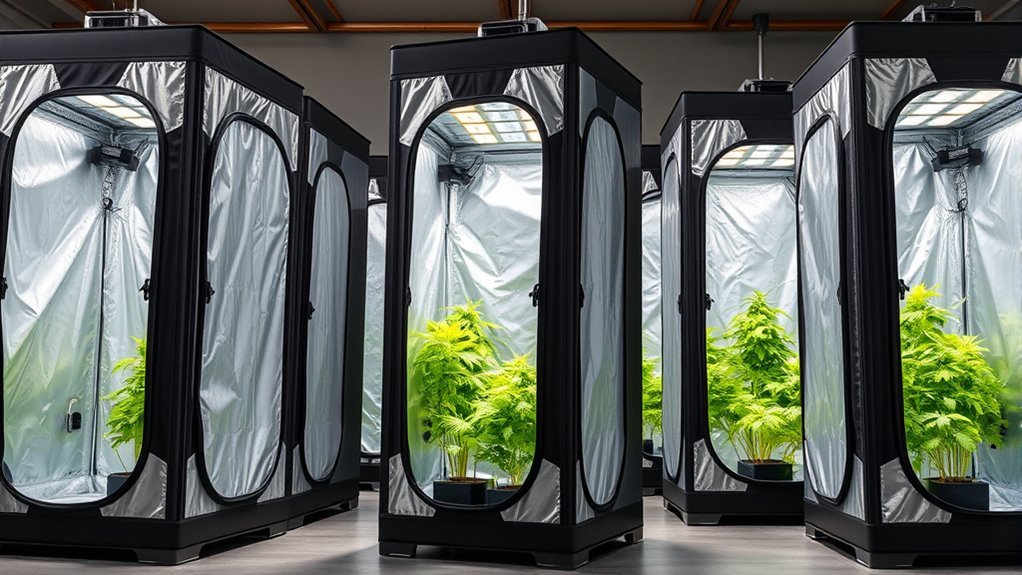
The most important buying factors are tent size, available height, frame strength, reflective materials, and ventilation. Start with your room measurements and plant needs, then choose the model that gives you enough space for equipment and maintenance.
Tent Size and Capacity
Tent size determines how much growing area you can use and how easily you can work around plants. A 2×2 tent is manageable in a small room, while 4×4 and 5×5 models offer more room for wider canopies.
AC Infinity lists the CLOUDLAB 422 and 632 for one plant each, the 642 for two, the 733 for three, the 844 for four, and the 866 for six when using 5-gallon containers. These are planning estimates rather than guaranteed maximums.
Height also matters. The 48-inch CLOUDLAB 422 is best for compact setups, while the 72-inch models provide more clearance. The 80-inch CLOUDLAB 844 and 866 offer additional space for plants, hanging lights, and ventilation hardware.
For a balanced medium-sized indoor garden, the CLOUDLAB 844 offers a useful combination of floor area and height.
Pole Strength and Frame
A sturdy frame supports hanging equipment and keeps the tent stable during daily use. The current CLOUDLAB product specifications list 22 mm steel poles, reinforced corners, and heavy-duty support structures.
AC Infinity’s current standalone tent pages list a 250-lb beam-load rating for these models. However, older manufacturer materials and some product listings show different limits. Do not treat the published rating as permission to load a single bar or connection point with that amount of weight.
Spread equipment loads across suitable support points and follow the instructions for the exact product revision. Heavy fixtures and filters should be mounted securely, and the frame must be assembled correctly before adding weight.
Canvas and Mylar Quality
Canvas thickness affects durability, while reflective lining helps make use of the lighting inside the enclosure. These CLOUDLAB models use 2000D Oxford canvas with diamond-patterned Mylar interiors.
AC Infinity describes its Mylar as laboratory-tested for high reflectivity. That is a manufacturer claim about the material, not a guarantee that every growing setup will deliver better results.
Strong zippers and light-blocking flaps also matter. They help reduce gaps around access points, while reinforced corners support repeated assembly and regular use. A removable catch tray makes cleaning spills and debris easier.
Ventilation Port Options
Good ventilation helps manage heat, humidity, and air exchange. CLOUDLAB tents include multiple duct openings so you can route exhaust fans, air intake, and other climate-control equipment.
Port sizes and positions vary by model. For example, the CLOUDLAB 642 has 4-inch, 6-inch, and 8-inch duct openings, while the CLOUDLAB 866 uses 4-inch and 8-inch openings.
Choose your fan and ducting based on the tent’s volume, equipment heat, and growing conditions. AC Infinity also publishes a CLOUDLAB duct port location guide that can help you plan equipment placement.
Keep unused duct openings closed and route cables through suitable passthroughs. This helps limit unwanted light and uncontrolled air movement.
Access and Lightproofing
Access features affect how easily you can inspect plants, adjust equipment, and clean the enclosure. SBS zippers, viewing windows, and front zipper flaps are common features across the CLOUDLAB models in this comparison.
A viewing window lets you observe the growing area without opening the main door. However, you still need enough space outside the tent to reach the zippers and work inside comfortably.
The larger models offer more access options. If you will frequently reach plants near the back of the enclosure, consider a tent with convenient side access rather than choosing on floor area alone.
Accessories and Storage
Small accessories help keep a grow tent organized. The CLOUDLAB models include practical features such as hanging bars, a catch tray, and controller mounting provisions.
The detachable tool bag provides a place for small items such as plant ties, meters, and pruning tools. Hanging bars help keep compatible equipment off the floor, while the catch tray makes cleanup easier.
Remember that the controller mounting plate is not the same as an electronic controller. A tent enclosure also does not automatically include every light, fan, filter, or climate-control device needed for a complete grow system.
Mistakes to Avoid When Buying an AC Infinity Grow Tent
- Choosing only by plant count: Consider mature canopy width, pot size, and the space needed for equipment.
- Ignoring vertical clearance: Account for grow lights, hanging hardware, containers, and safe distances from plants.
- Buying an oversized enclosure: Match the tent to your room and realistic growing goals.
- Assuming all specifications match every revision: Confirm the exact product’s dimensions, beam-load rating, and port layout.
- Forgetting ventilation needs: Plan airflow and equipment placement before filling the tent with plants.
Frequently Asked Questions
How Do I Choose the Right Tent Height for My Plants?
Choose a tent height by adding your expected plant height, container height, lighting fixture, hanging hardware, and required light clearance. The CLOUDLAB 422 is only 48 inches tall nominally, while other models offer 72 or 80 inches. Taller tents give you more flexibility for equipment and plant growth, especially when you cannot easily reduce plant height.
Can I Fit Ventilation Equipment Without Reducing Grow Space?
Yes, you can preserve more floor space by placing suitable ventilation equipment above the growing area or outside the tent. Compact inline fans and careful duct routing also help. However, externally mounted equipment still needs space, secure support, and accessible connections. Plan your ventilation layout before installing lights and plants so you avoid unnecessary obstructions.
What Weight Can AC Infinity Tent Poles Safely Support?
AC Infinity’s current standalone CLOUDLAB product specifications list a beam-load rating of up to 250 pounds for the models compared here. Some older documentation lists lower ratings. This is not a per-pole or per-hook allowance. Confirm the rating for your exact tent revision and distribute hanging equipment loads according to the manufacturer’s instructions.
How Easy Is It to Assemble an AC Infinity Grow Tent Alone?
Smaller CLOUDLAB tents may be manageable for one person, but larger models are easier to assemble with help. AC Infinity’s manual recommends two people for portions of the assembly process, including handling the frame and canvas. Lay out the labeled poles first, follow the correct model diagram, and avoid forcing the fabric around an incomplete frame.
Which Tent Size Works Best for Beginners With Limited Space?
A 2×2 or 4×2 tent is often a practical starting point for a beginner with limited room. The CLOUDLAB 422 suits short, compact setups, while the CLOUDLAB 642 provides more growing length and height. Choose based on the available floor area, the plants you intend to grow, and your lighting and ventilation equipment.
Does an AC Infinity CLOUDLAB Grow Tent Include Lights and Fans?
No, a standalone CLOUDLAB grow tent is an enclosure, not a complete grow system. It includes structural and organizational components such as the frame, canvas, hanging bars, and accessories specified for that model. Grow lights, powered fans, filters, and electronic controllers must be obtained separately unless you choose a complete grow tent kit that explicitly includes them.
Is a 4×4 Grow Tent Better Than a 4×2 Grow Tent?
A 4×4 grow tent is better when you need a larger square canopy and more room for equipment. A 4×2 tent is usually easier to place against a wall in a narrow room. The CLOUDLAB 844 offers twice the nominal floor area of the CLOUDLAB 642, but the right choice depends on your available space and plant needs.
Can You Use an AC Infinity Grow Tent Without a Smart Controller?
Yes, you can use a CLOUDLAB enclosure without an AC Infinity smart controller. The tent itself is a passive enclosure with openings and mounting provisions. You can arrange suitable lighting and ventilation equipment separately. A compatible controller adds convenience for supported devices, but it is not required simply to assemble or use the tent.
Final Verdict: Which AC Infinity Grow Tent Is Best?
The AC Infinity CLOUDLAB 844 is our best overall pick because it balances growing space, height, construction, and access features. Its 4×4 layout suits growers who need more room than a compact enclosure but do not want the footprint of a 5×5 tent.
For a narrower and more economical setup, choose the AC Infinity CLOUDLAB 642. If you need a larger growing area, the CLOUDLAB 866 provides a spacious 5×5 enclosure.
