
Lead reduction remains a priority for households seeking safer drinking water in 2027. Several dispensers stand out for different reasons, from large-capacity pitchers to advanced reverse osmosis systems and bottleless coolers. Some focus on convenience, while others emphasize stronger contaminant removal and certification. The choices are not identical, and the differences may matter more than expected.
Brita XL 27 Cup Water Pitcher Dispenser, Includes 1 Elite Filter, Black

The Brita XL 27 Cup Water Pitcher Dispenser is a strong choice for households that need a large-capacity, countertop solution for lead reduction. The BPA-free UltraMax design includes one Elite filter and a convenient spigot for freestanding use. Its Advanced Carbon Core Technology reduces 99% of lead and more than 30 contaminants, including microplastics, chlorine, pharmaceuticals, and pesticides. WQA NSF/ANSI certification supports its effectiveness. With 27-cup capacity and a filter life of 120 gallons, it offers long service and can replace hundreds of single-use plastic bottles, reducing waste and cost.
Best For: Households or offices that want a large-capacity, freestanding countertop water dispenser with strong lead reduction and long-lasting filtration.
Pros:
- Filters up to 99% of lead and 30+ contaminants, including chlorine, microplastics, pharmaceuticals, and pesticides.
- Large 27-cup capacity with a convenient spigot makes it practical for frequent use.
- Elite filter lasts up to 120 gallons or about 6 months, helping reduce plastic waste and replacement frequency.
Cons:
- Takes up more counter space than standard pitchers due to its larger size.
- Filter replacement costs can be higher than basic filter models.
- Not a full under-sink or refrigerated system, so it may not suit users wanting a more permanent installation.
Culligan ZeroWater 40-Cup Glass Water Filter Dispenser

With its 40-cup glass design, this dispenser suits households hosting frequent gatherings. The Culligan ZeroWater system uses a 5-stage filter that removes 99.9% of dissolved solids and is IAPMO certified to reduce lead, Total PFAS, chlorine, mercury, and other contaminants. A built-in TDS meter helps monitor water quality, signaling filter replacement when readings rise; a zero reading indicates effective filtration. The drop-in filter and spigot simplify daily use. It is compatible only with new Culligan with ZeroWater Technology filters. Its reusable design can displace up to 150 single-use bottles, supporting lower plastic waste.
Best For: Households or hosts who want a large, stylish countertop water dispenser with advanced filtration, water-quality monitoring, and reduced plastic waste.
Pros:
- 5-stage filtration removes 99.9% of dissolved solids and is IAPMO certified to reduce lead, Total PFAS, chlorine, mercury, and other contaminants.
- Built-in TDS meter makes it easy to monitor water quality and know when to replace the filter.
- 40-cup glass design is elegant, reusable, and can help reduce up to 150 single-use plastic bottles.
Cons:
- Only compatible with new Culligan with ZeroWater Technology filters, not legacy ZeroWater filters.
- Glass construction may be heavier and more fragile than plastic dispensers.
- Large 40-cup size may take up significant space on a countertop.
ZeroWater 23-Cup Water Filter Dispenser Removes PFOA/PFAS

ZeroWater’s 23-cup dispenser suits households wanting strong contaminant reduction in a large-capacity format. The ZD-018 uses a 5-stage ion exchange filter to remove virtually all TDS, while IAPMO certification confirms reduction of PFOA/PFOS, lead, chromium, and mercury. A built-in TDS meter helps track filter performance, and Ready-Pour technology lets users dispense water during filtration. The BPA-free plastic body holds 5.4 liters and includes an ergonomic handle and spigot. It works only with ZeroWater filters, but one filter can save up to 110 plastic bottles, supporting lower waste over time.
Best For: Households or small offices that want a large-capacity dispenser with strong contaminant reduction, easy pouring, and a built-in way to monitor filter performance.
Pros:
- 5-stage ion exchange filtration removes virtually all TDS and is IAPMO certified for reducing PFOA/PFOS, lead, chromium, and mercury.
- Ready-Pour technology and the 23-cup capacity make it convenient for frequent use.
- Includes a TDS meter and can help reduce plastic waste by replacing single-use bottles.
Cons:
- Works only with ZeroWater replacement filters, limiting compatibility.
- Larger size may take up more fridge or counter space than smaller dispensers.
- Filter changes can be needed relatively often depending on local water quality.
ZeroWater 32-Cup Water Filter Dispenser Removes PFOA/PFAS
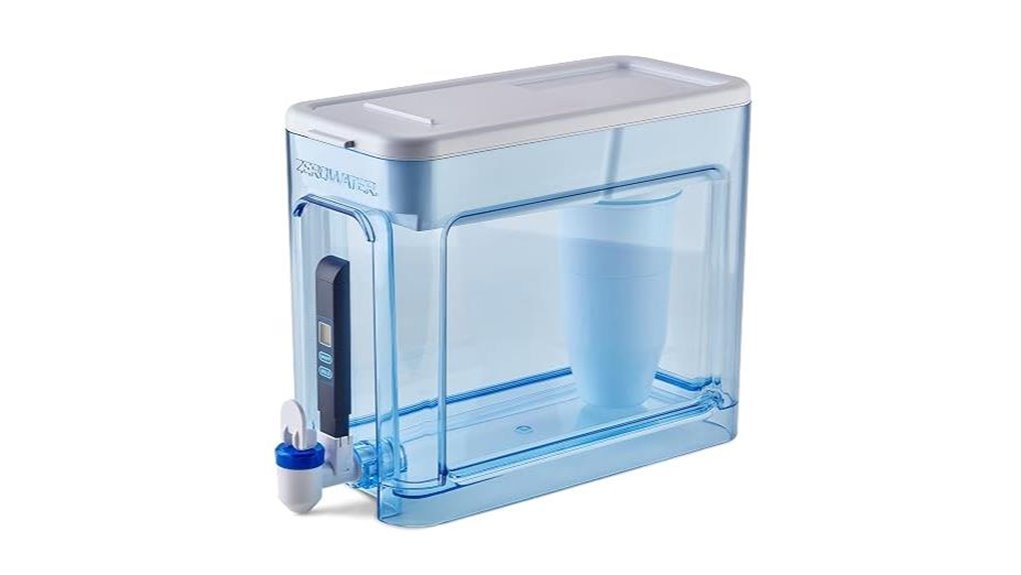
Ideal for households seeking a space-saving dispenser with certified contaminant reduction, the ZeroWater 32-Cup model combines a 5-stage ion exchange filter with an integrated TDS meter to remove lead, PFOA/PFAS, chromium, and mercury. Its 32-cup, BPA-free countertop design suits kitchens or refrigerators, while the meter signals replacement at 006 TDS. IAPMO certification supports its contaminant-reduction claims. Each filter can reduce up to 110 plastic bottles, or 660 annually. Weighing 5.5 pounds, model ZD-032-RR includes the dispenser, filter, and meter, and operates within 20-80 psi.
Best For: Households looking for a space-saving, BPA-free countertop or fridge water dispenser with certified reduction of lead, PFOA/PFAS, chromium, and mercury.
Pros:
- 5-stage ion exchange filtration with an integrated TDS meter for easy monitoring
- IAPMO certified for reducing PFOA/PFOS, lead, chromium, and mercury
- Reduces single-use plastic waste by up to 110 bottles per filter
Cons:
- Filter replacements are required when the TDS meter reaches 006
- 32-cup capacity may still be limited for larger households
- Best performance depends on maintaining appropriate water pressure and operating conditions
PUR Plus 30-Cup Water Filter Dispenser with 1 Lead-Reducing Filter, Blue

The PUR Plus 30-Cup Water Filter Dispenser suits households wanting lead reduction in a roomy, space-saving design. Model DS1811Z holds 1.88 gallons and fits a refrigerator or countertop with its slim 5.3-by-15.3-by-10.1-inch frame. Its genuine PUR PLUS filter is IAPMO certified and reduces 99% of lead and microplastics, plus PFAS, chlorine, and more than 25 other substances. The filter lasts up to 40 gallons, about two months, and the built-in indicator helps track replacement. A pull-down spout, carry handle, and dishwasher-safe plastic body add convenience while replacing over 303 single-serve bottles.
Best For: Households looking for a large-capacity, space-saving water dispenser that reduces lead, PFAS, and microplastics while fitting neatly in a fridge or on a countertop.
Pros:
- Reduces 99% of lead and microplastics, plus PFAS, chlorine, and 25+ other contaminants.
- Large 30-cup capacity with a slim design that works well in refrigerators or on countertops.
- Convenient features like a pull-down spout, carry handle, filter change indicator, and dishwasher-safe body.
Cons:
- Filter replacement is needed about every 2 months or 40 gallons, which adds ongoing cost.
- Plastic construction may not appeal to buyers seeking glass or stainless-steel options.
- Best performance depends on regular filter monitoring and timely replacement.
AquaTru Glass Carafe Countertop Reverse Osmosis Water Filter

AquaTru’s glass carafe countertop reverse osmosis system suits households wanting serious lead reduction without installation. Its four-stage process removes 84 contaminants, including lead, PFOA, PFOS, microplastics, fluoride, chromium-6, and arsenic. The unit plugs into a standard outlet, needs no plumbing or tools, and uses a borosilicate glass carafe for purified water storage. Filters last up to six months or 300 gallons, one year or 600 gallons, and one year or 300 gallons, respectively. Compact dimensions, a 0.5-gallon-per-minute flow, and a 1-year warranty complete the package.
Best For: Households that want a no-installation countertop reverse osmosis system with strong lead and contaminant reduction, especially those who prefer storing purified water in glass.
Pros:
- Removes 84 contaminants, including lead, PFOA, PFOS, microplastics, fluoride, chromium-6, and arsenic.
- No plumbing, drilling, or tools required; plugs into a standard outlet for easy setup.
- Borosilicate glass carafe and compact footprint make it a convenient, healthier-looking countertop option.
Cons:
- Requires periodic filter replacements, which adds ongoing maintenance and cost.
- Countertop design may still take up noticeable space in smaller kitchens.
- Maximum supported TDS is 300 PPM, so it may not be ideal for very high-mineral water sources.
AquaTru Water Purification Unit NSF/ANSI Certified

With NSF/ANSI certification and reverse osmosis, this dispenser suits households seeking serious lead reduction. The AquaTru Water Purification Unit uses ultra reverse osmosis and meets NSF/ANSI 41, 53, 58, 401, and P473 standards. It removes 84 contaminants, including lead-related toxins, microplastics, PFOA, PFOS, hormones, and carcinogens. The countertop unit requires no plumbing and sets up in minutes. Its 2.7-liter capacity, BPA-free construction, and corded design support convenient daily use. Filter life ranges from 600 to 1200 gallons, helping cut bottled water waste and plastic use.
Best For: Households that want a countertop reverse osmosis purifier with NSF/ANSI-certified contaminant reduction, easy no-plumbing setup, and a strong focus on reducing lead-related toxins and bottled water use.
Pros:
- NSF/ANSI certified to standards 41, 53, 58, 401, and P473 for broad contaminant reduction.
- Removes 84 contaminants, including lead-related toxins, microplastics, PFOA, PFOS, hormones, and carcinogens.
- No plumbing required and sets up in minutes, with a compact 2.7-liter BPA-free design.
Cons:
- Requires corded electric power, so it must be placed near an outlet.
- 2.7-liter capacity may be small for larger households or heavy daily use.
- Filter replacements are still needed every 6 months to 2 years, adding ongoing maintenance costs.
Avalon Self-Cleaning Bottleless Water Cooler Dispenser (A7BOTTLELESSBLK)

Avalon’s bottleless design suits households wanting low-maintenance lead reduction and hot-cold convenience. The Avalon Self Cleaning Touchless Bottleless Water Cooler Dispenser, model A7BOTTLELESSBLK, uses a slim freestanding black chassis and connects directly to plumbing. Its dual-stage system pairs a sediment filter with a carbon block filter, each rated for six months or 1,500 gallons. Hot and cold spouts, a child safety lock, and a night-light improve daily use. The self-cleaning function helps sanitize the unit. Included installation parts simplify setup, while the 1-year warranty adds modest reassurance.
Best For: Households that want a slim, bottleless water cooler with hot-and-cold dispensing, low-maintenance filtration, and self-cleaning convenience.
Pros:
- Dual filtration system helps reduce sediment and improve water quality.
- Hot and cold spouts with a child safety lock add convenience and safety.
- Self-cleaning feature and included installation kit make upkeep and setup easier.
Cons:
- Requires plumbing connection and installation, so it’s less plug-and-play than bottled coolers.
- Filter replacements are needed every 6 months or 1,500 gallons.
- At 40 pounds, it may be somewhat cumbersome to move or reposition.
Factors to Consider When Choosing Water Filter Dispensers for Lead Reduction in 2026

When selecting a water filter dispenser for lead reduction in 2026, lead removal certification should be checked first, along with the filter technology used to achieve it. The scope of contaminant reduction, filter lifespan value, and dispenser capacity needs also shape overall performance and convenience. These factors help determine which models provide the most reliable protection and practical long-term use.
Lead Removal Certification
Certification should be the first checkpoint for anyone choosing a water filter dispenser for lead reduction in 2026, because reputable standards such as NSF/ANSI confirm that a system has been tested for lead removal and overall safety. NSF/ANSI 53 is especially relevant, since it directly addresses lead reduction and signals rigorous performance verification. Certified dispensers can reduce lead by 99% or more, making them far more dependable than unverified options. Beyond the label, buyers should review the filter’s rated lifespan and capacity to guarantee the certification remains valid across months of use. Many systems also include replacement indicators, which help maintain consistent protection by signaling when a filter has reached its limit. Regular maintenance is essential for preserving lead reduction and keeping drinking water safer over time.
Filter Technology Types
Beyond certification, the filtration method inside a water dispenser plays a major role in how well it reduces lead in 2026. Activated carbon systems often improve taste and reduce several impurities, while ion exchange targets dissolved metals by swapping lead ions for harmless minerals. Reverse osmosis is typically the most aggressive option, forcing water through a fine membrane that strips out lead and many other dissolved contaminants. The best choice depends on household needs, available space, and desired maintenance frequency. Some technologies offer longer service lives, reaching around 120 gallons or six months, whereas others need earlier replacement. Dispensers with TDS meters can help track performance and signal when filters are nearing exhaustion, supporting consistent water quality without guesswork.
Contaminant Reduction Scope
Contaminant scope is a key measure of value in lead-reducing water filter dispensers. Models differ widely in what they remove, and stronger options can cut lead by up to 99% while also reducing more than 30 other contaminants, including microplastics and pharmaceuticals. Broader reduction capacity matters because tap water may contain multiple unwanted substances, not just lead. Filtration systems using 5-stage ion exchange and activated carbon often improve removal of dissolved solids and toxic compounds, producing cleaner drinking water. Independent certifications from NSF/ANSI and IAPMO help verify these claims and support comparison across products. A wider contaminant profile can also lessen dependence on bottled water, which supports lower plastic waste and a smaller environmental footprint.
Filter Lifespan Value
Filter scope matters, but filter lifespan is just as important when comparing lead-reducing water filter dispensers in 2026. Some filters last up to 120 gallons, or about six months, while others need replacement after only 40 gallons and two months. That gap affects convenience, maintenance, and value. Longer-lasting filters can lower waste by reducing how often spent cartridges are discarded, which also improves their environmental profile. A durable filter that continues to reduce lead and other contaminants over time may outperform several short-lived options in total value. Buyers should compare replacement costs over the full ownership period, not just the initial price. Filters with certified lead reduction and longer service life often offer stronger long-term savings and more consistent protection.
Dispenser Capacity Needs
How much water a household needs should guide dispenser choice as much as lead-reduction performance. Larger households, frequent guests, or offices often benefit from dispensers holding 27 to 40 cups, since bigger reservoirs cut down on repeated refills and keep water available through the day. Daily consumption matters too: if people in the home drink more than 2 liters each, a high-capacity model better matches demand. Capacity should also be weighed against available space, because roomy dispensers can crowd a small kitchen or break area, while compact units fit tighter surfaces more easily. Larger models may also support sustainability by replacing more single-use bottles, reducing plastic waste over time. Filter lifespan should still be considered, since longer-lasting cartridges lower upkeep and replacement frequency.
TDS Monitoring Features
TDS monitoring has become a useful feature in water filter dispensers because it provides a quick, real-time snapshot of dissolved solids in the water. These meters help assess filtration performance by showing whether the system is removing contaminants effectively. A reading of 0 typically signals that the dispenser is operating at its best, with lead and other unwanted substances being reduced to minimal levels. Many advanced models now include TDS meters as standard, making it easier to track water purity without guesswork. Regular checks also help indicate when filters are losing efficiency and should be replaced. Lower TDS readings often align with stronger contaminant reduction, so this feature offers a practical way to confirm lead-focused filtration and maintain safer drinking water over time.
Design And Placement
Beyond monitoring water quality, the physical design of a dispenser also shapes how practical it is for daily lead-reduction use. A well-sized unit should fit on a countertop or in a refrigerator without crowding nearby items or blocking access. Placement matters because convenient positioning supports frequent use and reduces the chance of neglect. A user-friendly spigot adds value by making pouring quick and controlled, which can improve everyday convenience. Weight and overall dimensions should also be reviewed, since lighter models are easier to refill and move when needed. Capacity is equally important: larger dispensers suit households or shared offices by reducing refill frequency. A sleek form can complement kitchen or office décor while still keeping the dispenser accessible and functional.
Sustainability Impact
Sustainability is an important factor when choosing a water filter dispenser for lead reduction in 2026, since effective filtration can cut dependence on single-use plastic bottles and, in some cases, replace up to 1,800 bottles a year. Models with advanced filtration may remove up to 99% of lead while also lowering environmental impact. Long-lasting filters matter as well, especially those rated for six months or 120 gallons, because fewer replacements mean less waste and fewer packaging materials entering the stream. BPA-free construction supports sustainability by reducing chemical concerns and extending product usefulness through safer, more durable materials. Over time, a well-chosen dispenser can help households reduce plastic waste, support conservation goals, and maintain cleaner drinking water without adding avoidable disposal burdens.
Frequently Asked Questions
How Often Should I Test My Water for Lead Contamination?
Water should ideally be tested for lead contamination at least once a year, with more frequent checks if pipes are old, service lines are unknown, or plumbing has been disturbed. A new home, recent renovation, or infant in the household justifies prompt testing. If a test shows lead, follow-up testing after corrective action is prudent. Public water advisories or changing taste, color, or pressure also warrant immediate retesting.
Do Water Filter Dispensers Remove Dissolved Lead From Old Plumbing?
About 10 million U.S. homes still receive water through lead service lines, a sobering reminder of the risk. Yes, many water filter dispensers can remove dissolved lead from old plumbing, but only if they use certified lead-reduction media, such as activated carbon with ion exchange. Performance varies widely. Consumers should check for NSF/ANSI Standard 53 or 58 certification, replace cartridges on schedule, and retest water after installation.
Are Replacement Filters for Lead Reduction Expensive Annually?
Replacement filters for lead reduction are often moderately expensive annually, but the total depends on usage, filter life, and brand. Some households spend roughly $40 to $150 per year, while premium systems can cost more. Cost increases if filters need frequent replacement due to higher water demand or poor water quality. Still, compared with bottled water, many find the expense reasonable and predictable over time.
Can Filtered Water Dispensers Improve Taste After Lead Removal?
Yes—filtered water dispensers can make water taste dramatically cleaner, fresher, and almost magically crisp after lead removal. By stripping out lead and often reducing chlorine, sediment, and metallic notes, they can transform an unpleasant glass into something noticeably smoother. The result is not only safer water, but also a far more appealing flavor profile. Taste improvements, however, depend on the filter type, maintenance, and source water quality.
What Certifications Matter Most for Lead-Reducing Water Filters?
The most important certifications for lead-reducing water filters are NSF/ANSI 53 and NSF/ANSI 401, with NSF/ANSI 53 being the key standard for lead removal. NSF/ANSI 42 matters for taste and chlorine, but not lead specifically. A credible certification from NSF or the Water Quality Association helps verify claims. Independent testing should confirm performance under realistic conditions, since marketing language alone does not guarantee effective lead reduction.
Conclusion
From spacious Brita pitchers to sophisticated AquaTru systems, the best dispensers deliver dependable defense against lead while fitting different family needs. Consumers can choose compact convenience, crystal clarity, or thorough contaminant control, depending on their daily demands. Careful comparison of capacity, certification, filter life, and maintenance helps buyers make a smart, safe selection. Ultimately, the right water dispenser offers peace of mind, purer pours, and practical protection for every household.
